

Kirjahaku
Etsi kirjoja tekijän nimen, kirjan nimen tai ISBN:n perusteella.
1000 tulosta hakusanalla Gordon A. Craig

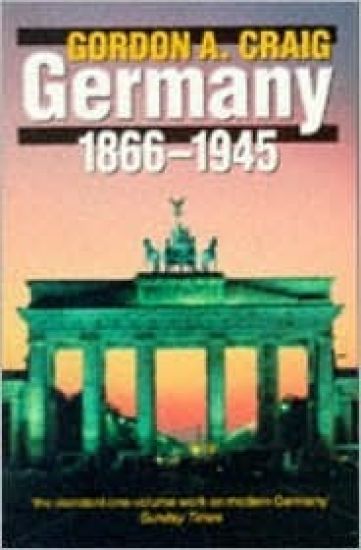
This is the history of the rise and fall of united Germany, which lasted only 75 years from its establishment by Bismark in 1870, and ended in the rubble of Hitler's regime. Gordon Craig not only analyses the political structures of and the foreign, social, and economic policies of successive governments, but also examines the individuals who dominated the period and the important intellectual and cultural influences at work. His fascinating chapter on the rich diversity of Weimar culture - Mann and Hesse, Marlene Deitrich and film, Brecht, Schonberg, Expressionist art, and the growth of psychoanalytic theory - is proof enough that this is not an ordinary history book.


Craig deals with a question that has always been a point of controversy: do political writers have responsibility and are they obliged to show political engagement in their works? Craig answers this question by studying ten German writers from 1770-1871, among them Goethe, Schiller, Kleist, and Heine and finds that these `unpolitical' writers were actively engaged in their politics.
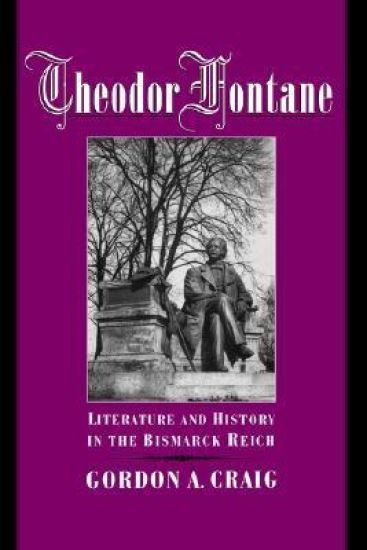
This work, first published in Germany, is a historical biography of Theodor Fontane, a major German novelist of the late nineteenth century. Through his study of Fontane, Craig presents his perceptions of nineteenth-century German, and in particular Prussian, history.

One of the livlier debates amongst historians concerns the dates of the beginning and, particularly, the end of Prussian history. This work explores the slow death of Prussia by examining several key individuals and their actions at four distinct periods of Prussian history.

They have given mankind unique triumphs in science, literature, philosophy, music, and art. They have also produced Hitler and the Holocaust. They are romantic and conservative, idealistic and practical, proud and insecure, ruthless and good-natured. They are, in short, the Germans. In this definitive history, Professor Gordon A. Craig, one of the world’s premier authorities on Germany, comes to grips with the complex paradoxes at the heart of the German identity. His masterly study explores the roots of many contemporary institutions in German history and closely examines such topics as religion, money, Germans and Jews, women, professors and students, romantics, literature and society, soldiers, Berlin, and the German language. Craig also discusses the events surrounding the fall of the Berlin Wall and the German reunification, while offering invaluable insights into Germany’s pivotal role in world affairs for over a century.

Koniggratz, a city overlooking the river Elbe, was a western strongpoint of the Austrian Empire. On the morning of July 3, 1866, Prussia attacked the city against high odds and defeated the Austrian army in a single day, despite the Austrian advantage in heavy artillery and command of the high ground. The fall of Koniggratz transferred power over the German states from Austria to Prussia, marking the beginning of the German nation, a political consequence considered to be among the most important of any conflict in modern history. The battle for the city of Koniggratz-now called Hradec Kralove, located in the Czech Republic-was the largest of its time, with nearly half a million troops involved. It was also the first battle where the outcome was directly determined by the availability of new technologies, including the railroad, telegraph, cast steel rifled cannon, and breech-loading rifle. It also marked a lesson in the fallacy of dependence on technology at the expense of sound strategy. In this full account, distinguished historian Gordon A. Craig discusses the state of political affairs surrounding the battle, the personalities involved, the weaponry, and the tactics in order to recreate the battlefield in all its complexity.
Tact and Intelligence
Gordon A. Craig
Society for the Promotion of Science Scholarship Inc.,U.S.
2007
pokkari
During a career that spanned sixty years, Gordon A. Craig (1913-2005) was one of America's leading authorities on diplomatic history and international relations. This volume of previously uncollected essays (with one essay published here for the first time) includes several surveys, from different perspectives, of the field of diplomatic history; comparative studies of American and European conceptions of foreign policy and the balance of power; and essays on the theory and practice of diplomacy, focusing especially on the turbulent twentieth century.
Knowledge and Power
Gordon A. Craig
Society for the Promotion of Science Scholarship Inc.,U.S.
2012
pokkari
Gordon A. Craig (1913-2005), one of America's most distinguished historians of modern Germany, was an indefatigable essayist. This volume gathers previously uncollected articles from the last quarter of a career that spanned six decades. Placing politics in the perspective of culture, and culture in the perspective of politics, these essays examine the persistent tension between liberalism and militarism in German history, and include the author's reflections on political leadership, intellectual creativity, and military catastrophe.

Gordon A. Craigs erfolgreiches Buch "Deutsche Geschichte 1866-1945" ist eine umfassende Darstellung nicht nur der Geschichte von Staat, Gesellschaft und Wirtschaft, sondern auch der Entwicklung von Erziehung und Kultur vom Kaiserreich bis zur Epoche des Nationalsozialismus. Gordon A. Craigs "Buch ist ein Lesevergnügen, was man von vielen der heute modischen Geschichtsanalysen und Geschichtsdeutungen nicht sagen kann - Alles wird lebendig, keine Person tritt auf, ohne knapp und einprägsam charakterisiert zu werden, das vergessene politische und diplomatische Intrigenspiel von einst wird wieder spannend gemacht, und die ungeheure Detailfülle ist mit Meisterhand arrangiert und komponiert, so daß der Leser nie den Überblick verliert."

The Second Chance America And The Peace
Gordon A Craig; Gerhart Niemeyer
Hutson Street Press
2025
sidottu

The Second Chance America And The Peace
Gordon A Craig; Gerhart Niemeyer
Hutson Street Press
2025
pokkari
Force and Statecraft
Paul Gordon Lauren; Gordon A. Craig; Alexander L. George
Oxford University Press Inc
2021
nidottu
Force and Statecraft: Diplomatic Challenges of Our Time, Sixth Edition, is a stimulating, highly readable, and insightful analysis of humanity's quest for peace and security. Its unique interdisciplinary approach combines history, political science, international law, and philosophy in order to explore the rich experience of the past and consider how it can be brought to bear on the diplomatic challenges that we confront in our world today. This new edition makes a classic even better. It provides an up-to-date treatment of the most recent and significant international developments, including: - the profound impact of the foreign policies of three individuals: Donald Trump of the United States, Xi Jinping of China, and Vladimir Putin of Russia - growing fears of nuclear proliferation in North Korea and Iran, "Brexit" and divisions within the European Union and NATO, the civil war in Syria, the Islamic State (ISIS), and other terrorist groups - updated and thought-provoking coverage of the instruments of statecraft, the multiple dimensions of power, the nature of security (including "the security dilemma" and the "indivisibility of security"), the changing features of sovereignty, and the role of normative values as seen in ethical restraints, concepts of legitimacy, international law, and norms of human rights - evolving challenges for force and statecraft presented by weapons of mass destruction, the diplomatic revolution, the "digital revolution," cyberattacks, climate change, and the global pandemic of COVID-19
Force and Statecraft
Lauren Paul Gordon; Gordon A. Craig; Alexander L. George
Oxford University Press
2006
nidottu
This book is for upper division courses in Diplomatic History, Diplomacy and Statecraft, or history of foreign relations, and has sold extremely well through three editions. For the fourth edition, the original co-authors, Craig and George, were joined by Paul Lauren from the University of Montana. The book is divided into three parts: the first section is a survey of international history and diplomacy; the second part is about specific problems, divided into chapters on the Lessons of History, Negotiation, Deterrence, Coercive Diplomacy and Crisis Management; the third part explores ethics and other restraints on force and statecraft.
Geneva, Zurich, Basel
Nicolas Bouvier; Gordon A. Craig; Lionel Gossman
Princeton University Press
2014
pokkari
Recognized by historians and politicians as a model for European unity, Switzerland is nonetheless a difficult country to understand as a whole. Whereas individual Swiss cities have strong identities in the international political, cultural, and economic arenas, the country itself seems to be less than the sum of its parts. To capture the elusive spirit of Switzerland, four eminent writers explore the roots of its political unity and cultural diversity in a series of urban portraits. Their observations make for both good storytelling and insightful social commentary. Nicolas Bouvier offers a quick-paced history of Geneva--the city John Calvin had envisioned as a radiating center of godliness, international in its scope and legal in its methods--the home of the Red Cross and the League of Nations and, since 1945, the location of numerous disarmament and diplomatic conferences. Gordon Craig examines Zurich, the city of the militant religious reformer Huldrych Zwingli, whose centralizing political zeal was harnessed by subsequent generations of Zurichers to lead Switzerland in its modernization. Today's economically powerful Zurich is analyzed in terms of its liberal past as a refuge for political activists and artists, and in terms of its current generational divisions on moral and cultural questions. Finally, Lionel Gossman explores the conciliatory Basel of Erasmus, showing how vigorous independence, resourcefulness, and remembrance of its humanist traditions shaped the city's culture and economy. Tying together important themes in the histories of these cities, Carl Schorske focuses his introduction on how Switzerland has capitalized on their cultural differences and refined the art of political negotiation to serve a wide range of civic interests. Originally published in 1994. The Princeton Legacy Library uses the latest print-on-demand technology to again make available previously out-of-print books from the distinguished backlist of Princeton University Press. These editions preserve the original texts of these important books while presenting them in durable paperback and hardcover editions. The goal of the Princeton Legacy Library is to vastly increase access to the rich scholarly heritage found in the thousands of books published by Princeton University Press since its founding in 1905.
Geneva, Zurich, Basel
Nicolas Bouvier; Gordon A. Craig; Lionel Gossman
Princeton University Press
2016
sidottu
Recognized by historians and politicians as a model for European unity, Switzerland is nonetheless a difficult country to understand as a whole. Whereas individual Swiss cities have strong identities in the international political, cultural, and economic arenas, the country itself seems to be less than the sum of its parts. To capture the elusive spirit of Switzerland, four eminent writers explore the roots of its political unity and cultural diversity in a series of urban portraits. Their observations make for both good storytelling and insightful social commentary. Nicolas Bouvier offers a quick-paced history of Geneva--the city John Calvin had envisioned as a radiating center of godliness, international in its scope and legal in its methods--the home of the Red Cross and the League of Nations and, since 1945, the location of numerous disarmament and diplomatic conferences. Gordon Craig examines Zurich, the city of the militant religious reformer Huldrych Zwingli, whose centralizing political zeal was harnessed by subsequent generations of Zurichers to lead Switzerland in its modernization. Today's economically powerful Zurich is analyzed in terms of its liberal past as a refuge for political activists and artists, and in terms of its current generational divisions on moral and cultural questions. Finally, Lionel Gossman explores the conciliatory Basel of Erasmus, showing how vigorous independence, resourcefulness, and remembrance of its humanist traditions shaped the city's culture and economy. Tying together important themes in the histories of these cities, Carl Schorske focuses his introduction on how Switzerland has capitalized on their cultural differences and refined the art of political negotiation to serve a wide range of civic interests. Originally published in 1994. The Princeton Legacy Library uses the latest print-on-demand technology to again make available previously out-of-print books from the distinguished backlist of Princeton University Press. These editions preserve the original texts of these important books while presenting them in durable paperback and hardcover editions. The goal of the Princeton Legacy Library is to vastly increase access to the rich scholarly heritage found in the thousands of books published by Princeton University Press since its founding in 1905.

Edward Gordon Craig's ideas regarding set and lighting have had an enormous impact on the development of the theatre we know today. In this new and updated edition of his well-known study of Edward Gordon Craig, Professor Christopher Innes shows how Craig's stage work and theoretical writings were crucial to the development of modern theatre. This book contains extensive documentation and re-evaluates his significance as an artist, actor, director and writer. Craig is placed in historical context, and his productions are reconstituted from unpublished prompt-books, sketches, journals and correspondence. Most of the designs and photographs, and many of Craig's writings cited, are not available elsewhere in print. Readers will gain insight into a key period of theatrical history, the life of one of its most fascinating individuals, the nature of stage performance, and into revolutionary ideas that are still challenging today.

Edward Gordon Craig's ideas regarding set and lighting have had an enormous impact on the development of the theatre we know today. In this new and updated edition of his well-known study of Edward Gordon Craig, Professor Christopher Innes shows how Craig's stage work and theoretical writings were crucial to the development of modern theatre. This book contains extensive documentation and re-evaluates his significance as an artist, actor, director and writer. Craig is placed in historical context, and his productions are reconstituted from unpublished prompt-books, sketches, journals and correspondence. Most of the designs and photographs, and many of Craig's writings cited, are not available elsewhere in print. Readers will gain insight into a key period of theatrical history, the life of one of its most fascinating individuals, the nature of stage performance, and into revolutionary ideas that are still challenging today.