Kirjojen hintavertailu. Mukana 11 244 527 kirjaa ja 12 kauppaa.

Kirjahaku

Etsi kirjoja tekijän nimen, kirjan nimen tai ISBN:n perusteella.

1000 tulosta hakusanalla Gordon A. Wilson

Harbinger of Calamity: A Firetok Novel

Harbinger of Calamity: A Firetok Novel

Gordon A. Wilson

Createspace Independent Publishing Platform
2016
nidottu
They rescued the brothers from traffickers and ended up with a mysterious "boy who don't talk." Was it an accident or is there more to him than meets the eye? A band of mysterious vigilantes tied to an ancient civilization fight to bring justice to a depraved, indifferent world as their reluctant leader fights battles of his own.
The Merlin

The Merlin

Gordon A. A. Wilson; Steve Hinton JR

Amberley Publishing
2020
pokkari
The Rolls-Royce Merlin is the most recognisable aero engine in the world. It powered the Battle of Britain aircraft, the Spitfire and Hurricane, as they defended the shores of Britain against the Luftwaffe, foiling Hitler's plans to invade in summer 1940. It also powered the Lancasters and Halifaxes of Bomber Command as they went on their missions of destruction to the German heartland. And the ‘wooden wonder’, the Mosquito, was powered by the Merlin, its pinpoint bombing accuracy and reconnaissance work proving vital to the war effort. For the Americans, the Merlin was the power plant of the Mustang escort fighter that protected the US Air Force B-17 Flying Fortress and B-29 Super Fortress bombers on their daylight raids to the enemy. The P-51 was also used in the North African, Mediterranean and Pacific theatres. So the Merlin worked day and night to secure the eventual Allied victory. It has rightfully been described as the most significant aircraft piston engine in history and in the twenty-first century its distinctive ‘drone’ can still be heard over England as the Battle of Britain Memorial Flight take to the air on special occasions – most recently on the centenary of the RAF – with its Lancaster leading the Merlin-powered Spitfires and Hurricanes in formation. Retired military and commercial pilot Gordon Wilson tells the human story of the development of the engine and its operational use during the war, featuring the voices of air crew who relied on this technological tour de force.
The Hercules

The Hercules

Gordon A. A. Wilson

AMBERLEY PUBLISHING
2024
sidottu
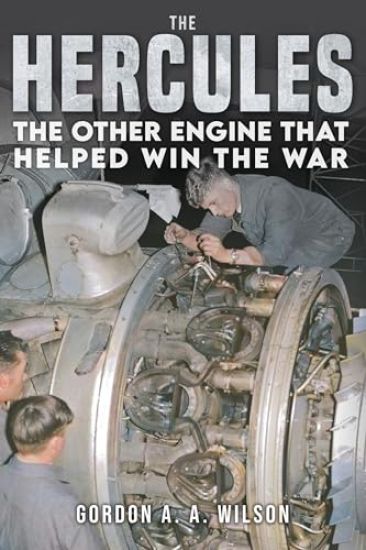
The Bristol Hercules was a 14-cylinder sleeve valve radial engine designed by Sir Roy Fedden and produced from 1939 by BAC. It powered Bristol’s own Beaufighter but was more commonly used on bombers. From the 1375 hp Hercules I to the 1735 hp Hercules XVII produced late in the war, the variants powered the Avro Lancaster B.II, the Handley Page Halifax, the Short Stirling, the Vickers Wellesley and the Vickers Wellington, among others. The sleeve valve engine was an efficient configuration that allowed the use of lower-octane fuels for the same compression ratio. It was clever, and it worked. Gordon Wilson provides a biography of this ingenious workhorse, designed and modified under the pressure of wartime. He has had exclusive access to the restoration of a Handley Page Halifax, which has provided picture details unavailable elsewhere.
The Lancaster

The Lancaster

Gordon A. A. Wilson

Amberley Publishing
2017
nidottu
The Avro Lancaster took the RAF’s bombing campaign right to the heart of Nazi Germany, night after night, despite suffering appalling losses. The unique airframe, with one continuous bomb bay and four powerful Rolls-Royce Merlin engines, allowed the Lancaster to carry a variety of bomb loads. Without the Lancaster, RAF Bomber Command’s offensive against Germany would not have had the devastating and controversial impact that it achieved. The speed, agility and bomb-carrying capacity of this bomber allowed it to destroy targets ranging from hardened-concrete submarine pens and reservoir dams to railway marshalling yards and factories producing vital military hardware. This book is both the story of the Lancaster and that of its seven-man crews: pilot, bomb aimer/nose gunner, wireless operator, flight engineer, navigator and mid-upper and rear gunners. Illustrated with over 250 photographs, including several wartime images as well and many in full colour, it is also the history of the four most complete surviving airframes: the only two flying Lancasters in the world (PA474 and FM213) and the two ground-running aircraft (NX611 and FM159). Lancaster NX611 has been extensively photographed inside and out by Martin Keen, to give a real sense of what it was like to fly in this aircraft.
Bomber Command

Bomber Command

Gordon A. A. Wilson

AMBERLEY PUBLISHING
2021
sidottu
Bomber Command is a richly illustrated account of the Royal Air Force organisation from its inception prior to the Second World War in 1936 to its final years during the Cold War. The book covers the reasons for Bomber Command and the personnel that guided its formation and the philosophy and politics of the change from strategic bombing to area bombing, and the ensuing controversy. The Bomber Command organisation and how it functioned is traced, from Headquarters down to the various Groups and the many Squadrons. Famous and specialised Squadrons and the honours awarded to them are explored. Gordon Wilson does not neglect the social impact of this huge organisation: a bomber base had a large impact on the local economy and many lasting war-time bonds were established. The operational aircraft that spearheaded the might of Bomber Command and brought the bombs to the enemy’s shores included famous machines such as the Avro Lancaster, Handley Page Halifax and the unique fighter-bomber, the de Havilland Mosquito. The author analyses their construction and performance. Major target raids and the aircraft and Squadrons taking part are described. Some raids were ill conceived, others were brilliant in their execution. The transition to the Cold War and nuclear deterrence naturally confronted Bomber Command with an entirely rewritten role and saw the introduction of a new generation of V-Force jet bombers. Complemented with a range of images of memorials, famous personnel, stations, aircraft, aircraft engines, and manufacturer’s factories, Bomber Command is a fitting tribute to ‘The Many’.
Norad and the Soviet Nuclear Threat

Norad and the Soviet Nuclear Threat

Gordon A. A. Wilson

Dundurn Group Ltd
2012
pokkari
NORAD and the Soviet Nuclear Threat is the history of the air defence of Canada during the Cold War era. The reader is taken into the Top Secret world of NORAD, the joint Canadian-American North American Air Defence network. Ride along with the aircrew in their cockpit as they fight an electronic joust in the skies. Go deep underground to the Command Centre as the Air Weapons controllers plot the air war on their radar screens. Visit the radar sites deep in the Canadian bush as they struggle to provide the radar data for an electronic air battle happening overhead. An actual NORAD exercise on 10 May 1973, called Amalgam Mute, is used as an example. This exercise tested that NORAD was honouring its motto: Deter, Detect, Destroy, and was protecting North America from aerial threat. There is an extensive explanation of the aircraft, squadrons, weapons, radar, and radar sites involved. Included are two personal accounts of the first interception of a Soviet "Bear" bomber off the coast of Canada, and the first Canadian fighter interceptor pilot to win the coveted United States Air Force "Top Gun" award.
The Hercules

The Hercules

Gordon A. A. Wilson

AMBERLEY PUBLISHING
2026
pokkari
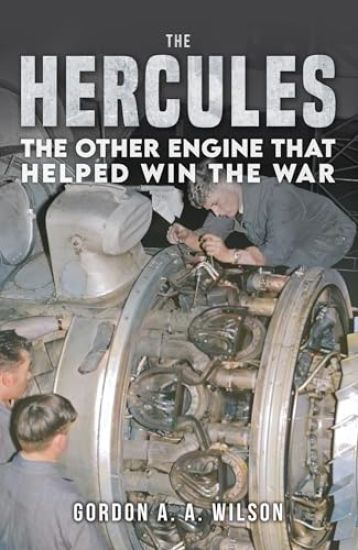
The Bristol Hercules was a 14-cylinder sleeve valve radial engine designed by Sir Roy Fedden and produced from 1939 by BAC. It powered Bristol’s own Beaufighter but was more commonly used on bombers. From the 1375 hp Hercules I to the 1735 hp Hercules XVII produced late in the war, the variants powered the Avro Lancaster B.II, the Handley Page Halifax, the Short Stirling, the Vickers Wellesley and the Vickers Wellington, among others. The sleeve valve engine was an efficient configuration that allowed the use of lower-octane fuels for the same compression ratio. It was clever, and it worked. Gordon Wilson provides a biography of this ingenious workhorse, designed and modified under the pressure of wartime. He has had exclusive access to the restoration of a Handley Page Halifax, which has provided picture details unavailable elsewhere.
A Different Shade of Green

A Different Shade of Green

Gordon Wilson

Canon Press
2019
pokkari
We have been shockingly bad at using our Bibles and our brains when it comes to conservation and the environment. Unhinged environmentalism is not the answer, but neither are ignorance and apathy. It's time for something different.Christian responsibility for the natural world goes back to the very beginning, when God commanded us to "fill the earth and subdue it." This Dominion Mandate is an authoritative alternative to both environmental activists and to those who think "conservation" is a word progressives made up.So what does "dominion" mean for us, living in a world of constant reports about impending global meltdown; of oils spills, pollution, and strip-mining; of extinction threats both real and imagined? A Different Shade of Green contains a compelling Christian approach to biodiversity conservation and other environmental issues, offering solutions and correcting errors while teaching us how to give thanks for and rule over all of creation.
A Preliminary Investigation of Ship Acquisition Options for Joint Forcible Entry Operations

A Preliminary Investigation of Ship Acquisition Options for Joint Forcible Entry Operations

Robert Button; Irv Blickstein; John Gordon; Peter Wilson; Jessie Riposo

RAND
2005
pokkari
Describes the global environment in which joint forcible entry; operations might occur and the role of naval power in that environment; In the global security environment of the future, sea basing (loosely; speaking, the ability to assemble, equip, and support forces from sea; platforms without relying on land bases) will be critical to the Navy and; Marine Corps' ability to project-and sustain-forces ashore. Sea basing; clearly will be useful in the event of joint forcible entry operations; (JEFOs). This monograph describes the global environment in which JEFOs; might occur and the role of naval power in that environment.
Emergency Planning & Community Right-to-Know Act Handbook

Emergency Planning & Community Right-to-Know Act Handbook

J. Gordon Arbuckle; Timothy A Vanderver; Paul A. J Wilson

Government Institutes Inc.,U.S.
1992
nidottu
A thorough, up-to-date manual by the law firm of Patton, Boggs and Blow (formerly titled SARA Title III: law and regulations ) giving a clear, concise analysis of all the legal and regulatory requirements of the EPCRA, including a look at reporting requirements and future developments.
Warfighting and Logistic Support of Joint Forces from the Joint Sea Base

Warfighting and Logistic Support of Joint Forces from the Joint Sea Base

Robert W Button; John Gordon; Jessie Riposo; Irv Blickstein; Peter A Wilson

RAND
2007
pokkari
Sea Basing, a concept fundamental to the U.S. Navy's operational vision for the 21st century, is intended to use the flexibility and protection provided by the sea base while minimizing the presence of forces ashore. This study analyzed the feasibility of simultaneously sustaining Marine Corps and Army elements ashore from a sea base or of moving an Army element in a reasonable period while sustaining a Marine Corps ground element already ashore.
The Ukrainian Crisis and European Security

The Ukrainian Crisis and European Security

F. Stephen Larrabee; Peter A. Wilson; John Gordon

RAND
2015
pokkari
In the wake of Russia s annexation of Crimea and attempt to destabilize eastern Ukraine, the United States will have to reexamine the basic premises of its European policy. The requirement that NATO may have to build a more robust deterrence and defense posture in Eastern Europe would require the Army and Air Force to revisit their planning assumptions that have minimized the U.S. military commitments to the region since the end of the Cold War."
Instant Insights: Rewilding in Agriculture

Instant Insights: Rewilding in Agriculture

Various authors; Thomas A. Jones; Kiarrah J. Smith; Iain J. Gordon; Belinda A. Wilson; Adrian D. Manning; Christopher R. Dickman; Aaron C. Greenville; Glenda M. Wardle

Burleigh Dodds Science Publishing Limited
2026
pokkari
This book features three peer-reviewed reviews on rewilding in agriculture. The first chapter highlights the diversity of best practices used to rewild grasslands and rangelands, including those used to restore biological soil crusts, apply prescribed fire, increase stand establishment and persistence, overcome soil limitations, rectify nutrient pollution, and sequester soil carbon. The chapter also provides a case study on the restoration of sagebrush-steppe rangelands in the state of Utah, USA. The second chapter provides an overview of the trade-offs related to animal rewilding in agroecosystems (e.g. ecosystem services versus disservices). The chapter also discusses three key management trends the authors foresee will facilitate net positive outcomes in animal rewilding: capturing wild provisioning services, coordinating broad spatial heterogeneity in land use and employing coexistence conservation tactics. The final chapter outlines the benefits and challenges of rewilding in Australia and New Zealand and references four case studies to study this. The first two describe rewildings on formerly degraded agricultural land (Tiritiri Matangi Island, Scotia Sanctuary), while the third posits a conceptual rewilding program using a continental top predator, the dingo. The fourth case study describes a digitally-enabled survey and monitoring system on a mixed-agriculture farm that provides a step towards rewilding such landscapes in future.
Maritime Prepositioning Force (Future) Capability Assessment

Maritime Prepositioning Force (Future) Capability Assessment

Robert W. Button; John Gordon; Dick Hoffmann; Jessie Riposo; Peter A. Wilson

RAND
2010
pokkari
Navy and Marine Corps Sea Basing concepts envision the rapid deployment, assembly, command, projection, reconstitution, and re-employment of expeditionary forces from the sea. RAND researchers assessed alternative structures for the proposed Maritime Prepositioning Force (Future), or MPF(F), squadron and their effects on operational support. For example, eliminating large-deck ships could be offset by substituting CH-53K helicopters for MV-22s.