Kirjojen hintavertailu. Mukana 11 234 096 kirjaa ja 12 kauppaa.

Kirjahaku

Etsi kirjoja tekijän nimen, kirjan nimen tai ISBN:n perusteella.

1000 tulosta hakusanalla Graham Oppy

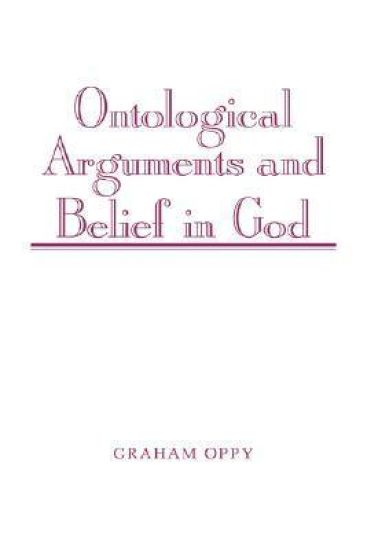
Ontological Arguments and Belief in God

Ontological Arguments and Belief in God

Graham Oppy

Cambridge University Press
2007
pokkari
This book is an interesting contribution to the philosophy of religion. It offers a comprehensive discussion of one of the most famous arguments for the existence of God: the ontological argument. The author provides and analyses a critical taxonomy of those versions of the argument that have been advanced in recent philosophical literature, as well as of those historically important versions found in the work of St Anselm, Descartes, Leibniz, Hegel and others. A central thesis of the book is that ontological arguments have no value in the debate between theists and atheists. There is a detailed review of the literature on the topic (separated from the main body of the text) and a very substantial bibliography, making this volume an indispensable resource for philosophers of religion and others interested in religious studies.
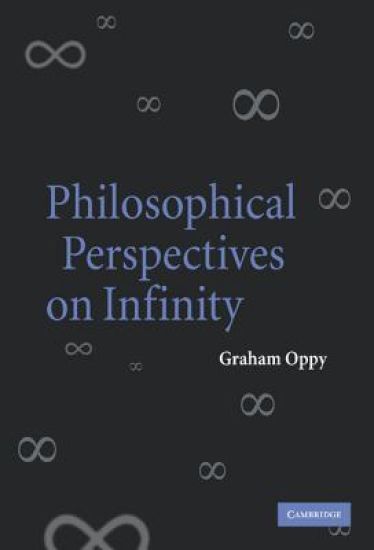
Philosophical Perspectives on Infinity

Philosophical Perspectives on Infinity

Graham Oppy

Cambridge University Press
2009
pokkari
This book is an exploration of philosophical questions about infinity. Graham Oppy examines how the infinite lurks everywhere, both in science and in our ordinary thoughts about the world. He also analyses the many puzzles and paradoxes that follow in the train of the infinite. Even simple notions, such as counting, adding and maximising present serious difficulties. Other topics examined include the nature of space and time, infinities in physical science, infinities in theories of probability and decision, the nature of part/whole relations, mathematical theories of the infinite, and infinite regression and principles of sufficient reason.
Ontological Arguments and Belief in God

Ontological Arguments and Belief in God

Graham Oppy

Cambridge University Press
1996
sidottu
This book is a unique contribution to the philosophy of religion. It offers a comprehensive discussion of one of the most famous arguments for the existence of God: the ontological argument. The author provides and analyses a critical taxonomy of those versions of the argument that have been advanced in recent philosophical literature, as well as of those historically important versions found in the work of St Anselm, Descartes, Leibniz, Hegel and others. A central thesis of the book is that ontological arguments have no value in the debate between theists and atheists. There is a detailed review of the literature on the topic (separated from the main body of the text) and a very substantial bibliography, making this volume an indispensable resource for philosophers of religion and others interested in religious studies.
Philosophical Perspectives on Infinity

Philosophical Perspectives on Infinity

Graham Oppy

Cambridge University Press
2006
sidottu
This book is an exploration of philosophical questions about infinity. Graham Oppy examines how the infinite lurks everywhere, both in science and in our ordinary thoughts about the world. He also analyses the many puzzles and paradoxes that follow in the train of the infinite. Even simple notions, such as counting, adding and maximising present serious difficulties. Other topics examined include the nature of space and time, infinities in physical science, infinities in theories of probability and decision, the nature of part/whole relations, mathematical theories of the infinite, and infinite regression and principles of sufficient reason.
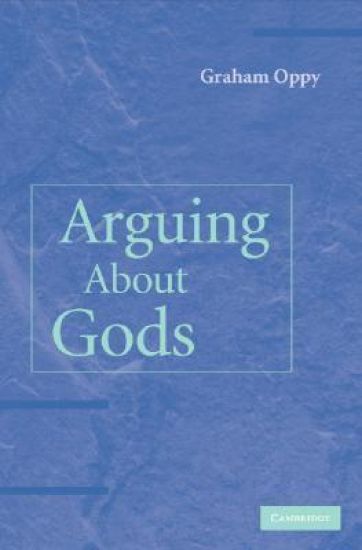
Arguing about Gods

Arguing about Gods

Graham Oppy

Cambridge University Press
2006
sidottu
In this book, Graham Oppy examines arguments for and against the existence of God. He shows that none of these arguments is powerful enough to change the minds of reasonable participants in debates on the question of the existence of God. His conclusion is supported by detailed analyses of the arguments as well as by the development of a theory about the purpose of arguments and the criteria that should be used in judging whether or not arguments are successful. Oppy discusses the work of a wide array of philosophers, including Anselm, Aquinas, Descartes, Locke, Leibniz, Kant, Hume and, more recently, Plantinga, Dembski, White, Dawkins, Bergman, Gale and Pruss.
Naturalism and Religion

Naturalism and Religion

Graham Oppy

CRC Press Inc
2018
sidottu
This book guides readers through an investigation of religion from a naturalistic perspective and explores the very meaning of the term ‘religious naturalism’. Oppy considers several widely disputed claims: that there cannot be naturalistic religion; that there is nothing in science that poses any problems for naturalism; that there is nothing in religion that poses any serious challenges to naturalism; and that there is a very strong case for thinking that naturalism defeats religion. Naturalism and Religion: A Contemporary Philosophical Investigation is an ideal introduction for undergraduate and postgraduate students of religious studies and philosophy who want to gain an understanding of the key themes and claims of naturalism from a religious and philosophical perspective.
Naturalism and Religion

Naturalism and Religion

Graham Oppy

CRC Press Inc
2018
nidottu
This book guides readers through an investigation of religion from a naturalistic perspective and explores the very meaning of the term ‘religious naturalism’. Oppy considers several widely disputed claims: that there cannot be naturalistic religion; that there is nothing in science that poses any problems for naturalism; that there is nothing in religion that poses any serious challenges to naturalism; and that there is a very strong case for thinking that naturalism defeats religion. Naturalism and Religion: A Contemporary Philosophical Investigation is an ideal introduction for undergraduate and postgraduate students of religious studies and philosophy who want to gain an understanding of the key themes and claims of naturalism from a religious and philosophical perspective.
Describing Gods

Describing Gods

Graham Oppy

Cambridge University Press
2014
sidottu
How do religious believers describe God, and what sort of attributes do they attribute to him? These are central topics in the philosophy of religion. In this book Graham Oppy undertakes a careful study of attributes which are commonly ascribed to God, including infinity, perfection, simplicity, eternity, necessity, fundamentality, omnipotence, omniscience, freedom, incorporeality, perfect goodness and perfect beauty. In a series of substantial chapters, he examines divine attributes one by one, and relates them to a larger taxonomy of those attributes. He also examines the difficulties involved in establishing the claim that understandings of divine attributes are inconsistent or incoherent. Intended as a companion to his 2006 book Arguing about Gods, his study engages with a range of the best contemporary work on divine attributes. It will appeal to readers in philosophy of religion.
Atheism and Agnosticism

Atheism and Agnosticism

Graham Oppy

Cambridge University Press
2018
pokkari
This Element is an elementary introduction to atheism and agnosticism. It begins with a careful characterisation of atheism and agnosticism, distinguishing them from many other things with which they are often conflated. After a brief discussion of the theoretical framework within which atheism and agnosticism are properly evaluated, it then turns to the sketching of cases for atheism and agnosticism. In both cases, the aim is not conviction, but rather advancement of understanding: the point of the cases is to make it intelligible why some take themselves to have compelling reason to adopt atheism or agnosticism.
Atheism: The Basics

Atheism: The Basics

Graham Oppy

Routledge
2018
sidottu
Atheism: The Basics is a concise and engaging introduction to belief in the non-existence of deities. Atheism has long fascinated people but debate around this controversial position may seem daunting. In this lively and lucid book, Graham Oppy addresses the following important questions:• What does it mean to be an atheist?• What is the difference between atheism, agnosticism, theism and innocence?• How has atheism been distributed over time and place?• What does science tell us about atheism?• Are there good reasons to be an atheist?• Are there good reasons not to be an atheist?• What do we mean by ‘new atheism'? With a glossary of key terms and suggestions for further reading throughout, the book considers key philosophical arguments around atheism, making this an ideal starting point for anyone seeking a full introduction to the arguments between those who hold atheistic beliefs and those who do not.
Atheism: The Basics

Atheism: The Basics

Graham Oppy

Routledge
2018
nidottu
Atheism: The Basics is a concise and engaging introduction to belief in the non-existence of deities. Atheism has long fascinated people but debate around this controversial position may seem daunting. In this lively and lucid book, Graham Oppy addresses the following important questions:• What does it mean to be an atheist?• What is the difference between atheism, agnosticism, theism and innocence?• How has atheism been distributed over time and place?• What does science tell us about atheism?• Are there good reasons to be an atheist?• Are there good reasons not to be an atheist?• What do we mean by ‘new atheism'? With a glossary of key terms and suggestions for further reading throughout, the book considers key philosophical arguments around atheism, making this an ideal starting point for anyone seeking a full introduction to the arguments between those who hold atheistic beliefs and those who do not.
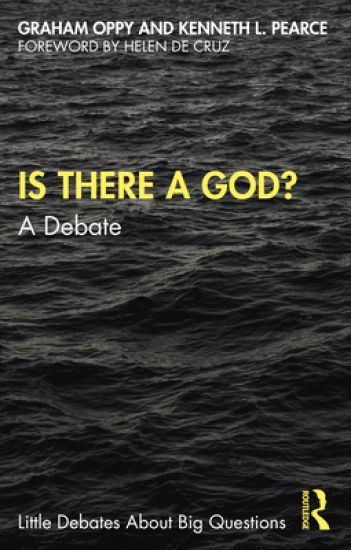
Is There a God?

Is There a God?

Graham Oppy; Kenneth L. Pearce

Routledge
2021
sidottu
Bertrand Russell famously quipped that he didn’t believe in God for the same reason that he didn’t believe in a teapot in orbit between the earth and Mars: it is a bizarre assertion for which no evidence can be provided. Is belief in God really like belief in Russell’s teapot? Kenneth L. Pearce argues that God is no teapot. God is a real answer to the deepest question of all: why is there something rather than nothing? Graham Oppy argues that we should believe that there are none but natural causal entities with none but natural causal properties—and hence should believe that there are no gods. Beginning from this basic disagreement, the authors proceed to discuss and debate a wide range of philosophical questions, including questions about explanation, necessity, rationality, religious experience, mathematical objects, the foundations of ethics, and the methodology of philosophy. Each author first presents his own side, and then they interact through two rounds of objections and replies. Pedagogical features include standard form arguments, section summaries, bolded key terms and principles, a glossary, and annotated reading lists. In the volume foreword, Helen De Cruz calls the debate "both edifying and a joy," and sums up what’s at stake: "Here you have two carefully formulated positive proposals for worldviews that explain all that is: classical theism, or naturalistic atheism. You can follow along with the authors and deliberate: which one do you find more plausible?"Though written with beginning students in mind, this debate will be of interest to philosophers at all levels and to anyone who values careful, rational thought about the nature of reality and our place in it.
Is There a God?

Is There a God?

Graham Oppy; Kenneth L. Pearce

Routledge
2021
nidottu
Bertrand Russell famously quipped that he didn’t believe in God for the same reason that he didn’t believe in a teapot in orbit between the earth and Mars: it is a bizarre assertion for which no evidence can be provided. Is belief in God really like belief in Russell’s teapot? Kenneth L. Pearce argues that God is no teapot. God is a real answer to the deepest question of all: why is there something rather than nothing? Graham Oppy argues that we should believe that there are none but natural causal entities with none but natural causal properties—and hence should believe that there are no gods. Beginning from this basic disagreement, the authors proceed to discuss and debate a wide range of philosophical questions, including questions about explanation, necessity, rationality, religious experience, mathematical objects, the foundations of ethics, and the methodology of philosophy. Each author first presents his own side, and then they interact through two rounds of objections and replies. Pedagogical features include standard form arguments, section summaries, bolded key terms and principles, a glossary, and annotated reading lists. In the volume foreword, Helen De Cruz calls the debate "both edifying and a joy," and sums up what’s at stake: "Here you have two carefully formulated positive proposals for worldviews that explain all that is: classical theism, or naturalistic atheism. You can follow along with the authors and deliberate: which one do you find more plausible?"Though written with beginning students in mind, this debate will be of interest to philosophers at all levels and to anyone who values careful, rational thought about the nature of reality and our place in it.
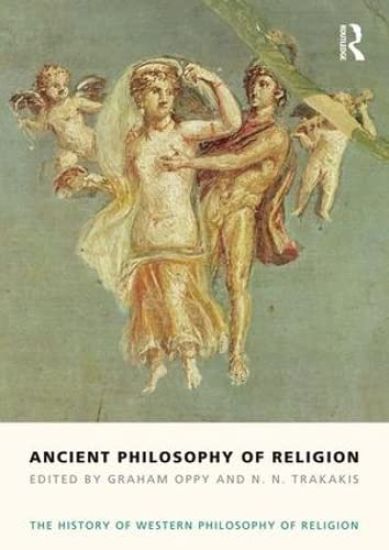
Ancient Philosophy of Religion

Ancient Philosophy of Religion

Graham Oppy; N. N. Trakakis

Acumen Publishing Ltd
2013
sidottu
The origins of the Western philosophical tradition lie in the ancient Greco-Roman world. This volume provides a unique insight into the life and writings of a diverse group of philosophers in antiquity and presents the latest thinking on their views on God, the gods, religious belief and practice. Beginning with the 'pre-Socratics', the volume then explores the influential contributions made to the Western philosophy of religion by the three towering figures of Socrates, Plato and Aristotle. The chapters that follow cover the the leading philosophers of the major schools of the ancient world - Epicureanism, Stoicism, Neoplatonism and the early Christian Church. "Ancient Philosophy of Religion" will be of interest to scholars and students of Philosophy, Classics and Religion, while remaining accessible to any interested in the rich cultural heritage of ancient religious thought.
Medieval Philosophy of Religion

Medieval Philosophy of Religion

Graham Oppy; N. N. Trakakis

Acumen Publishing Ltd
2013
sidottu
The Medieval period was one of the richest eras for the philosophical study of religion. Covering the period from the 6th to the 16th century, reaching into the Renaissance, "The History of Western Philosophy of Religion 2" shows how Christian, Islamic and Jewish thinkers explicated and defended their religious faith in light of the philosophical traditions they inherited from the ancient Greeks and Romans. The enterprise of 'faith seeking understanding', as it was dubbed by the medievals themselves, emerges as a vibrant encounter between - and a complex synthesis of - the Platonic, Aristotelian and Hellenistic traditions of antiquity on the one hand, and the scholastic and monastic religious schools of the medieval West, on the other. "Medieval Philosophy of Religion" will be of interest to scholars and students of Philosophy, Medieval Studies, the History of Ideas, and Religion, while remaining accessible to any interested in the rich cultural heritage of medieval religious thought.
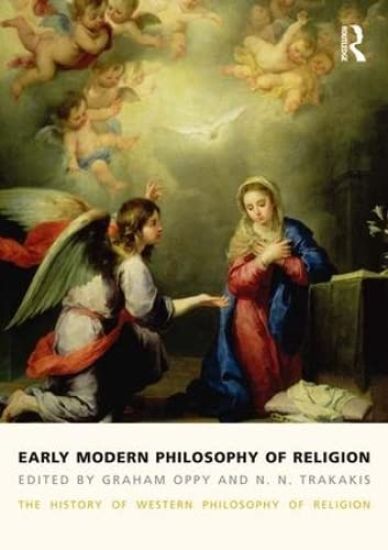
Early Modern Philosophy of Religion

Early Modern Philosophy of Religion

Graham Oppy; N. N. Trakakis

Acumen Publishing Ltd
2013
sidottu
The early modern period in philosophy - encompassing the 16th to the 18th centuries - reflects a time of social and intellectual turmoil. The Protestant Reformation, the Catholic Counter-Reformation, and the birth of the Enlightenment all contributed to the re-evaluation of reason and faith. The revolution in science and in natural philosophy swept away two millennia of Aristotelian certainty in a human-centred universe. Covering some of the most important figures in the history of Western thought - notably Descartes, Locke, Hume and Kant - "Early Modern Philosophy of Religion" charts the philosophical understanding of religion at a time of intellectual and spiritual revolution. "Early Modern Philosophy of Religion" will be of interest to historians and philosophers of religion, while also serving as an indispensable reference for teachers, students and others who would like to learn more about this formative period in the history of ideas.
Nineteenth-Century Philosophy of Religion

Nineteenth-Century Philosophy of Religion

Graham Oppy; N. N. Trakakis

Acumen Publishing Ltd
2013
sidottu
The nineteenth century was a turbulent period in the history of the philosophical scrutiny of religion. Major scholars - such as Hegel, Fichte, Schelling, Newman, Caird and Royce - sought to construct systematic responses to the Enlightenment critiques of religion carried out by Spinoza and Hume. At the same time, new critiques of religion were launched by philosophers such as Schopenhauer and Nietzsche and by scholars engaged in textual criticism, such as Schleiermacher and Dilthey. Over the course of the century, the work of Marx, Freud, Darwin and Durkheim brought the revolutionary perspectives of political economy, psychoanalysis, evolutionary theory and anthropology to bear on both religion and its study. These challenges played a major role in the shaping of twentieth-century philosophical thought about religion. "Nineteenth-Century Philosophy of Religion" will be of interest to scholars and students of Philosophy and Religion, and will serve as an authoritative guide for all who are interested in the debates that took place in this seminal period in the history of philosophical thinking about religion.
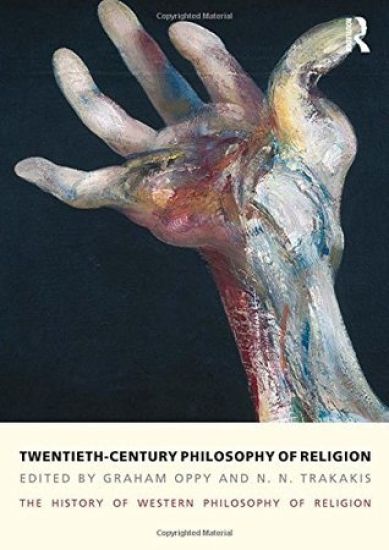
Twentieth-Century Philosophy of Religion

Twentieth-Century Philosophy of Religion

Graham Oppy; N. N. Trakakis

Acumen Publishing Ltd
2013
sidottu
The twentieth century saw religion challenged by the rise of science and secularism, a confrontation which resulted in an astonishingly diverse range of philosophical views about religion and religious belief. Many of the major philosophers of the twentieth century - James, Bergson, Russell, Wittgenstein, Ayer, Heidegger, and Derrida - significantly engaged with religious thought. Idiosyncratic thinkers, such as Whitehead, Levinas and Weil, further contributed to the extraordinary diversity of philosophical investigation of religion across the century. In their turn, leading theologians and religious philosophers - notably Buber, Tillich and Barth - directly engaged with the philosophy of religion. Later, philosophy of religion became a distinct field of study, led by the work of Hick, Alston, Plantinga, and Swinburne. "Twentieth-Century Philosophy of Religion" provides an accessible overview of the major strands in the rich tapestry of twentieth-century thought about religion and will be an indispensible resource for any interested in contemporary philosophy of religion.
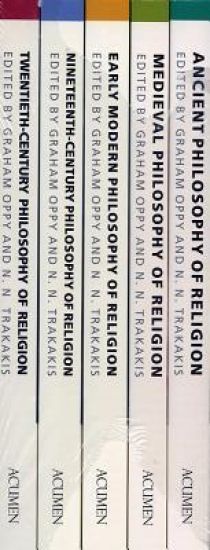
The History of Western Philosophy of Religion

The History of Western Philosophy of Religion

Graham Oppy; N. N. Trakakis

Acumen Publishing Ltd
2013
nidottu
'The History of Western Philosophy of Religion' brings together an international team of over 100 leading scholars to provide authoritative exposition of how history's most important philosophical thinkers - from antiquity to the present day - have sought to analyse the concepts and tenets central to Western religious belief, especially Christianity. Divided chronologically into five volumes, 'The History of Western Philosophy of Religion' is designed to be accessible to a wide range of readers, from the scholar looking for original insight and the latest research findings to the student wishing for a masterly encapsulation of a particular philosopher's views. Together these volumes provide an indispensable resource for anyone conducting research or teaching in the philosophy of religion and related fields, such as theology, religious studies, the history of philosophy, and the history of ideas.
Ancient Philosophy of Religion

Ancient Philosophy of Religion

Graham Oppy; N. N. Trakakis

Acumen Publishing Ltd
2013
nidottu
The origins of the Western philosophical tradition lie in the ancient Greco-Roman world. This volume provides a unique insight into the life and writings of a diverse group of philosophers in antiquity and presents the latest thinking on their views on God, the gods, religious belief and practice. Beginning with the 'pre-Socratics', the volume then explores the influential contributions made to the Western philosophy of religion by the three towering figures of Socrates, Plato and Aristotle. The chapters that follow cover the the leading philosophers of the major schools of the ancient world - Epicureanism, Stoicism, Neoplatonism and the early Christian Church. "Ancient Philosophy of Religion" will be of interest to scholars and students of Philosophy, Classics and Religion, while remaining accessible to any interested in the rich cultural heritage of ancient religious thought.