Kirjojen hintavertailu. Mukana 11 244 527 kirjaa ja 12 kauppaa.

Kirjahaku

Etsi kirjoja tekijän nimen, kirjan nimen tai ISBN:n perusteella.

1000 tulosta hakusanalla Gregg Veronica Marie

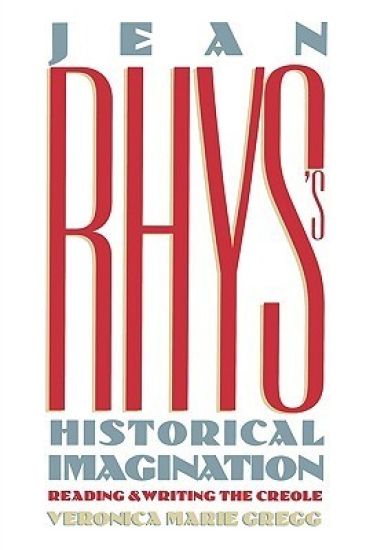
Jean Rhys's Historical Imagination

Jean Rhys's Historical Imagination

Gregg Veronica Marie

The University of North Carolina Press
1995
nidottu
As the foremost white West Indian writer of this century and author of the widely acclaimed novel Wide Sargasso Sea , Jean Rhys (1890-1979) has attracted much critical attention, most often from the perspective of gender analysis. Veronica Gregg extends our critical appreciation of Rhys by analyzing the complex relationship between Rhys's identity and the structures of her fiction, and she reveals the ways in which this relationship is connected to the history of British colonization of the West Indies. Gregg focuses on Rhys as a writer--a Creole woman analyzing the question of identity through literary investigations of race, gender, and colonialism. Arguing that history itself can be a site where different narratives collide and compete, she explores Rhys's rewriting of the historical discourses of the West Indies and of European canonical texts, such as Rhys's treatment of Jane Eyre in Wide Sargasso Sea . Gregg's analysis also reveals the precision with which Rhys crafted her work and her preoccupation with writing as performance.
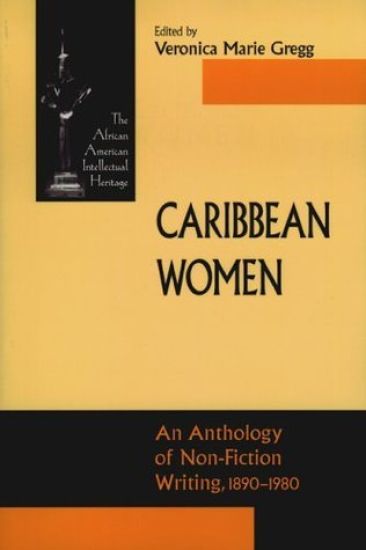
Caribbean Women

Caribbean Women

Veronica Marie Gregg

University of Notre Dame Press
2005
sidottu
In this volume, the first in a two-part anthology of non-fiction writings by Caribbean women, Veronica Marie Gregg has collected works written from the turn of the nineteenth century to 1980. Her selections are guided by a search for answers to the questions: What have West Indian women contributed to the creation of Anglophone Caribbean society, politics, cultures, and intellectual traditions? How is Caribbean womanhood defined and articulated? Beginning with the writings of generations of women born after slavery ended, the anthology builds on existing bodies of knowledge and forms of inquiry into Caribbean women's lives through its presentation of some of their many important contributions to the creation and development of Caribbean intellectual history. This volume is divided into two sections that are broadly shaped by major historical flashpoints: the postemancipation and decolonization struggles (1890–1945), and the postwar period marked by a movement toward nation building, constitutional independence, and cultural nationalism (1945–1980). The volume begins with some of the (so far) earliest known writing by native born West Indian women on political and social issues and ends at the point where sustained Caribbean feminist scholarship begins. Writings in the first section are drawn primarily from newspapers, pamphlets, and occasional publications. They address key issues such as voting rights, political equality, colonialism, race, work, and social welfare. The second section includes the work of some of the women who were part of the first and second generations of professional academic women at the University of the West Indies, established in 1948. Their selections challenge many of the prevailing intellectual models used to define Caribbean societies and identities. This distinctive collection is an excellent resource for students and professors in the fields of Caribbean Studies, African American Studies, and women's studies.
Caribbean Women

Caribbean Women

Veronica Marie Gregg

University of Notre Dame Press
2005
nidottu
In this volume, the first in a two-part anthology of non-fiction writings by Caribbean women, Veronica Marie Gregg has collected works written from the turn of the nineteenth century to 1980. Her selections are guided by a search for answers to the questions: What have West Indian women contributed to the creation of Anglophone Caribbean society, politics, cultures, and intellectual traditions? How is Caribbean womanhood defined and articulated? Beginning with the writings of generations of women born after slavery ended, the anthology builds on existing bodies of knowledge and forms of inquiry into Caribbean women's lives through its presentation of some of their many important contributions to the creation and development of Caribbean intellectual history. This volume is divided into two sections that are broadly shaped by major historical flashpoints: the postemancipation and decolonization struggles (1890–1945), and the postwar period marked by a movement toward nation building, constitutional independence, and cultural nationalism (1945–1980). The volume begins with some of the (so far) earliest known writing by native born West Indian women on political and social issues and ends at the point where sustained Caribbean feminist scholarship begins. Writings in the first section are drawn primarily from newspapers, pamphlets, and occasional publications. They address key issues such as voting rights, political equality, colonialism, race, work, and social welfare. The second section includes the work of some of the women who were part of the first and second generations of professional academic women at the University of the West Indies, established in 1948. Their selections challenge many of the prevailing intellectual models used to define Caribbean societies and identities. This distinctive collection is an excellent resource for students and professors in the fields of Caribbean Studies, African American Studies, and women's studies.
David Greig’s Holed Theatre

David Greig’s Holed Theatre

Verónica Rodríguez

Springer Nature Switzerland AG
2019
sidottu
With a Foreword by Dan Rebellato, this book offers up a detailed exploration of Scottish playwright David Greig’s work with particular attention to globalization, ethics, and the spectator. It makes the argument that Greig’s theatre works by undoing, cracking, or breaking apart myriad elements to reveal the holed, porous nature of all things. Starting with a discussion of Greig’s engagement with shamanism and arguing for holed theatre as a response to globalization, for Greig’s works’ politics of aesthethics, and for the holed spectator as part of an affective ecology of transfers, this book discusses some of Greig’s most representative political theatre from Europe (1994) to The Events (2013), concluding with an exploration of Greig’s theatre’s world-forming quality.
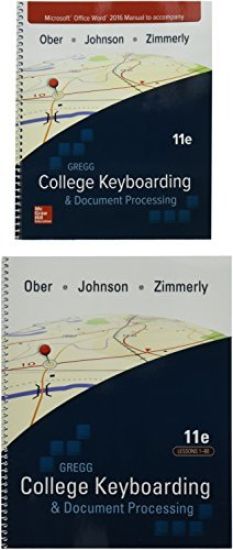
Gregg College Keyboarding & Document Processing (GDP); Lessons 1-120, main text

Gregg College Keyboarding & Document Processing (GDP); Lessons 1-120, main text

Scot Ober; Jack Johnson; Arlene Zimmerly

McGraw-Hill Professional
2010
kierre
Gregg College Keyboarding and Document Processing (GDP), 11e by Ober, Johnson, and Zimmerly: Your complete learning/teaching system. Your guide to success. GDP/11 is an integrated keyboarding system designed to process and score documents created in Microsoft Word. Together, the book and software systematically lead students through each lesson to provide an easy path to success. As a solid product for over 50 years, this version of the GDP software has grown into an online functionality. The same program is now web-based with seamless updates to provide greater accessibility for use at home, in class, and in labs - perfect for distance learning! Strong enhancements to the book while maintaining key elements including integrated language arts (starting at lesson 21) support the cohesive program's strong content. Skillbuilding is reinforced with MAP+ (Misstroke Analysis and Prescription). MAP+ is an individualized, diagnostic tool that is built into the software to help identify student's strengths and weaknesses while providing prescriptive drills to help them practice where they need it most. Also, MAP+ now has new, unlimited drill lines that begin at Lesson 1. Additionally, GDP/11 automatically scores for keyboarding errors and now formatting errors too! As a result, instructors will appreciate the customization of course management tools in GDP/11, including the new GPS (Grade Posting System) which allows complete flexibility in setting up grades. GDP/11 your complete learning/teaching system. Your guide to success.
Gregg College Keyboarding & Document Processing (GDP); Lessons 1-60 text

Gregg College Keyboarding & Document Processing (GDP); Lessons 1-60 text

Scot Ober; Jack Johnson; Arlene Zimmerly

McGraw-Hill Professional
2010
kierre
Gregg College Keyboarding and Document Processing (GDP), 11e by Ober, Johnson, and Zimmerly: Your complete learning/teaching system. Your guide to success. GDP/11 is an integrated keyboarding system designed to process and score documents created in Microsoft Word. Together, the book and software systematically lead students through each lesson to provide an easy path to success. As a solid product for over 50 years, this version of the GDP software has grown into an online functionality. The same program is now web-based with seamless updates to provide greater accessibility for use at home, in class, and in labs - perfect for distance learning! Strong enhancements to the book while maintaining key elements including integrated language arts (starting at lesson 21) support the cohesive program's strong content. Skillbuilding is reinforced with MAP+ (Misstroke Analysis and Prescription). MAP+ is an individualized, diagnostic tool that is built into the software to help identify student's strengths and weaknesses while providing prescriptive drills to help them practice where they need it most. Also, MAP+ now has new, unlimited drill lines that begin at Lesson 1. Additionally, GDP/11 automatically scores for keyboarding errors and now formatting errors too! As a result, instructors will appreciate the customization of course management tools in GDP/11, including the new GPS (Grade Posting System) which allows complete flexibility in setting up grades. GDP/11 your complete learning/teaching system. Your guide to success.
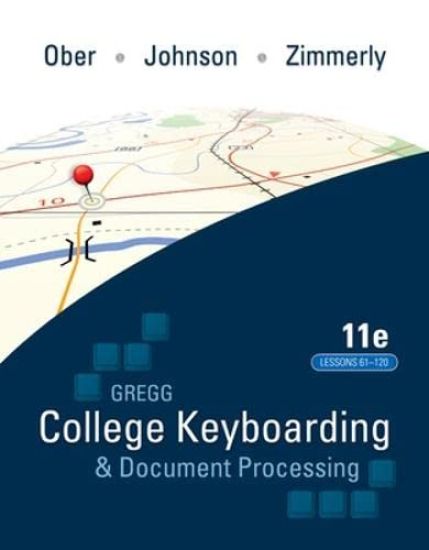
Gregg College Keyboarding & Document Processing (GDP); Lessons 61-120 text

Gregg College Keyboarding & Document Processing (GDP); Lessons 61-120 text

Scot Ober; Jack Johnson; Arlene Zimmerly

McGraw-Hill Professional
2010
kierre
Gregg College Keyboarding and Document Processing (GDP), 11e by Ober, Johnson, and Zimmerly: Your complete learning/teaching system. Your guide to success. GDP/11 is an integrated keyboarding system designed to process and score documents created in Microsoft Word. Together, the book and software systematically lead students through each lesson to provide an easy path to success. As a solid product for over 50 years, this version of the GDP software has grown into an online functionality. The same program is now web-based with seamless updates to provide greater accessibility for use at home, in class, and in labs - perfect for distance learning! Strong enhancements to the book while maintaining key elements including integrated language arts (starting at lesson 21) support the cohesive program's strong content. Skillbuilding is reinforced with MAP+ (Misstroke Analysis and Prescription). MAP+ is an individualized, diagnostic tool that is built into the software to help identify student's strengths and weaknesses while providing prescriptive drills to help them practice where they need it most. Also, MAP+ now has new, unlimited drill lines that begin at Lesson 1. Additionally, GDP/11 automatically scores for keyboarding errors and now formatting errors too! As a result, instructors will appreciate the customization of course management tools in GDP/11, including the new GPS (Grade Posting System) which allows complete flexibility in setting up grades. GDP/11 your complete learning/teaching system. Your guide to success.
Gregg Shorthand Paper (US)

Gregg Shorthand Paper (US)

Rwg

Rwg Publishing
2019
pokkari
There are a number of different shorthand systems (also known as stenography or steno). Pitman is popular in the UK (although a new system called 'Teeline' is rapidly gaining popularity there) while Gregg is the most common in the US. Shorthand systems are a way of writing using squiggles and abbreviations for speed and they may be based on spelling or phonetics. A trained shorthand writer is able to write as fast as people can speak which makes it ideal for taking dictation. Shorthand is still sometimes used by secretaries and secretarial schools but also by closed captioners, by court reporters and by journalists and news reporters. It may also have military and law enforcement use or be used by anyone else who has to take notes fast. 'Stenopads' or Steno paper is ruled down the center of the page to help the writer work quickly. Instead of using the full length of the book, they write in the first column to the middle line which saves time on their hand traveling across the whole line. Then they use the second column.
Gregg Bordowitz: Drive

Gregg Bordowitz: Drive

Anthony Elms

WhiteWalls, Inc
2005
nidottu
Gregg Bordowitz: Drive presents a series of essays and texts surrounding Gregg Bordowitz's films Fast Trip, Long Drop and Habit. Images from Bordowitz's installation Drive, exhibited at the Museum of Contemporary Art, Chicago April 6-July 7, 2002, are also featured. Bordowitz made a big splash in 1993 with Fast Trip, Long Drop. It featured a blend of documentary footage and fictional narrative to focus on his HIV positive diagnosis, the diagnosis of a friend's breast cancer, and the recent deaths of his grandparents. Instead of creating a somber ode to mortality, Bordowitz offered a darkly humorous essay on history, illness, AIDS activism, and representational strategies. Habit (2002) is the sequel to Fast Trip, Long Drop. It follows the regimens, routines, and thoughts that result from Bordowitz's decade of life as a person with AIDS. Coupled with this are new interviews with some of the same faces featured in Fast Trip, Long Drop, the introduction of new friends and confidants, and extensive footage of AIDS activists in South Africa fighting and organizing to gain access to the same drugs that are keeping Bordowitz and many of his friends alive. The tone of this film is slower from the earlier one, reflecting a change in the tenor of AIDS activism, the fact that South Africa 2001 is not New York 1992, and the new domesticity and responsibility that governs Bordowitz's life today. For the book, Brodowitz assembled a collection of authors whose views on AIDS and/or aesthetics he greatly respects. Topics range from critical assessments of his films, to the moralizing tenor found in popular images of homosexuality and AIDS, the current state of the aesthetic avant-garde, political activism, race and its complicated relation to sexuality and public policy, living with illness, and a short fiction work on the mental space of illness.
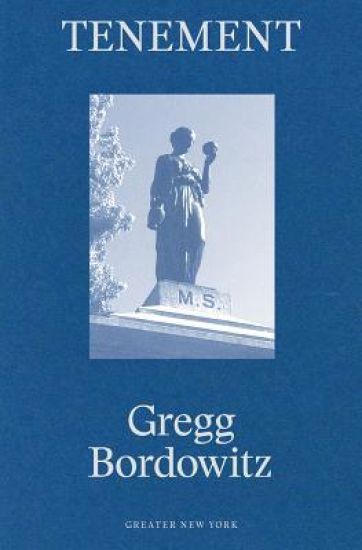
Gregg Bordowitz: Tenement
MoMA PS1 presents the fourth iteration of Greater New York. Recurring every five years, the exhibition has traditionally showcased the work of emerging artists living and working in the New York metropolitan area. Considering the “greater” aspect of its title in terms of both geography and time, Greater New York. begins roughly with the moment when MoMA PS1 was founded in 1976 as an alternative venue that took advantage of disused real estate, reaching back to artists who engaged the margins of the city. In conjunction with the exhibition, MoMA PS1 is publishing a series of readers that will be released throughout the run of the exhibition. These short volumes revisit older histories of New York while also inviting speculation about its future, highlighting certain works in the exhibition and engaging a range of subjects including disco, performance anxiety, real estate and newly unearthed historical documents. The series features contributions from Fia Backström, Mark Beasley, Gregg Bordowitz, Susan Cianciolo, Douglas Crimp, Catherine Damman, David Grubbs, Angie Keefer, Aidan Koch, Glenn Ligon, Gordon Matta-Clark, Claudia Rankine, Collier Schorr, and Sukhdev Sandhu, concluding with a round-table conversation with exhibition curators Peter Eleey, Douglas Crimp, Thomas J. Lax and Mia Locks. The series is edited by Jocelyn Miller, Curatorial Associate, MoMA PS1.
Gregg Notehand: A Personal Use Shorthand with Integrated Instruction in How to Make Notes

Gregg Notehand: A Personal Use Shorthand with Integrated Instruction in How to Make Notes

Louis A. Leslie; Charles E. Zoubek; James Deese

Literary Licensing, LLC
2012
sidottu
Gregg Notehand is a book that teaches a personal use shorthand system for taking notes. Written by Louis A. Leslie, it includes integrated instruction on how to make notes effectively. The book is designed to help individuals who need to take notes quickly and efficiently, such as students, secretaries, and journalists. The Notehand system is based on the Gregg shorthand system, which was developed by John Robert Gregg in the late 19th century. The book includes detailed instructions on how to write the shorthand symbols, as well as exercises and practice sheets to help readers master the system. The Notehand system is designed to be easy to learn and use, and it can be adapted to suit individual needs and preferences. Overall, Gregg Notehand is a practical and useful guide for anyone who needs to take notes quickly and accurately.Shorthand Written By Charles Rader. Illustrated By David W. Corson.This scarce antiquarian book is a facsimile reprint of the old original and may contain some imperfections such as library marks and notations. Because we believe this work is culturally important, we have made it available as part of our commitment for protecting, preserving, and promoting the world's literature in affordable, high quality, modern editions, that are true to their original work.