Kirjojen hintavertailu. Mukana 11 244 527 kirjaa ja 12 kauppaa.

Kirjahaku

Etsi kirjoja tekijän nimen, kirjan nimen tai ISBN:n perusteella.

1000 tulosta hakusanalla Gregory A Harrison

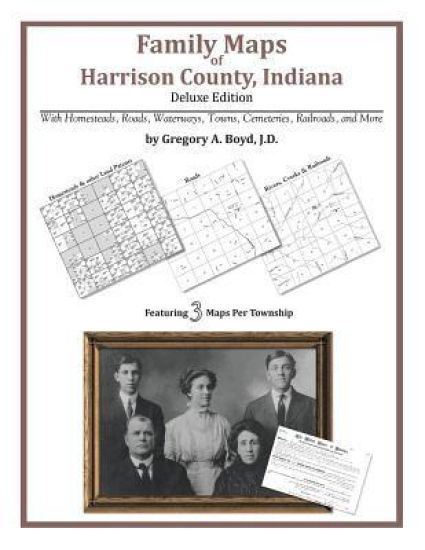
Family Maps of Harrison County, Indiana

Family Maps of Harrison County, Indiana

Gregory a. Boyd J. D.

Arphax Publishing Co.
2010
nidottu
222 pages with 65 total maps Locating original landowners in maps has never been an easy task-until now. This volume in the Family Maps series contains newly created maps of original landowners (patent maps) in what is now Harrison County, Indiana, gleaned from the indexes of the U.S. Bureau of Land Management. But it offers much more than that. For each township in the county, there are two additional maps accompanying the patent map: a road map and a map showing waterways, railroads, and both modern and many historical city-centers and cemeteries. Included are indexes to help you locate what you are looking for, whether you know a person's name, a last name, a place-name, or a cemetery. The combination of maps and indexes are designed to aid researchers of American history or genealogy to explore frontier neighborhoods, examine family migrations, locate hard-to-find cemeteries and towns, as well as locate land based on legal descriptions found in old documents or deeds. The patent-maps are essentially plat maps but instead of depicting owners for a particular year, these maps show original landowners, no matter when the transfer from the federal government was completed. Dates of patents typically begin near the time of statehood and run into the early 1900s. What's Mapped in this book (that you'll not likely find elsewhere) . . . 2349 Parcels of Land (with original landowner names and patent-dates labeled in the relevant map) 45 Cemeteries plus . . . Roads, and existing Rivers, Creeks, Streams, Railroads, and Small-towns (including some historical), etc. What YEARS are these maps for? Here are the counts for parcels of land mapped, by the decade in which the corresponding land patents were issued: DecadeParcel-count 1820s100 1830s1294 1840s709 1850s229 1860s1 1920s1 1950s10 1960s4 1970s1 What Cities and Towns are in Harrison County, Indiana (and in this book)? Bradford, Breckenridge, Bridgeport, Buena Vista, Byrneville, Cedar Farm Landing, Central, Central Barren, Corydon, Corydon Junction, Crandall, Davidson, Depauw, Dixie, Dogwood, Elizabeth, Evans Landing, Fairdale, Fishtown, Frenchtown, Glidas, Gurley Landing, Hancock Chapel, Happy Hollow, Harrison Grange, Hillcrest, Kings Store, Laconia, Lanesville, Little Saint Louis, Locust Point, Lottick Corner, Macedonia, Mauckport, Moberly, Morvins Landing, Mott Station, New Amsterdam, New Boston, New Middletown, New Salisbury, Palmyra, Ramsey, Rehoboth, Rosewood, Salina, Seven Springs, Sugar Grove, Titus, Tobacco Landing, Valley City, White Cloud, Wynnsboro (historical)
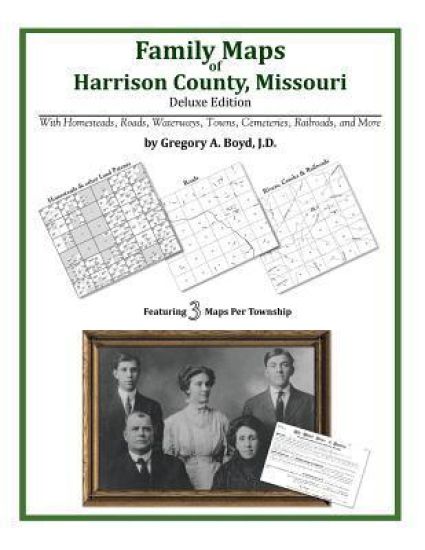
Family Maps of Harrison County, Missouri

Family Maps of Harrison County, Missouri

Gregory a. Boyd J. D.

Arphax Publishing Co.
2010
nidottu
372 pages with 77 total maps Locating original landowners in maps has never been an easy task-until now. This volume in the Family Maps series contains newly created maps of original landowners (patent maps) in what is now Harrison County, Missouri, gleaned from the indexes of the U.S. Bureau of Land Management. But it offers much more than that. For each township in the county, there are two additional maps accompanying the patent map: a road map and a map showing waterways, railroads, and both modern and many historical city-centers and cemeteries. Included are indexes to help you locate what you are looking for, whether you know a person's name, a last name, a place-name, or a cemetery. The combination of maps and indexes are designed to aid researchers of American history or genealogy to explore frontier neighborhoods, examine family migrations, locate hard-to-find cemeteries and towns, as well as locate land based on legal descriptions found in old documents or deeds. The patent-maps are essentially plat maps but instead of depicting owners for a particular year, these maps show original landowners, no matter when the transfer from the federal government was completed. Dates of patents typically begin near the time of statehood and run into the early 1900s. What's Mapped in this book (that you'll not likely find elsewhere) . . . 6529 Parcels of Land (with original landowner names and patent-dates labeled in the relevant map) 31 Cemeteries plus . . . Roads, and existing Rivers, Creeks, Streams, Railroads, and Small-towns (including some historical), etc. What YEARS are these maps for? Here are the counts for parcels of land mapped, by the decade in which the corresponding land patents were issued: DecadeParcel-count 1840s387 1850s5256 1860s700 1870s147 1880s22 1890s3 1900s4 1910s3 1920s1 1940s2 1960s1 1970s1 1980s2 What Cities and Towns are in Harrison County, Missouri (and in this book)? Akron, Andover, Bethany, Blue Ridge, Blythedale, Bolton, Bridgeport, Brooklyn, Cainsville, Eagleville, Gardner, Gilman City, Hatfield, Martinsville, Matkins, Melbourne, Mitchellville, Mount Moriah, New Hampton, Pawnee, Pleasant Ridge, Ridgeway, Washington Center, Wildwood
The Myth of a Christian Nation

The Myth of a Christian Nation

Gregory A. Boyd

Zondervan
2007
nidottu
The church was established to serve the world with Christ-like love, not to rule the world. It is called to look like a corporate Jesus, dying on the cross for those who crucified him, not a religious version of Caesar. It is called to manifest the kingdom of the cross in contrast to the kingdom of the sword. Whenever the church has succeeded in gaining what most American evangelicals are now trying to get – political power – it has been disastrous both for the church and the culture. Whenever the church picks up the sword, it lays down the cross. The present activity of the religious right is destroying the heart and soul of the evangelical church and destroying its unique witness to the world. The church is to have a political voice, but we are to have it the way Jesus had it: by manifesting an alternative to the political, “power over,” way of doing life. We are to transform the world by being willing to suffer for others – exercising “power under,” not by getting our way in society – exercising “power over.”
God of the Possible – A Biblical Introduction to the Open View of God

God of the Possible – A Biblical Introduction to the Open View of God

Gregory A. Boyd

Baker Books, a division of Baker Publishing Group
2000
nidottu
Perhaps no theological topic is more hotly debated within evangelical Christianity these days than God's foreknowledge. Is the future exhaustively settled, or does it include possibilities ("maybes")? In encountering such questions, a growing number of evangelicals are becoming dissatisfied with the classical view of foreknowledge and have accepted an alternative, open view of God. In God of the Possible theologian Greg Boyd offers an accessible introduction to the freewill theism position. Boyd begins by laying out and critiquing the "motif of future determinism," which forms the basis of the classical view of foreknowledge. He goes on to explicate several scripture passages that depict the future as partially open and that God therefore knows it as such. He then discusses some practical areas in which he thinks the open view can make a positive difference. Finally, Boyd addresses the most frequently asked questions and typical objections raised against the open view. An appendix explores other passages supporting the open view of God and the future. Exploring issues of foreknowledge, freedom, and the future, Boyd presents biblical, theological, and philosophical insights into the openness issue in this introductory, yet provocative, book. While geared particularly for a lay readership, more advanced students of theology will also benefit from his presentation."
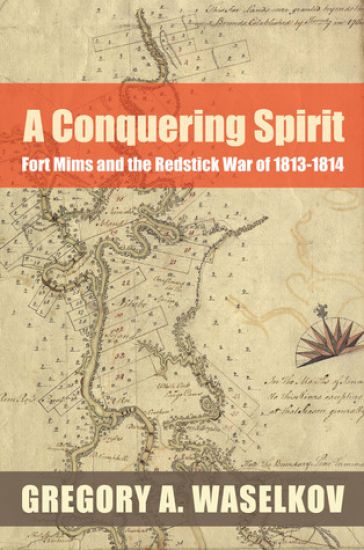
A Conquering Spirit

A Conquering Spirit

Gregory A. Waselkov

The University of Alabama Press
2006
sidottu
The Fort Mims massacre changed the course of American history in many ways, not the least of which was the ensuing rise of one Andrew Jackson to the national stage. The unprecedented Indian victory over the encroaching Americans who were bent on taking their lands and destroying their culture horrified many and injured the young nation's pride. Tragedies such as this one have always rallied Americans to a common cause: a single-minded determination to destroy the enemy and avenge the fallen. The August 30, 1813, massacre at Fort Mims, involving hundreds of dead men, women, and children, was just such a spark. Gregory Waselkov tells compellingly the story of this fierce battle at the fortified plantation home of Samuel Mims in the Tensaw District of the Mississippi Territory. With valuable maps, tables, and artifact illustrations, Waselkov looks closely at the battle to cut through the legends and misinformation that have grown around the event almost from the moment the last flames died at the smoldering ruins. At least as important as the details of the battle, though, is his elucidation of how social forces remarkably converged to spark the conflict and how reverberations of the battle echo still today, nearly two hundred years later.
A Conquering Spirit

A Conquering Spirit

Gregory A. Waselkov

The University of Alabama Press
2009
nidottu
The August 30, 1813, massacre at Fort Mims left hundreds dead and ultimately changed the course of American history. The Indian victory shocked and horrified a young America, ushering in a period of violence surrounded by racial and social confusion. Fort Mims became a rallying cry, calling Americans to fight their assailants and avenge the dead. In ""A Conquering Spirit"", Waselkov thoroughly explicates the social climes surrounding this tumultuous moment in early American history with a comprehensive collection of illustrations, artifact photographs, and detailed accounts of every known participant in the attack on Fort Mims. These rich and extensive resources make ""A Conquering Spirit"" an invaluable collection for any reader interested in America's frontier era.
Tamburlaine: A Broadway Revival

Tamburlaine: A Broadway Revival

Gregory a. Kompes

Fabulist Flash Publishing, Ltd.
2017
nidottu
Chris Marlowe, a drag queen of a certain age, has kept the failing, New York City show bar, Tamburlaine, open because of a long-ago made promise. When a young man enters her life, Chris reconnects with the world and everything changes. The bar once again enjoys success, crowds flood to Tamburlaine for the gender-bending shows directed by The Great Jericho Taylor, and Chris's impersonations of the famed comedienne, Rusty Warren are once again loved by audiences. So, why is someone trying to kill Christopher Marlowe-again and again?"Kompes writes in a confident, playful prose that perfectly captures Chris' snarky worldview.... A colorful, surprising novel about an over-the-hill artist grappling with times gone by." Kirkus Reviews
Letters from A Skeptic

Letters from A Skeptic

Gregory A. Boyd

David C Cook Publishing Company
2008
nidottu
Greg Boyd and his father, Ed, were on opposite sides of a great divide. Greg was a newfound Christian, while his father was a longtime agnostic. So Greg offered his father an invitation: Ed could write with any questions on Christianity, and his son would offer a response. Letters from a Skeptic contains this special correspondence. The letters tackle some of today's toughest challenges facing Christianity, including Do all non-Christians go to hell? How can we believe a man rose from the dead? Why is the world so full of suffering? How do we know the Bible was divinely inspired? Does God know the future? Each response offers insights into the big questions, while delivering intelligent answers that connect with both the heart and mind. Whether you're a skeptic, a believer, or just unsure, these letters can provide a practical, common-sense guide to the Christian faith.