Kirjahaku
Etsi kirjoja tekijän nimen, kirjan nimen tai ISBN:n perusteella.
1000 tulosta hakusanalla Gregory F. Lawler
A more accurate title for this book would be "Problems dealing with the non-intersection of paths of random walks. " These include: harmonic measure, which can be considered as a problem of nonintersection of a random walk with a fixed set; the probability that the paths of independent random walks do not intersect; and self-avoiding walks, i. e. , random walks which have no self-intersections. The prerequisite is a standard measure theoretic course in probability including martingales and Brownian motion. The first chapter develops the facts about simple random walk that will be needed. The discussion is self-contained although some previous expo sure to random walks would be helpful. Many of the results are standard, and I have made borrowed from a number of sources, especially the ex cellent book of Spitzer [65]. For the sake of simplicity I have restricted the discussion to simple random walk. Of course, many of the results hold equally well for more general walks. For example, the local central limit theorem can be proved for any random walk whose increments have mean zero and finite variance. Some of the later results, especially in Section 1. 7, have not been proved for very general classes of walks. The proofs here rely heavily on the fact that the increments of simple random walk are bounded and symmetric.
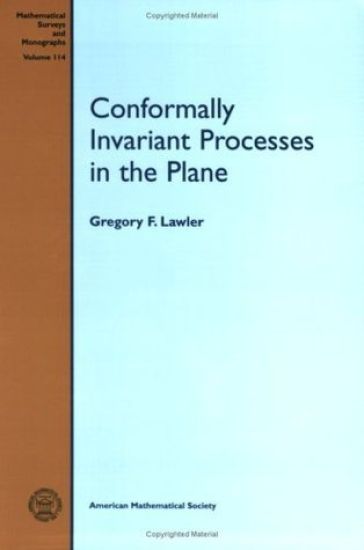
Conformally Invariant Processes in the Plane
Gregory F. Lawler
Amer Mathematical Society
2008
pokkari
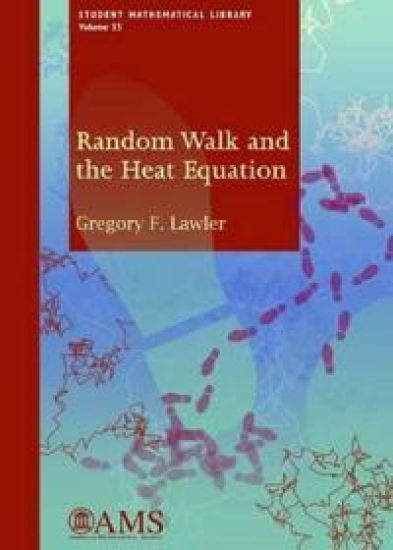
The heat equation can be derived by averaging over a very large number of particles. Traditionally, the resulting PDE is studied as a deterministic equation, an approach that has brought many significant results and a deep understanding of the equation and its solutions. By studying the heat equation by considering the individual random particles, however, one gains further intuition into the problem. While this is now standard for many researchers, this approach is generally not presented at the undergraduate level. In this book, Lawler introduces the heat equation and the closely related notion of harmonic functions from a probabilistic perspective. The theme of the first two chapters of the book is the relationship between random walks and the heat equation. The first chapter discusses the discrete case, random walk and the heat equation on the integer lattice; and the second chapter discusses the continuous case, Brownian motion and the usual heat equation. Relationships are shown between the two. For example, solving the heat equation in the discrete setting becomes a problem of diagonalization of symmetric matrices, which becomes a problem in Fourier series in the continuous case. Random walk and Brownian motion are introduced and developed from first principles. The latter two chapters discuss different topics: martingales and fractal dimension, with the chapters tied together by one example, a random Cantor set. The idea of this book is to merge probabilistic and deterministic approaches to heat flow. It is also intended as a bridge from undergraduate analysis to graduate and research perspectives. The book is suitable for advanced undergraduates, particularly those considering graduate work in mathematics or related areas.
A central study in Probability Theory is the behavior of fluctuation phenomena of partial sums of different types of random variable. One of the most useful concepts for this purpose is that of the random walk which has applications in many areas, particularly in statistical physics and statistical chemistry. Originally published in 1991, Intersections of Random Walks focuses on and explores a number of problems dealing primarily with the nonintersection of random walks and the self-avoiding walk. Many of these problems arise in studying statistical physics and other critical phenomena. Topics include: discrete harmonic measure, including an introduction to diffusion limited aggregation (DLA); the probability that independent random walks do not intersect; and properties of walks without self-intersections. The present softcover reprint includes corrections and addenda from the 1996 printing, and makes this classic monograph available to a wider audience. With a self-contained introduction to the properties of simple random walks, and an emphasis on rigorous results, the book will be useful to researchers in probability and statistical physics and to graduate students interested in basic properties of random walks.
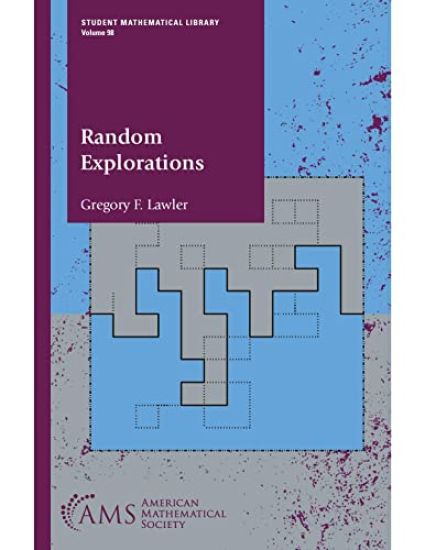
The title Random Explorations has two meanings. First, a few topics of advanced probability are deeply explored. Second, there is a recurring theme of analyzing a random object by exploring a random path.This book is an outgrowth of lectures by the author in the University of Chicago Research Experiences for Undergraduate (REU) program in 2020. The idea of the course was to expose advanced undergraduates to ideas in probability research.The book begins with Markov chains with an emphasis on transient or killed chains that have finite Green's function. This function, and its inverse called the Laplacian, is discussed next to relate two objects that arise in statistical physics, the loop-erased random walk (LERW) and the uniform spanning tree (UST). A modern approach is used including loop measures and soups. Understanding these approaches as the system size goes to infinity requires a deep understanding of the simple random walk so that is studied next, followed by a look at the infinite LERW and UST. Another model, the Gaussian free field (GFF), is introduced and related to loop measure. The emphasis in the book is on discrete models, but the final chapter gives an introduction to the continuous objects: Brownian motion, Brownian loop measures and soups, Schramm-Loewner evolution (SLE), and the continuous Gaussian free field. A number of exercises scattered throughout the text will help a serious reader gain better understanding of the material.
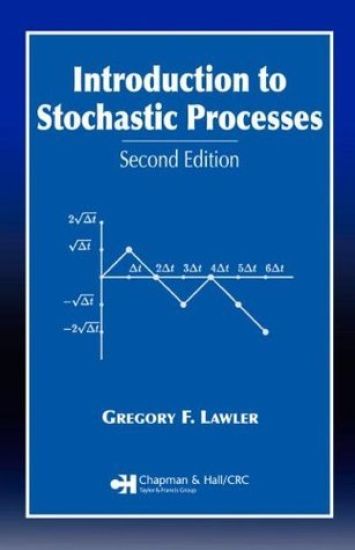
Emphasizing fundamental mathematical ideas rather than proofs, Introduction to Stochastic Processes, Second Edition provides quick access to important foundations of probability theory applicable to problems in many fields. Assuming that you have a reasonable level of computer literacy, the ability to write simple programs, and the access to software for linear algebra computations, the author approaches the problems and theorems with a focus on stochastic processes evolving with time, rather than a particular emphasis on measure theory.For those lacking in exposure to linear differential and difference equations, the author begins with a brief introduction to these concepts. He proceeds to discuss Markov chains, optimal stopping, martingales, and Brownian motion. The book concludes with a chapter on stochastic integration. The author supplies many basic, general examples and provides exercises at the end of each chapter.New to the Second Edition:Expanded chapter on stochastic integration that introduces modern mathematical finance Introduction of Girsanov transformation and the Feynman-Kac formula Expanded discussion of Itô's formula and the Black-Scholes formula for pricing options New topics such as Doob's maximal inequality and a discussion on self similarity in the chapter on Brownian motionApplicable to the fields of mathematics, statistics, and engineering as well as computer science, economics, business, biological science, psychology, and engineering, this concise introduction is an excellent resource both for students and professionals.
Random Walk: A Modern Introduction
Gregory F. Lawler; Vlada Limic
Cambridge University Press
2010
sidottu
Random walks are stochastic processes formed by successive summation of independent, identically distributed random variables and are one of the most studied topics in probability theory. This contemporary introduction evolved from courses taught at Cornell University and the University of Chicago by the first author, who is one of the most highly regarded researchers in the field of stochastic processes. This text meets the need for a modern reference to the detailed properties of an important class of random walks on the integer lattice. It is suitable for probabilists, mathematicians working in related fields, and for researchers in other disciplines who use random walks in modeling.
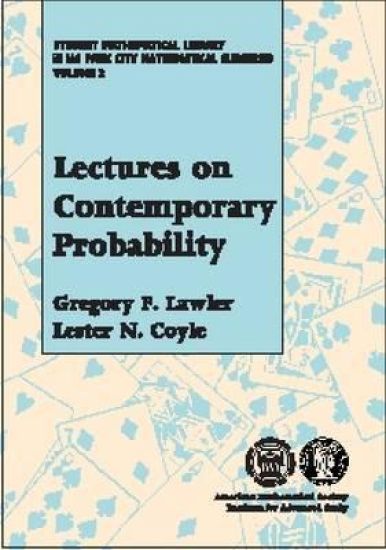
Lectures on Contemporary Probability
Gregory F. Lawler; Lester N. Coyle
Amer Mathematical Society
1999
pokkari
This volume is based on classes in probability for advanced undergraduates held at the IAS/Park City Mathematics Institute (Utah). It is derived from both lectures (Chapters 1-10) and computer simulations (Chapters 11-13) that were held during the program. The material is coordinated so that some of the major computer simulations relate to topics covered in the first ten chapters. The goal is to present topics that are accessible to advanced undergraduates, yet are areas of current research in probability. The combination of the lucid yet informal style of the lectures and the hands-on nature of the simulations allows readers to become familiar with some interesting and active areas of probability. The first four chapters discuss random walks and the continuous limit of random walks: Brownian motion.Chapters 5 and 6 consider the fascinating mathematics of card shuffles, including the notions of random walks on a symmetric group and the general idea of random permutations. Chapters 7 and 8 discuss Markov chains, beginning with a standard introduction to the theory.Chapter 8 addresses the recent important application of Markov chains to simulations of random systems on large finite sets: Markov Chain Monte Carlo. Random walks and electrical networks are covered in Chapter 9. Uniform spanning trees, as connected to probability and random walks, are treated in Chapter 10. The final three chapters of the book present simulations. Chapter 11 discusses simulations for random walks.Chapter 12 covers simulation topics such as sampling from continuous distributions, random permutations, and estimating the number of matrices with certain conditions using Markov Chain Monte Carlo. Chapter 13 presents simulations of stochastic differential equations for applications in finance. (The simulations do not require one particular piece of software. They can be done in symbolic computation packages or via programming languages such as C.) The volume concludes with a number of problems ranging from routine to very difficult. Of particular note are problems that are typical of simulation problems given to students by the authors when teaching undergraduate probability.
Random Walks, Random Fields, and Disordered Systems
Anton Bovier; David Brydges; Amin Coja-Oghlan; Dmitry Ioffe; Gregory F. Lawler
Springer International Publishing AG
2015
nidottu
Focusing on the mathematics that lies at the intersection of probability theory, statistical physics, combinatorics and computer science, this volume collects together lecture notes on recent developments in the area. The common ground of these subjects is perhaps best described by the three terms in the title: Random Walks, Random Fields and Disordered Systems. The specific topics covered include a study of Branching Brownian Motion from the perspective of disordered (spin-glass) systems, a detailed analysis of weakly self-avoiding random walks in four spatial dimensions via methods of field theory and the renormalization group, a study of phase transitions in disordered discrete structures using a rigorous version of the cavity method, a survey of recent work on interacting polymers in the ballisticity regime and, finally, a treatise on two-dimensional loop-soup models and their connection to conformally invariant systems and the Gaussian Free Field. The notes are aimed at early graduate students with a modest background in probability and mathematical physics, although they could also be enjoyed by seasoned researchers interested in learning about recent advances in the above fields.
Urbanization is typically narrated as a tale of migration and industrialization--a mass exodus from rural areas to burgeoning cities with centripetal economies. Today, however, many rural settlements are not hollowing out. Rather, they are filling up and filling in, even far beyond the fringes of large metropolitan areas. In Urbanization from Within, Gregory F. Randolph challenges our conventional understanding of how humans are becoming an increasingly urban species, revealing an alternative pathway of urban transition. Drawing on research in the Indian state of Bihar, Randolph shows that agrarian villages are transforming into urban towns through internal population growth, a bootstrapped non-farm economy, and interwoven processes of social change--a phenomenon he terms urbanization from within. In this account, urbanization is still linked to rural-urban mobility, but rather than the migrant's destination, it is the migrant's origin that is urbanizing, fueled by the circular flow of people and the skills, resources, and expectations they carry and transmit to their hometowns. While rooting his study in a specific region, Randolph connects urbanization from within to a set of global forces shaping twenty-first century urban transitions in and beyond India. Urbanization from Within provides an in-depth understanding of these mechanisms as well as the consequences and future of new urbanization patterns--integrating qualitative interviews, analysis of geospatial data and large-scale surveys, econometric modeling, and insights from a wide range of disciplines. Like other pathways of urban transition, urbanization from within generates possibilities and constraints for human agency and fulfillment. To imagine a role for planning and policymaking institutions in shaping this process, Randolph provides an assessment of these tradeoffs, which are different from those generally associated with urbanization. Ultimately, Urbanization from Within fundamentally reshapes our understanding of how the world is urbanizing, with important insights for scholars, policymakers, and practitioners.
Solar energy is a substantial global industry, one that has generated trade disputes among superpowers, threatened the solvency of large energy companies, and prompted serious reconsideration of electric utility regulation rooted in the 1930s. One of the biggest payoffs from solar’s success is not the clean inexpensive electricity it can produce, but the lessons it provides for innovation in other technologies needed to address climate change.Despite the large literature on solar, including analyses of increasingly detailed datasets, the question as to how solar became inexpensive and why it took so long still remains unanswered. Drawing on developments in the US, Japan, Germany, Australia, and China, this book provides a truly comprehensive and international explanation for how solar has become inexpensive. Understanding the reasons for solar’s success enables us to take full advantage of solar’s potential. It can also teach us how to support other low-carbon technologies with analogous properties, including small modular nuclear reactors and direct air capture. However, the urgency of addressing climate change means that a key challenge in applying the solar model is in finding ways to speed up innovation. Offering suggestions and policy recommendations for accelerated innovation is another key contribution of this book.This book will be of great interest to students and scholars of energy technology and innovation, climate change and energy analysis and policy, as well as practitioners and policymakers working in the existing and emerging energy industries.
How to Start and Run a Successful Consulting Business
Gregory F. Kishel; Patricia Gunter Kishel
John Wiley Sons Inc
1996
sidottu
"The consulting industry is one of the fastest growing business sectors worldwide with new opportunities emerging continually in hundreds of different fields. Whatever your area of expertiseengineering or employee relations, computers or customer servicethere's likely to be a demand for your consulting abilities." Gregory Kishel and Patricia Kishel from the Preface Who needs consultants? The answer is simple: everyone does! Consultants are no longer viewed as a luxury. They've become a necessity in today's constantly evolving business environment. And, for millions of career changers, recent graduates, retirees, and former government employees, consulting is an excellent way to turn knowledge and experience into a profitable business. Now, two highly successful consultants provide you with a proven plan for entering and growing in this lucrative field. You'll get practical advice on what it takes to succeed as a consultant, where the real opportunities are, and the types of situations you are most likely to encounter. You'll learn all of the aspects of becoming an independent consultant, including how to choose a specific field and set up business, how to determine fees and market your services, how to get referrals and maintain good client relations, how to write winning proposals, what kinds of insurance you should have, how to win government contracts, how to enter foreign markets, and much, much more. Packed with step-by-step guidelines, forms, and checklists, this valuable guide is must reading for both working consultants and anyone interested in starting a consulting business. Written for anyone with ideas, information, or skills to sell, this valuable guide shows you how to make the most of your talents, putting them to work for yourself and your clients. Drawing on their own experiences as management consultants, Gregory Kishel and Patricia Kishel offer down-to-earth advice on what it takes to succeed as a consultant, where the opportunities are, and the types of situations you are likely to encounter. Step by step, you will learn all of the aspects of becoming an independent consultant, including: *How to choose a specific field and set up a business *How to determine fees and market your services *How to get referrals and maintain good client relations *What kinds of insurance you should have *How to win government contracts, enter foreign markets, and much more Whatever your area of specialization, this indispensable book will give you the information you need to build and maintain a profitable consulting business.
Build Your Own Network Sales Business
Gregory F. Kishel; Patricia Gunter Kishel
John Wiley Sons Inc
1992
sidottu
The Wall Street Journal predicts that between 50-60% of all goods and services in the U.S. will be sold through network or multi-level marketing methods in this decade. Shows entrepreneurs how to start up and run their own successful, self-replicating network. Covers everything from picking the right product or service, managing your time, to tax and legal considerations.
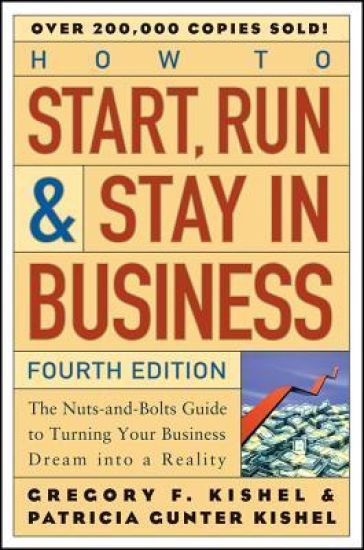
How to Start, Run, and Stay in Business
Gregory F. Kishel; Patricia Gunter Kishel
John Wiley Sons Inc
2005
nidottu
A new 25th anniversary update of the entrepreneur's bible For twenty-five years, entrepreneurs have relied on this friendly, comprehensive guide to the basics of successfully operating a small business. Now, this new Fourth Edition of How to Start, Run & Stay in Business completely updates the bestselling classic for today's entrepreneur. It features all the reliable, straightforward advice readers expect and also includes entirely new information on online business and marketing as well as new Internet resources. Material on legal and financial issues, international business, customer service, and state and federal tax regulations has been fully revised. Plus, new charts, illustrations, questionnaires, and checklists make the book more practical and useful than ever. Inside, you'll find world-class guidance on every vital aspect of small business success, including: * Preparing a business plan * Finding the right location * Deciding on an ownership structure * Record keeping and taxes * Financing and capital * Inventory and distribution * Hiring and staffing * Managing and motivating people * Marketing and promotions * Risk management * And much more In addition, a wealth of helpful resources covers all your outside needs, from attorneys and accountants to trade associations and Web site designers. Whether your business is brick-and-mortar, mom-and-pop, home-based, or online, How to Start, Run & Stay in Business, Fourth Edition provides all the information you need to make your entrepreneurial dream a reality.
During the Cold War, U.S. intelligence was concerned primarily with states; non-state actors like terrorists were secondary. Now the priorities are reversed and the challenge is enormous. States had an address, and they were hierarchical and bureaucratic. They thus came with some 'story'. Terrorists do not. States were 'over there', but terrorists are there and here. They thus put pressure on intelligence at home, not just abroad. The strength of this book is that it underscores the extent of the change and ranges broadly across data collection and analysis, foreign and domestic, as well as presenting the issues of value that arise as new targets require collecting more information at home.
Reshaping National Intelligence for an Age of Information
Gregory F. Treverton
Cambridge University Press
2003
pokkari
The world of intelligence has been completely transformed by the end of the Cold War and the onset of an age of information. Prior to the 1990s, US government intelligence had one principal target, the Soviet Union; a narrow set of ‘customers’, the political and military officials of the US government; and a limited set of information from the sources they owned, spy satellites and spies. Today, world intelligence has many targets, numerous consumers - not all of whom are American or in the government - and too much information, most of which is not owned by the U.S. government and is of widely varying reliability. In this bold and penetrating study, Gregory Treverton, former Vice Chair of the National Intelligence Council and Senate investigator, offers his insider’s views on how intelligence gathering and analysis must change. He suggests why intelligence needs to be both contrarian, leaning against the conventional wisdom, and attentive to the longer term, leaning against the growing shorter time horizons of Washington policy makers. He urges that the solving of intelligence puzzles tap expertise outside government - in the academy, think tanks, and Wall Street - to make these parties colleagues and co-consumers of intelligence, befitting the changed role of government from doer to convener, mediator, and coalition-builder.
Reshaping National Intelligence for an Age of Information
Gregory F. Treverton
Cambridge University Press
2001
sidottu
The world of intelligence has been completely transformed by the end of the Cold War and the onset of an age of information. Prior to the 1990s, US government intelligence had one principal target, the Soviet Union; a narrow set of 'customers', the political and military officials of the US government; and a limited set of information from the sources they owned, spy satellites and spies. Today, world intelligence has many targets, numerous consumers - not all of whom are American or in the government - and too much information, most of which is not owned by the U.S. government and is of widely varying reliability. In this bold and penetrating study, Gregory Treverton, former Vice Chair of the National Intelligence Council and Senate investigator, offers his insider's views on how intelligence gathering and analysis must change. He suggests why intelligence needs to be both contrarian, leaning against the conventional wisdom, and attentive to the longer term, leaning against the growing shorter time horizons of Washington policy makers. He urges that the solving of intelligence puzzles tap expertise outside government - in the academy, think tanks, and Wall Street - to make these parties colleagues and co-consumers of intelligence, befitting the changed role of government from doer to convener, mediator, and coalition-builder.