Henry Frederick Baker (1866–1956) was a renowned British mathematician specialising in algebraic geometry. He was elected a Fellow of the Royal Society in 1898 and appointed the Lowndean Professor of Astronomy and Geometry in the University of Cambridge in 1914. First published between 1922 and 1925, the six-volume Principles of Geometry was a synthesis of Baker's lecture series on geometry and was the first British work on geometry to use axiomatic methods without the use of co-ordinates. The first four volumes describe the projective geometry of space of between two and five dimensions, with the last two volumes reflecting Baker's later research interests in the birational theory of surfaces. The work as a whole provides a detailed insight into the geometry which was developing at the time of publication. This, the first volume, describes the foundations of projective geometry.
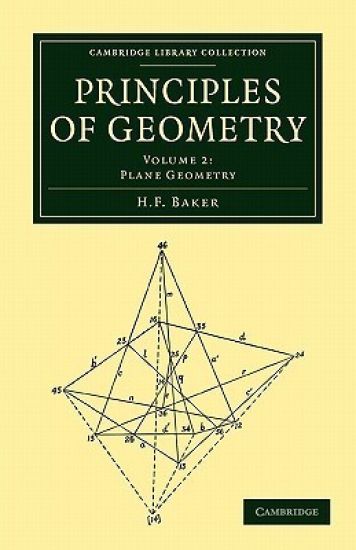
Henry Frederick Baker (1866–1956) was a renowned British mathematician specialising in algebraic geometry. He was elected a Fellow of the Royal Society in 1898 and appointed the Lowndean Professor of Astronomy and Geometry in the University of Cambridge in 1914. First published between 1922 and 1925, the six-volume Principles of Geometry was a synthesis of Baker's lecture series on geometry and was the first British work on geometry to use axiomatic methods without the use of co-ordinates. The first four volumes describe the projective geometry of space of between two and five dimensions, with the last two volumes reflecting Baker's later research interests in the birational theory of surfaces. The work as a whole provides a detailed insight into the geometry which was developing at the time of publication. This, the second volume, describes the principal configurations of space of two dimensions.
Henry Frederick Baker (1866–1956) was a renowned British mathematician specialising in algebraic geometry. He was elected a Fellow of the Royal Society in 1898 and appointed the Lowndean Professor of Astronomy and Geometry in the University of Cambridge in 1914. First published between 1922 and 1925, the six-volume Principles of Geometry was a synthesis of Baker's lecture series on geometry and was the first British work on geometry to use axiomatic methods without the use of co-ordinates. The first four volumes describe the projective geometry of space of between two and five dimensions, with the last two volumes reflecting Baker's later research interests in the birational theory of surfaces. The work as a whole provides a detailed insight into the geometry which was developing at the time of publication. This, the third volume, describes the principal configurations of space of three dimensions.
Henry Frederick Baker (1866–1956) was a renowned British mathematician specialising in algebraic geometry. He was elected a Fellow of the Royal Society in 1898 and appointed the Lowndean Professor of Astronomy and Geometry in the University of Cambridge in 1914. First published between 1922 and 1925, the six-volume Principles of Geometry was a synthesis of Baker's lecture series on geometry and was the first British work on geometry to use axiomatic methods without the use of co-ordinates. The first four volumes describe the projective geometry of space of between two and five dimensions, with the last two volumes reflecting Baker's later research interests in the birational theory of surfaces. The work as a whole provides a detailed insight into the geometry which was developing at the time of publication. This, the fourth volume, describes the principal configurations of space of four and five dimensions.
Henry Frederick Baker (1866–1956) was a renowned British mathematician specialising in algebraic geometry. He was elected a Fellow of the Royal Society in 1898 and appointed the Lowndean Professor of Astronomy and Geometry in the University of Cambridge in 1914. First published between 1922 and 1925, the six-volume Principles of Geometry was a synthesis of Baker's lecture series on geometry and was the first British work on geometry to use axiomatic methods without the use of co-ordinates. The first four volumes describe the projective geometry of space of between two and five dimensions, with the last two volumes reflecting Baker's later research interests in the birational theory of surfaces. The work as a whole provides a detailed insight into the geometry which was developing at the time of publication. This, the fifth volume, describes the birational geometry of curves.
Henry Frederick Baker (1866–1956) was a renowned British mathematician specialising in algebraic geometry. He was elected a Fellow of the Royal Society in 1898 and appointed the Lowndean Professor of Astronomy and Geometry in the University of Cambridge in 1914. First published between 1922 and 1925, the six-volume Principles of Geometry was a synthesis of Baker's lecture series on geometry and was the first British work on geometry to use axiomatic methods without the use of co-ordinates. The first four volumes describe the projective geometry of space of between two and five dimensions, with the last two volumes reflecting Baker's later research interests in the birational theory of surfaces. The work as a whole provides a detailed insight into the geometry which was developing at the time of publication. This, the sixth and final volume, describes the birational geometric theory of surfaces.
Classical algebraic geometry, inseparably connected with the names of Abel, Riemann, Weierstrass, Poincaré, Clebsch, Jacobi and other outstanding mathematicians of the last century, was mainly an analytical theory. In our century it has been enriched by the methods and ideas of topology, commutative algebra and Grothendieck’s schemes seemed to have replaced once and forever the somewhat naive language of classical algebraic geometry. This book contains more than its modest title suggests. Written in 1897, its scope was as broad as it could possibly be, namely to cover the whole of algebraic geometry, and associated theories. The subject is discussed by Baker in terms of transcendental functions, and in particular theta functions. Many of the ideas put forward are of continuing relevance today, and some of the most exciting ideas from theoretical physics draw on work presented here.
This work has been selected by scholars as being culturally important and is part of the knowledge base of civilization as we know it.This work is in the public domain in the United States of America, and possibly other nations. Within the United States, you may freely copy and distribute this work, as no entity (individual or corporate) has a copyright on the body of the work.Scholars believe, and we concur, that this work is important enough to be preserved, reproduced, and made generally available to the public. To ensure a quality reading experience, this work has been proofread and republished using a format that seamlessly blends the original graphical elements with text in an easy-to-read typeface.We appreciate your support of the preservation process, and thank you for being an important part of keeping this knowledge alive and relevant.
This work has been selected by scholars as being culturally important and is part of the knowledge base of civilization as we know it.This work is in the public domain in the United States of America, and possibly other nations. Within the United States, you may freely copy and distribute this work, as no entity (individual or corporate) has a copyright on the body of the work.Scholars believe, and we concur, that this work is important enough to be preserved, reproduced, and made generally available to the public. To ensure a quality reading experience, this work has been proofread and republished using a format that seamlessly blends the original graphical elements with text in an easy-to-read typeface.We appreciate your support of the preservation process, and thank you for being an important part of keeping this knowledge alive and relevant.
This work has been selected by scholars as being culturally important and is part of the knowledge base of civilization as we know it.This work is in the public domain in the United States of America, and possibly other nations. Within the United States, you may freely copy and distribute this work, as no entity (individual or corporate) has a copyright on the body of the work.Scholars believe, and we concur, that this work is important enough to be preserved, reproduced, and made generally available to the public. To ensure a quality reading experience, this work has been proofread and republished using a format that seamlessly blends the original graphical elements with text in an easy-to-read typeface.We appreciate your support of the preservation process, and thank you for being an important part of keeping this knowledge alive and relevant.
This work has been selected by scholars as being culturally important and is part of the knowledge base of civilization as we know it.This work is in the public domain in the United States of America, and possibly other nations. Within the United States, you may freely copy and distribute this work, as no entity (individual or corporate) has a copyright on the body of the work.Scholars believe, and we concur, that this work is important enough to be preserved, reproduced, and made generally available to the public. To ensure a quality reading experience, this work has been proofread and republished using a format that seamlessly blends the original graphical elements with text in an easy-to-read typeface.We appreciate your support of the preservation process, and thank you for being an important part of keeping this knowledge alive and relevant.
This work has been selected by scholars as being culturally important and is part of the knowledge base of civilization as we know it.This work is in the public domain in the United States of America, and possibly other nations. Within the United States, you may freely copy and distribute this work, as no entity (individual or corporate) has a copyright on the body of the work.Scholars believe, and we concur, that this work is important enough to be preserved, reproduced, and made generally available to the public. To ensure a quality reading experience, this work has been proofread and republished using a format that seamlessly blends the original graphical elements with text in an easy-to-read typeface.We appreciate your support of the preservation process, and thank you for being an important part of keeping this knowledge alive and relevant.