Kirjojen hintavertailu. Mukana 12 363 183 kirjaa ja 12 kauppaa.

Kirjahaku

Etsi kirjoja tekijän nimen, kirjan nimen tai ISBN:n perusteella.

1000 tulosta hakusanalla H. G. Wells; Peter Straub

The Island of Dr. Moreau

The Island of Dr. Moreau

H. G. Wells; Peter Straub

Modern Library Inc
2002
pokkari
Written in 1896, The Island of Dr. Moreau is one of the earliest scientific romances. An instant sensation, it was meant as a commentary on Darwin’s theory of evolution, which H. G. Wells stoutly believed. The story centers on the depraved Dr. Moreau, who conducts unspeakable animal experiments on a remote tropical island, with hideous, humanlike results. Edward Prendick, an English-man whose misfortunes bring him to the island, is witness to the Beast Folk’s strange civilization and their eventual terrifying regression. While gene-splicing and bioengineering are common practices today, readers are still astounded at Wells’s haunting vision and the ethical questions he raised a century before our time.
H. G. Wells and the Culminating Ape

H. G. Wells and the Culminating Ape

Peter Kemp

Palgrave Macmillan
1996
nidottu
H.G. Wells's view of the world - and hence his writing - was strongly influenced by the biologist's training he received during his three years as a student at the Normal School of Science, South Kensington (now Imperial College, London). Those things which a creature needs in order for it and its species to thrive get particular attention in Wells's books. Tracing biological themes through Wells's work, as Peter Kemp does here, shows the pattern of his thought and brings to light the bizarre workings of a fascinating imagination. For the book's reissue in paperback, an afterword has been added.
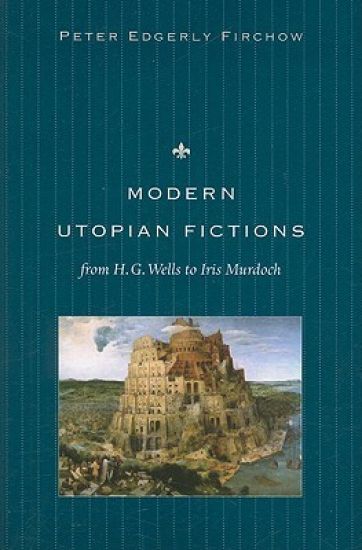
Modern Utopian Fictions from H. G. Wells to Iris Murdoch

Modern Utopian Fictions from H. G. Wells to Iris Murdoch

Peter Edgerly Firchow

The Catholic University of America Press
2008
nidottu
While tracing the development of fiction in the writing of modern utopias, the author seeks to demonstrate in specific ways how those utopias have become increasingly literary. After an introductory discussion of how we understand - and how we should understand - modern utopian fictions, the book provides several examples of the ways in which those understandings affect our appreciation of utopian fiction. There are chapters on H. G. Wells' ""Time Machine""; Bernard Shaw's ""Major Barbara""; Aldous Huxley's ""Brave New World""; George Orwell's ""Animal Farm and Nineteen Eighty-Four""; William Golding's ""Lord of the Flies""; and, Iris Murdoch's ""The Bell"". 'This book will inspire readers to devote more time to this literature, and it will be invaluable to those designing courses on utopian fiction. Highly recommended' - ""Choice"".
The Invisible Man (1897) Novel by: H.G. Wells

The Invisible Man (1897) Novel by: H.G. Wells

H. G. Wells

Createspace Independent Publishing Platform
2017
nidottu
The Invisible Man is a 1897 science fiction novel, originally serialized in Pearson's Magazine. The Invisible Man of the title is "Griffin", a scientist who theorizes that if a person's refractive index is changed to exactly that of air and his body does not absorb or reflect light, then he will not be visible. He successfully carries out this procedure on himself, but cannot become visible again, becoming mentally unstable as a result.Herbert George Wells (21 September 1866 - 13 August 1946)-known as H. G. Wells-was a prolific English writer in many genres, including the novel, history, politics, social commentary, and textbooks and rules for war games. Wells is now best remembered for his science fiction novels and is called a "father of science fiction", along with Jules Verne and Hugo Gernsback. His most notable science fiction works include The Time Machine (1895), The Island of Doctor Moreau (1896), The Invisible Man (1897), and The War of the Worlds (1898). He was nominated for the Nobel Prize in Literature four times.