Harold Frederic (born Harold Henry Frederick; August 19, 1856 - October 19, 1898) was an American journalist and novelist. Frederic was born in Utica, New York, to Presbyterian parents. After his father was killed in a railroad accident when Frederic was 18 months old, the boy was raised primarily by his mother. He finished school at age fifteen, and soon began work as a photographer. For four years he was a photographic touch-up artist in his hometown and in Boston. In 1875 he began work as a proofreader for the newspaper The Utica Herald and then The Utica Daily Observer. Frederic later became a reporter. Frederic married Grace Green Williams in 1877, and they had five children together. By 1882 he was editor of the newspaper The Albany Evening Journal in the state capital. In 1884 Frederic went to live in England as London correspondent of the New York Times, and worked at this position for the rest of his life. He brought his family to London by 1889. Afterward he met Kate Lyon, who became his mistress. Frederic and Lyon established a second household, living openly together; and they had three illegitimate children. Frederic wrote several early stories, but it was not until he published Illumination (1896), better known by its American title, The Damnation of Theron Ware; followed by Gloria Mundi (1898), that his talent as a novelist was fully realized. Critic Jonathan Yardley called Damnation "a minor classic of realism". Kate Lyon was a Christian Scientist. When Frederic suffered a stroke in 1898, she tried to cure him by faith healing. 3] 4] After his death, she was tried on charges of manslaughter brought by his wife Grace Frederic, and acquitted at trial.
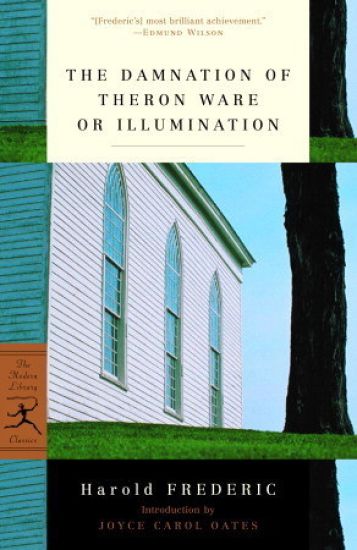
The Damnation of Theron Ware (published in England as Illumination) is an 1896 novel by American author Harold Frederic. The novel reveals a great deal about late 19th century provincial America, religious life, and the depressed state of intellectual and artistic culture in small towns. It is similar to Samuel Butler's The Way of All Flesh and Sinclair Lewis's Elmer Gantry. It is written in a realistic style. The novel centers on the life of a Methodist pastor named Theron Ware who has recently moved to a fictional small town in the Adirondack Mountains of upstate New York, which Frederic modeled after Utica, New York. A promising young pastor recently married, Theron has a number of experiences that cause him to begin to question the Methodist religion, his role as a minister and even the very existence of God. His moral decline (or illumination) is heightened through his dealings with Father Forbes, the town's Catholic priest; Dr. Ledsmar, a local atheist, philosopher, and man of science; and Celia Madden, a local Irish Catholic girl, a species of aesthete, with whom Theron becomes hopelessly infatuated. In the end, these three "advanced" characters find Theron a bore, and tell him so. He goes on a binge, and is saved by Brother and Sister Soulsby, common-sensical fund-raisers for Methodist congregations. Their feet are on the ground, and they pack Theron and his wife off to the new state of Washington, where-who knows?--he might end up in politics. The name "Theron Ware" was later used by author James Blish for his "villain" in the novel Black Easter. In this novel Ware brings about the death of God and the triumph of Satan. The book was adapted into a play in 1979 by a Troy University theatre professor and produced by the school's drama department....... Harold Frederic (born Harold Henry Frederick; August 19, 1856 - October 19, 1898) was an American journalist and novelist. Life and career: Frederic was born in Utica, New York, to Presbyterian parents. After his father was killed in a railroad accident when Frederic was 18 months old, the boy was raised primarily by his mother. He finished school at age fifteen, and soon began work as a photographer. For four years he was a photographic touch-up artist in his hometown and in Boston. In 1875, he began work as a proofreader for the newspaper The Utica Herald and then The Utica Daily Observer. Frederic later became a reporter. Frederic married Grace Green Williams in 1877, and they had five children together. By 1882 he was editor of the newspaper The Albany Evening Journal in the state capital. In 1884 Frederic went to live in England as London correspondent of the New York Times, and worked at this position for the rest of his life. He brought his family to London by 1889. Afterward he met Kate Lyon, who became his mistress. Frederic and Lyon established a second household, living openly together; and they had three illegitimate children. Frederic wrote several early stories, but it was not until he published Illumination (1896), better known by its American title, The Damnation of Theron Ware, followed by Gloria Mundi (1898), that his talent as a novelist was fully realized. Critic Jonathan Yardley called Damnation "a minor classic of realism". Kate Lyon was a Christian Scientist. Frederic suffered a stroke in 1898. After his death, she was tried on charges of manslaughter brought by his wife Grace Frederic, and acquitted at trial................
In the Valley (1890) is a historical novel by Anglo-American novelist Harold Frederic. It is set in the United States in the Mohawk Valley and in Albany, New York, from 1757 to 1777. Plot A Mohawk Valley Dutchman finds himself pitted against a brilliant villain, a British officer, who for a time wins the affections of the heroine who has been thrown among "Tories" and British but steadfastly loyal to her native colony, though in the end he loses her to the less-worldly though courageous and honorable Douw Mauverensen, who is historian as well as hero of the tale. The climax of the book is the Battle of Oriskany. 1] The book adheres to the New York tradition, early set down in Irving and Cooper, of respect for Dutch prudence, suspicion of British perfidy and active prejudice against all New Englanders, particularly those from Connecticut. There are also faithful black slaves and ferocious Indians................... Harold Frederic (born Harold Henry Frederick; August 19, 1856 - October 19, 1898) was an American journalist and novelist. Life and career: Frederic was born in Utica, New York, to Presbyterian parents. After his father was killed in a railroad accident when Frederic was 18 months old, the boy was raised primarily by his mother. He finished school at age fifteen, and soon began work as a photographer. For four years he was a photographic touch-up artist in his hometown and in Boston. In 1875, he began work as a proofreader for the newspaper The Utica Herald and then The Utica Daily Observer. Frederic later became a reporter. Frederic married Grace Green Williams in 1877, and they had five children together. By 1882 he was editor of the newspaper The Albany Evening Journal in the state capital. In 1884 Frederic went to live in England as London correspondent of the New York Times, and worked at this position for the rest of his life. He brought his family to London by 1889. Afterward he met Kate Lyon, who became his mistress. Frederic and Lyon established a second household, living openly together; and they had three illegitimate children. Frederic wrote several early stories, but it was not until he published Illumination (1896), better known by its American title, The Damnation of Theron Ware, followed by Gloria Mundi (1898), that his talent as a novelist was fully realized. Critic Jonathan Yardley called Damnation "a minor classic of realism". Kate Lyon was a Christian Scientist. Frederic suffered a stroke in 1898. After his death, she was tried on charges of manslaughter brought by his wife Grace Frederic, and acquitted at trial............................
Harold Frederic - American Writers 83 was first published in 1969. Minnesota Archive Editions uses digital technology to make long-unavailable books once again accessible, and are published unaltered from the original University of Minnesota Press editions.
Published in 1896, The Damnation of Theron Ware or Illumination is a profound psychological portrait of the spiritual undoing of a guileless Methodist minister who is taken in by a rural townspeople’s various progressive ideas, from liberalism to bohemianism, only to be spurned by them for being too conventional. Described by Everett Carter as “among the four or five best novels written by an American during the nineteenth century,” the novel, as Joyce Carol Oates writes in her Introduction, has “shrewd, disturbing insights into the human pysche.” This Modern Library Paperback Classic is set from the text of the authoritative Harold Frederic Edition.