Hanes Walton Jr. (1941-2013) was a pioneering and prolific scholar of African American politics, and the architect of the modern scientific study of the subject.The first person to earn a PhD in political science from Howard University, Walton devoted his career to laying the intellectual foundations in his writings, and lobbying for the establishment of black politics as a subfield in political science. This study comprehensively analyses Walton’s corpus, while providing a history of the development of the study of black politics in political science. It concludes with an analysis of how the subfield has evolved since Walton’s pioneering work.
This pioneering work offers a theoretical perspective on two new variables that shape presidential voting behavior in America. It does this through an exploration of the impact that native son presidential candidate Jimmy Carter had upon his home state electorate in Georgia. The work fully documents the electoral support that Carter received in his twelve elections in the state of Georgia and the support he garnered for his former vice president in the 1984 presidential election.This is the first longitudinal study to examine the impact of native son candidates on voting behavior. It concludes that native son presidential candidates do affect voting behavior in their states and that this effect sometimes extends such behavior throughout their region. This study and its conclusions will be of interest to scholars and historians in political science and presidential studies.
This pioneering volume advances the thesis that there exists a significant linkage between Black politics and Black political behavior, heretofore treated as separate and distinct areas of study. This is the first work to bring the two together and to support such an approach with empirical studies. Chapter authors explore and analyze basic and fundamental areas of linkage providing a provocative and insightful contribution to the literature of Black politics and political behavior in America. Organized into five main linkage blocks, the work examines: Theoretical linkages between Black politics and Black political behavior; national linkages; state-contextual linkages; procedural linkages; and gender linkages. This volume will be of interest to scholars and students in American politics and political behavior and African-American politics and political behavior.
This book takes the "next step" in the study of the civil rights movement in the United States. To date, the vast majority of books on the civil rights movement have analyzed either the origins and philosophies, or the strategies and tactics of the movement. When the Marching Stopped is the first comprehensive and systematic study of the various civil rights regulatory agencies created under Titles VI and VII of the 1964 Civil Rights Act. The development of these agencies and the subsequent attainment of regulatory power is certainly one of the most significant achievements of the movement.Walton begins with the creation of the regulatory agencies in 1964 under President Johnson, and continues to describe and evaluate them through the Reagan presidency, exploring the creation, structuring, staffing, financing, and attainments of these agencies. The book also compares the work of these "new" civil rights regulatory agencies with earlier efforts ranging from Reconstruction to the late 1930s and early 1940s. An introduction by Mary Frances Berry adds important insights to Walton's monumental efforts.
With a view that behavioralism has distorted perceptions of black political activity, Hanes Walton, Jr., here reformulates the assumptions of behavioralism to arrive at a more realistic understanding of the political actions of black Americans. Considering the cultural and historical events that have shaped black lives, Walton examines voting patterns, socialization, and the development of political opinion. his analysis of leadership includes not only legislative and judicial leaders, but also leaders of those organizations so influential in black political culture: civil rights, churches, and grassroots organizations. Whether he looks at how local politics have changed through the years of civil rights action or how blacks' ideas on foreign policy have developed, Walton provides a long-needed reassessment of the role of black participation in American politics.
Demonstrates the profound influence of African Americans on American politics This dynamic and comprehensive text from two nationally renowned scholars continues to demonstrate the profound influence African Americans have had -- and continue to have -- on American politics. Through the use of two interrelated themes -- the idea of universal freedom and the concept of minority-majority coalitions -- the text demonstrates how the presence of Africans in the United States affected the founding of the Republic and its political institutions and processes. The authors show that through the quest for their own freedom in the United States, African Americans have universalized and expanded the freedoms of all Americans. MySearchLab is a part of the Walton/Smith program. Research and writing tools, including access to academic journals, help students understand critical thinking in even greater depth. To provide students with flexibility, students can download the eText to a tablet using the free Pearson eText app. ALERT: Before you purchase, check with your instructor or review your course syllabus to ensure that you select the correct ISBN. Several versions of Pearson's MyLab & Mastering products exist for each title, including customized versions for individual schools, and registrations are not transferable. In addition, you may need a CourseID, provided by your instructor, to register for and use Pearson's MyLab & Mastering products. Packages Access codes for Pearson's MyLab & Mastering products may not be included when purchasing or renting from companies other than Pearson; check with the seller before completing your purchase. Used or rental books If you rent or purchase a used book with an access code, the access code may have been redeemed previously and you may have to purchase a new access code. Access codes Access codes that are purchased from sellers other than Pearson carry a higher risk of being either the wrong ISBN or a previously redeemed code. Check with the seller prior to purchase. --
The first comprehensive analysis of the impact of the Reagan revolution on African-American political life, this book explores the ways in which conservative elites mobilized the American public around issues of race as ideology, discourse, strategy, and political elections from the Reagan victory of 1980 to the Republican congressional triumphs of 1994. The book also critically assesses the Clinton administration's record on race and the Democratic party response to affirmative action, welfare, and other aspects of the African-American political agenda.
The first comprehensive analysis of the impact of the Reagan revolution on African-American political life, this book explores the ways in which conservative elites mobilized the American public around issues of race as ideology, discourse, strategy, and political elections from the Reagan victory of 1980 to the Republican congressional triumphs of 1994. The book also critically assesses the Clinton administration's record on race and the Democratic party response to affirmative action, welfare, and other aspects of the African-American political agenda.
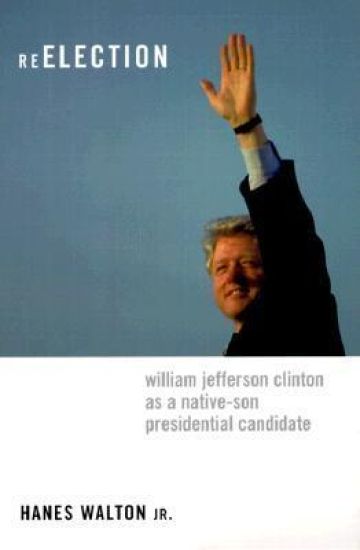
Since the passage of the Civil Rights Bill of 1964, only three Democrats have captured the White House-all of them natives of southern states. The ascendancy and reelection of Bill Clinton to the presidency is a prime example of this phenomenon, and although books have been published on the "native son" psychological variable in electoral contests, no work to date has investigated this aspect of Clinton's political career. Covering all of Clinton's twenty-one elections to state and national offices, Hanes Walton Jr. explores one of the political success stories of our century, showing how Clinton's popularity in his southern home has had a profound influence on his national electoral dominance. Walton combines the native-son theory with the issue of race to describe how the Democrats have built a vital power base in the South, in large measure because of their popularity among African-American voters. With an epilogue on the Monica Lewinsky scandal and its effect on the Democratic Party, Reelection is a major contribution to the literature on the psychology of national elections at a time when its insight into the possibility of Democratic leadership into the next century is most critical.
Since the passage of the Civil Rights Bill of 1964, only three Democrats have captured the White House-all of them natives of southern states. The ascendancy and reelection of Bill Clinton to the presidency is a prime example of this phenomenon, and although books have been published on the "native son" psychological variable in electoral contests, no work to date has investigated this aspect of Clinton's political career. Covering all of Clinton's twenty-one elections to state and national offices, Hanes Walton Jr. explores one of the political success stories of our century, showing how Clinton's popularity in his southern home has had a profound influence on his national electoral dominance. Walton combines the native-son theory with the issue of race to describe how the Democrats have built a vital power base in the South, in large measure because of their popularity among African-American voters. With an epilogue on the Monica Lewinsky scandal and its effect on the Democratic Party, Reelection is a major contribution to the literature on the psychology of national elections at a time when its insight into the possibility of Democratic leadership into the next century is most critical.
This pioneering volume advances the thesis that there exists a significant linkage between Black politics and Black political behavior, heretofore treated as separate and distinct areas of study. This is the first work to bring the two together and to support such an approach with empirical studies. Chapter authors explore and analyze basic and fundamental areas of linkage providing a provocative and insightful contribution to the literature of Black politics and political behavior in America. Organized into five main linkage blocks, the work examines: Theoretical linkages between Black politics and Black political behavior; national linkages; state-contextual linkages; procedural linkages; and gender linkages. This volume will be of interest to scholars and students in American politics and political behavior and African-American politics and political behavior.
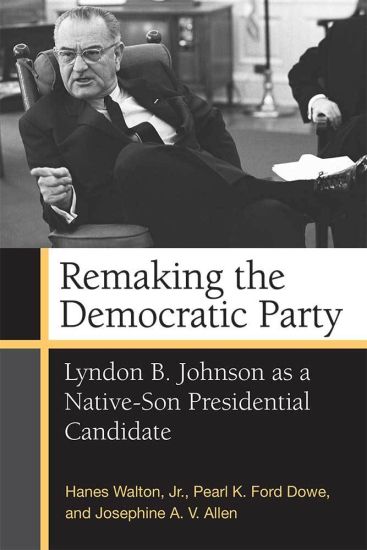
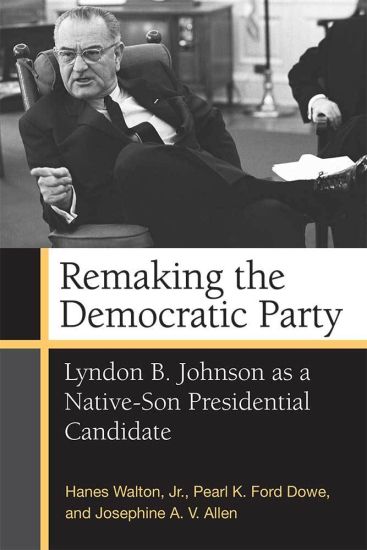
A continuation of Hanes Walton Jr.’s work on Southern Democratic presidents, Remaking the Democratic Party analyzes the congressional and presidential elections of Lyndon Baines Johnson. This study builds upon the general theory of the native-son phenomenon to demonstrate that a Southern native-son can win the presidency without the localism evident in the elections of Bill Clinton and Jimmy Carter. Although ridiculed by contemporaries for his apparent lack of control over formal party politics and the national committee, Johnson excelled at leading the Democratic Party’s policy agenda. While a senator and as president, Johnson advocated for—and secured—liberal social welfare and civil rights legislation, forcing the party to break with its Southern tradition of elitism, conservatism, and white supremacy. In a way, Johnson set the terms for the continuing partisan battle because, by countering the Democrats’ new ideology, the Republican Party also underwent a transformation.
"Hanes Walton, Donald Deskins, and Sherman Puckett have produced a highly impressive collection and valuable contribution to the literature on American electoral politics. This work is indispensable for academic libraries, political scientists, historians, and serious students of American government."---Immanuel Ness, Professor, Department of Political Science, Brooklyn College, City University of New York "Massive amounts of information about presidential elections which are not readily available elsewhere. Unprecedented coverage in one volume of every single American presidential election."---James Gimpel, Professor of Government, University of Maryland"This is an extraordinary research endeavor; the most comprehensive set of aggregate election data ever assembled. Painstakingly researched, this color-coded volume presents data for every presidential election from 1789 to 2008. Unlike most, the wide ranging narrative for this atlas identifies racial patterns in the vote. Everyone who studies or is interested in presidential elections should have this impressive collection of statistical data in their libraries. A visual gem for the digital age."---Robert Smith, Professor of Political Science, San Francisco State University"Presidential Elections, 1789–2008 is a genuine tour de force that captures in an extremely accessible and comprehensive way the electoral geography of America's presidential elections, from Washington to Obama. An invaluable addition to the library of all those interested in presidential elections and U.S. politics."---Marion Orr, Frederick Lippitt Professor of Public Policy and Professor of Political Science, Brown University"This volume sets an extraordinarily high standard in scholarship, completeness, description, and explanation of our political process. It has been said that all politics are local, but never before has this been demonstrated with such clarity and panache, using the simple method of standardized tables summarizing voting, then showing state and county breakdowns of the numbers, greatly strengthened by beautiful full-color maps and cartograms. Every scholar of politics and democracy will benefit from the work laid out in this volume."---Keith Clarke, Professor of Geography, University of California, Santa BarbaraPresidential Elections is an almanac of the popular vote in every presidential election in American history, analyzed at the county level with histories of each campaign, graphs, and stunning four-color maps. Most Americans are familiar with the crude red state/blue state maps used by commentators and campaign strategists---and even, for want of an alternative, by many academics. In providing a higher-resolution view of voting behavior the authors of this new volume enable examination of local and regional political trends that are invisible in state-level aggregations.Presidential Elections will enable scholars to more subtly analyze voting behavior, campaigns, and presidential politics; commentators will use it to analyze trends and trace the historical evolution of new coalitions and voting blocs; strategists will use it to plan campaigns and mobilize constituencies. Presidential Elections will become the standard almanac on the subject: a required resource for academic and public libraries, as well as for scholars, consultants, and pundits nationwide. Donald R. Deskins, Jr., is a political geographer and Emeritus Professor of Sociology and a former Associate Dean of the Horace H. Rackham School of Graduate Studies at the University of Michigan. Hanes Walton, Jr., is Professor of Political Science at the University of Michigan. He also holds positions as Senior Research Scientist at the Center for Political Studies and as a faculty member in the Center for Afroamerican and African Studies. Sherman C. Puckett is a Ph.D. graduate of the University of Michigan in urban and regional planning. He was a mayoral appointee in the data processing department of the Coleman A. Young administration in the City of Detroit and recently retired from Wayne County government as manager of technology, geographic information systems, and development of maintenance management systems.
A continuation of Hanes Walton Jr.’s work on Southern Democratic presidents, Remaking the Democratic Party analyzes the congressional and presidential elections of Lyndon Baines Johnson. This study builds upon the general theory of the native-son phenomenon to demonstrate that a Southern native-son can win the presidency without the localism evident in the elections of Bill Clinton and Jimmy Carter. Although ridiculed by contemporaries for his apparent lack of control over formal party politics and the national committee, Johnson excelled at leading the Democratic Party’s policy agenda. While a senator and as president, Johnson advocated for—and secured—liberal social welfare and civil rights legislation, forcing the party to break with its Southern tradition of elitism, conservatism, and white supremacy. In a way, Johnson set the terms for the continuing partisan battle because, by countering the Democrats’ new ideology, the Republican Party also underwent a transformation.
The African Foreign Policy of Secretary of State Henry Kissinger outlines in clear, comprehensive terms the details of Secretary of State Henry Kissinger's foreign policy toward Africa and how that policy related to other aspects of his global viewpoint. For the first time, editors Hanes Walton, Jr., Robert Louis Stevenson, and James Bernard Rosser bring together a diverse collection of public documents, speeches, and congressional presentations for critical analysis and in-depth discussion. This book presents an intellectual evaluation of governmental sources to determine the kinds of foreign policy proposals and programs that Kissinger developed for the various crises and problems which were under way in Africa. The essays demonstrate how Kissinger used his brand of shuttle diplomacy to set up delicate negotiations to ease the new international tensions and the power-rivalry. The African Foreign Policy of Secretary of State Henry Kissinger offers important insight that will stimulate debate and be a lively read for those interested in international politics and political science.
The African Foreign Policy of Secretary of State Henry Kissinger outlines in clear, comprehensive terms the details of Secretary of State Henry Kissinger's foreign policy toward Africa and how that policy related to other aspects of his global viewpoint. For the first time, editors Hanes Walton, Jr., Robert Louis Stevenson, and James Bernard Rosser bring together a diverse collection of public documents, speeches, and congressional presentations for critical analysis and in-depth discussion. This book presents an intellectual evaluation of governmental sources to determine the kinds of foreign policy proposals and programs that Kissinger developed for the various crises and problems which were under way in Africa. The essays demonstrate how Kissinger used his brand of shuttle diplomacy to set up delicate negotiations to ease the new international tensions and the power-rivalry. The African Foreign Policy of Secretary of State Henry Kissinger offers important insight that will stimulate debate and be a lively read for those interested in international politics and political science.
How have African Americans voted over time? What types of candidates and issues have been effective in drawing people to vote? These are just two of the questions that The African American Electorate: A Statistical History attempts to answer by bringing together all of the extant, fugitive and recently discovered registration data on African-American voters from Colonial America to the present. This pioneering work also traces the history of the laws dealing with enfranchisement and disenfranchisement of African Americans and provides the election return data for African-American candidates in national and sub-national elections over this same time span. Combining insightful narrative, tabular data, and original maps, The African American Electorate offers students and researchers the opportunity, for the first time, to explore the relationship between voters and political candidates, identify critical variables, and situate African Americans’ voting behavior and political phenomena in the context of America’s political history.