
Kirjahaku
Etsi kirjoja tekijän nimen, kirjan nimen tai ISBN:n perusteella.
1000 tulosta hakusanalla Hanna David

Erika Landau’s Contribution to the History of Gifted Education
Hanna David
Springer International Publishing AG
2025
sidottu
This book describes some of the most critical issues in gifted education, i.e., gender inequity concerning giftedness examinations and the boys/girls ratio. The book also discusses the background of the gifted child's family, including their parents’ education and number of their siblings. The book’s findings are based on quantitative studies concerning 5–15-year-old gifted children participating at the Erika Landau Institute for Gifted and Creative Children and Youths in Tel Aviv, Israel, from 1968 until 2003. It discusses aspects such as the advantages of affirmative action standards in gifted education because girls who score lower than boys on the admission test to a gifted program usually have better social skills, persistence, and fine motor skills and, thus, integrate successfully in a gifted group with boys of higher intelligence. The book's second part addresses Landau's academic work in multiple languages and offers a critique that helps educators and mental health experts build gifted programs.


Gifted Children and Adolescents Through the Lens of Neuropsychology
Hanna David; Eva Gyarmathy
Springer International Publishing AG
2023
nidottu
This book addresses a wide range of issues situated in the core of theoreticians’ and clinicians’ work in the field of giftedness. It gathers practical issues, relevant for the lives of many gifted children, adolescents and adults, from a neuropsychological point of view. By studying the basic questions in gifted education through a neuropsychological lens, this book aims to establish a uniform new way for the treatment of gifted children with social or emotional difficulties, learning disabilities, physical limitations, or psychological and psychiatric disorders. This book helps educators and mental-health professionals to obtain a deeper understanding of the neurological system and its role in learning. This includes memory, knowledge-processing, making connections, and the implications on the cognitive, emotional, and physical aspects – all of which play major roles in the life of each gifted child and adolescent. By acquiring this new knowledge, more teachers, counsellors, psychologists and psychiatrists will be able to help individuals materialize their giftedness, while preserving their mental health and productivity.

On September 27, 1939, after the Nazi invasion, Poland ceased to exist as a nation. Ten-year-old Hanna Davidson's father, Simon, and older brother, Kazik, had been drafted to defend Warsaw. Hanna and her mother, Sofia, found themselves subjected to Hitlers efforts to dehumanize Poland's Jewish population. There seemed no choice but to submit to a ruthless tyranny. Learning that Simon and Kazik were alive in the Soviet-occupied zone of Poland, Hanna and her mother decided to risk a harrowing escape from Nazi Poland into safer Soviet territory. With only the clothes on their backs, they fled their apartment to face a daunting crossing and the threat of persecution under Stalin's regime. As recounted by Hanna, the Davidson's journey into the Soviet interior makes for an extraordinary story. More than a memoir of survival, their story is clearly one of a family whose spirit could not be destroyed by persecution, war, famine, or political oppression.

Gifted Children and Adolescents Through the Lens of Neuropsychology
David Hanna David; Gyarmathy Eva Gyarmathy
Springer Nature B.V.
2023
nidottu



Knights of the Sea: The True Story of the Boxer and the Enterprise and the War of 1812
David Hanna
Dutton Caliber
2013
nidottu
On a September day in 1813, as citizens watched from the rocky shore of Pemaquid, Maine, two of the last and bravest military sailing commanders engaged in a battle that would change the course of the War of 1812... Samuel Blyth was the youthful commander of His Britannic Majesty's brig Boxer, and William Burrows, younger still, commanded the USS Enterprise. Both men valued honor above all, and on this day their commitment would be put to the ultimate test. Though it lasted less than an hour, the battle between the Boxer and the Enterprise was a brutal contest whose outcome was uncertain. When the cannon smoke cleared, good men had been lost, and the U.S. Navy's role in the war had changed. In Knights of the Sea, David Hanna brings to life a lost era, paying tribute to the young commanders who considered it the highest honor to harness the wind to meet their foes, and would be immortalized by the poet Henry Wadsworth Longfellow. The only major naval battle of the War of 1812, the battle between the Boxer and the Enterprise came to represent not only a military turning point, but a maritime era that would soon be gone forever.INCLUDES PHOTOS AND MAPS


This work has been selected by scholars as being culturally important and is part of the knowledge base of civilization as we know it.This work is in the public domain in the United States of America, and possibly other nations. Within the United States, you may freely copy and distribute this work, as no entity (individual or corporate) has a copyright on the body of the work.Scholars believe, and we concur, that this work is important enough to be preserved, reproduced, and made generally available to the public. To ensure a quality reading experience, this work has been proofread and republished using a format that seamlessly blends the original graphical elements with text in an easy-to-read typeface.We appreciate your support of the preservation process, and thank you for being an important part of keeping this knowledge alive and relevant.




The Road to the Stars is Paved
John David Hanna
Createspace Independent Publishing Platform
2016
nidottu

This is a 3 Act Christian play.The main character Susan has demanded her inheritance before the death of her parents and she leaves with it. She has no clue to the trouble she has caused and business at home takes a down turn and the money is needed - but Susan took it.Living the good life soon lowers her funds and all too soon she is living hand to mouth in a fretful existence where she has become a burden to society. She cheats everyone and is behind in all her bills.Run out of town she begs her father for a return ticket. She hasn't spoken with him since she took the money from him. He sends her a return ticket which she cashes in for an inexpensive ride for her and her boyfriend. They arrive at her parents home and create all the chaos you might imagine when someone brings a thief inside the trust of a family.Her parents take a downturn and must be hospitalized. She is defiant and defends all she has done until the Holy Spirit begins to gnaw through her armor.She finally begins to feel for others while at her parents bedside.Will it be enough? Is it too late?
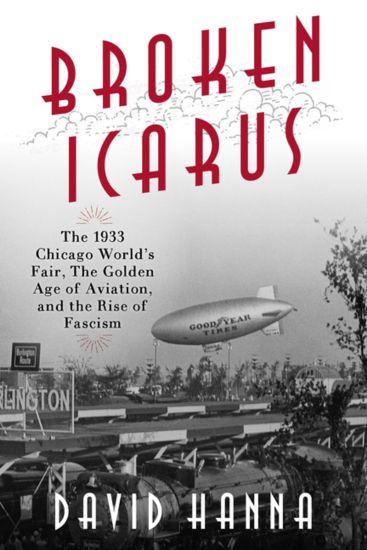
The 1930s still conjure painful images: the great want of the Depression, and overseas, the exuberant crowds motivated by self-appointed national saviors dressing up old hatreds as new ideas. But there was another story that embodied mankind in that decade. In the same year that both Adolf Hitler and Franklin D. Roosevelt came to power, the city of Chicago staged what was, up to that time, the most forward-looking international exhibition in history. The 1933-34 World’s Fair looked to the future, unabashedly, as one full of glowing promise.No technology loomed larger at the Fair than aviation. And no persons at the Fair captured the public’s interest as much as the romantic figures associated with it: Italy’s internationally renowned chief of aeronautics, Italo Balbo; German Zeppelin designer and captain, Doctor Hugo Eckener; and the husband and wife aeronaut team of Swiss-born Jean Piccard and Chicago-born Jeanette Ridlon Piccard.This golden age of aviation and its high priests and priestesses portended to many the world over that a new age was dawning, an age when man would not only leave the ground behind, but also his uglier, less admirable heritage of war, poverty, corruption, and disease. It was only later in the decade that the dark correlation between the rise of aviation’s superstars and the rise of fascism was to be revealed. But for a moment in 1933, this all lay in a future that still seemed so promising. In Broken Icarus, author David Hanna tracks the inspiring trajectory of aviation leading up to and through the World’s Fair of 1933, as well as the field of flight’s more sinister ties to fascism domestic and abroad to present a unique history that is both riveting and revelatory.