"Prove It With Figures" displays some of the tools of the social and statistical sciences that have been applied to the proof of facts in the courtroom and to the study of questions of legal importance. It explains how researchers can extract the most valuable and reliable data that can conveniently be made available, and how these efforts sometimes go awry. In the tradition of Zeisel's "Say It with Figures," a standard in the field of social statistics since 1947, it clarifies, in non-technical language, some of the basic problems common to all efforts to discern cause-and-effect relationships. Designed as a textbook for law students who seek an appreciation of the power and limits of empirical methods, the work also is a useful reference for lawyers, policymakers, and members of the public who would like to improve their critical understanding of the statistics presented to them. The many case histories include analyses of the death penalty, jury selection, employment discrimination, mass torts, and DNA profiling. Hans Zeisel was Professor of Law and Sociology Emeritus at the University of Chicago, where he pioneered the application of social science to the law. Earlier, he had a distinguished career in public opinion and market research. He has written on a wide variety of topics, ranging from research methodology and history to law enforcement, juries, and Sheakespeare. He was elected Fellow of the American Statistical Assoication and the American Association for the Advancement of Science, and in 1980 he was inducted into the Market Research Hall of Fame. David Kaye is Regents Professor at the Arizona State University, where he teaches evidence and related topics. An author of several law textbooks and treatises, his work also has appeared in journals of


Marienthal-studiens grunnspørsmål var: Blir arbeidere apatiske eller revolusjonære under arbeidsledigheten? Denne undersøkelsen er kjent for en fantasifull kombinasjon av metoder, bl.a bruk av dagbøker og deltagende observasjon.
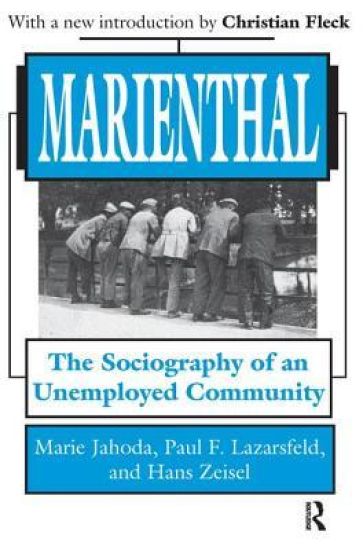
"One of the main theses of the Marienthal study was that prolonged unemployment leads to a state of apathy in which the victims do not utilize any longer even the few opportunities left to them. The vicious cycle between reduced opportunities and reduced level of aspiration has remained the focus of all subsequent discussions." So begin the opening remarks to the English-language edition of what has become a major classic in the literature of social stratification.
När textilfabriken i den lilla orten Marienthal i Österrike slog igen i spåren av den stora depressionen blev följderna förödande: ett helt samhälle kastades ut i arbetslöshet. Hur skulle befolkningen reagera? Skulle de resa sig i protest som många av samtidens radikala intellektuella trodde och hoppades? Nej, blev det korta svaret från det unga forskarlag som 1933 med sin studie De arbetslösa i Marienthal (Die Arbeitslosen von Marienthal) kunde konstatera att bottenlöst elände inte i sig skapar sociala omvälvningar. Arbetslösheten ledde till resignation och apati snarare än vilja att förändra samhällets ekonomiska och sociala ordning. Arbetes dolda betydelse för det sociala och mänskliga livet blev tydlig när det försvann. Marienthalstudien har kommit att bli ett av samhällsvetenskapens mest legendariska arbeten. Den var nyskapande i sitt sätt att kombinera kvalitativa och kvantitativa data och åttio år senare finns det fortfarande mycket att lära av forskarnas oförvägna sätt att använda sig av allt från biografiska intervjuer till hushållsbudgetar, föreningsdeltagande och kostnaden för att förverkliga barns julklappslistor. Boken kan än idag med fördel användas som introduktion till konsten att göra samhällsvetenskapliga undersökningar. Den österrikiske sociologen Christian Fleck ger i sin inledning en introduktion till boken och författarna och svenske sociologen Paavo Bergman framhäver i sitt efterord Marienthalstudiens metodologiska och analytiska förtjänster och visar på dess centrala plats i studiet av arbetslöshet.
CassieHow to make the handsome, brooding man across the street notice me. Step one: Deliver baked goods to his front porch, even though he never answers his door and always returns the containers when I'm not home. Step two: Slowly lose my mind as a whole year passes without ever running into him, no matter how hard I try. Step three: Have my boudoir photos accidentally delivered to his mailbox instead of mine. Have him open the package. Then have him storm into my home for the most panty-melting scolding of my life. Step four: Still figuring out step four. HansI'm a dangerous man. A man who has spent the last two decades removing so many souls from this earth that it's a miracle my hands aren't permanently stained red. I'm a man who belongs in the shadows. I certainly don't belong in my pretty little neighbor's bedroom when she's not home, touching her things and inhaling her scent. I shouldn't follow her. Shouldn't watch her. Because no number of cookies on my doorstep will change the fact that love isn't an option for me.
The first English language biographer to have returned to the original Danish sources, Wullshlager creates a fascinating picture of Andersen as a deeply troubled man, as far from Danny Kaye's all-singing version as it is possible to imagine. Desperately sensitive, sexually confused and socially awkward, Andersen found grace and acceptance through the creation of a distinct and beguiling literary world, becoming, as was once said of Tolkien, 'the creative equivalent of a people'. Wullschlager's achievement is to demonstrate the unity of his troubled life and and the soaring achievement of his work. He appears in this biography more various and more flawed, but also more convincing and more impressive, than ever before.