Kirjojen hintavertailu. Mukana 11 213 693 kirjaa ja 12 kauppaa.

Kirjahaku

Etsi kirjoja tekijän nimen, kirjan nimen tai ISBN:n perusteella.

1000 tulosta hakusanalla Harold Holzer

Lincoln

Lincoln

Harold Holzer

HARPERCOLLINS PUBLISHERS INC
2013
nidottu
How did President Abraham Lincoln come to believe that slavery was "morally wrong," and that Congress needed to pass a law to abolish it once and for all What did he do in January 1865—three months before he was assassinated—to ensure passage of the Thirteenth AmendmentThis fast-paced, riveting book answers these questions and more as it tells the story of Lincoln's life and times from his upbringing in Kentucky and Illinois, through his work as a lawyer and congressman, to his candidacies and victory in two Presidential elections. It also describes Lincoln's duties in the Civil War as Commander-in-Chief, his actions as President, and his relationships with his family, his political allies and rivals, and the public who voted for and against him. Harold Holzer makes an important era in American history come alive for readers of all ages.An official companion to Steven Spielberg's Oscar® award-winning film Lincoln, the book also includes thirty historical photographs, a chronology, a cast of characters, texts of selected Lincoln writings and speeches, a bibliography, and a foreword by the author about his experience working as a consultant on the movie.
Brought Forth on This Continent: Abraham Lincoln and American Immigration
**Winner of the Barondess/Lincoln Award****Winner of the Lincoln Group of New York's Award of Achievement** From acclaimed Abraham Lincoln historian Harold Holzer, a groundbreaking account of Lincoln's grappling with the politics of immigration against the backdrop of the Civil War. In the three decades before the Civil War, some ten million foreign-born people settled in the United States, forever altering the nation's demographics, culture, and--perhaps most significantly--voting patterns. America's newest residents fueled the national economy, but they also wrought enormous changes in the political landscape and exposed an ugly, at times violent, vein of nativist bigotry. Abraham Lincoln's rise ran parallel to this turmoil; even Lincoln himself did not always rise above it. Tensions over immigration would split and ultimately destroy Lincoln's Whig Party years before the Civil War. Yet the war made clear just how important immigrants were, and how interwoven they had become in American society. Harold Holzer, winner of the Lincoln Prize, charts Lincoln's political career through the lens of immigration, from his role as a member of an increasingly nativist political party to his evolution into an immigration champion, a progression that would come at the same time as he refined his views on abolition and Black citizenship. As Holzer writes, "The Civil War could not have been won without Lincoln's leadership; but it could not have been fought without the immigrant soldiers who served and, by the tens of thousands, died that the 'nation might live.'" An utterly captivating and illuminating work, Brought Forth on This Continent assesses Lincoln's life and legacy in a wholly original way, unveiling remarkable similarities between the nineteenth century and the twenty-first.
Emancipating Lincoln

Emancipating Lincoln

Harold Holzer

Harvard University Press
2012
sidottu
Emancipating Lincoln seeks a new approach to the Emancipation Proclamation, a foundational text of American liberty that in recent years has been subject to woeful misinterpretation. These seventeen hundred words are Lincoln’s most important piece of writing, responsible both for his being hailed as the Great Emancipator and for his being pilloried by those who consider his once-radical effort at emancipation insufficient and half-hearted.Harold Holzer, an award-winning Lincoln scholar, invites us to examine the impact of Lincoln’s momentous announcement at the moment of its creation, and then as its meaning has changed over time. Using neglected original sources, Holzer uncovers Lincoln’s very modern manipulation of the media—from his promulgation of disinformation to the ways he variously withheld, leaked, and promoted the Proclamation—in order to make his society-altering announcement palatable to America. Examining his agonizing revisions, we learn why a peerless prose writer executed what he regarded as his “greatest act” in leaden language. Turning from word to image, we see the complex responses in American sculpture, painting, and illustration across the past century and a half, as artists sought to criticize, lionize, and profit from Lincoln’s endeavor.Holzer shows the faults in applying our own standards to Lincoln’s efforts, but also demonstrates how Lincoln’s obfuscations made it nearly impossible to discern his true motives. As we approach the 150th anniversary of the Proclamation, this concise volume is a vivid depiction of the painfully slow march of all Americans—white and black, leaders and constituents—toward freedom.
Lincoln Seen and Heard

Lincoln Seen and Heard

Harold Holzer

University Press of Kansas
2000
sidottu
Abraham Lincoln remained a controversial figure up to the time of his assassination. In this book, the author probes the development of Lincoln's image and reputation in his own time. He considers a wide range of images to reveal what they say about the American President.
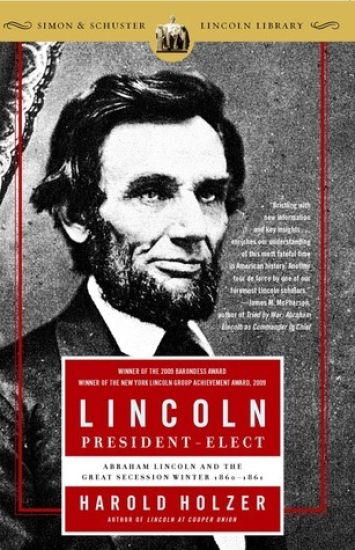
Lincoln President-Elect: Abraham Lincoln and the Great Secession Winter 1860-1861
One of our most eminent Lincoln scholars, winner of a Lincoln Prize for his Lincoln at Cooper Union, examines the four months between Lincoln's election and inauguration, when the president-elect made the most important decision of his coming presidency--there would be no compromise on slavery or secession of the slaveholding states, even at the cost of civil war. Abraham Lincoln first demonstrated his determination and leadership in the Great Secession Winter--the four months between his election in November 1860 and his inauguration in March 1861--when he rejected compromises urged on him by Republicans and Democrats, Northerners and Southerners, that might have preserved the Union a little longer but would have enshrined slavery for generations. Though Lincoln has been criticized by many historians for failing to appreciate the severity of the secession crisis that greeted his victory, Harold Holzer shows that the presidentelect waged a shrewd and complex campaign to prevent the expansion of slavery while vainly trying to limit secession to a few Deep South states. During this most dangerous White House transition in American history, the country had two presidents: one powerless (the president-elect, possessing no constitutional authority), the other paralyzed (the incumbent who refused to act). Through limited, brilliantly timed and crafted public statements, determined private letters, tough political pressure, and personal persuasion, Lincoln guaranteed the integrity of the American political process of majority rule, sounded the death knell of slavery, and transformed not only his own image but that of the presidency, even while making inevitable the war that would be necessary to make these achievements permanent. Lincoln President-Elect is the first book to concentrate on Lincoln's public stance and private agony during these months and on the momentous consequences when he first demonstrated his determination and leadership. Holzer recasts Lincoln from an isolated prairie politician yet to establish his greatness, to a skillful shaper of men and opinion and an immovable friend of freedom at a decisive moment when allegiance to the founding credo "all men are created equal" might well have been sacrificed.
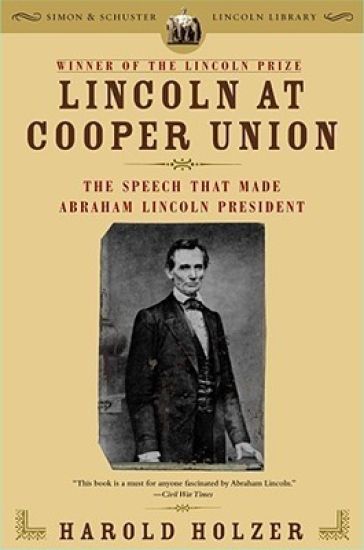
Lincoln at Cooper Union: The Speech That Made Abraham Lincoln President
Winner of the Lincoln Prize Lincoln at Cooper Union explores Lincoln's most influential and widely reported pre-presidential address -- an extraordinary appeal by the western politician to the eastern elite that propelled him toward the Republican nomination for president. Delivered in New York in February 1860, the Cooper Union speech dispelled doubts about Lincoln's suitability for the presidency and reassured conservatives of his moderation while reaffirming his opposition to slavery to Republican progressives. Award-winning Lincoln scholar Harold Holzer places Lincoln and his speech in the context of the times -- an era of racism, politicized journalism, and public oratory as entertainment -- and shows how the candidate framed the speech as an opportunity to continue his famous "debates" with his archrival Democrat Stephen A. Douglas on the question of slavery. Holzer describes the enormous risk Lincoln took by appearing in New York, where he exposed himself to the country's most critical audience and took on Republican Senator William Henry Seward of New York, the front runner, in his own backyard. Then he recounts a brilliant and innovative public relations campaign, as Lincoln took the speech "on the road" in his successful quest for the presidency.
The Union Preserved

The Union Preserved

Harold Holzer

Fordham University Press
1999
sidottu
The Union Preserved: A Guide to the Civil War Records in the New York State Archives is a comprehensive reference work that, for the first time, makes available to a wide public one of the most important and extensive Civil War resources in the nation: the collections of the New York State Archives and Records Administration. The guide also seeks to make readers aware of the vast collections of wartime manuscripts, newspapers, maps, rare books, ephemera, and artifacts held by the New York State Museum, The New York State Library, and The New York State Division of Military and Naval Affairs. Collectively, the holdings of these four institutions constitute one of the largest and most significant collections of Civil War materials available to the public. Unlike similar guides that have been published by other archival institutions, The Union Preserved contains eleven appendices that are intended to facilitate and further the research of those interested in New York's role in the Civil War. Much of the information contained in these appendices either has been long out of print or has never been published and should prove to be an invaluable source to researchers.
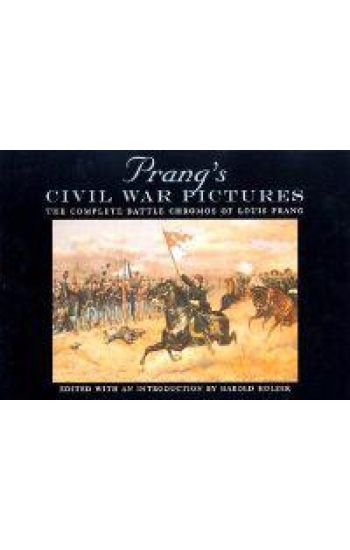
Prang's Civil War Pictures

Prang's Civil War Pictures

Harold Holzer

Fordham University Press
2001
sidottu
During the 1880s, a German-born, Boston-based picture publisher successfully commissioned the most ambitious series of battle prints ever published. Louis Prang, best known as the "father of the Christmas card," hired noted military and marine artists to create original scenes of combat, and then reproduced their works in a wildly popular portfolio of chromolithographs. He called the set Prang's War Pictures. They were offered to an eager public accompanied by "descriptive texts" that told the story of each engagement through eyewitness recollection by the heroes of each action. The set proved both appealing and influential, selling vigorously in various editions for a generation, and elevating the stature of military illustration in America. For 20 years, Civil War prints for the masses had featured uninspired, one-dimensional views of armies in hand-to-hand combat.Prang and his artists demonstrated genuine skill and imaginative perspective. They showed both real carnage and important technological advances, revealing both the broad sweep of panoramic battlefields and the intimate action of individual combatants. These famously sepia-toned chromos went on to become familiar illustrations in books and magazines-often offered as definitive examples of Civil War art. But until now, the complete set of 18 chromos has never been collected in a single volume. And the original "Descriptive Texts" first offered Prang's customers as marketing brochures to boost sales-a priceless historical archive in and of themselves-have never been published since, anywhere.Holzer reunites pictures and texts in an authoritative, milestone volume orchestrating prints and descriptions that resurrect Prang's original conception of battle art for the masses for a new generation. The book also features reproductions of the original works of art that inspired the prints, created on commission by battle painter Thure de Thulstrup and naval specialist Julian Oliver Davidson-now housed in art collections around the country-but seldom seen since they were commissioned by Prang as models for his ambitious chromolithographs. This long-needed complete Prang portfolio will undoubtedly become an essential collectible for Civil War aficionados in the country, as well as for libraries and university collections increasingly aware of the importance of art and iconography in defining the Civil War experience and the impact of Civil War memory.
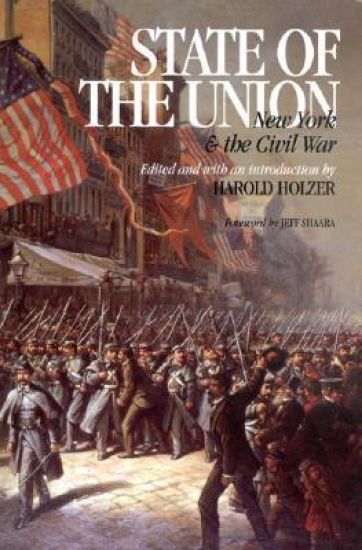
State of the Union

State of the Union

Harold Holzer

Fordham University Press
2002
sidottu
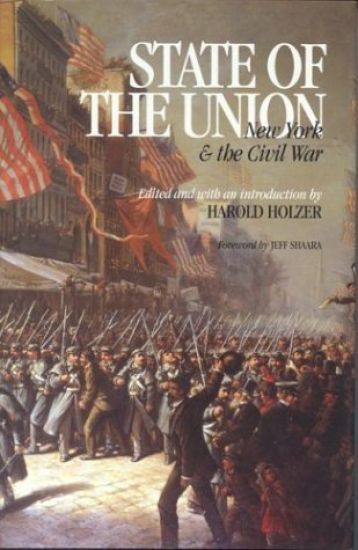
Three years ago, in celebration of the publication of The Union Preserved: A Guide to the Civil War Records in the New York State Archives, the New York State Archives Partnership Trust, a program of the New York State Education Department, held a two-day symposium featuring research by leading scholars on New York's role in the Civil War. The symposium brought together a broad spectrum of attendees from the Lincoln Forum, Civil War re-enactors, Civil War Roundtable members, students, local historians, educators, and history enthusiasts. As the most populous state at the time of the Civil War, New York was central to winning the war. The state not only provided the most men and materiel, but was also the North's economic center as well as an important center of political and social activism. Inhabited by increasing numbers of immigrant groups, abolitionists, and an emerging free black community, New York's social and political environment was a microcosm of the larger social and political conflict being played out in the war. The symposium addressed these tensions by examining the role of women, blacks, Native Americans, and European immigrant groups in New York, particularly the various perspectives held by members of each group regarding the war effort. The symposium examined the difficulties Abraham Lincoln faced in keeping New York favorable to his policies. It revealed the tremendous sacrifice New York made in the military campaign, as well as the treatment of Confederate soldiers at New York's Elmira Prison Camp. The State of the Union is a compilation of the papers presented at the symposium. The essays included in the volume: Housekeeping on Its Own Terms: Abraham Lincoln in New York, by Harold Holzer The Volcano Under the City: The Significance of Draft Rioting in New York City and State, July 1863, by Iver Bernstein What's Gender Got to Do With It? New York in the Age of the Civil War, by Lillian Serece Williams In the Shadow of American Indian Removal: The Iroquois in the Civil War, by Laurance M. Hauptman Above the Law: Abitrary Arrest, Habeas Corpus, and the Freedom of the Press in New York, by Joseph M. Bellacosa and Frank J. Williams New York's "Andersonville:" The Elmira Military Prison, by Lonnie R. Speer The Continuing Conflict: New York and the Impeachment of Andrew Johnson, by Hans Trefousse
State of the Union

State of the Union

Harold Holzer

Fordham University Press
2002
pokkari
Three years ago, in celebration of the publication of The Union Preserved: A Guide to the Civil War Records in the New York State Archives, the New York State Archives Partnership Trust, a program of the New York State Education Department, held a two-day symposium featuring research by leading scholars on New York's role in the Civil War. The symposium brought together a broad spectrum of attendees from the Lincoln Forum, Civil War re-enactors, Civil War Roundtable members, students, local historians, educators, and history enthusiasts. As the most populous state at the time of the Civil War, New York was central to winning the war. The state not only provided the most men and materiel, but was also the North's economic center as well as an important center of political and social activism. Inhabited by increasing numbers of immigrant groups, abolitionists, and an emerging free black community, New York's social and political environment was a microcosm of the larger social and political conflict being played out in the war. The symposium addressed these tensions by examining the role of women, blacks, Native Americans, and European immigrant groups in New York, particularly the various perspectives held by members of each group regarding the war effort. The symposium examined the difficulties Abraham Lincoln faced in keeping New York favorable to his policies. It revealed the tremendous sacrifice New York made in the military campaign, as well as the treatment of Confederate soldiers at New York's Elmira Prison Camp. The State of the Union is a compilation of the papers presented at the symposium. The essays included in the volume: Housekeeping on Its Own Terms: Abraham Lincoln in New York, by Harold Holzer The Volcano Under the City: The Significance of Draft Rioting in New York City and State, July 1863, by Iver Bernstein What's Gender Got to Do With It? New York in the Age of the Civil War, by Lillian Serece Williams In the Shadow of American Indian Removal: The Iroquois in the Civil War, by Laurance M. Hauptman Above the Law: Abitrary Arrest, Habeas Corpus, and the Freedom of the Press in New York, by Joseph M. Bellacosa and Frank J. Williams New York's "Andersonville:" The Elmira Military Prison, by Lonnie R. Speer The Continuing Conflict: New York and the Impeachment of Andrew Johnson, by Hans Trefousse
New York's Golden Age of Bridges

New York's Golden Age of Bridges

Harold Holzer

Fordham University Press
2011
sidottu
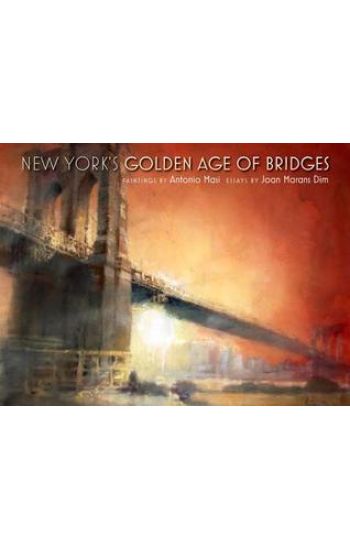
In New York's Golden Age of Bridges, artist Antonio Masi teams up with writer and New York City historian Joan Marans Dim to offer a multidimensional exploration of New York City's nine major bridges, their artistic and cultural underpinnings, and their impact worldwide. The tale of New York City's bridges begins in 1883, when the Brooklyn Bridge rose majestically over the East River, signaling the start of America's "Golden Age" of bridge building. The Williamsburg followed in 1903, the Queensboro (renamed the Ed Koch Queensboro Bridge) and the Manhattan in 1909, the George Washington in 1931, the Triborough (renamed the Robert F. Kennedy Bridge) in 1936, the Bronx-Whitestone in 1939, the Throgs Neck in 1961, and the Verrazano-Narrows in 1964. Each of these classic bridges has its own story, and the book's paintings show the majesty and artistry, while the essays fill in the fascinating details of its social, cultural, economic, political, and environmental history. America's great bridges, built almost entirely by immigrant engineers, architects, and laborers, have come to symbolize not only labor and ingenuity but also bravery and sacrifice. The building of each bridge took a human toll. The Brooklyn Bridge's designer and chief engineer, John A. Roebling, himself died in the service of bridge building. But beyond those stories is another narrative—one that encompasses the dreams and ambitions of a city, and eventually a nation. At this moment in Asia and Europe many modern, largescale, long-span suspension bridges are being built. They are the progeny of New York City's Golden Age bridges. This book comes along at the perfect moment to place these great public projects into their historical and artistic contexts and to inform and delight artists, engineers, historians, architects, and city planners. In addition to the historical and artistic perspectives, New York's Golden Age of Bridges explores the inestimable connections that bridges foster, and reveals the extraordinary impact of the nine Golden Age bridges on the city, the nation, and the world.
Lincoln and the Power of the Press: The War for Public Opinion
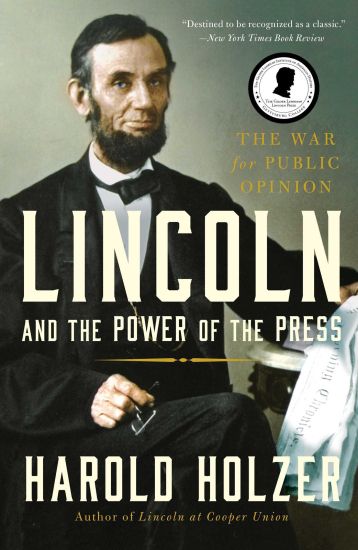
"Lincoln believed that 'with public sentiment nothing can fail; without it, nothing can succeed.' Harold Holzer makes a significant contribution to our understanding of Lincoln's leadership by showing us how deftly he managed his relations with the press of his day to move public opinion forward to preserve the Union and abolish slavery." --Doris Kearns Goodwin From his earliest days, Lincoln devoured newspapers. As he started out in politics he wrote editorials and letters to argue his case. He spoke to the public directly through the press. He even bought a German-language newspaper to appeal to that growing electorate in his state. Lincoln alternately pampered, battled, and manipulated the three most powerful publishers of the day: Horace Greeley of the New York Tribune, James Gordon Bennett of the New York Herald, and Henry Raymond of the New York Times. When war broke out and the nation was tearing itself apart, Lincoln authorized the most widespread censorship in the nation's history, closing down papers that were "disloyal" and even jailing or exiling editors who opposed enlistment or sympathized with secession. The telegraph, the new invention that made instant reporting possible, was moved to the office of Secretary of War Stanton to deny it to unfriendly newsmen. Holzer shows us an activist Lincoln through journalists who covered him from his start through to the night of his assassination--when one reporter ran to the box where Lincoln was shot and emerged to write the story covered with blood. In a wholly original way, Holzer shows us politicized newspaper editors battling for power, and a masterly president using the press to speak directly to the people and shape the nation.
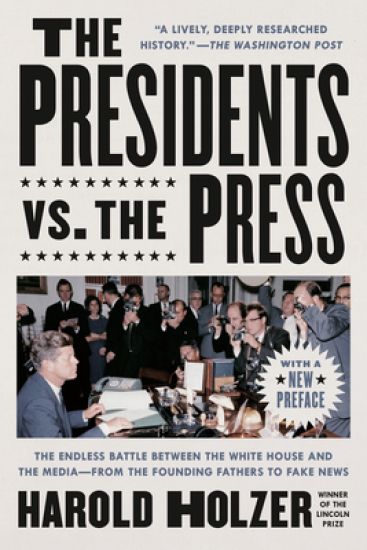
The Presidents vs. the Press: The Endless Battle Between the White House and the Media--From the Founding Fathers to Fake News
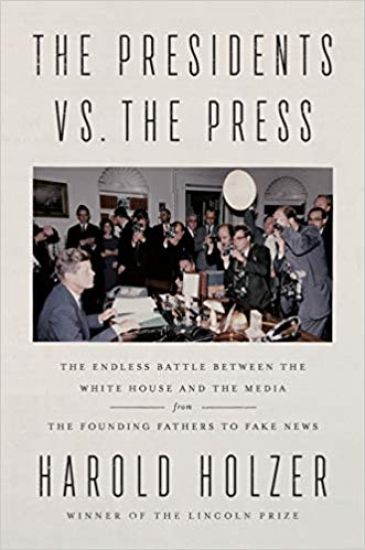
An award-winning presidential historian offers an authoritative account of American presidents' attacks on our freedom of the press. "The FAKE NEWS media," Donald Trump has tweeted, "is not my enemy, it is the enemy of the American People " Has our free press ever faced as great a threat? Perhaps not--but the tension between presidents and journalists is as old as the republic itself. Every president has been convinced of his own honesty and transparency; every reporter who has covered the White House beat has believed with equal fervency that his or her journalistic rigor protects the country from danger. Our first president, George Washington, was also the first to grouse about his treatment in the newspapers, although he kept his complaints private. Subsequent chiefs like John Adams, Abraham Lincoln, Woodrow Wilson, and Barack Obama were not so reticent, going so far as to wield executive power to overturn press freedoms, and even to prosecute journalists. Theodore Roosevelt was the first president to actively manage the stable of reporters who followed him, doling out information, steering coverage, and squashing stories that interfered with his agenda. It was a strategy that galvanized TR's public support, but the lesson was lost on Woodrow Wilson, who never accepted reporters into his inner circle. Franklin Roosevelt transformed media relations forever, holding more than a thousand presidential press conferences and harnessing the new power of radio, at times bypassing the press altogether. John F. Kennedy excelled on television and charmed reporters to hide his personal life, while Richard Nixon was the first to cast the press as a public enemy. From the days of newsprint and pamphlets to the rise of Facebook and Twitter, each president has harnessed the media, whether intentional or not, to imprint his own character on the office. In this remarkable new history, acclaimed scholar Harold Holzer examines the dual rise of the American presidency and the media that shaped it. From Washington to Trump, he chronicles the disputes and distrust between these core institutions that define the United States of America, revealing that the essence of their confrontation is built into the fabric of the nation.
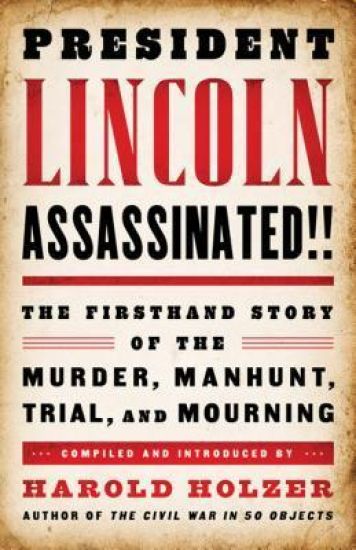
President Lincoln Assassinated!!

President Lincoln Assassinated!!

Harold Holzer

The Library of America
2015
sidottu
For the 150th anniversary, Harold Holzer (The Civil War in 150 Objects) presents an unprecedented firsthand chronicle of one of the most pivotal moments in American history. On April 14, 1865, Good Friday, the Civil War claimed its ultimate sacrifice. President Lincoln Assassinated!! recaptures the dramatic immediacy of Lincoln s assassination, the hunt for the conspirators and their military trial, and the nation s mourning for the martyred president. The fateful story is told in more than eighty original documents eyewitness reports, medical records, trial transcripts, newspaper articles, speeches, letters, diary entries, and poems by more than seventy-five participants and observers, including the assassin John Wilkes Booth and Boston Corbett, the soldier who shot him. Courtroom testimony exposes the intricacies of the plot to kill the president; eulogies by Ralph Waldo Emerson, Wendell Phillips, and Benjamin Disraeli and poetry by Walt Whitman, Herman Melville and Julia Ward Howe give eloquent voice to grief; two emotional speeches by Frederick Douglass one of them never before published reveal his evolving perspective on Lincoln s legacy. Together these voices combine to reveal the full panorama of one the most shocking and tragic events in our history."
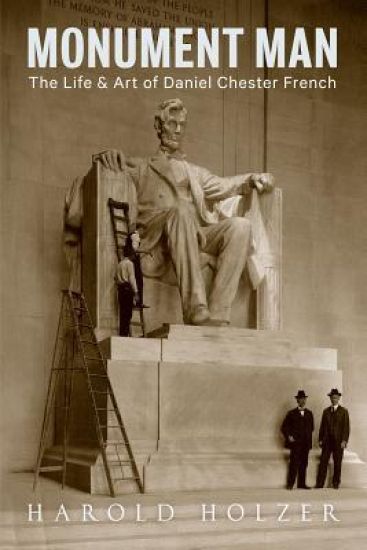
Monument Man

Monument Man

Harold Holzer

Princeton Architectural Press
2019
sidottu
The artist who created the statue for the Lincoln Memorial, John Harvard in Harvard Yard, and The Minute Man in Concord, Massachusetts, Daniel Chester French (1850–1931) is America's best-known sculptor of public monuments. Monument Man is the first comprehensive biography of this fascinating figure and his illustrious career. Full of rich detail and beautiful archival photographs, Monument Man is a nuanced study of a preeminent artist whose evolution ran parallel to, and deeply influenced, the development of American sculpture, iconography, and historical memory. Monument Man was specially commissioned by Chesterwood / National Trust for Historic Preservation. The release will coincide with the fiftieth anniversary of the opening of Chesterwood, his country home and studio, as a public site and with a major renovation of the Lincoln Memorial. The book includes a comprehensive geographical guide to French's public work.
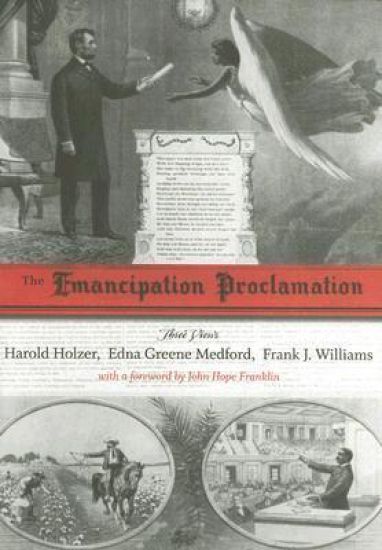
The Emancipation Proclamation

The Emancipation Proclamation

Harold Holzer; Edna G. Medford; Frank J. Williams; John Hope Franklin

Louisiana State University Press
2006
sidottu
The Emancipation Proclamation is the most important document of arguably the greatest president in U.S. history. Now, Edna Greene Medford, Frank J. Williams, and Harold Holzer -- eminent experts in their fields -- remember, analyse, and interpret the Emancipation Proclamation in three distinct respects: the influence of and impact upon African Americans; the legal, political, and military exigencies; and the role pictorial images played in establishing the document in public memory. The result is a carefully balanced yet provocative study that views the proclamation and its author from the perspective of fellow Republicans, antiwar Democrats, the press, the military, the enslaved, free blacks, and the antislavery white establishment, as well as the artists, publishers, sculptors, and their patrons who sought to enshrine Abraham Lincoln and his decree of freedom in iconography. Medford places African Americans, the people most affected by Lincoln's edict, at the center of the drama rather than at the periphery, as previous studies have done. She argues that blacks interpreted the proclamation much more broadly than Lincoln intended it, and during the postwar years and into the twentieth century they became disillusioned by the broken promise of equality and the realities of discrimination, violence, and economic dependence. Williams points out the obstacles Lincoln overcame in finding a way to confiscate property -- enslaved humans -- without violating the Constitution. He suggests that the president solidified his reputation as a legal and political genius by issuing the proclamation as Commander-in-Chief, thus taking the property under the pretext of military necessity. Holzer explores how it was only after Lincoln's assassination that the Emancipation Proclamation became an acceptable subject for pictorial celebration. Even then, it was the image of the martyr-president as the great emancipator that resonated in public memory, while any reference to those African Americans most affected by the proclamation was stripped away. This multilayered treatment reveals that the proclamation remains a singularly brave and bold act -- brilliantly calculated to maintain the viability of the Union during wartime, deeply dependent on the enlightened voices of Lincoln's contemporaries, and owing a major debt in history to the image-makers who quickly and indelibly preserved it.
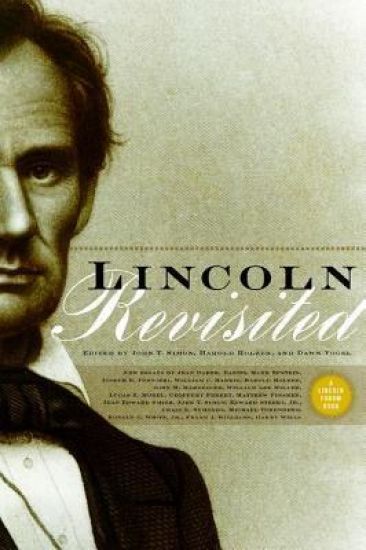
Lincoln Revisited

Lincoln Revisited

Harold Holzer; Dawn Vogel

Fordham University Press
2007
sidottu
In February 2009, America celebrates the bicentennial of the birth of Abraham Lincoln, and the pace of new Lincoln books and articles has already quickened. From his cabinet's politics to his own struggles with depression, Lincoln remains the most written-about story in our history. And each year historians find something new and important to say about the greatest of our Presidents. Lincoln Revisited is a masterly guidePub to what's new and what's noteworthy in this unfolding story—a brilliant gathering of fresh scholarship by the leading Lincoln historians of our time. Brought together by The Lincoln Forum, they tackle uncharted territory and emerging questions; they also take a new look at established debates—including those about their own landmark works. Here, these well-known historians revisit key chapters in Lincoln's legacy—from Matthew Pinsker on Lincoln's private life and Jean Baker on religion and the Lincoln marriage to Geoffrey Perret on Lincoln as leader and Frank J. Williams on Lincoln and civil liberties in wartime. The eighteen original essays explore every corner of Lincoln's world—religion and politics, slavery and sovereignty, presidential leadership and the rule of law, the Second Inaugural Address and the assassination. In his 1947 classic, Lincoln Reconsidered, David Herbert Donald confronted the Lincoln myth. Today, the scholars in Lincoln Revisited give a new generation of students, scholars, and citizens the perspectives vital for understanding the constantly reinterpreted genius of Abraham Lincoln.
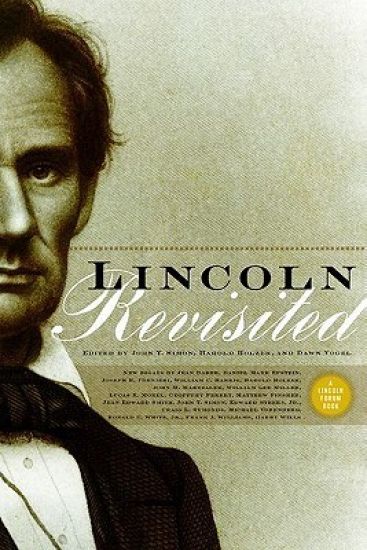
Lincoln Revisited

Lincoln Revisited

Harold Holzer; Dawn Vogel

Fordham University Press
2011
pokkari
In February 2009, America celebrates the bicentennial of the birth of Abraham Lincoln, and the pace of new Lincoln books and articles has already quickened. From his cabinet's politics to his own struggles with depression, Lincoln remains the most written-about story in our history. And each year historians find something new and important to say about the greatest of our Presidents. Lincoln Revisited is a masterly guidePub to what's new and what's noteworthy in this unfolding story—a brilliant gathering of fresh scholarship by the leading Lincoln historians of our time. Brought together by The Lincoln Forum, they tackle uncharted territory and emerging questions; they also take a new look at established debates—including those about their own landmark works. Here, these well-known historians revisit key chapters in Lincoln's legacy—from Matthew Pinsker on Lincoln's private life and Jean Baker on religion and the Lincoln marriage to Geoffrey Perret on Lincoln as leader and Frank J. Williams on Lincoln and civil liberties in wartime. The eighteen original essays explore every corner of Lincoln's world—religion and politics, slavery and sovereignty, presidential leadership and the rule of law, the Second Inaugural Address and the assassination. In his 1947 classic, Lincoln Reconsidered, David Herbert Donald confronted the Lincoln myth. Today, the scholars in Lincoln Revisited give a new generation of students, scholars, and citizens the perspectives vital for understanding the constantly reinterpreted genius of Abraham Lincoln.