Kirjojen hintavertailu. Mukana 12 390 323 kirjaa ja 12 kauppaa.

Kirjahaku

Etsi kirjoja tekijän nimen, kirjan nimen tai ISBN:n perusteella.

1000 tulosta hakusanalla Harry E Cook; James J Corboy

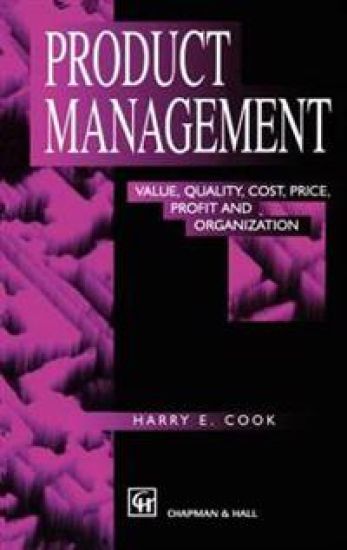
Product Management

Product Management

Harry E. Cook

Chapman and Hall
1997
sidottu
This book develops a quantitative structured methodology for managing the development of new products for highly competitive markets. Particular attention has been given to integrating a number of experimental tools and concepts within a common framework including marketing research. Taguchi methods, value benchmarking, value engineering, total quality management, activity based costing, concurrent engineering, statistical quality control, systems engineering, and organization treated today as related but separate tools and concepts. The reader should gain an understanding of how these tools complement each other and when they can be used most effectively to aid product decision making.
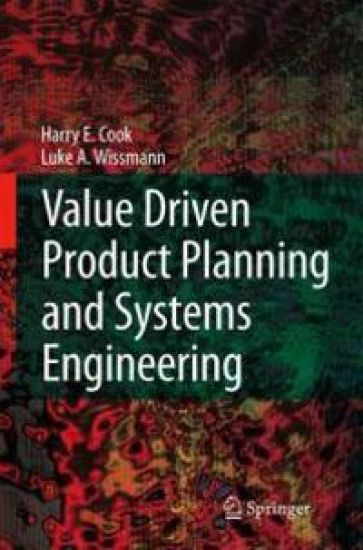
Value Driven Product Planning and Systems Engineering

Value Driven Product Planning and Systems Engineering

Harry E. Cook; Luke A. Wissmann

Springer London Ltd
2007
sidottu
Engineers and scientists often need to sell an innovative idea for a new product or a new product improvement to top management. Sometimes their tendency is to focus on the "WOW!" of the new technology at the expense of making a convincing business case. When the new technology represents a large cost reduction, there will be much less of a problem in convincing management to approve the project if the investment level is acceptable. The major rub comes when the new feature or technology is an improvement in customer value that also generates an increase in cost. This makes the sell difficult in spite of the fact that many of the inventive products available today are widely used because they provide very high value in relation to their added cost. Engineers and scientists also occupy product planning positions where they need to be constantly scanning ideas for improving value that come both from inside and outside the company to see if they make sense to incorporate in a future product. At the same time they need to anticipate what their major competitors are likely to do to improve their next generation of product. These problems are exacerbated in today’s global economy because the number of competitors has increased markedly in many product segments and there are many technological alternatives available for consideration. The problem of anticipating the moves of your major competitor is particularly challenging because most firms keep plans very secure. The engineer as product planner must learn to think like its major competitor using customer value as a guide. Value Driven Product Planning and Systems Engineering provides essential support for engineers and scientists who are required to make realistic business cases for new innovative product concepts.
Value Driven Product Planning and Systems Engineering

Value Driven Product Planning and Systems Engineering

Harry E. Cook; Luke A. Wissmann

Springer London Ltd
2010
nidottu
Engineers and scientists often need to sell an innovative idea for a new product or a new product improvement to top management. Sometimes their tendency is to focus on the "WOW!" of the new technology at the expense of making a convincing business case. When the new technology represents a large cost reduction, there will be much less of a problem in convincing management to approve the project if the investment level is acceptable. The major rub comes when the new feature or technology is an improvement in customer value that also generates an increase in cost. This makes the sell difficult in spite of the fact that many of the inventive products available today are widely used because they provide very high value in relation to their added cost. Engineers and scientists also occupy product planning positions where they need to be constantly scanning ideas for improving value that come both from inside and outside the company to see if they make sense to incorporate in a future product. At the same time they need to anticipate what their major competitors are likely to do to improve their next generation of product. These problems are exacerbated in today’s global economy because the number of competitors has increased markedly in many product segments and there are many technological alternatives available for consideration. The problem of anticipating the moves of your major competitor is particularly challenging because most firms keep plans very secure. The engineer as product planner must learn to think like its major competitor using customer value as a guide. Value Driven Product Planning and Systems Engineering provides essential support for engineers and scientists who are required to make realistic business cases for new innovative product concepts.
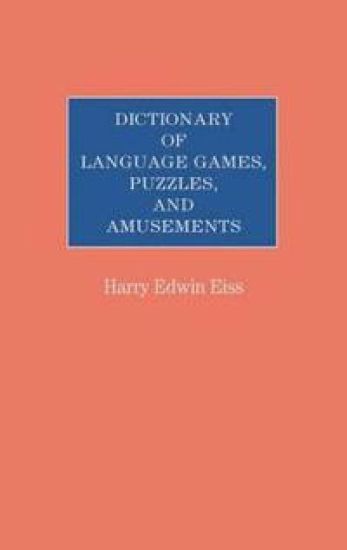
Dictionary of Language Games, Puzzles, and Amusements
Throughout recorded history, mankind has turned to language play as a source of entertainment and intellectual stimulation. This unique new reference provides comprehensive listings and explainations, together with samples and historical information, concerning the hundreds of letter and word games, puzzles, and linguistic entertainments that enrich our cultural life.In an introductory section, the author discusses the various ways of manipulating words and letters and the relation of this pastime to literature, linguistics, education and humor. He comments on the use of word-play techniques in the teaching of language arts, noting their demonstrated benefits in stimulating creativity and motivating the unwilling student. Turning to the literary uses of language play, he talks about writers--from Shakespeare, Dickens, James Joyce, and Gertrude Stein to the dadaists, Edward Lear, Ogden Nash, and various contemporary literary artists--whose linguistic devices run the gamut from riddles, acrostics, cross-word puzzles, and anagrams--are considered, along with individual and group games intended to entertain, teach skills, or challenge the imagination or intellect.
Literature for Young People on War and Peace
This annotated bibliography concentrates on books dealing with an important category of literature for youths, that of war and peace. The number of books for young people on this subject is surprisingly large, yet it is often ignored. Though such books don't form the center of children's literature, they do represent an important portion of it, revealing to children vital truths about the human condition and how nobly humans can act under extreme hardship.The book includes a number of different types of works dealing with war and peace, e.g., allegories and parables, picture books, poetry, biographies, Revolutionary and Civil War books, tales of the Holocaust and Hiroshima, and stories dealing with pacifism. Each entry includes author, title, publishing data, and age level, as well as an annotation that assesses the entry's pertinence, quality, and value. In addition to this bibliography for youths, there is an annotated bibliography of materials for adults that covers how to discuss the subject of war and peace with young people. The volume is also extensively cross-referenced and indexed, providing access to authors, illustrators, and titles, subject entries such as warriors and pacifists, and categories of material such as parables or poetry. It will be an important reference work for teachers dealing with the subject of conflict and for courses in education and the social sciences, and a worthwhile addition to college, university, and public libraries.
Warriors and Fools

Warriors and Fools

Harry E Rothmann

Rothmann Consulting, Inc.
2018
sidottu
Warriors and Fools is not just another book about the Vietnam War. It is different from most. Unlike some others, the author is a veteran of that conflict, and a retired military officer with nearly thirty years' service. He has spent much of the last three decades studying the war and taught a course on Vietnam at a prestigious senior military war college.This book is also different from others because it is a story not just of the American decisions and actions during the war. This Vietnam War story uses the latest, ground breaking research and released documentation of the war from the Communist Vietnamese side of the conflict. Consequently, the book delves deeply into the decision making, strategies, motives, and goals of the North Vietnam leaders as they waged their war for unification, first against the French and then against the Americans. The book also uses memoirs, interviews, and oral histories of former South Vietnamese leaders and combatants to discover their views on their struggle to form a new nation free from communist aggression.Warriors and Fools is both broad and deep in scope in its narration of the Vietnam War story. It takes the reader from the White House's oval office and Hanoi's Politburo room, to the Pentagon's and North Vietnam Army's command centers, to Vietnam's mountain and rice patty battlefields to show the determination, deceit, foolhardiness, mistakes, courage, and horrors of war from the views of both sides. While it examines multiple participant views, overall the book seeks to answer one specific question - why did the US fail to achieve its principal objective to defend South Vietnam from communist aggression? The story's findings and conclusions are neither orthodox nor revisionist. Those trying to gain insights on how American civilian leaders lost the war that its military could have won; or how the US Congress, Press, or Antiwar activists convinced the Public to stop its support will be disappointed. None of these traditional 'answers' on why the US lost are really valid.Rather, as this story explains the answer is much more linked to human factors, interactions, and relationships. In this case, the interrelationship between American civilian and military leaders and advisors was extraordinarily divisive and dysfunctional. So much so that it resulted in flawed, timid policies and foolish strategies that led to defeat. Moreover, that troublesome interrelationship was primarily a result of mistrusts, misunderstandings, and misperceptions on their roles, responsibilities, and what they thought would lead to a positive end to the war. In addition, primarily because they were either ignorant of the nature of war or overconfident from their past experiences, civilian and military policymakers ignored or misunderstood their enemy.Warriors and Fools should be of interest to those who served in the war, and serious students and teachers of this event and period. It is not intended as light reading, or for someone trying to get just a brief understanding of what happened there and in America at the time.