This guide describes the principles and requirements for safety, serviceability and durability of concrete bridges. It provides the user with guidance on the interpretation and use of EN 1992-2 and the relevant provisions of the general rules ofEN 1992-1-1. Worked examples are provided to illustrate the use of the rules. It also explains the relationship with the other Eurocode parts to which if refers (ENs 1990, 1991). The provision of background information and references also enables the users of Eurocode 2: Part 2 to understand the origin and objectives of its provisions.
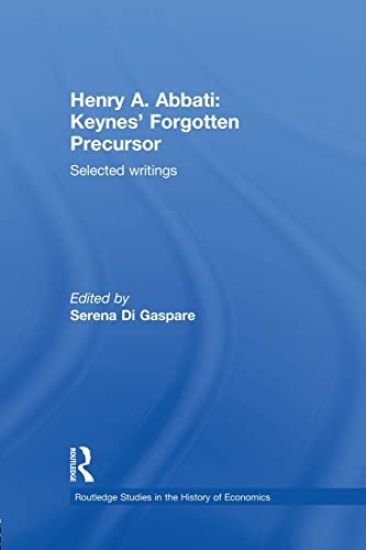
Henry A. Abbati was not an economist by profession. After retiring from business, in 1924 he published his first book, The Unclaimed Wealth: How Money Stops Production in which he expounded his theory of ‘effective demand’ (terminology of his own) and its differences with respect to current theories on economic fluctuations. He was advocating public intervention in the economy in the crisis. His second book, The Final Buyer marshalled his criticisms of current theories and further clarified salient aspects of his theory, such as ‘saving’ and its various definitions, the working of the banking system, the interest rate and the role of public works as a means of reducing unemployment. Later work in the 30s and 40s looked at full employment, reflections on the economic crisis and further analysis of the concept of unclaimed wealth.In many ways Abbati’s work in the twenties was an important precursor to Keynes’ Treatise on Money, though despite being admired by Robertson and indeed Keynes, his work is today largely unknown and entirely ignored by the numerous authors who have examined the debate of the twenties and thirties on the crises and business cycles and by academic opinion in general. In this book, Di Gaspare restores Abbati’s position as a pioneer in macroeconomic theory with a selection of his writings and a far reaching introduction to his contribution to the history of economic thought.
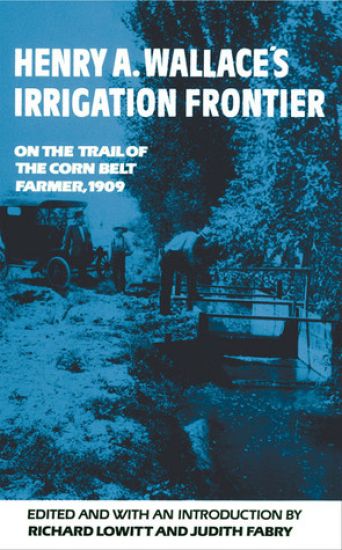
When Franklin D. Roosevelt's agriculture secretary and vice-president, Henry A. Wallace, had completed his junior year at Iowa State College in 1909, his family sent him on a western tour ""in search of the Corn Belt farmer."" Young Henry was to report to the family journal, Wallace's Farmer, how former Corn Belt farmers were prospering in the districts newly irrigated under public or private auspices, such as Arizona's Salt River, Idaho's Boise-Payette and Twin Falls, and farms on the Arkansas River near Garden City, Kansas.Wallace's articles, collected and reprinted here for the first time, are lively descriptions of up-and-coming western locales such as Amarillo, Texas; Phoenix, Arizona; the orange groves of southern California; the San Joaquin and Sacramento valleys; and the Greeley District of Colorado. Along the way, the young reporter and agriculturist critiqued dry farming in Cheyenne, Wyoming, and wrestled calves on a Matador Land Company ranch in the Texas panhandle.Henry Wallace made a specialty of down-home conversation with farmers and their wives and of cross-examining the real-estate agents who profited from the government's commitment to sell water rights to the new property owners. He wrote what today we call New History, concentrating on the impact of irrigation on individuals more than technology, law, or institutions.Modern-day readers will prize Wallace's clear, expert analysis of the different environments that he visited and his farmer-conservationist ethic. Social historians will be interested as he explains how the closer proximity of irrigated farms and greater abundance of neighbors would produce prosperous communities with schools, roads, and social institutions better than most that then prevailed in America's rural regions. They will be fascinated to learn how the cooperative aspects of irrigation farming tempered the independence of the immigrants from the Corn Belt.
Henry A. Wallace (1888-1965) remains one of the most puzzling figures of twentieth-century American politics. Serving as secretary of agriculture during the Great Depression, as vice president from 1941 to 1945, and advocating accommodation with the Soviet Union as the Progressive Party's candidate for president in 1948, Wallace had embarked on a spiritual odyssey that shaped his quest for world peace. In this interpretive biography, Graham White and John Maze explore Wallace's political career, his enigmatic personality, and the origins and development of his social, political, and religious thought, including his mystical beliefs. According to White and Maze, an eclectic spiritualism and its attendant social attitudes were central to Wallace's political goals and the course of his public life. Wallace hoped that through free trade, shared technological development, and international economic cooperation, inequity and greed would be made obsolete. Drawing extensively on Wallace's personal papers, his political diary, and his 5,000-page memoir, this study sheds new light not only on Wallace himself, but also on the Roosevelt administration in which he served.
This work has been selected by scholars as being culturally important and is part of the knowledge base of civilization as we know it.This work is in the public domain in the United States of America, and possibly other nations. Within the United States, you may freely copy and distribute this work, as no entity (individual or corporate) has a copyright on the body of the work.Scholars believe, and we concur, that this work is important enough to be preserved, reproduced, and made generally available to the public. To ensure a quality reading experience, this work has been proofread and republished using a format that seamlessly blends the original graphical elements with text in an easy-to-read typeface.We appreciate your support of the preservation process, and thank you for being an important part of keeping this knowledge alive and relevant.
This work has been selected by scholars as being culturally important and is part of the knowledge base of civilization as we know it.This work is in the public domain in the United States of America, and possibly other nations. Within the United States, you may freely copy and distribute this work, as no entity (individual or corporate) has a copyright on the body of the work.Scholars believe, and we concur, that this work is important enough to be preserved, reproduced, and made generally available to the public. To ensure a quality reading experience, this work has been proofread and republished using a format that seamlessly blends the original graphical elements with text in an easy-to-read typeface.We appreciate your support of the preservation process, and thank you for being an important part of keeping this knowledge alive and relevant.
Henry A. Abbati was not an economist by profession. After retiring from business, in 1924 he published his first book, The Unclaimed Wealth: How Money Stops Production in which he expounded his theory of ‘effective demand’ (terminology of his own) and its differences with respect to current theories on economic fluctuations. He was advocating public intervention in the economy in the crisis. His second book, The Final Buyer marshalled his criticisms of current theories and further clarified salient aspects of his theory, such as ‘saving’ and its various definitions, the working of the banking system, the interest rate and the role of public works as a means of reducing unemployment. Later work in the 30s and 40s looked at full employment, reflections on the economic crisis and further analysis of the concept of unclaimed wealth.In many ways Abbati’s work in the twenties was an important precursor to Keynes’ Treatise on Money, though despite being admired by Robertson and indeed Keynes, his work is today largely unknown and entirely ignored by the numerous authors who have examined the debate of the twenties and thirties on the crises and business cycles and by academic opinion in general. In this book, Di Gaspare restores Abbati’s position as a pioneer in macroeconomic theory with a selection of his writings and a far reaching introduction to his contribution to the history of economic thought.
Number One for Fiendish Fun! Join Horrid Henry in a special bumper book of mayhem with this brilliant collection of twelve of his best stories!Perfect for new readers and existing fans alike, this BIG story collection features a year's worth of mischief and fun. From antics at school to summer fun and Christmas chaos, there's something for everyone in this twelve-story collection. Bonus fun activity section also included!