Kirjojen hintavertailu. Mukana 11 244 527 kirjaa ja 12 kauppaa.

Kirjahaku

Etsi kirjoja tekijän nimen, kirjan nimen tai ISBN:n perusteella.

1000 tulosta hakusanalla Henry C. Lucas

Information Technology and the Productivity Paradox

Information Technology and the Productivity Paradox

Henry C. Lucas

Oxford University Press Inc
1999
sidottu
From networks to databases, email to voicemail, the amount of capital being invested in information technology each year is staggering. By 1996, U.S. firms were spending more than $500 billion annually on software, networks and staff. The recently merged Bank of America and NationsBank have an initial IT budget of 4 billion dollars. As firms like this push rapidly into the business world of the 21st century, the question has remained: how do firms measure returns from these substantial investments in information technology? Henry C. Lucas effectively answers this question by providing a creative and reliable framework for measuring the competitive advantages and profits gained through investments in state-of-the-art information systems. There is value in information technology, and it is possible to show returns, Lucas argues--unfortunately this value just doesn't always show up clearly on the bottom line of a ledger. In five expertly presented sections, he spells out exactly what businesses can expect from their information technology investments--some investments create a measurable value, some do not, but all are important nonetheless. Through a precise mix of frameworks and models, such as an Investment Opportunities Matrix, and punctuated with real examples from successful firms, this is the first book to allow executives to see exactly how their information technology investment can be expected to return value, thereby maximizing their advantages in an age of global competitiveness. Indeed, firms who manage their information systems most efficiently are best suited to succeed in a rapidly evolving marketplace. With so much at stake, Information Technology is certain to be the essential guide for firms determined to compete and flourish in the highly competitive economy of the next century.
Inside the Future

Inside the Future

Henry C. Lucas

Praeger Publishers Inc
2008
sidottu
From iPods to EZPass technology to YouTube to eGovernment initiatives, the impact of technology is changing our lives more and more each day. This book, a counterpart to a Maryland Public Television documentary, chronicles how and why and shows ways people can take advantage of the revolution in their personal and professional lives. As technology expert Henry C. Lucas, Jr., argues, the fundamentals of business and the economy—not to mention the details of daily life—are changing in every market, in every industry, and in every nation. This book explores the most significant of these technology-enabled transformations to help readers understand and appreciate the opportunities and threats presented by a new, technology-driven global economy.Among other things, Inside the Future demonstrates that: -A revolution in technology is transforming business and the way individuals live and work. -It's essential to adapt to change. Resisting technological advances is futile, and countries or people that fall behind in technology may never catch up. -The U.S. needs to prepare current and future workers for an economy that incorporates technology in every business process, an economy in which there are almost no constraints from time and place, and an economy in which most hierarchical organizations disappear. -The future competitiveness of the country depends on our ability to innovate and implement change enabled by technology. This revolution is leaving no person or organization untouched. From business to education and healthcare, the digitization and mobilization of every process affects us all. Yet this isn't a book about technology, but one that shows how people and organizations can adapt technology to transform their businesses as well as create a more productive, satisfying personal life. Readers will gain a new awareness of how leading organizations apply IT to create transformations, and how they can use technology to improve their lives, remain competitive in the workforce, and survive in this new age of constant change and re-invention.
Information Technology

Information Technology

Henry C. Lucas

John Wiley Sons Inc
2004
nidottu
Managers must be able to keep pace with the latest technological advances and make decisions on what needs to be implemented. This book gives them the tools to effectively manage technology in a 21st Century organization. The author clearly demonstrates how to best allocate resources to and within the technology function. He also includes a framework for determining IT strategy given the dynamic environment of electronic commerce and the Internet. Throughout the chapters, emphasis is placed on strategy and management issues to show the relevance of information technology.
Information Systems Implementation

Information Systems Implementation

Henry C. Lucas Jr.; Michael C. Ginzberg; Randall L. Schultz

Praeger Publishers Inc
1990
sidottu
This book presents a structural model of information system implementation and tests using data from several independent system implementation efforts. The model is based on the results of 15 years of implementation research and integrates the two primary streams of that research: factor studies and process studies. Testing the model involved three studies in diverse implementation contexts. The tests provide strong support for some aspects of the model and identify areas where the model is in need of further development and testing. The book includes a detailed review of past implementation research, a thorough explanation of the basis for the structural model's mathematical properties, descriptions of two field tests of the model including details about the research instruments employed, and a discussion of the utility of these studies for implementation research and practice.
The Search for Survival

The Search for Survival

Henry C. Lucas Jr.

Praeger Publishers Inc
2012
sidottu
Ideal for business students, business managers, and corporate senior executives, this book distills the lessons learned from the disasters that have befallen companies that were unable to cope with disruptive technologies.In recent decades, technology has changed rapidly to the point that it can very quickly affect a seemingly impregnable company or industry. Unexpected technological developments enable innovators to offer new products and services that threaten incumbents. In order to survive, existing firms must be able to see a disruption on the horizon and figure out how to respond. The Search for Survival: Lessons from Disruptive Technologies examines organizations that failed to develop a strategy for coping with a technological disruption and have suffered greatly or even gone out of business. The first chapter presents a model of how firms can respond to and hopefully survive a disruptive technology. Each following chapter focuses on firms that have failed to survive or whose future is in doubt, accompanied by an extensive, detailed discussion of the lessons learned from each company or field's failings, covering examples from industries such as recorded music, book publishing, video, newspaper, and higher education.
Beware the Winner's Curse

Beware the Winner's Curse

G. Anandalingam; Henry C. Lucas

Oxford University Press Inc
2004
sidottu
In the roaring 1990s, many companies seemed to claim great victories-acquiring another company, obtaining state-of-the art technology, or hiring a potential CEO savior-only to find that they had made a great mistake. The term "Winner's Curse" was coined by economists to explain an effect commonly observed in auctions. In such situations, since the winning bidder is usually the most optimistic about the value of the item being auctioned, there is a very good chance that the bid will be more (sometimes much more) than the item is worth. So a company that overvalues a good or service, or bids higher than its value has the potential of experiencing this Winner's Curse. In this book, G. Anandalingam and Henry C. Lucas, Jr. expand the model of the Winner's Curse to explain how companies like Tyco, MCI-WorldCom and Bank One overpaid for acquisitions, and how shareholders suffered as a result. They elucidate the disasters that happened during the rush to acquire new technologies and illuminate the reasons that companies that were seemingly pioneers in the dot-com era fell by the wayside. Beginning by exploring the psychological, personal and market factors that can encourage a decision maker to overvalue an asset and experience the Winner's Curse, the book goes on to examine several case studies, including the disastrous wireless spectrum auctions that have devastated the telecommunications industry, and the dot-com bust. It concludes by discussing ways to avoid the Winner's Curse, calling for major changes in the behavior of CEOs and members of boars of directors, as well as the use of powerful techniques for analyzing decisions, including a systems approach to decision making, scenario analysis and game theory.
Henry C. "Hank" Smith and the Cross B Ranch

Henry C. "Hank" Smith and the Cross B Ranch

Morgan Scott Sosebee

Texas A M University Press
2021
sidottu
When people think of legendary Texas cattle ranches the images that first come to mind are iconic, open-range operations like King Ranch of South Texas. In Henry C. 'Hank' Smith and the Cross B Ranch, historian M. Scott Sosebee tells the story of one pioneer settler's small but significant ranch in West Texas. The Cross B Ranch of Blanco Canyon struggled but endured to become quite successful, even while surrounded by big ranching empires. Founder Hank Smith went on to become one of the region's most prominent, civic-minded citizens.Born in Bavaria, Smith left Germany in 1851 at the age of fourteen and traveled to Ohio to live with a sister. Less than two years later, he left Ohio to seek better opportunities in the American West. In the course of his westering life he worked as a teamster on the Santa Fe Trail, searched for gold in Arizona and New Mexico, served in both the Confederate and Union armies during the Civil War, operated a freighting business, owned a hotel, and eventually moved to Blanco Canyon and became a stock raiser. Although he did raise cattle, for most of his life as a stockman he raised twice as many sheep as he did cows, yet was one of the first in West Texas to upgrade his cattle stock with purebred bloodlines.In Henry C. 'Hank' Smith and the Cross B Ranch, M. Scott Sosebee enriches our understanding of western heritage and ranching in America through a compelling and lively biography set on the small stage of an unassuming but important ranch.
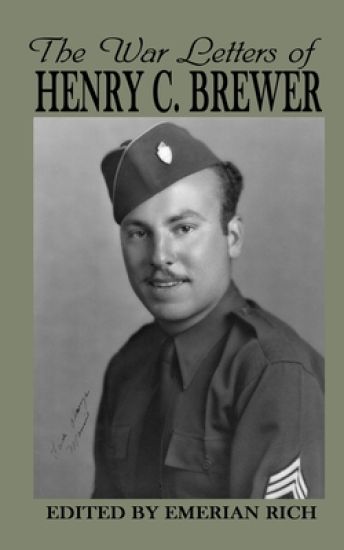
Henry C. Brewer: The War Letters of

Henry C. Brewer: The War Letters of

Henry C. Brewer

Independently Published
2019
nidottu
Henry Carroll Brewer, was born in 1918 in Simpson, Louisiana. Henry was a Sgt. in the 30th Infantry for the USA in WWII and died in 1944 in France fighting for his country. Henry fell in love with an Oakland girl, Madeline Aguiar, about 1940. These letters not only tell of their love affair, but of the life he wanted to have with her that was unfortunately cut short due to war.
Address of Henry C. Robinson

Address of Henry C. Robinson

Henry Cornelius Robinson

Hutson Street Press
2025
sidottu
This is the "Address of Henry C. Robinson," delivered in 1888. Robinson, a prominent figure of his time, offers insights into the pressing political and social issues facing the United States during the late 19th century. This historical document provides a valuable glimpse into the debates and concerns that shaped American society during a period of significant transformation. Readers interested in American history, political science, and the evolution of social thought will find this address to be a compelling and informative resource. The text offers primary source material for understanding the perspectives and arguments of an era grappling with industrialization, immigration, and evolving social norms. This work has been selected by scholars as being culturally important, and is part of the knowledge base of civilization as we know it. This work was reproduced from the original artifact, and remains as true to the original work as possible. Therefore, you will see the original copyright references, library stamps (as most of these works have been housed in our most important libraries around the world), and other notations in the work. This work is in the public domain in the United States of America, and possibly other nations. Within the United States, you may freely copy and distribute this work, as no entity (individual or corporate) has a copyright on the body of the work. As a reproduction of a historical artifact, this work may contain missing or blurred pages, poor pictures, errant marks, etc. Scholars believe, and we concur, that this work is important enough to be preserved, reproduced, and made generally available to the public. We appreciate your support of the preservation process, and thank you for being an important part of keeping this knowledge alive and relevant.