Kirjojen hintavertailu. Mukana 11 244 527 kirjaa ja 12 kauppaa.

Kirjahaku

Etsi kirjoja tekijän nimen, kirjan nimen tai ISBN:n perusteella.

1000 tulosta hakusanalla Henry E. Allison

Kant's Transcendental Deduction

Kant's Transcendental Deduction

Henry E. Allison

Oxford University Press
2015
sidottu
Henry E. Allison presents an analytical and historical commentary on Kant`s transcendental deduction of the pure concepts of the understanding in the Critique of Pure Reason. He argues that, rather than providing a new solution to an old problem (refuting a global skepticism regarding the objectivity of experience), it addresses a new problem (the role of a priori concepts or categories stemming from the nature of the understanding in grounding this objectivity), and he traces the line of thought that led Kant to the recognition of the significance of this problem in his 'pre-critical' period. Allison locates four decisive steps in this process: the recognition that sensibility and understanding are distinct and irreducible cognitive powers, which Kant referred to as a 'great light' of 1769; the subsequent realization that, though distinct, these powers only yield cognition when they work together, which is referred to as the 'discursivity thesis' and which led directly to the distinction between analytic and synthetic judgments and the problem of the synthetic a priori; the discovery of the necessary unity of apperception as the supreme norm governing discursive cognition; and the recognition, through the influence of Tetens, of the role of the imagination in mediating between sensibility and understanding. In addition to the developmental nature of the account of Kant`s views, two distinctive features of Allison'sreading of the deduction are a defense of Kant`s oft criticized claim that the conformity of appearances to the categories must be unconditionally rather than merely conditionally necessary (the 'non-contingency thesis') and an insistence that the argument cannot be separated from Kant`s transcendental idealism (the 'non-separability thesis').
Kant's Transcendental Deduction

Kant's Transcendental Deduction

Henry E. Allison

Oxford University Press
2015
nidottu
Henry E. Allison presents an analytical and historical commentary on Kant`s transcendental deduction of the pure concepts of the understanding in the Critique of Pure Reason. He argues that, rather than providing a new solution to an old problem (refuting a global skepticism regarding the objectivity of experience), it addresses a new problem (the role of a priori concepts or categories stemming from the nature of the understanding in grounding this objectivity), and he traces the line of thought that led Kant to the recognition of the significance of this problem in his 'pre-critical' period. Allison locates four decisive steps in this process: the recognition that sensibility and understanding are distinct and irreducible cognitive powers, which Kant referred to as a 'great light' of 1769; the subsequent realization that, though distinct, these powers only yield cognition when they work together, which is referred to as the 'discursivity thesis' and which led directly to the distinction between analytic and synthetic judgments and the problem of the synthetic a priori; the discovery of the necessary unity of apperception as the supreme norm governing discursive cognition; and the recognition, through the influence of Tetens, of the role of the imagination in mediating between sensibility and understanding. In addition to the developmental nature of the account of Kant`s views, two distinctive features of Allison'sreading of the deduction are a defense of Kant`s oft criticized claim that the conformity of appearances to the categories must be unconditionally rather than merely conditionally necessary (the 'non-contingency thesis') and an insistence that the argument cannot be separated from Kant`s transcendental idealism (the 'non-separability thesis').
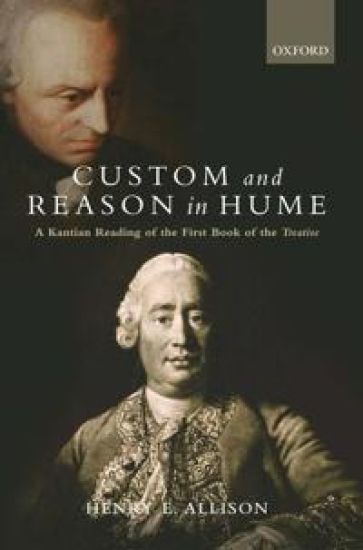
Custom and Reason in Hume

Custom and Reason in Hume

Henry E. Allison

Oxford University Press
2008
sidottu
Henry Allison examines the central tenets of Hume's epistemology and cognitive psychology, as contained in the Treatise of Human Nature. Allison takes a distinctive two-level approach. On the one hand, he considers Hume's thought in its own terms and historical context. So considered, Hume is viewed as a naturalist, whose project in the first three parts of the first book of the Treatise is to provide an account of the operation of the understanding in which reason is subordinated to custom and other non-rational propensities. Scepticism arises in the fourth part as a form of metascepticism, directed not against first-order beliefs, but against philosophical attempts to ground these beliefs in the "space of reasons." On the other hand, Allison provides a critique of these tenets from a Kantian perspective. This involves a comparison of the two thinkers on a range of issues, including space and time, causation, existence, induction, and the self. In each case, the issue is seen to turn on a contrast between their underlying models of cognition. Hume is committed to a version of the perceptual model, according to which the paradigm of knowledge is a seeing with the "mind's eye" of the relation between mental contents. By contrast, Kant appeals to a discursive model in which the fundamental cognitive act is judgment, understood as the application of concepts to sensory data, Whereas regarded from the first point of view, Hume's account is deemed a major philosophical achievement, seen from the second it suffers from a failure to develop an adequate account of concepts and judgment.
Custom and Reason in Hume

Custom and Reason in Hume

Henry E. Allison

Oxford University Press
2010
nidottu
Henry Allison examines the central tenets of Hume's epistemology and cognitive psychology, as contained in the Treatise of Human Nature. Allison takes a distinctive two-level approach. On the one hand, he considers Hume's thought in its own terms and historical context. So considered, Hume is viewed as a naturalist, whose project in the first three parts of the first book of the Treatise is to provide an account of the operation of the understanding in which reason is subordinated to custom and other non-rational propensities. Scepticism arises in the fourth part as a form of metascepticism, directed not against first-order beliefs, but against philosophical attempts to ground these beliefs in the "space of reasons." On the other hand, Allison provides a critique of these tenets from a Kantian perspective. This involves a comparison of the two thinkers on a range of issues, including space and time, causation, existence, induction, and the self. In each case, the issue is seen to turn on a contrast between their underlying models of cognition. Hume is committed to a version of the perceptual model, according to which the paradigm of knowledge is a seeing with the "mind's eye" of the relation between mental contents. By contrast, Kant appeals to a discursive model in which the fundamental cognitive act is judgment, understood as the application of concepts to sensory data, Whereas regarded from the first point of view, Hume's account is deemed a major philosophical achievement, seen from the second it suffers from a failure to develop an adequate account of concepts and judgment.
Essays on Kant

Essays on Kant

Henry E. Allison

Oxford University Press
2012
nidottu
This volume comprises seventeen essays by Henry E. Allison, one of the world's leading Kant scholars. They cover virtually the full spectrum of Allison's work on Kant, ranging from his epistemology, metaphysics, and moral theory to his views on teleology, political philosophy, the philosophy of history, and the philosophy of religion. But most of the essays revolve around three basic themes: the nature of transcendental idealism and its relation to other aspects of Kant's thought; freedom of the will; and the concept of the purposiveness of nature. The first two themes have been prominent in Allison's work on Kant since its inception. The essays on the third theme constitute a major new contribution to the understanding of Kant's 'critical' philosophy; their primary concern is to demonstrate the central place of the third Critique in Kant's thought. Among the notable features of Allison's essays is the presence of a significant comparative dimension, which places Kant's views in their historical context and explores their contemporary relevance. To this end, these views are contrasted with those of his major predecessors and immediate successors, as well as philosophers of the present day.
Essays on Kant

Essays on Kant

Henry E. Allison

Oxford University Press
2012
sidottu
This volume comprises seventeen essays by Henry E. Allison, one of the world's leading Kant scholars. They cover virtually the full spectrum of Allison's work on Kant, ranging from his epistemology, metaphysics, and moral theory to his views on teleology, political philosophy, the philosophy of history, and the philosophy of religion. But most of the essays revolve around three basic themes: the nature of transcendental idealism and its relation to other aspects of Kant's thought; freedom of the will; and the concept of the purposiveness of nature. The first two themes have been prominent in Allison's work on Kant since its inception. The essays on the third theme constitute a major new contribution to the understanding of Kant's 'critical' philosophy; their primary concern is to demonstrate the central place of the third Critique in Kant's thought. Among the notable features of Allison's essays is the presence of a significant comparative dimension, which places Kant's views in their historical context and explores their contemporary relevance. To this end, these views are contrasted with those of his major predecessors and immediate successors, as well as philosophers of the present day.
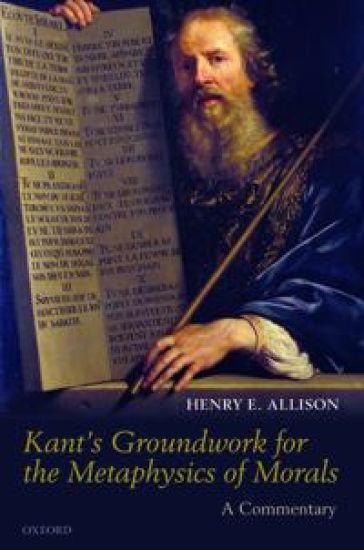
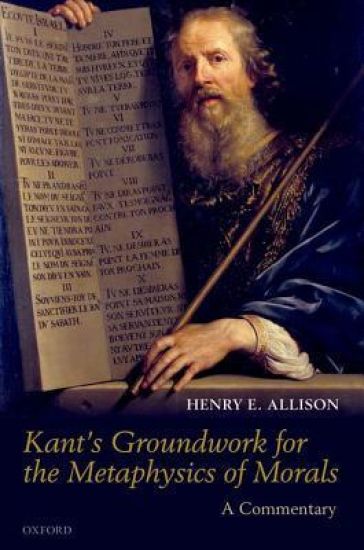
Kant's Groundwork for the Metaphysics of Morals

Kant's Groundwork for the Metaphysics of Morals

Henry E. Allison

Oxford University Press
2011
sidottu
Henry E. Allison presents a comprehensive commentary on Kant's Groundwork for the Metaphysics of Morals (1785). It differs from most recent commentaries in paying special attention to the structure of the work, the historical context in which it was written, and the views to which Kant was responding. Allison argues that, despite its relative brevity, the Groundwork is the single most important work in modern moral philosophy and that its significance lies mainly in two closely related factors. The first is that it is here that Kant first articulates his revolutionary principle of the autonomy of the will, that is, the paradoxical thesis that moral requirements (duties) are self-imposed and that it is only in virtue of this that they can be unconditionally binding. The second is that for Kant all other moral theories are united by the assumption that the ground of moral requirements must be located in some object of the will (the good) rather than the will itself, which Kant terms heteronomy. Accordingly, what from the standpoint of previous moral theories was seen as a fundamental conflict between various views of the good is reconceived by Kant as a family quarrel between various forms of heteronomy, none of which are capable of accounting for the unconditionally binding nature of morality. Allison goes on to argue that Kant expresses this incapacity by claiming that the various forms of heteronomy unavoidably reduce the categorical to a merely hypothetical imperative.
Kant's Groundwork for the Metaphysics of Morals

Kant's Groundwork for the Metaphysics of Morals

Henry E. Allison

Oxford University Press
2011
nidottu
Henry E. Allison presents a comprehensive commentary on Kant's Groundwork for the Metaphysics of Morals (1785). It differs from most recent commentaries in paying special attention to the structure of the work, the historical context in which it was written, and the views to which Kant was responding. Allison argues that, despite its relative brevity, the Groundwork is the single most important work in modern moral philosophy and that its significance lies mainly in two closely related factors. The first is that it is here that Kant first articulates his revolutionary principle of the autonomy of the will, that is, the paradoxical thesis that moral requirements (duties) are self-imposed and that it is only in virtue of this that they can be unconditionally binding. The second is that for Kant all other moral theories are united by the assumption that the ground of moral requirements must be located in some object of the will (the good) rather than the will itself, which Kant terms heteronomy. Accordingly, what from the standpoint of previous moral theories was seen as a fundamental conflict between various views of the good is reconceived by Kant as a family quarrel between various forms of heteronomy, none of which are capable of accounting for the unconditionally binding nature of morality. Allison goes on to argue that Kant expresses this incapacity by claiming that the various forms of heteronomy unavoidably reduce the categorical to a merely hypothetical imperative.
Kant’s Transcendental Idealism

Kant’s Transcendental Idealism

Henry E. Allison

Yale University Press
2004
pokkari
This landmark book is now reissued in a new edition that has been vastly rewritten and updated to respond to recent Kantian literature. It includes a new discussion of the Third Analogy, a greatly expanded discussion of Kant’s Paralogisms, and entirely new chapters dealing with Kant’s theory of reason, his treatment of theology, and the important Appendix to the Dialectic.Praise for the earlier edition:“Probably the most comprehensive and substantial study of the Critique of Pure Reason written by any American philosopher. . . . This is a splendid book.”—Lewis White Beck“This masterful study . . . will most certainly join the canon of required reading for future interpreters of Kant’s theoretical philosophy. Superbly organized and lucidly written.”—Garrett Green, Journal of Religion
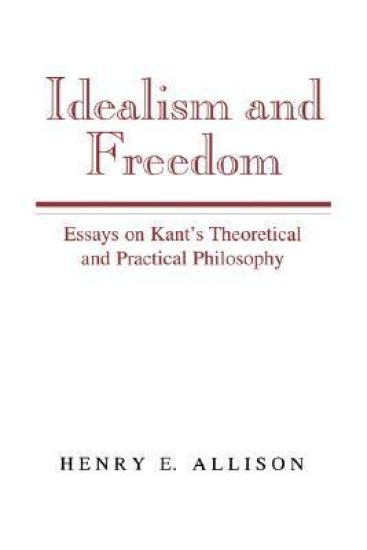
Idealism and Freedom

Idealism and Freedom

Henry E. Allison

Cambridge University Press
1996
pokkari
Henry Allison is one of the foremost interpreters of the philosophy of Kant. This new volume collects all his recent essays on Kant’s theoretical and practical philosophy. All the essays postdate Allison’s two major books on Kant (Kant’s Transcendental Idealism, 1983, and Kant’s Theory of Freedom, 1990), and together they constitute an attempt to respond to critics and to clarify, develop and apply some of the central theses of those books. Two are published here for the first time. Special features of the collection are: a detailed defence of the author’s interpretation of transcendental idealism; a consideration of the Transcendental Deduction and some other recent interpretations thereof; further elaborations of the tensions between various aspects of Kant’s conception of freedom and of the complex role of this conception within Kant’s moral philosophy.
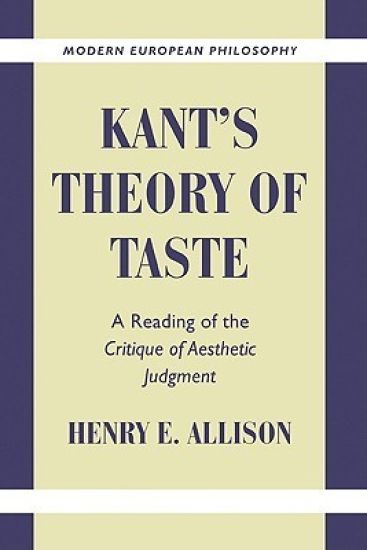
Kant's Theory of Taste

Kant's Theory of Taste

Henry E. Allison

Cambridge University Press
2001
sidottu
This book constitutes one of the most important contributions to recent Kant scholarship. In it, one of the pre-eminent interpreters of Kant, Henry Allison, offers a comprehensive, systematic, and philosophically astute account of all aspects of Kant's views on aesthetics. The first part of the book analyses Kant's conception of reflective judgment and its connections with both empirical knowledge and judgments of taste. The second and third parts treat two questions that Allison insists must be kept distinct: the normativity of pure judgments of taste, and the moral and systematic significance of taste. The fourth part considers two important topics often neglected in the study of Kant's aesthetics: his conceptions of fine art, and the sublime.
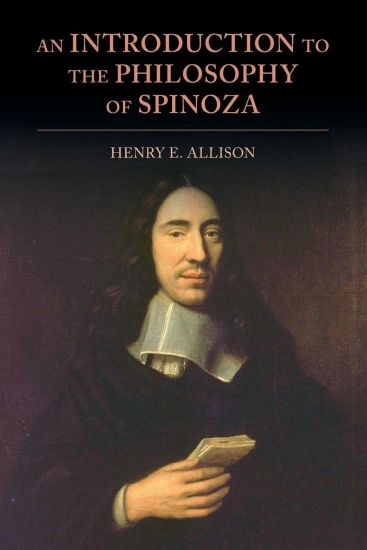
An Introduction to the Philosophy of Spinoza

An Introduction to the Philosophy of Spinoza

Henry E. Allison

Cambridge University Press
2022
pokkari
Aimed at those new to studying Spinoza, this book provides a comprehensive introduction to his thought, placing it in its historical and philosophical contexts, and assessing its critical reception. In addition to providing an analysis of Spinoza's metaphysical, epistemological, psychological, and ethical views in the Ethics, Henry Allison also explores his political theory and revolutionary views on the Bible, as well as his account of Judaism, which led to the excommunication of the young Spinoza from the Jewish community in Amsterdam. Although the book's main focus is on the analysis of Spinoza's views, including a close reading of the central arguments of the Ethics, it also considers many of the standard objections to these arguments as well as possible responses to them. This completely revised and updated new edition of Allison's classic book, with two new chapters, will help a new generation of students to understand and value Spinoza's work.
An Introduction to the Philosophy of Spinoza

An Introduction to the Philosophy of Spinoza

Henry E. Allison

Cambridge University Press
2022
sidottu
Aimed at those new to studying Spinoza, this book provides a comprehensive introduction to his thought, placing it in its historical and philosophical contexts, and assessing its critical reception. In addition to providing an analysis of Spinoza's metaphysical, epistemological, psychological, and ethical views in the Ethics, Henry Allison also explores his political theory and revolutionary views on the Bible, as well as his account of Judaism, which led to the excommunication of the young Spinoza from the Jewish community in Amsterdam. Although the book's main focus is on the analysis of Spinoza's views, including a close reading of the central arguments of the Ethics, it also considers many of the standard objections to these arguments as well as possible responses to them. This completely revised and updated new edition of Allison's classic book, with two new chapters, will help a new generation of students to understand and value Spinoza's work.
Kant's Conception of Freedom

Kant's Conception of Freedom

Henry E. Allison

Cambridge University Press
2020
sidottu
Although a good deal has been written about Kant's conception of free will in recent years, there has been no serious attempt to examine in detail the development of his views on the topic. This book endeavours to remedy the situation by tracing Kant's thoughts on free will from his earliest discussions of it in the 1750s through to his last accounts in the 1790s. This developmental approach is of interest for at least two reasons. First, it shows that the path that led Kant to view freedom as a transcendental power that is both radically distinct from and compatible with the causality of nature was a winding one. Second, it indicates that, despite the variety of views of free will that Kant held at various times, the concept occupied a central place in his thought, because it was the point of union between his theoretical and practical philosophy.
Kant's Conception of Freedom

Kant's Conception of Freedom

Henry E. Allison

Cambridge University Press
2021
pokkari
Although a good deal has been written about Kant's conception of free will in recent years, there has been no serious attempt to examine in detail the development of his views on the topic. This book endeavours to remedy the situation by tracing Kant's thoughts on free will from his earliest discussions of it in the 1750s through to his last accounts in the 1790s. This developmental approach is of interest for at least two reasons. First, it shows that the path that led Kant to view freedom as a transcendental power that is both radically distinct from and compatible with the causality of nature was a winding one. Second, it indicates that, despite the variety of views of free will that Kant held at various times, the concept occupied a central place in his thought, because it was the point of union between his theoretical and practical philosophy.
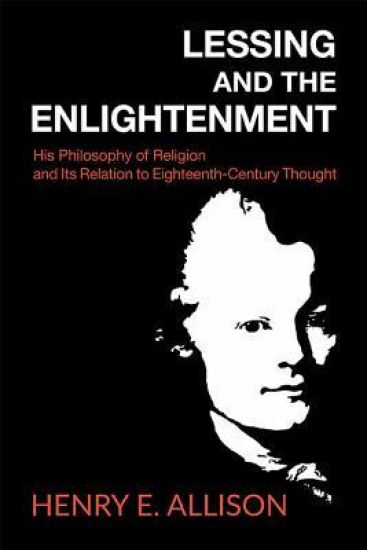
Lessing and the Enlightenment

Lessing and the Enlightenment

Henry E. Allison

State University of New York Press
2018
pokkari
A comprehensive study of Lessing's religious thought.Although only one aspect of Gotthold Ephraim Lessing's diverse oeuvre, his religious thought had a significant influence on thinkers such as Kant, Hegel, Kierkegaard, and present-day liberal Protestant theologians. His thought is particularly difficult to assess, however, because it is found largely in a series of essays, reviews, critical studies, polemical writings, and commentary on theological texts. Beyond these, his correspondence, and a few fragmentary essays unpublished during his lifetime, we have his famous drama of religious toleration, Nathan the Wise, and his philosophical-historical sketch, The Education of the Human Race. In these scattered texts, Lessing challenged the full range of theological views in the Enlightenment, from Protestant orthodoxy, with its belief in Biblical inerrancy, to a radical naturalism, which rejected both the concept of a divine revelation and the historically based claims of Christianity to be one, as well as virtually everything in between. Since he refused to identify himself with any of these parties, Lessing was an enigmatic figure, and a central question from his time to today is where he stood on the issue of the truth of the Christian religion. Now back in print, and with the addition of two supplementary essays, Henry E. Allison's book argues that, despite appearances, Lessing was not merely an eclectic thinker or intellectual provocateur, but a serious philosopher of religion, who combined a basically Spinozistic conception of God with a sophisticated pluralistic conception of religious truth inspired by Leibniz.
Kant's Theory of Freedom

Kant's Theory of Freedom

Allison Henry E.

Cambridge University Press
1990
pokkari
In his new book the eminent Kant scholar Henry Allison provides an innovative and comprehensive interpretation of Kant’s concept of freedom. The author analyzes the concept and discusses the role it plays in Kant’s moral philosophy and psychology. He also considers in full detail the critical literature on the subject from Kant’s own time to the present day. In the first part Professor Allison argues that at the centre of the Critique of Pure Reason there is the foundation for a coherent general theory of rational agency. The second part employs this account of rational agency as a key to understanding Kant’s concept of moral agency and associated moral psychology. The third part focuses on Kant’s attempt to ground both moral law and freedom in the Groundwork and the Critique of Practical Reason. This is a major contribution to the interpretation of Kant which will be of special interest to scholars and graduate students of Kant’s moral theory.
Kant's Theory of Taste

Kant's Theory of Taste

Allison Henry E.

Cambridge University Press
2001
pokkari
This book constitutes one of the most important contributions to recent Kant scholarship. In it, one of the pre-eminent interpreters of Kant, Henry Allison, offers a comprehensive, systematic, and philosophically astute account of all aspects of Kant’s views on aesthetics. The first part of the book analyses Kant’s conception of reflective judgment and its connections with both empirical knowledge and judgments of taste. The second and third parts treat two questions that Allison insists must be kept distinct: the normativity of pure judgments of taste, and the moral and systematic significance of taste. The fourth part considers two important topics often neglected in the study of Kant’s aesthetics: his conceptions of fine art, and the sublime.