Kirjojen hintavertailu. Mukana 11 244 527 kirjaa ja 12 kauppaa.

Kirjahaku

Etsi kirjoja tekijän nimen, kirjan nimen tai ISBN:n perusteella.

1000 tulosta hakusanalla Henry Heller

Labour, Science and Technology in France, 1500–1620

Labour, Science and Technology in France, 1500–1620

Henry Heller

Cambridge University Press
1995
sidottu
For a generation, the history of the ancien régime has been written from the perspective of the Annales school, with its emphasis on the role of long-term economic and cultural factors in shaping the development of early modern France. In this detailed study, Henry Heller challenges such a paradigm and assembles a huge range of information about technical innovation and ideas of improvement in sixteenth-century France. Emphasising the role of state intervention in the economy, the development of science and technology, and recent research into early modern proto-industrialisation, Heller counters notions of a France mired in an archaic, determinist mentalité. Despite the tides of religious fanaticism and seigneurial reaction, the period of the religious wars saw a surprising degree of economic, technological and scientific innovation, making possible the consolidation of capitalism in French society during the reign of Henri IV.

Labour, Science and Technology in France, 1500–1620

Labour, Science and Technology in France, 1500–1620

Henry Heller

Cambridge University Press
2002
pokkari
For a generation, the history of the ancien régime has been written from the perspective of the Annales school, with its emphasis on the role of long-term economic and cultural factors in shaping the development of early modern France. In this detailed study, Henry Heller challenges such a paradigm and assembles a huge range of information about technical innovation and ideas of improvement in sixteenth-century France. Emphasising the role of state intervention in the economy, the development of science and technology, and recent research into early modern proto-industrialisation, Heller counters notions of a France mired in an archaic, determinist mentalité. Despite the tides of religious fanaticism and seigneurial reaction, the period of the religious wars saw a surprising degree of economic, technological and scientific innovation, making possible the consolidation of capitalism in French society during the reign of Henri IV.

The Birth of Capitalism

The Birth of Capitalism

Henry Heller

Pluto Press
2011
pokkari
In the light of the deepening crisis of capitalism and continued non-Western capitalist accumulation, Henry Heller re-examines the debates surrounding the transition from feudalism to capitalism in Europe and elsewhere. Focusing on arguments about the origin, nature and sustainability of capitalism, Heller offers a new reading of the historical evidence and a critical interrogation of the transition debate. He advances the idea that capitalism must be understood as a political as well as an economic entity. This book breathes new life into the scholarship, taking issue with the excessively economistic approach of Robert Brenner, which has gained increasing support over the last ten years. It concludes that the future of capitalism is more threatened than ever before. The new insights in this book make it essential reading for engaged students and scholars of political economy and history.
The Capitalist University

The Capitalist University

Henry Heller

Pluto Press
2016
sidottu
Can the ivory tower rise above capitalism? Or are the humanities and social sciences merely handmaids to the American imperial order? The Capitalist University surveys the history of higher education in the United States over the last century, revealing how campuses and classrooms have become battlegrounds in the struggle between liberatory knowledge and commodified learning. Henry Heller takes readers from the ideological apparatus of the early Cold War, through the revolts of the 1960s and on to the contemporary malaise of postmodernism, neoliberalism and the so-called 'knowledge economy' of academic capitalism. He reveals how American educational institutions have been forced to decide between teaching students to question the dominant order and helping to perpetuate it. The Capitalist University presents a comprehensive overview of a topic which affects millions of students in America and increasingly, across the globe.
Iron and Blood

Iron and Blood

Henry Heller

McGill-Queen's University Press
1991
sidottu
Heller refutes Roland Mousnier's thesis that early modern France was a society of orders in which most people knew and accepted their status in society. This concept of order certainly had meaning for the sixteenth-century elite because of aristocratic domination over land and people, but it is not clear that this was also the view of the commoners. Heller maintains that for peasants, craftsmen, and merchants the decline of the French economy started at the beginning rather than the middle of the sixteenth century. This resulted in unrest which spread from town to countryside, culminating in the three great popular movements of the civil wars: the Calvinist Revolt of the 1560s, the Catholic League's challenge to the power of the Monarchy, and the revolts of the 1590s. Heller stresses that the history of sixteenth-century France is one of both resistance and domination. It was often the upper class which took the initiative, directing much of the violence toward the commoners, and many of those involved in the civil wars were fighting for their own economic positions. Iron and Blood helps to clarify the significance of the French Civil Wars by showing them to be rooted in an aristocratic reaction against the earlier social unrest which began among the common people.
Anti-Italianism in Sixteenth-Century France

Anti-Italianism in Sixteenth-Century France

Henry Heller

University of Toronto Press
2003
sidottu
Sixteenth century Europe, like the late twentieth century, did not escape the ravages of ethnic discord. In an examination of the Italian presence in France under the Valois and Bourbon monarchs, Henry Heller explores how the economic power of Italian merchants, bankers, and ecclesiastics provoked a hostile reaction from French humanists, lawyers, and nobles that eventually spread to the Huguenots and the urban Catholic population. He also discusses the important role of anti-Italian xenophobia in the events surrounding the Saint Bartholomew's Day Massacre, the Estates-General of Blois in 1576-77, the Catholic League revolt, and the triumph of Henri IV. Heller links the cultural, moral, and political aspects of anti-Italianism with the rise of economic nationalism among the emergent French middle class. He also sheds light on the origins of the social construction of European anti-Semitism by showing how the language and rhetoric employed by the French against the Italians was similar to that used against Jews elsewhere in Europe. As one of the few studies of ethnic conflict within Renaissance Europe, this ground-breaking work will be indispensable to all scholars of European politics, ethnicity, economics, and history, as well as all those interested in the roots of today's ethnic tensions.
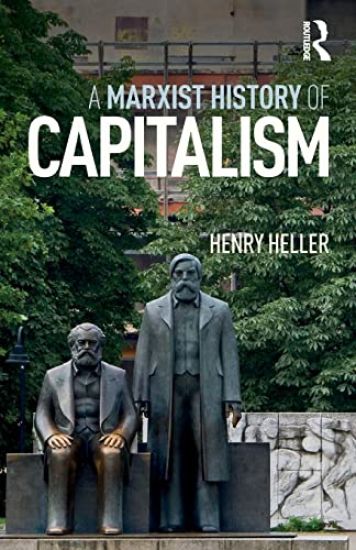
A Marxist History of Capitalism

A Marxist History of Capitalism

Henry Heller

Routledge
2018
sidottu
Henry Heller’s short account of the history of capitalism combines Marx’s economic and political thought with contemporary scholarship to shed light on the current capitalist crisis. It argues that capitalism is an evolving mode of production that has now outgrown its institutional and political limits. The book provides an overview of the different historical stages of capitalism, underpinned by accessible discussions of its theoretical foundations. Heller shows that capitalism has always been a double-edged sword, on one hand advancing humanity, and on the other harming traditional societies and our natural environment. He makes the case that capitalism has now become self-destructive, and that our current era of neoliberalism may trigger a transition to a democratic and ecologically aware form of socialism.
A Marxist History of Capitalism

A Marxist History of Capitalism

Henry Heller

Routledge
2018
nidottu
Henry Heller’s short account of the history of capitalism combines Marx’s economic and political thought with contemporary scholarship to shed light on the current capitalist crisis. It argues that capitalism is an evolving mode of production that has now outgrown its institutional and political limits. The book provides an overview of the different historical stages of capitalism, underpinned by accessible discussions of its theoretical foundations. Heller shows that capitalism has always been a double-edged sword, on one hand advancing humanity, and on the other harming traditional societies and our natural environment. He makes the case that capitalism has now become self-destructive, and that our current era of neoliberalism may trigger a transition to a democratic and ecologically aware form of socialism.
The Cold War and the New Imperialism

The Cold War and the New Imperialism

Henry Heller

Monthly Review Press,U.S.
2006
nidottu
"The Cold War and the New Imperialism" is an account of global history since 1945, which brings massive changes in global politics, economics, and society together in a single narrative, illuminating and clarifying the dilemmas of the present. Written for the general reader, it draws together scholarly research from a wide range of sources without losing sight of the larger pattern of events. In the sixty-year period since the end of World War II, the world has indeed been remade. The war itself mobilized the political and social aspirations of hundreds of millions of people. The contest between the United States and the Soviet Union for global dominance drew every country into its field of force. Struggles for national liberation in the Third World brought an end to colonial empires. Revolutions in China, Cuba, Vietnam and elsewhere shook the global order, as did failed uprisings in Paris and Prague. Since the end of the Cold War the forces of the capitalist market have overwhelmed social institutions that have given meaning to human existence for centuries. But the end of the Cold War has created as many problems for the world's remaining superpower, the United States, as it has solved. With its political, economic, and financial hegemony eroding, the United States has responded with military adventures abroad and increasing inequality and authoritarianism at home. "The Cold War and the New Imperialism" draws all these threads together and shows vividly that the end of history is not in sight.
The Cold War and the New Imperialism

The Cold War and the New Imperialism

Henry Heller

Monthly Review Press,U.S.
2006
sidottu
"The Cold War and the New Imperialism" is an account of global history since 1945, which brings massive changes in global politics, economics, and society together in a single narrative, illuminating and clarifying the dilemmas of the present. Written for the general reader, it draws together scholarly research from a wide range of sources without losing sight of the larger pattern of events. In the sixty-year period since the end of World War II, the world has indeed been remade. The war itself mobilized the political and social aspirations of hundreds of millions of people. The contest between the United States and the Soviet Union for global dominance drew every country into its field of force. Struggles for national liberation in the Third World brought an end to colonial empires. Revolutions in China, Cuba, Vietnam and elsewhere shook the global order, as did failed uprisings in Paris and Prague. Since the end of the Cold War the forces of the capitalist market have overwhelmed social institutions that have given meaning to human existence for centuries. But the end of the Cold War has created as many problems for the world's remaining superpower, the United States, as it has solved. With its political, economic, and financial hegemony eroding, the United States has responded with military adventures abroad and increasing inequality and authoritarianism at home. "The Cold War and the New Imperialism" draws all these threads together and shows vividly that the end of history is not in sight.
The French Revolution And Historical Materialism
In this stirring and persuasive defence of the classical Marxist view of the French Revolution as a bourgeois and capitalist revolution, Henry Heller lays to rest the stylish revisionism on the subject that still dominates in academic circles. Based mainly on articles published in the journal Historical Materialism, Heller that the rise of a bourgeois capitalist class in France stretches back to the sixteenth century, and that the Revolution itself played a large role in strengthening this nascent class politically and economically.
The Bourgeois Revolution in France 1789-1815
In the last generation the classic Marxist interpretation of the French Revolution has been challenged by the so-called revisionist school. The Marxist view that the Revolution was a bourgeois and capitalist revolution has been questioned by Anglo-Saxon revisionists like Alfred Cobban and William Doyle as well as a French school of criticism headed by François Furet. Today revisionism is the dominant interpretation of the Revolution both in the academic world and among the educated public. Against this conception, this book reasserts the view that the Revolution - the capital event of the modern age - was indeed a capitalist and bourgeois revolution. Based on an analysis of the latest historical scholarship as well as on knowledge of Marxist theories of the transition from feudalism to capitalism, the work confutes the main arguments and contentions of the revisionist school while laying out a narrative of the causes and unfolding of the Revolution from the eighteenth century to the Napoleonic Age.
The Bourgeois Revolution in France 1789-1815
In the last generation the classic Marxist interpretation of the French Revolution has been challenged by the so-called revisionist school. The Marxist view that the Revolution was a bourgeois and capitalist revolution has been questioned by Anglo-Saxon revisionists like Alfred Cobban and William Doyle as well as a French school of criticism headed by François Furet. Today revisionism is the dominant interpretation of the Revolution both in the academic world and among the educated public. Against this conception, this book reasserts the view that the Revolution - the capital event of the modern age - was indeed a capitalist and bourgeois revolution. Based on an analysis of the latest historical scholarship as well as on knowledge of Marxist theories of the transition from feudalism to capitalism, the work confutes the main arguments and contentions of the revisionist school while laying out a narrative of the causes and unfolding of the Revolution from the eighteenth century to the Napoleonic Age.
Mode of Production

Mode of Production

Henry Heller; Peter Kulchyski

BRILL
2025
sidottu
Mode of Production: The Final Horizon of Practice and Theory re-invigorates the Marxist concept ‘mode of production’ by showing how it continues to have a central place in understanding the broad sweep of human history, while also offering crucial resources to inform social justice activism today. Drawing on recent materialist theory and newer insights from historical and anthropological scholarship, the book discusses the three modes of production that existed, the conflicts between them, the importance of Indigenous struggles to socialism, and explicates a materialist contemporary cultural politics. The book offers a pathway for activism and theory through the wide range of contemporary hegemonies.
The Birth of Capitalism

The Birth of Capitalism

Heller Henry

Pluto Press
2011
sidottu
In the light of the deepening crisis of capitalism and continued non-Western capitalist accumulation, Henry Heller re-examines the debates surrounding the transition from feudalism to capitalism in Europe and elsewhere. Focusing on arguments about the origin, nature and sustainability of capitalism, Heller offers a new reading of the historical evidence and a critical interrogation of the transition debate. He advances the idea that capitalism must be understood as a political as well as an economic entity. This book breathes new life into the scholarship, taking issue with the excessively economistic approach of Robert Brenner, which has gained increasing support over the last ten years. It concludes that the future of capitalism is more threatened than ever before. The new insights in this book make it essential reading for engaged students and scholars of political economy and history.
Maximillien Heller

Maximillien Heller

Henry Cauvain

Createspace Independent Publishing Platform
2016
nidottu
R sum Quoiqu'il n'ait pas atteint la renomm e d'un Emile Gaboriau, Henry Cauvain est l'auteur avec Maximilien Heller d'un livre majeur de la litt rature polici re fran aise du xixe si cle. S'il a comme Gaboriau cr un d tective amateur, il l'a dot en outre d'attributs qui feront le succ s seize ans plus ans d'un nomm Sherlock Holmes. Et en effet, le dilettante et c r bral Maximilien Heller constitue la pr figuration du personnage de Conan Doyle: ami des chats et opiom... Henry Cauvain, n Paris le 17 f vrier 1847 et mort Lausanne en 1899, tait un crivain fran ais, dont le personnage de d tective Maximilien Heller, dans le roman du m me nom publi en 1871, a t repris par Arthur Conan Doyle pour cr er celui de Sherlock Holmes. Biographie Son p re, Henri-Alexis Cauvain (1815-1858), tait journaliste et avocat. Henry, entr dans l'administration des Finances, fut tr sorier g n ral Annecy et vreux. Il publia de nombreux romans de veine polici re et historique.
Maximilien Heller

Maximilien Heller

Henry Cauvain

Createspace Independent Publishing Platform
2016
nidottu
Monsieur Br hat-Lenoir a t assassin et une somme consid rable lui a t vol e. Son valet, Jean-Louis Gu rin est accus de l'avoir empoisonn l'arsenic, poison qu'il a effectivement achet peu avant l'assassinat, voquant des rats envahissants. C'est son voisin, Maximilien Heller, qui prouvera avec une logique implacable, que le pauvre Gu rin est innocent du crime dont on l'accuse...
Maximilien Heller

Maximilien Heller

Henry Cauvain

Createspace Independent Publishing Platform
2017
nidottu
Extrait du chapitre Chapitre 1 UN TRANGE MALADE Ce fut le 3 janvier 1845, 8 heures du soir, que je fis la connaissance de M. Maximilien Heller. Quelques jours auparavant, j'avais t abord dans la rue par un de mes amis, Jules H..., qui, les premiers compliments chang s, m'avait dit avec une insistance toute particuli re: Voici d j quelque temps que je voulais aller chez vous, mon cher docteur, pour vous prier de me rendre un grand service. Un de mes anciens confr res du barreau, M. Heller, qui demeure ici pr s, est dans l' tat de sant le plus alarmant. Nous avions d'abord cru, ses amis et moi, que son mal tait plus moral que physique. Nous avons essay tous les moyens de distraction possibles, nous avons t ch de donner quelques aliments son intelligence, que nous avons connue autrefois si belle et si lumineuse. Je dois convenir que tous nos efforts ont chou . Il ne nous reste plus qu' implorer le secours de la science. Ce que notre amiti n'a pu faire, votre autorit de docteur le fera peut- tre. Maximilien a une nature nergique, et il ne c dera gu re, je crois, qu' une raison sup rieure Biographie Henry Cauvain, n Paris en 1847 et mort Lausanne en 1899, tait un crivain fran ais, dont le personnage de d tective Maximilien Heller, dans le roman du m me nom publi en 1871, a t par repris par Arthur Conan Doyle pour cr er celui de Sherlock Holmes. Son p re, Henri-Alexis Cauvain (1815-1858), tait journaliste et avocat. Henry, entr dans l'administration des Finances, fut tr sorier g n ral Annecy et vreux. Il publia de nombreux romans de veine polici re et historique.
Maximilien Heller (2e Édition)

Maximilien Heller (2e Édition)

Henry Cauvain

Hachette Livre - BNF
2013
pokkari
Maximilien Heller (2e edition) / par Henry CauvainDate de l'edition originale: 1875Ce livre est la reproduction fidele d une uvre publiee avant 1920 et fait partie d une collection de livres reimprimes a la demande editee par Hachette Livre, dans le cadre d un partenariat avec la Bibliotheque nationale de France, offrant l opportunite d acceder a des ouvrages anciens et souvent rares issus des fonds patrimoniaux de la BnF.Les uvres faisant partie de cette collection ont ete numerisees par la BnF et sont presentes sur Gallica, sa bibliotheque numerique.En entreprenant de redonner vie a ces ouvrages au travers d une collection de livres reimprimes a la demande, nous leur donnons la possibilite de rencontrer un public elargi et participons a la transmission de connaissances et de savoirs parfois difficilement accessibles.Nous avons cherche a concilier la reproduction fidele d un livre ancien a partir de sa version numerisee avec le souci d un confort de lecture optimal. Nous esperons que les ouvrages de cette nouvelle collection vous apporteront entiere satisfaction.Pour plus d informations, rendez-vous sur www.hachettebnf.fr