Kirjojen hintavertailu. Mukana 11 244 527 kirjaa ja 12 kauppaa.

Kirjahaku

Etsi kirjoja tekijän nimen, kirjan nimen tai ISBN:n perusteella.

1000 tulosta hakusanalla Herbert Davidson

Moses Maimonides

Moses Maimonides

Herbert Davidson

Oxford University Press Inc
2005
sidottu
Moses Maimonides, rabbinist, philosopher, and physician, had a greater impact on Jewish history than any other medieval figure. Born in Cordova, Spain, in 1137 or 1138, he spent a few years in Morocco, visited Palestine, and settled in Egypt by 1167. He died there in 1204. Maimonides was a man of superlatives. He wrote the first commentary to cover the entire Mishna corpus; composed what quickly became the dominant work on the 613 commandments believed to have been given by God to Moses; produced the most comprehensive and most intensely studied code of rabbinic law to emerge from the Middle Ages; and his Guide for the Perplexed has had a greater influence on Jewish thought than any other Jewish philosophic work. During the last decades of his life, he conducted an active medical practice, which extended into the royal court--the Sultan Saladin is reported to have been his patient--and composed some ten or eleven works on medicine. This book offers a fresh look at every aspect of Maimonides' life and works: the course of his life, his education, his personality, and his rabbinic, philosophical, and medical writings. At a number of junctures, Davidson points out that information about Maimonides which has been accepted for decades or centuries as common knowledge is in actuality supported by no credible evidence and often, more disconcertingly, is patently incorrect. Maimonides' diverse writings are frequently viewed as expressions of several distinct personas, uncomfortably and awkwardly bundled into a single human frame; the present book treats his writings as expressions of a single, integrated, albeit complex, mind.
Moses Maimonides

Moses Maimonides

Herbert Davidson

Oxford University Press Inc
2010
nidottu
Moses Maimonides (1137/38-1204), scholar, physician, and philosopher, was the most influential Jewish thinker of the Middle Ages. In this magisterial biography, Herbert Davidson provides an exhaustive guide to Maimonides' life and works. After considering Maimonides' upbringing and education, Davidson expounds all of his many writings in exhaustive detail, with separate chapters on rabbinic, philosophical, and medical texts. Moses Maimonides has been recognized as the standard work on a towering figure of Western intellectual history.
Harley Davidson Motorcycles, 1930-1941

Harley Davidson Motorcycles, 1930-1941

Herbert Wagner

Schiffer Publishing Ltd
1997
nidottu
Relive the golden age of Milwaukee motorcycling with this unique book that goes beyond the rest. Read intimate accounts from company officials, dealers, and riders of classic Harley Davidson motorcyles of the 1930s. Hundreds of period photographs from private collections and massive text trace the development of the H-D Big Twin from the sidevalve VL to the '61 and '74 models, and the legendary Knucklehead. Experience the Milwaukee motorcycle scene from the men and women who lived it.
Death Stalks the House of Herbert

Death Stalks the House of Herbert

Sue Taylor-Davidson

RENAISSANCE PRESS
2020
nidottu
If you are ready for more adventures, follow our protagonists as they traverse England on a sometimes merry and always dangerous quest for the truth to the Shakespearean authorship question.In this second book of the series, Janek and Sarah are hot on the trail of further clues to the mystery of Mary Sidney's life and her possible authorship of the Shakespearean canon. They are being followed as before, but by a quirky new character named Crik, as they come across more clues about the man who has hired the "watchers."Continue to read about Mary Sidney Herbert and her brother Philip Sidney as death truly does stalk the House of Herbert. The intrigues of court and the dramas therein are never far from our Elizabethan heroine and hero. Mary's involvement as leader of the Wilton Circle of Writers deepens, and she never stops writing. Will Mary's missing manuscripts finally be found?
Alfarabi, Avicenna, and Averroes, on Intellect

Alfarabi, Avicenna, and Averroes, on Intellect

Herbert A. Davidson

Oxford University Press Inc
1992
sidottu
The distinction between the potential intellect and the active intellect was first drawn by Aristotle. Medieval Islamic, Jewish, Christian philosophers, and European philosophers in the sixteenth century considered it a possible key to deciphering the nature of man and the universe. In this book, Herbert Davidson examines the treatment of intellect in Alfarabi (d. 950), Avicenna (980-1037) and Averroes (1126-1198), with particular attention to the way in which they addressed the tangle of issues that grew up around the active intellect.
Proofs for Eternity, Creation and the Existence of God in Medieval Islamic and Jewish Philosophy
In this classic study, Herbert A. Davidson examines every medieval Arabic and Hebrew proof for the eternity of the world, the creation of the world and the existence of God which has philosophical character, disregarding only those that rest entirely on religious faith or fall below a minimum threshold of plausibility. Classifying the proofs systematically, he analyses and explains them, and traces their sources in Greek philosophy. He pursues the penetration of some of these Islamic and Jewish arguments into medieval Christian philosophy and, in a few instances, all the way into seventeenth- and eighteenth-century European philosophy. Unique in both its classification of the proofs and its comprehensiveness, this work will once again serve medievalists, historians of philosophy and historians of ideas.
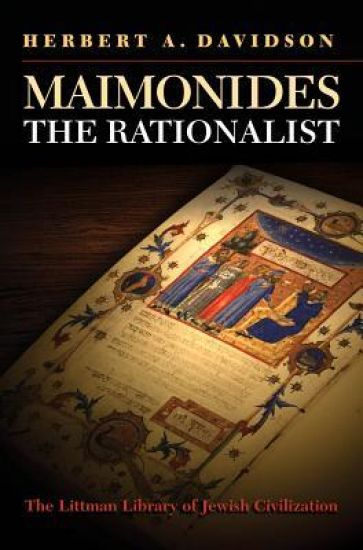
Maimonides the Rationalist

Maimonides the Rationalist

Herbert A. Davidson

The Littman Library of Jewish Civilization
2015
nidottu
Maimonides was not the first rabbinic scholar to take an interest in philosophy, but he was unique in being a towering figure in both areas. His law code, the Mishneh torah, stands with Rashi's commentary on the Babylonian Talmud as one of the two most intensely studied rabbinic works coming out of the Middle Ages, while his Guide of the Perplexed is the most influential and widely read Jewish philosophical work ever written. Admirers and critics have arrived at wildly divergent perceptions of the man. We have Maimonides the atheist or agnostic, Maimonides the sceptic, Maimonides the deist, Maimonides the Aristotelian, the Averroist, or proto-Kantian. We have a Maimonides seduced by the blandishments of 'accursed philosophy'; a Maimonides who sowed the seeds that led to Spanish Jews' loss of faith and mass apostasy and who was therefore responsible for the demise of Spanish Jewry; a Maimonides who incorporated philosophical elements into his rabbinic works and wrote the Guide of the Perplexed not to propagate doctrines to which he was personally committed but in order to rescue errant souls seduced by philosophy; a Maimonides who was the defender of the faith and defined the articles of Jewish belief for all time. In his own estimation, Maimonides was neither exclusively a dedicated philosopher nor exclusively a devoted rabbinist: he saw philosophy and the Written and Oral Torahs as a single, harmonious domain, and he believed that this view was similarly fundamental to the lives of the prophets and rabbis of old. In this book, Herbert Davidson examines Maimonides’ efforts to reconstitute this all-embracing, rationalist worldview that he felt had been lost during the millennium-long exile.
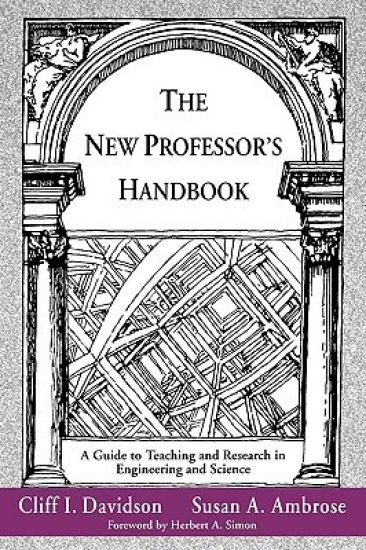
The New Professor's Handbook

The New Professor's Handbook

Cliff I. Davidson; Susan A. Ambrose; Herbert A. Simon

Anker Publishing Co
2007
nidottu
This book is an ideal resource for those making the transition from graduate student to new faculty member in engineering and science. Developed through years of use with new faculty, it tackles the two themes that will be constant in a young faculty member’s career: teaching and research. The book first distills the abundant literature that has already been published on teaching, covering student learning and course planning, conducting discussions and lecturing, creating exams and assignments, and working with teaching assistants. Bringing together guidance gained from numerous seminars, discussions, and interviews, and the little existing in current literature on starting and conducting scientific research, the next section includes assembling research teams, supervising graduate research, getting research funding, writing research papers, reviewing research proposals, presenting results, and conducting graduate seminar programs. The book features practical chapter exercises that apply concepts, and it concludes with an extensive bibliography. It will be of help to any faculty member embarking on a teaching and research career in higher education in the sciences.
Sacred Trust

Sacred Trust

Robert B. Ekelund; Robert F. Hébert; Robert D. Tollison; Gary M. Anderson; Audrey B. Davidson

Oxford University Press Inc
1997
sidottu
The Church dominated society in the Middle Ages and functioned as a quasi-government, providing public and private goods. This book is the first to examine specific institutions in the Church in the Middle Ages in economic terms. Other books have argued generally that the Church either had a positive or negative effect on economic development. The authors of this book look more closely at the actual Church institutions and practices and describe how each functioned as a part of the larger economy of the time. They focus especially on marriage, usury, heresy, the crusades, and the monasteries. It is not their purpose to reject or impugn religious motives that may be advanced by theologians and historians. Their goal is to bring a fresh perspective to the role of institutions of the medieval Church in economic development.
Herbert

Herbert

Nabarun Bhattacharya

Seagull Books London Ltd
2019
sidottu
May 1992. In Russia, Boris Yeltsin is showing millions of communists the spectre of capitalism. Yugoslavia is disintegrating. United Germany is uncertain about their next move, and communism is collapsing all around. And in a corner of old Calcutta, Herbert Sarkar, sole proprietor of a company that delivers messages from the dead, decides to give up the ghost. Decides to give up his aunt and uncle, his friends and foes, his fondness for kites, his aching heart that broke for Buki, his top terrace from where he stared up at the sky, his Ulster overcoat with buttons like big black medals, his notebook full of poems, his Park Street every evening when the sun goes down, his memory of a Russian girl running across the great black earth as the soldiers lift their guns and get ready to fire, his fairy who beat her wings against his window and filled his room with blue light . . .Now in a new translation, Herbert, the beloved cult favourite by Nabarun Bhattacharya, and winner of the 1997 Sahitya Akademi Award, is a 'scathingly satiric, wildly energetic, and yet depply tender' portrayal of a doomed young man and a city struggling to resist forces that, alas, prove to be entirely beyond their control.Praise for Herbert'This first U.S. publication brings off a remarkable resurrection, one that erupts full-blooded, alive with laughter, stink and rage.'- John Domini, Washington Post'Swift and strange, [Herbert] tells the story of its titular character, an orphan whose life is characterized by loss and longing: a sweeping view of the richness and the turmoil of Bengali culture, literature, and politics in the twentieth century.'- New Yorker'[Sunandini] Banerjee's acrobatic translation is both enormously fun and true to the radical content. The writing disrupts the hegemony of the English language from the inside by celebrating the multilingualism possible within it.'- Asymptote'Nimble and vivid, Bhattacharya's slippery narrative slithers forward and sideways through time: an acute, idiosyncratic reading experience.' - Publishers Weekly'What is needed [now] is a kind of novel that attends to how society is being organized by certain vested interests; a novel that goes to the heart-rather, goes for the jugular-of the economic system itself. [Herbert] is prophetic of this tradition to come.'- Ratik Asokan, 4Columns'[Herbert] reads like Rainer Maria Rilke's Notebooks of Malte Laurids Brigge set in Calcutta. Featuring a young man with an open channel to the dead who drinks and grieves to excess, it is a mosaic of manic and immersive episodes. It is a spinning drunken stumble through a city that feels menacingly sensual.'- Nate McNamara, LitHub