Kirjojen hintavertailu. Mukana 11 717 486 kirjaa ja 12 kauppaa.

Kirjahaku

Etsi kirjoja tekijän nimen, kirjan nimen tai ISBN:n perusteella.

1000 tulosta hakusanalla Hilda Doolittle (H.D.)

Asphodel

Asphodel

Hilda Doolittle (H.D.)

Duke University Press
1992
sidottu
"DESTROY," H.D. had pencilled across the title page of this autobiographical novel. Although the manuscript survived, it has remained unpublished since its completion in the 1920s. Regarded by many as one of the major poets of the modernist period, H.D. created in Asphodel a remarkable and readable experimental prose text, which in its manipulation of technique and voice can stand with the works of Joyce, Woolf, and Stein; in its frank exploration of lesbian desire, pregnancy and motherhood, artistic independence for women, and female experience during wartime, H.D.'s novel stands alone.A sequel to the author's HERmione, Asphodel takes the reader into the bohemian drawing rooms of pre-World War I London and Paris, a milieu populated by such thinly disguised versions of Ezra Pound, Richard Aldington, May Sinclair, Brigit Patmore, and Margaret Cravens; on the other side of what H.D. calls "the chasm," the novel documents the war's devastating effect on the men and women who considered themselves guardians of beauty. Against this riven backdrop, Asphodel plays out the story of Hermione Gart, a young American newly arrived in Europe and testing for the first time the limits of her sexual and artistic identities. Following Hermione through the frustrations of a literary world dominated by men, the failures of an attempted lesbian relationship and a marriage riddled with infidelity, the birth of an illegitimate child, and, finally, happiness with a female companion, Asphodel describes with moving lyricism and striking candor the emergence of a young and gifted woman from her self-exile.Editor Robert Spoo's introduction carefully places Asphodel in the context of H.D.'s life and work. In an appendix featuring capsule biographies of the real figures behind the novel's fictional characters, Spoo provides keys to this roman à clef.
Asphodel

Asphodel

Hilda Doolittle (H.D.)

Duke University Press
1992
pokkari
"DESTROY," H.D. had pencilled across the title page of this autobiographical novel. Although the manuscript survived, it has remained unpublished since its completion in the 1920s. Regarded by many as one of the major poets of the modernist period, H.D. created in Asphodel a remarkable and readable experimental prose text, which in its manipulation of technique and voice can stand with the works of Joyce, Woolf, and Stein; in its frank exploration of lesbian desire, pregnancy and motherhood, artistic independence for women, and female experience during wartime, H.D.'s novel stands alone.A sequel to the author's HERmione, Asphodel takes the reader into the bohemian drawing rooms of pre-World War I London and Paris, a milieu populated by such thinly disguised versions of Ezra Pound, Richard Aldington, May Sinclair, Brigit Patmore, and Margaret Cravens; on the other side of what H.D. calls "the chasm," the novel documents the war's devastating effect on the men and women who considered themselves guardians of beauty. Against this riven backdrop, Asphodel plays out the story of Hermione Gart, a young American newly arrived in Europe and testing for the first time the limits of her sexual and artistic identities. Following Hermione through the frustrations of a literary world dominated by men, the failures of an attempted lesbian relationship and a marriage riddled with infidelity, the birth of an illegitimate child, and, finally, happiness with a female companion, Asphodel describes with moving lyricism and striking candor the emergence of a young and gifted woman from her self-exile.Editor Robert Spoo's introduction carefully places Asphodel in the context of H.D.'s life and work. In an appendix featuring capsule biographies of the real figures behind the novel's fictional characters, Spoo provides keys to this roman à clef.
H.D. (Hilda Doolittle)

H.D. (Hilda Doolittle)

Lara Vetter

REAKTION BOOKS
2023
nidottu
H.D. (Hilda Doolittle, 1886–1961) was one of the first writers of free verse in English, best known for her sparse Imagist poems. For over forty years she wrote poetry that resurrected forgotten ancient goddesses, and autobiographical prose that explored her trauma, her desires and the unique struggles of a twentieth-century woman writer. She was also a scholar of religion, mythology and history, a translator of ancient Greek, and worked in early avant-garde film. Dubbed the ‘perfect bi-’ by Sigmund Freud, she placed issues of sexuality and gender at the centre of her writings. This new biography explores the fascinating life and work of this important modernist figure, once written out of literary history but now receiving the attention she deserves.
Tribute to Freud

Tribute to Freud

H. D. (Hilda Doolittle); Norman Holmes (AFT) Pearson; Adam (INT) Philips

New Directions Publishing Corporation
2012
pokkari
My bat-like thought-wings would beat painfully in that sudden searchlight, H.D. writes in Tribute to Freud, her moving memoir. Compelled by historical as well as personal crises, H.D. underwent therapy with Freud during 1933 34, as the streets of Vienna were littered with tokens dropped like confetti on the city stating Hitler gives work, Hitler gives bread. Having endured World War I, she was now gathering her resources to face the cataclysm she knew was approaching. The first part of the book, Writing on the Wall, was composed some ten years after H.D. s stay in Vienna; the second part, Advent, is a journal she kept during her analysis. Revealed here in the poet s crystal shard-like words and in Freud s own letters (which comprise an appendix) is a remarkably tender and human portrait of the legendary Doctor in the twilight of his life. Time double backs on itself, mingling past, present, and future in a visionary weave of dream, memory, and reflections.
Notes on Thought and Vision & the Wise Sappho

Notes on Thought and Vision & the Wise Sappho

H. D. (Hilda Doolittle)

City Lights Books
1982
pokkari
Notes on Thought and Vision by Imagist poet H.D. (Hilda Doolittle) is an aphoristic meditation on how one works toward an ideal body-mind synthesis; a contemplation of the sources of imagination and the creative process; and a study of gender differences H.D. believed to be inherent in women's and men's consciousness. Here, too, is The Wise Sappho, a lyrical tribute to the great poet of Lesbos, for whom H.D. felt deep personal kinship.""Notes" is filled with dualisms that seem to split experience at all levels: body and spirit, womb and head, feeling and thought, the unconscious and ego consciousness, female and male, nature and divinity, classical and Christian, Greek and Hebrew, Greek and Egyptian, Sphinx and Centaur, Pan and Helios, Naiads and Athene, thistle and serpent. But the impulse behind "Notes" is to account for those mysterious moments in which the polarities seemed to fall away, or more accurately to find their contradictions lifted and subsumed into a gestalt that illuminated the cross-patch of the past and released her to the chances of the future."  Albert Gelpi, Introduction"H. D.'s Notes on Thought and Vision [is] such a unique, inspiring, exploration of her notion of the creative process, orchestrated through an array of fully female, not feminine, not feminist, female figures."  Paul Kameen, University of Pittsburgh, English DepartmentHilda "H.D." Doolittle (1886-1961) was a poet, novelist, and memoirist well-known for her role with the avant-gard Imagist group. Though born in Bethlehem, Pennsylvania, her publications took off in London and earned her a spot within the emerging Imagist movement. She is also known for being unapologetic about her sexuality and is an icon for LGBT rights and feminist movements.
Havsträdgård

Havsträdgård

H. D.; Hilda Doolittle

Bokförlaget Faethon
2025
nidottu
H.D. (Hilda Doolittle) var en amerikansk poet som levde mellan åren 1886–1961. År 1916 debuterade hon med Sea Garden, Havsträdgård, som vann kritikernas uppskattning. Den storartade debuten kom dock att bli en börda eftersom hon framgent inte ansågs »utveckla« sin poesi. Numera tillhör dock H.D. de stora modernisterna. Havsträdgård är märkt av första världskriget och poesin tematiserar män­niskans destruktiva sidor, något som gör henne ständigt aktuell. Havsträdgård är översatt av Bo Gustavsson som också skrivit ett efterord.
Hermetic Definition: Poetry

Hermetic Definition: Poetry

Hilda Doolittle

NEW DIRECTIONS PUBLISHING CORPORATION
1972
nidottu
H. D.'s (Hilda Doolittle, 1884-1961) late poems of search and longing represent the mature achievement of a poet who has come increasingly to be recognized as one of the most important of her generation. The title poem and other long pieces in this collection ("Sagesse" and "Winter Love") were written between 1957 and her death four years later, and are heretofore unpublished, except in fragments. We can see now in proper context her fine ear for the free line, and understand why other poets, such as Denise Levertov, Robert Creeley, and Robert Duncan, find so much to admire in H. D.'s work. As in her earlier books, one level of H.D.'s significant poetic statement derives from her intimate knowledge of and identification with classical Greek and arcane cultures; taken together, these elements make up the poet's own personal myth. Norman Holmes Pearson, H. D's friend and literary executor, has contributed an illuminating foreword to this impressive collection. H. D.'s (Hilda Doolittle, 1884-1961) late poems of search and longing represent the mature achievement of a poet who has come increasingly to be recognized as one of the most important of her generation. The title poem and other long pieces in this collection ("Sagesse" and "Winter Love") were written between 1957 and her death four years later, and are heretofore unpublished, except in fragments. We can see now in proper context her fine ear for the free line, and understand why other poets, such as Denise Levertov, Robert Creeley, and Robert Duncan, find so much to admire in H. D.'s work. As in her earlier books, one level of H.D.'s significant poetic statement derives from her intimate knowledge of and identification with classical Greek and arcane cultures; taken together, these elements make up the poet's own personal myth. Norman Holmes Pearson, H. D's friend and literary executor, has contributed an illuminating foreword to this impressive collection.
The Gift: Novel

The Gift: Novel

Hilda Doolittle

NEW DIRECTIONS PUBLISHING CORPORATION
2014
nidottu
In recapturing her memories of being a very little girl in Bethlehem, Pennsylvania, and later on a country place outside Philadelphia, H.D. "let the story tell itself or the child tell it." It is this voice or child's-eye view that lends The Gift its special charm as H.D. recreates the ordinary and extraordinary occasions of her early youth, the nightmares and delights. A road-company presentation of Uncle Tom's Cabin, Christmas Eve with its particular family ritual, a family outing, a disturbing accident--the happenings and incidents, perceptions and misconceptions with which a child's life is crowded are the substance of this most winning book. As she did for the H.D. novel HERmione, H.D.'s daughter, Perdita Schaffner, provides a fine introduction.
Kora & Ka

Kora & Ka

Hilda Doolittle

New Directions Publishing Corporation
1997
nidottu
Written by H. D. in 1930 and only published in a 100-copy edition for friends in 1934, Kora and Ka marked a new level of intensity in the poet's experiments with prose fiction. The two long stories contained in this volume, Kora and Ka and Mira-Mare, are at once profoundly autobiographical yet, through H. D.'s unusual brand of modernist story-telling, pushed beyond personality. The men and women who haunt these tales are wraiths in spiritual exile, wanderers in a Europe still recovering from the devastations of World War I. Her descriptions of the beaches at Monte Carlo are triumphs of vivid detail - bright watercolors set against brooding psychological portraits. In its exploration of the broken dualities of self and civilization, Kora and Ka looks forward to H. D.'s masterpieces, Tribute to Freud and Trilogy.
Pilate's Wife

Pilate's Wife

Hilda Doolittle

NEW DIRECTIONS PUBLISHING CORPORATION
2000
nidottu
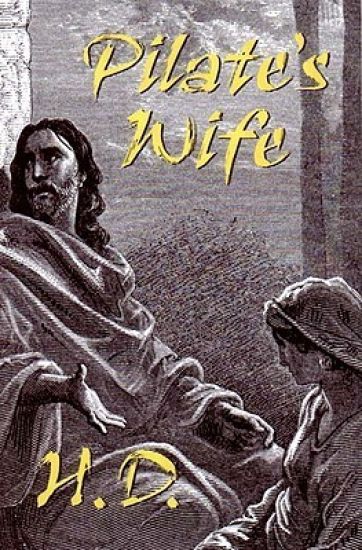
Veronica--Pontius Pilate's wife--is beautiful, brilliant, and weary of a life spent in her boudoir and the Roman court. When one of her lovers sends her disguised as a servant to a seer, she feels suddenly alive, experiencing "sudden pre-visions of inner splendor." The seer, Mnevis, arouses the artist, the dreamer in her, eventually telling her of a Jew, a "love-god," who believes women have an important place in the spiritual hierarchy. What follows is a chain of events in which Veronica commits the one genuine act of her life, offering Jesus a "way out" before his crucifixion.This revision of biblical history--in the tradition of D. H. Lawrence's The Man Who Died and Kazantzakis's The Last Temptation of Christ--is not just a novel; but part of the ongoing dialogue about the feminine and divine. Pilate's Wife was written by H.D. in 1929, revised in 1934, and is now finally published by New Directions, edited with an introduction by H.D. scholar Joan Burke. It is a testament to Alicia Ostriker's claim that, among the women poets and novelists of this century, "H.D. is the most profoundly religious, the most seriously engaged in spiritual quest."
Hippolytus Temporizes & Ion: Adaptations of Two Plays by Euripides

Hippolytus Temporizes & Ion: Adaptations of Two Plays by Euripides

Hilda Doolittle

NEW DIRECTIONS PUBLISHING CORPORATION
2003
nidottu
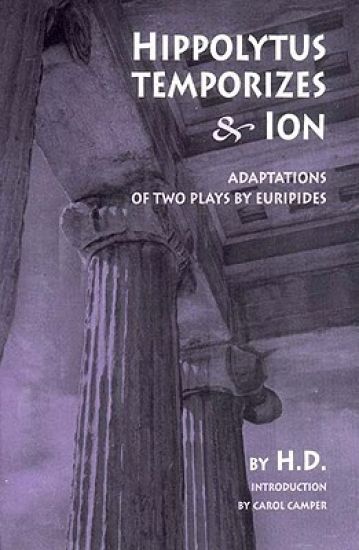
Brilliant reworkings of Euripides' classic dramas by the great modernist poet H.D., now available in one volume. H.D.'s 1927 adaptation of Euripides's Hippolytus Temporizes and her 1937 translation of Ion appeared midpoint in her career. These two verse dramas can both be considered as "freely adapted" from plays by Euripides; they constitute a commentary in action, and in this regard resemble the Oedipus plays of W. B. Yeats and Ezra Pound's Women of Trachis. In the first play, the young man Hippolytus is obsessed with the virgin goddess Artemis and discovers the depth of his passion with the sensual Phaedra, his disguised stepmother: this experience brings self-knowledge and death. The heroine Kreousa in Ion attempts to poison Ion when she fails to recognize him as her son by Apollo and sees instead an outsider and possible usurper of her throne. H.D.'s translations of the Greek were greatly admired by T. S. Eliot. In her reworkings, she creates modern versions of classic plays, enabling her to explore her favorite poetic themes. Sigmund Freud (with whom H.D. was undergoing analysis just before she embarked on Ion) commended her translations; and after writing them, H.D. was able to go on to write Helen in Egypt, "a sweeping epic of healing and integration." These marvelous versions attest to H.D.'s claim that "the lines of this Greek poet (and all Greek poets if we have but the clue) are today as vivid and as fresh as they ever were."