Kirjojen hintavertailu. Mukana 11 213 693 kirjaa ja 12 kauppaa.

Kirjahaku

Etsi kirjoja tekijän nimen, kirjan nimen tai ISBN:n perusteella.

1000 tulosta hakusanalla Horace Stapfer

La Kinésithérapie Gynécologique: Traitement Des Maladies Des Femmes Par Le Massage
La kinesitherapie gynecologique: traitement des maladies des femmes par le massage et la gymnastique (systeme de Brandt) / par H. Stapfer, ...Date de l'edition originale: 1899"Collection: L'oeuvre medico-chirurgical; N 16"Ce livre est la reproduction fidele d une uvre publiee avant 1920 et fait partie d une collection de livres reimprimes a la demande editee par Hachette Livre, dans le cadre d un partenariat avec la Bibliotheque nationale de France, offrant l opportunite d acceder a des ouvrages anciens et souvent rares issus des fonds patrimoniaux de la BnF.Les uvres faisant partie de cette collection ont ete numerisees par la BnF et sont presentes sur Gallica, sa bibliotheque numerique.En entreprenant de redonner vie a ces ouvrages au travers d une collection de livres reimprimes a la demande, nous leur donnons la possibilite de rencontrer un public elargi et participons a la transmission de connaissances et de savoirs parfois difficilement accessibles.Nous avons cherche a concilier la reproduction fidele d un livre ancien a partir de sa version numerisee avec le souci d un confort de lecture optimal. Nous esperons que les ouvrages de cette nouvelle collection vous apporteront entiere satisfaction.Pour plus d informations, rendez-vous sur www.hachettebnf.fr"
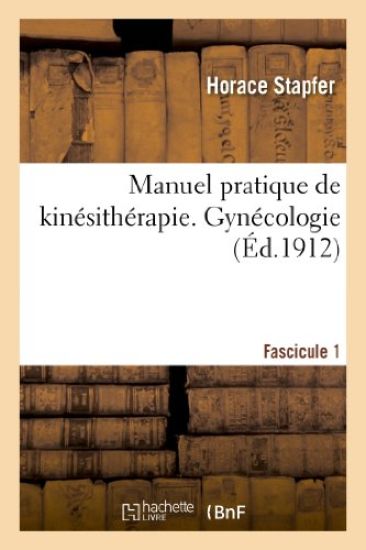
Manuel Pratique de Kinésithérapie. Gynécologie. Fascicule 1
Manuel pratique de kinesitherapie... Fascicule II. H. Stapfer. Gynecologie. Fascicule 1Date de l'edition originale: 1912Ce livre est la reproduction fidele d une uvre publiee avant 1920 et fait partie d une collection de livres reimprimes a la demande editee par Hachette Livre, dans le cadre d un partenariat avec la Bibliotheque nationale de France, offrant l opportunite d acceder a des ouvrages anciens et souvent rares issus des fonds patrimoniaux de la BnF.Les uvres faisant partie de cette collection ont ete numerisees par la BnF et sont presentes sur Gallica, sa bibliotheque numerique.En entreprenant de redonner vie a ces ouvrages au travers d une collection de livres reimprimes a la demande, nous leur donnons la possibilite de rencontrer un public elargi et participons a la transmission de connaissances et de savoirs parfois difficilement accessibles.Nous avons cherche a concilier la reproduction fidele d un livre ancien a partir de sa version numerisee avec le souci d un confort de lecture optimal. Nous esperons que les ouvrages de cette nouvelle collection vous apporteront entiere satisfaction.Pour plus d informations, rendez-vous sur www.hachettebnf.fr
Manuel Pratique de Kinésithérapie. Gynécologie. Fascicule 2
Manuel pratique de kinesitherapie... Fascicule II. H. Stapfer. Gynecologie. Fascicule 2Date de l'edition originale: 1912Ce livre est la reproduction fidele d une uvre publiee avant 1920 et fait partie d une collection de livres reimprimes a la demande editee par Hachette Livre, dans le cadre d un partenariat avec la Bibliotheque nationale de France, offrant l opportunite d acceder a des ouvrages anciens et souvent rares issus des fonds patrimoniaux de la BnF.Les uvres faisant partie de cette collection ont ete numerisees par la BnF et sont presentes sur Gallica, sa bibliotheque numerique.En entreprenant de redonner vie a ces ouvrages au travers d une collection de livres reimprimes a la demande, nous leur donnons la possibilite de rencontrer un public elargi et participons a la transmission de connaissances et de savoirs parfois difficilement accessibles.Nous avons cherche a concilier la reproduction fidele d un livre ancien a partir de sa version numerisee avec le souci d un confort de lecture optimal. Nous esperons que les ouvrages de cette nouvelle collection vous apporteront entiere satisfaction.Pour plus d informations, rendez-vous sur www.hachettebnf.fr
The Satires of Horace and Persius

The Satires of Horace and Persius

Horace

Penguin Classics
2005
pokkari
The Satires of Horace (65-8 BC), written in the troubled decade ending with the establishment of Augustus' regime, provide an amusing treatment of men's perennial enslavement to money, power, glory and sex. Epistles I, addressed to the poet's friends, deals with the problem of achieving contentment amid the complexities of urban life, while Epistles II and the Ars Poetica discuss Latin poetry - its history and social functions, and the craft required for its success. Both works have had a powerful influence on later Western literature, inspiring poets from Ben Jonson and Alexander Pope to W. H. Auden and Robert Frost. The Satires of Persius (AD 34-62) are highly idiosyncratic, containing a courageous attack on the poetry and morals of his wealthy contemporaries - even the ruling emperor, Nero.
Horace

Horace

Llewelyn Morgan

Oxford University Press
2023
nidottu
Very Short Introductions: Brilliant, Sharp, Inspiring Horace was one of the greatest poets during the reign of Augustus and is seen as a mark of cultural sophistication since this time. This Very Short Introduction examines how Horace's poetry has exerted enormous influence but argues that it is best understood within the traditions of ancient literature. Llewellyn Morgan guides the reader through the dizzying vagaries of Horace's biography, which reflects the political and social instability of the period. His poetry, and the life he artfully constructs and presents to us in it, engages both with the greatest crisis that Rome had ever faced, and its resolution by the first Emperor. Horace is Rome's laureate, and through him we experience the anxieties and triumphs of his age. For posterity, Horace has served for a model of the good life, a promoter of enlightened retirement, but has also exemplified poetic artistry, and is the most creative manipulator of the Latin language, even among his remarkable contemporaries. ABOUT THE SERIES: The Very Short Introductions series from Oxford University Press contains hundreds of titles in almost every subject area. These pocket-sized books are the perfect way to get ahead in a new subject quickly. Our expert authors combine facts, analysis, perspective, new ideas, and enthusiasm to make interesting and challenging topics highly readable.
Horace: Odes I: Carpe Diem

Horace: Odes I: Carpe Diem

Horace

Clarendon Press
1995
sidottu
Horace is a great poet, much loved and imitated in the past, and in recent years much better understood as a result of the learned commentaries of Nisbet and Hubbard (1970, 1978). and Syndikus (1972, 1973). Yet today he is little read. This is partly because he had never been translated into English which is both close to the Latin and readable. The aim of this book is to provide such a translation and support it by a basic commentary which will help newcomers to Horace, whether or not they know any Latin, to understand how the poetry works. It should also stimulate and provoke students of Latin and of Roman history by propounding interpretations which are not always in line with current orthodoxies.
Horace: Odes I: Carpe Diem

Horace: Odes I: Carpe Diem

Horace

Clarendon Press
1995
nidottu
Horace is the greatest Latin lyric poet, and certainly the most influential. This book provides a new translation of the famous first book of Odes which is both accurate and readable, supported by a basic commentary for students showing how the poems work. The book includes the Oxford Classical Text edition of the Latin text. This book is intended for students, mainly undergraduate but some sixth form, of Latin Literature on Classics courses and Classics and English courses. Latin text with translation and commentary by: West, David (Professor Emeritus of Latin, University of Newcastle);
Horace: Odes II: Vatis Amici

Horace: Odes II: Vatis Amici

Horace

Clarendon Press
1998
sidottu
In these odes Horace creates lyric poetry in Latin which stands comparison with anything written by his brilliant predecessors in Greek. Of the three books published together in 23 BC the second is in many ways the most rewarding. The first ode, for instance, looks back at the civil wars fought by Caesar and Pompey, and by Octavian and Antony, from the point of view of Horace and his friend Pollio who both took part in them. There are also poems of friendship which give insight into the social and intellectual tone of the age of the first Roman emperor Augustus, and Horace's unique, elusive sense of humour is in evidence throughout. This book contains the Latin text (from the Oxford Classical Text), a translation which attempts to be close to the Latin while catching as much as possible of the flavour of the original, and a commentary which tries to suggest how these poems work as poetry.
Horace: Odes II: Vatis Amici

Horace: Odes II: Vatis Amici

Horace

Clarendon Press
1998
nidottu
In these odes Horace creates lyric poetry in Latin which stands comparison with anything written by his brilliant predecessors in Greek. Of the three books published together in 23 BC the second is in many ways the most rewarding. The first ode, for instance, looks back at the civil wars fought by Caesar and Pompey, and by Octavian and Antony, from the point of view of Horace and his friend Pollio who both took part in them. There are also poems of friendship which give insight into the social and intellectual tone of the age of the first Roman emperor Augustus, and Horace's unique, elusive sense of humour is in evidence throughout. This book contains the Latin text (from the Oxford Classical Text), a translation which attempts to be close to the Latin while catching as much as possible of the flavour of the original, and a commentary which tries to suggest how these poems work as poetry.
Horace

Horace

David Armstrong

Yale University Press
1990
pokkari
Among the greatest names in Roman—and European—poetry has always been that of Horace. Through all the centuries since his death in 8 B.C., his superb poetic craftsmanship has remained unassailable. Yet the full range and depth of his humanity continue to prove curiously elusive, especially for the nonspecialist reader to whom above all this book is directed. In the days when Latin was generally read, Horace was too often seen as the poet of establishments, whether the establishment involved was the imperial Roman court, the aristocracy of Augustan England, or the nineteenth-century educational system, and something of that reputation has lingered on even into our own day. To see him thus is the entire aim of David Armstrong’s new study. From it emerges not just the illustrious master (“famous, calm, and dead”) in the arts of lyric and satiric poetry, but the freedman’s son who struggled through the terrible upheavals of the collapsing Roman Republic to become, by sheer force of genius, a member of the brilliant circle surrounding the Emperor Augustus. To the very end of that adventurous career on the fringes of power, Horace retained an extraordinary candor, independence, and common sense. It is as the ultimate critic and connoisseur, not merely of literature but also of love and life itself, that he surveys the Augustan scene: the tragicomedy of bisexual politics in the demi-monde, the pretentious fashions of middle-class dinner parties, the pomposity of jurists and philosophers, the idiocies of the literati, and not least the grandeur and terror of a novel political entity—an empire almost coextensive with the known world. The poetry thus restored to life proves to be a poetry for all thinking and feeling people.
Horace

Horace

R. O. A. M. Lyne

Yale University Press
2013
pokkari
This fascinating study of one of the greatest poets of the Augustan Age sheds new light on Horace's works by the way it combines literary analysis with investigation into the poet's social and political circumstances.Lyne's personal and historical approach focuses on the poet's relations with his patron Maecenas, with the Emperor Augustus, and with other grandees. Closely analyzing poems from Satires, Odes, and Epistles, Lyne reveals not only the magnificence of Horace's public literature, but the private man behind it. He shows how Horace neatly balanced deference with the careful assertion of his own social and political standing.According to Lyne, Horace was a master of private insinuation, as well as a skilled maker of public poetry. He was also a master in the art of ordering his works: exactly where a poem occurs is often of the subtlest importance. Lyne also examines the resumption of the great political lyric in the Odes of Book 4 (set aside in 23 B.C.), and contends that, beneath the public face, Horace here exhibited resentment, recording views that undermined earlier patriotic statements.
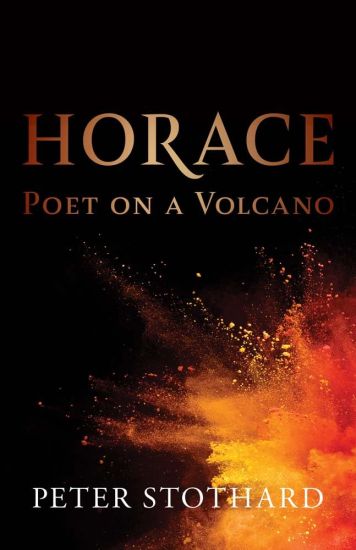
Horace

Horace

Peter Stothard

YALE UNIVERSITY PRESS
2025
sidottu
A biography of Horace, one of the most popular poets from antiquity, revealing the little-known man behind his famous lines “Peter Stothard is a master of modern writing about ancient Rome, of vividly bringing to life its poetry and its poets.”—Mary Beard Quintus Horatius Flaccus (65–8 BCE) wrote some of ancient Rome’s greatest poetry, melding languages and cultures with youthful ideals and a realist’s recognition of the dictatorial world around him. Horace is famed for his fine phrases, lyric sex, and guidance on how to live, but he was a poet maddened by war, and many of his most self-revealing poems have rarely been read. He could be sublime and obscene, amusing and abusive, a model of moderation and anything but. In this book, the first modern retelling of Horace’s life, Peter Stothard follows the poet from his birth as the son of a formerly enslaved father through his rise to the highest circles of Roman society. He shines a light on how shattering experiences in the war to save Rome’s republic shaped the loyal servant and revolutionary artist he became. With astute scholarship and sympathy, Stothard follows Horace’s rise from humble beginnings to the social and political heights of the autocracy he had fought to prevent.
The Epistles of Horace (Bilingual Edition)

The Epistles of Horace (Bilingual Edition)

Horace

Farrar, Straus and Giroux
2002
nidottu
My aim is to take familiar things and makePoetry of them, and do it in such a wayThat it looks as if it was as easy as could beFor anybody to do it . . . the power of makingA perfectly wonderful thing out of nothing much.--from "The Art of Poetry" When David Ferry's translation of The Odes of Horace appeared in 1997, Bernard Knox, writing in The New York Review of Books, called it "a Horace for our times." Now Ferry has translated Horace's two books of Epistles, in which Horace perfected the conversational verse medium that gives his voice such dazzling immediacy, speaking in these letters with such directness, wit, and urgency to young writers, to friends, to his patron Maecenas, to Emperor Augustus himself. It is the voice of a free man, talking about how to get along in a Roman world full of temptations, opportunities, and contingencies, and how to do so with one's integrity intact. Horace's world, so unlike our own and yet so like it, comes to life in these poems. And there are also the poems -- the famous "Art of Poetry" and others -- about the tasks and responsibilities of the writer: truth to the demands of one's medium, fearless clear-sighted self-knowledge, and unillusioned, uncynical realism, joyfully recognizing the world for what it is.
Horace

Horace

Chris D'Lacey

Penguin Random House Children's UK
2004
pokkari
That's what's written on the label attached to the old teddy bear Joel finds in a skip. It's exactly what his cash-strapped family need - but how does Joel feel about the possible sudden wealth? He's got enough to cope with already - what with dealing with his family and with his first-ever girlfriend-
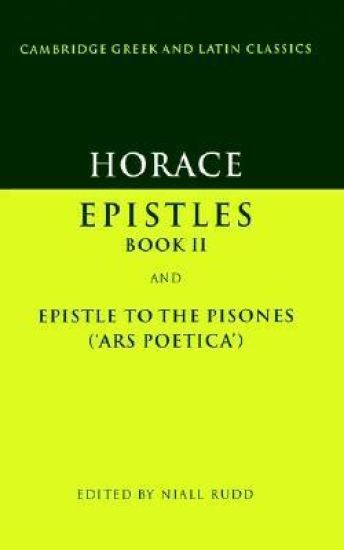
Horace: Epistles Book II and Ars Poetica

Horace: Epistles Book II and Ars Poetica

Horace

Cambridge University Press
1989
pokkari
This commentary fulfils the need for a student edition of Horace’s literary epistles, which have recently been the subject of renewed scholarly interest. Professor Rudd provides a clear introduction to each of the three poems: the Epistles to Augustus, to Florus, and to the Pisones (the so-called ‘Ars Poetica’). He sketches the historical context in which the poems were written, and comments on their structure and purpose. Attention is paid to the literary preoccupations of the individual epistles: the relations of poet and patron, and the role of poetry in the state (Augustus), the problems of a (professedly) tiring poet (Florus), and the presentation of classical poetic theory in the ‘Ars Poetica’. Horace’s influence on later criticism is noted, and there is a brief section on one of Alexander Pope’s Imitations. In his commentary on the text Professor Rudd addresses problems of grammar and style, focusing on linguistic difficulties and on the subtle movement of the poet’s thought.
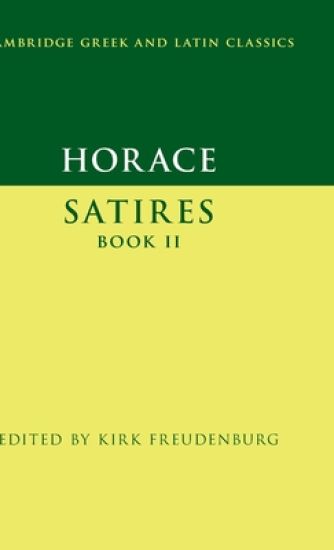
Horace: Satires Book II

Horace: Satires Book II

Horace

Cambridge University Press
2021
sidottu
The satires explored in this volume are some of the trickiest poems of ancient Rome's trickiest poet. Horace was an ironist, sneaky smart, and prone to hiding things under the surface. His Latin is dense and difficult. The challenges posed by these satires are especially acute because their voices, messages, and stylistic habits are many, and their themes range from the poet's anxieties about the limits of satiric free speech in the first poem to the ridiculous excesses of an outrageously overdone dinner party in the last. For students working at intermediate and advanced levels of Latin, this book makes the satires of Horace's second book of Sermones readable by explaining difficult issues of grammar, syntax, word-choice, genre, period, and style. For scholars who already know these poems well, it offers fresh insights into what satire is, and how these poems communicate as uniquely 'Horatian' expressions of the genre.