Kirjojen hintavertailu. Mukana 11 244 527 kirjaa ja 12 kauppaa.

Kirjahaku

Etsi kirjoja tekijän nimen, kirjan nimen tai ISBN:n perusteella.

1000 tulosta hakusanalla Ian Bogost

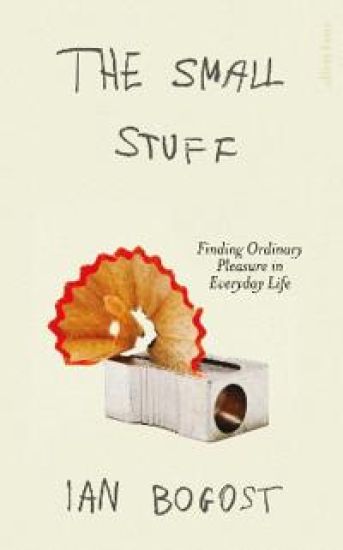
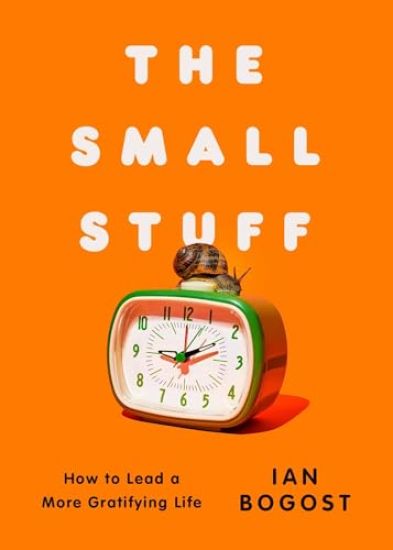
The Small Stuff

The Small Stuff

Ian Bogost

PENGUIN BOOKS LTD
2026
sidottu
In an era dominated by convenience and efficiency, you’d think life would be simpler, easier and, most importantly, happier. After all, shouldn’t all the time saved with technology leave us with more time for ourselves? The Atlantic columnist, game-designer and academic Ian Bogost thinks not. From QR code menus and digital tickets to automated self-checkout counters, he argues that the simple pleasures of daily life have been stripped away, replaced by sleek, but soulless, design. Through engaging anecdotes and sharp analysis, Bogost uncovers how modern conveniences not only fail to deliver on their promises but also rob us of small, satisfying tasks and moments that keep us grounded and human. By reframing how we approach ordinary interactions, Bogost shows us how we can transform our view of the material world, from merely utilitarian into a site of joy and gratification. Humorous, thought-provoking, and practical, The Small Stuff is a manifesto for reuniting and re-enchanting us with the world we inhabit, by observing and enjoying the small moments that make up our lives.
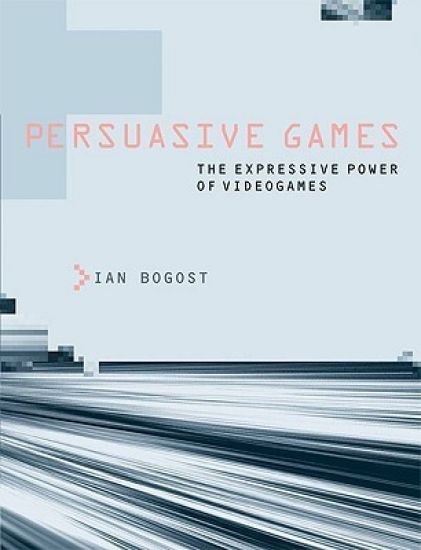
Persuasive Games

Persuasive Games

Ian Bogost

MIT Press
2010
pokkari
An exploration of the way videogames mount arguments and make expressive statements about the world that analyzes their unique persuasive power in terms of their computational properties.Videogames are an expressive medium, and a persuasive medium; they represent how real and imagined systems work, and they invite players to interact with those systems and form judgments about them. In this innovative analysis, Ian Bogost examines the way videogames mount arguments and influence players. Drawing on the 2,500-year history of rhetoric, the study of persuasive expression, Bogost analyzes rhetoric's unique function in software in general and videogames in particular. The field of media studies already analyzes visual rhetoric, the art of using imagery and visual representation persuasively. Bogost argues that videogames, thanks to their basic representational mode of procedurality (rule-based representations and interactions), open a new domain for persuasion; they realize a new form of rhetoric. Bogost calls this new form "procedural rhetoric," a type of rhetoric tied to the core affordances of computers: running processes and executing rule-based symbolic manipulation. He argues further that videogames have a unique persuasive power that goes beyond other forms of computational persuasion. Not only can videogames support existing social and cultural positions, but they can also disrupt and change these positions themselves, leading to potentially significant long-term social change. Bogost looks at three areas in which videogame persuasion has already taken form and shows considerable potential: politics, advertising, and learning.
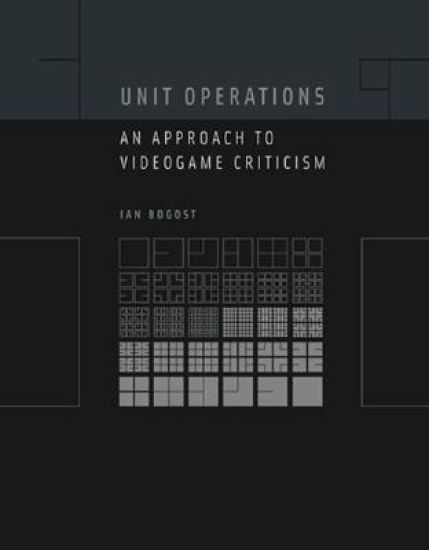
Unit Operations

Unit Operations

Ian Bogost

MIT Press
2008
pokkari
In Unit Operations, Ian Bogost argues that similar principles underlie both literary theory and computation, proposing a literary-technical theory that can be used to analyze particular videogames. Moreover, this approach can be applied beyond videogames: Bogost suggests that any medium-from videogames to poetry, literature, cinema, or art-can be read as a configurative system of discrete, interlocking units of meaning, and he illustrates this method of analysis with examples from all these fields. The marriage of literary theory and information technology, he argues, will help humanists take technology more seriously and hep technologists better understand software and videogames as cultural artifacts. This approach is especially useful for the comparative analysis of digital and nondigital artifacts and allows scholars from other fields who are interested in studying videogames to avoid the esoteric isolation of "game studies."The richness of Bogost's comparative approach can be seen in his discussions of works by such philosophers and theorists as Plato, Badiou, Zizek, and McLuhan, and in his analysis of numerous videogames including Pong, Half-Life, and Star Wars Galaxies. Bogost draws on object technology and complex adaptive systems theory for his method of unit analysis, underscoring the configurative aspects of a wide variety of human processes. His extended analysis of freedom in large virtual spaces examines Grand Theft Auto 3, The Legend of Zelda, Flaubert's Madame Bovary, and Joyce's Ulysses. In Unit Operations, Bogost not only offers a new methodology for videogame criticism but argues for the possibility of real collaboration between the humanities and information technology.
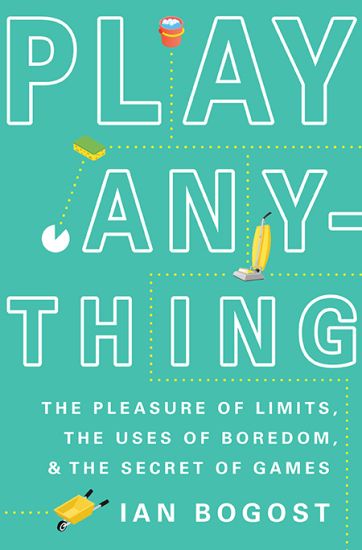
Play Anything

Play Anything

Ian Bogost

Basic Books
2016
sidottu
Play Anything is nothing short of brilliant... I will be recommending this provocative and entertaining book to everyone I know." u- Jane McGonigal, bestselling author of Reality is Broken and SuperBetter ife is boring: filled with meetings and traffic, errands and emails. Nothing we'd ever call fun . But what if we've gotten fun wrong? In Play Anything, visionary game designer and philosopher Ian Bogost shows how we can overcome our daily anxiety transforming the boring, ordinary world around us into one of endless, playful possibilities.The key to this playful mindset lies in discovering the secret truth of fun and games. Play Anything, reveals that games appeal to us not because they are fun, but because they set limitations . Soccer wouldn't be soccer if it wasn't composed of two teams of eleven players using only their feet, heads, and torsos to get a ball into a goal Tetris wouldn't be Tetris without falling pieces in characteristic shapes. Such rules seem needless, arbitrary, and difficult. Yet it is the limitations that make games enjoyable, just like it's the hard things in life that give it meaning. Play is what happens when we accept these limitations, narrow our focus, and, consequently, have fun. Which is also how to live a good life. Manipulating a soccer ball into a goal is no different than treating ordinary circumstances, like grocery shopping, lawn mowing, and making PowerPoints,as sources for meaning and joy. We can play anything" by filling our days with attention and discipline, devotion and love for the world as it really is, beyond our desires and fears.Ranging from Internet culture to moral philosophy, ancient poetry to modern consumerism, Bogost shows us how today's chaotic world can only be tamed,and enjoyed,when we first impose boundaries on ourselves. "An essential read for those seeking to understand how a new idea of play can be positive for our lives." u- Library Journal (STARRED review) /u Play Anything is a profound book: both a striking assessment of our current cultural landscape, and at the same time a smart self-improvement guide, teaching us the virtues of a life lived playfully." u- Steven Johnson, author of How We Got To Now and Everything Bad Is Good For You /u
How to Do Things with Videogames

How to Do Things with Videogames

Ian Bogost

University of Minnesota Press
2011
nidottu
In recent years, computer games have moved from the margins of popular culture to its center. Reviews of new games and profiles of game designers now regularly appear in the New York Times and the New Yorker, and sales figures for games are reported alongside those of books, music, and movies. They are increasingly used for purposes other than entertainment, yet debates about videogames still fork along one of two paths: accusations of debasement through violence and isolation or defensive paeans to their potential as serious cultural works. In How to Do Things with Videogames, Ian Bogost contends that such generalizations obscure the limitless possibilities offered by the medium’s ability to create complex simulated realities. Bogost, a leading scholar of videogames and an award-winning game designer, explores the many ways computer games are used today: documenting important historical and cultural events; educating both children and adults; promoting commercial products; and serving as platforms for art, pornography, exercise, relaxation, pranks, and politics. Examining these applications in a series of short, inviting, and provocative essays, he argues that together they make the medium broader, richer, and more relevant to a wider audience.Bogost concludes that as videogames become ever more enmeshed with contemporary life, the idea of gamers as social identities will become obsolete, giving rise to gaming by the masses. But until games are understood to have valid applications across the cultural spectrum, their true potential will remain unrealized. How to Do Things with Videogames offers a fresh starting point to more fully consider games’ progress today and promise for the future.
Alien Phenomenology, or What It's Like to Be a Thing

Alien Phenomenology, or What It's Like to Be a Thing

Ian Bogost

University of Minnesota Press
2012
nidottu
Humanity has sat at the center of philosophical thinking for too long. The recent advent of environmental philosophy and posthuman studies has widened our scope of inquiry to include ecosystems, animals, and artificial intelligence. Yet the vast majority of the stuff in our universe, and even in our lives, remains beyond serious philosophical concern. In Alien Phenomenology, or What It’s Like to Be a Thing, Ian Bogost develops an object-oriented ontology that puts things at the center of being-a philosophy in which nothing exists any more or less than anything else, in which humans are elements but not the sole or even primary elements of philosophical interest. And unlike experimental phenomenology or the philosophy of technology, Bogost’s alien phenomenology takes for granted that all beings interact with and perceive one another. This experience, however, withdraws from human comprehension and becomes accessible only through a speculative philosophy based on metaphor.Providing a new approach for understanding the experience of things as things, Bogost also calls on philosophers to rethink their craft. Drawing on his own background as a videogame designer, Bogost encourages professional thinkers to become makers as well, engineers who construct things as much as they think and write about them.
How to Talk about Videogames

How to Talk about Videogames

Ian Bogost

University of Minnesota Press
2015
nidottu
Videogames! Aren’t they the medium of the twenty-first century? The new cinema? The apotheosis of art and entertainment, the realization of Wagnerian gesamtkunstwerk? The final victory of interaction over passivity? No, probably not. Games are part art and part appliance, part tableau and part toaster. In How to Talk about Videogames, leading critic Ian Bogost explores this paradox more thoroughly than any other author to date.Delving into popular, familiar games like Flappy Bird, Mirror’s Edge, Mario Kart, Scribblenauts, Ms. Pac-Man, FarmVille, Candy Crush Saga, Bully, Medal of Honor, Madden NFL, and more, Bogost posits that videogames are as much like appliances as they are like art and media. We don’t watch or read games like we do films and novels and paintings, nor do we perform them like we might dance or play football or Frisbee. Rather, we do something in-between with games. Games are devices we operate, so game critique is both serious cultural currency and self-parody. It is about figuring out what it means that a game works the way it does and then treating the way it works as if it were reasonable, when we know it isn’t.Noting that the term games criticism once struck him as preposterous, Bogost observes that the idea, taken too seriously, risks balkanizing games writing from the rest of culture, severing it from the “rivers and fields” that sustain it. As essential as it is, he calls for its pursuit to unfold in this spirit: “God save us from a future of games critics, gnawing on scraps like the zombies that fester in our objects of study.”
The Geek's Chihuahua

The Geek's Chihuahua

Ian Bogost

University of Minnesota Press
2015
pokkari
At dinnertime: check. At a traffic light: check. In bed at the end of the day: check. In line at the coffee shop: check. In The Geek’s Chihuahua, Ian Bogost addresses the modern love affair of “living with Apple” during the height of the company’s market influence and technology dominance. The ubiquitous iPhone and its kin saturate our lives, changing everything from our communication to our posture. Bogost contrasts the values of Apple’s massive success in the twenty-first century with those of its rise in the twentieth. And he connects living with Apple with the phenomenon of “hyperemployment”-the constant overwork of today’s technological life that all of us now experience. Bogost also reflects on the new potential function-as well as anxiety and anguish-of devices like the Apple Watch. We are tethered to our devices, and, as Bogost says: that’s just life-anxious, overworked, and utterly networked life. Forerunners: Ideas First is a thought-in-process series of breakthrough digital publications. Written between fresh ideas and finished books, Forerunners draws on scholarly work initiated in notable blogs, social media, conference plenaries, journal articles, and the synergy of academic exchange. This is gray literature publishing: where intense thinking, change, and speculation take place in scholarship.
The Small Stuff: How to Lead a More Gratifying Life
From popular The Atlantic columnist Ian Bogost, a lively reflection about how we've become disconnected from the physical world--and how to reclaim joy and gratification in your day-to-day life. In an era dominated by convenience and efficiency, one would think that life would be simpler, easier, and most importantly, happier. After all, shouldn't all the time saved with machines and technology leave us with more time for ourselves? The Atlantic columnist Ian Bogost thinks not. From QR code menus and digital tickets to automated self-checkout counters, he argues that the simple pleasures of daily life have been stripped away, replaced by sleek, but soulless, design. Through engaging anecdotes and sharp analysis, Bogost uncovers how modern conveniences not only fail to deliver on their promises but also rob us of small, satisfying tasks and moments that keep us grounded and human. He challenges us to rethink our daily interactions with the material world and illuminates how the loss of these tangible interactions has contributed to widespread feelings of disconnection and dissatisfaction. But all hope is not lost. Bogost guides us to identify and appreciate the overlooked joys hidden in everyday life. By reforming how we approach ordinary tasks, we can rediscover the gratification embedded in the tactile world around us. Humorous, thought-provoking, and practical, The Small Stuff reveals that finding joy isn't about achieving monumental happiness or prolonged satisfaction. It's about doing small things, deliberately and with attention, to unlock the basic pleasures that flavor our daily lives.
Racing the Beam

Racing the Beam

Nick Montfort; Ian Bogost

MIT Press
2020
pokkari
A study of the relationship between platform and creative expression in the Atari VCS. The Atari Video Computer System dominated the home video game market so completely that “Atari” became the generic term for a video game console. The Atari VCS was affordable and offered the flexibility of changeable cartridges. Nearly a thousand of these were created, the most significant of which established new techniques, mechanics, and even entire genres. This book offers a detailed and accessible study of this influential video game console from both computational and cultural perspectives. Studies of digital media have rarely investigated platforms—the systems underlying computing. This book (the first in a series of Platform Studies) does so, developing a critical approach that examines the relationship between platforms and creative expression. Nick Montfort and Ian Bogost discuss the Atari VCS itself and examine in detail six game cartridges: Combat, Adventure, Pac-Man, Yars' Revenge, Pitfall!, and Star Wars: The Empire Strikes Back. They describe the technical constraints and affordances of the system and track developments in programming, gameplay, interface, and aesthetics. Adventure, for example, was the first game to represent a virtual space larger than the screen (anticipating the boundless virtual spaces of such later games as World of Warcraft and Grand Theft Auto), by allowing the player to walk off one side into another space; and Star Wars: The Empire Strikes Back was an early instance of interaction between media properties and video games. Montfort and Bogost show that the Atari VCS—often considered merely a retro fetish object—is an essential part of the history of video games.
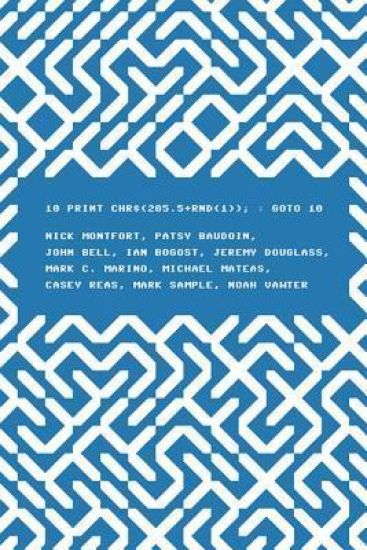
10 PRINT CHR$(205.5+RND(1)); : GOTO 10

10 PRINT CHR$(205.5+RND(1)); : GOTO 10

Nick Montfort; Patsy Baudoin; John Bell; Ian Bogost; Jeremy Douglass; Mark C. Marino; Michael Mateas; Casey Reas; Mark Sample; Noah Vawter

MIT Press
2014
pokkari
A single line of code offers a way to understand the cultural context of computing.This book takes a single line of code-the extremely concise BASIC program for the Commodore 64 inscribed in the title-and uses it as a lens through which to consider the phenomenon of creative computing and the way computer programs exist in culture. The authors of this collaboratively written book treat code not as merely functional but as a text-in the case of 10 PRINT, a text that appeared in many different printed sources-that yields a story about its making, its purpose, its assumptions, and more. They consider randomness and regularity in computing and art, the maze in culture, the popular BASIC programming language, and the highly influential Commodore 64 computer.
Boost Your Confidence With NLP

Boost Your Confidence With NLP

Ian McDermott

Piatkus Books
2010
pokkari
In BOOST YOUR CONFIDENCE WITH NLP, Ian McDermott demonstrates that by practising his five keys to confidence, and using simple and effective Neuro-linguistic Programming (NLP) techniques, you will be able to overcome your fears.BOOST YOUR CONFIDENCE WITH NLP includes easy-to-follow exercises to help you assess your own confidence levels, and then provides step-by-step guidance on how to work on your personal problem areas. Whether you need the strength to say 'yes', or maybe even the courage to say 'no', Ian McDermott will help find the style of confidence that suits the challenges that you are facing. Packed with accessible advice and motivating case histories, BOOST YOUR CONFIDENCE WITH NLP will give you the techniques you need to be confident in yourself and others, and deal with whatever comes your way.
Boost Your Confidence with NLP

Boost Your Confidence with NLP

Ian McDermott

Piatkus Books
2012
nidottu
In BOOST YOUR CONFIDENCE WITH NLP, Ian McDermott demonstrates that by practising his five keys to confidence, and using simple and effective Neuro-linguistic Programming (NLP) techniques, you will be able to overcome your fears. BOOST YOUR CONFIDENCE WITH NLP includes easy-to-follow exercises to help you assess your own confidence levels, and then provides step-by-step guidance on how to work on your personal problem areas. Whether you need the strength to say 'yes', or maybe even the courage to say 'no', Ian McDermott will help find the style of confidence that suits the challenges that you are facing. Packed with accessible advice and motivating case histories, BOOST YOUR CONFIDENCE WITH NLP will give you the techniques you need to be confident in yourself and others, and deal with whatever comes your way.
Gain Self-Confidence Fast with NLP: Effective Neuro-Linguistic Programming Techniques That Will Boost Your Self-Esteem Radically For Successful Life
Do you lack self-confidence to accomplish things in your life you would really like to? -Are you afraid of quitting boring job and finding a new, better one or maybe starting your own business? -Afraid of socializing and meeting new, fascinating and positive people? -Afraid of finally packing your suitcase and going to that Euro-trip you promised yourself decades ago? -Afraid of approaching that beautiful girl sitting on a park bench next to you or accepting a date from that handsome devil you've met lately? -Not feeling worthy enough to ask for a promotion? A sad fact widely known - because of social conditioning and many other factors - most people on this planet are. I know how it feels, I was exactly in the same place . And then I found the way It's high time you did something about it too, because truth be told- self confident people just have it way easier in every aspect of life Now, let me show you few simple and effective Neuro-Linguistic Programming tools that will help you overcome shyness and boost your natural self-confidence level permanently. In This Book I'll Show You: -Basic tools tailor-made for the beginning of your adventure with Neuro-Linguistic Programming... -How to stick to your NLP routine and your personal change plan... -How to minimalize annoying social factors lessening your self-esteem... -The right mindset you should have and how to act to maintain high level of self-confidence and keep growing... -And many, many more Table of Contents: Chapter 1: What Is NLP? Chapter 2: Getting Started On NLP Transformation Chapter 3: NLP During Your Self-Confidence Boost Journey Chapter 4: NLP To Maintain High Self-Confidence Forever And Never Feel Insecure Again Bonus Chapter: When They Say You Can't Do It.... Conclusion - Your Personal Success For Life Take action now Set the beginning of change
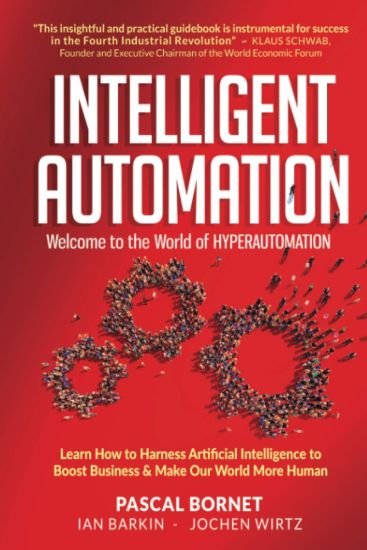
Intelligent Automation: Welcome To The World Of Hyperautomation: Learn How To Harness Artificial Intelligence To Boost Business & Make Our World More Human
'This insightful and practical guidebook is instrumental for success in the Fourth Industrial Revolution.'Klaus SchwabFounder and Executive Chairman of the World Economic Forum 'One of the most important books of our times!'Bernard MarrInternationally bestselling author and strategic business & technology advisorauthor of The Intelligent Company 'An insightful exploration of Intelligent Automation.'Dr Kai-Fu LeeAuthor of New York Times bestseller, AI Superpowers 'Especially helpful are the middle sections, which explain the various technologies on the market, and offer a roadmap for IA transformations. Here, you will learn what these technologies can accomplish - on their own, and combined. The book also recommends leading solution providers on the market, potentially saving you time in vendor selections. Case studies are interspersed throughout, of success stories in industries like banking and retail ... This is a roll-up-your-sleeves primer that anyone can understand. It is broad enough to apply across most Industries and types of organisations, yet specific enough to be of practical use.'The Business Times This book is the first book on the emerging trend of intelligent automation. Also known as hyperautomation, it is a cutting-edge combination of methods and technologies involving people, organizations, machine learning, natural language processing, computer vision, robotic process automation, and more. Accessible for all audiences, this book demonstrates that adopting intelligent automation has now become a condition for business survival. It delves into the technologies leveraged by hyperautomation, new trends relating to the field, and how society and work can be reinvented with intelligent automation.Key Points Covered:What is Intelligent Automation (IA)? What benefits does it unleash for companies, customers and society?How have leading organizations been able to harness the full potential of IA, at scale to generate massive efficiency gains?How can IA save 10+ million lives per year, triple our global budget for education, eliminate hunger, help protect our planet, or increase the resilience of society to pandemics and crises?What you will get from this book:Learn from 100+ IA transformation successes (and failures)Benefit from the largest publicly available library of IA use cases by industry and by business functionGain access to insights garnered from 200+ IA industry expertsRelated Link(s)
Intelligent Automation: Welcome To The World Of Hyperautomation: Learn How To Harness Artificial Intelligence To Boost Business & Make Our World More Human
'This insightful and practical guidebook is instrumental for success in the Fourth Industrial Revolution.'Klaus SchwabFounder and Executive Chairman of the World Economic Forum 'One of the most important books of our times!'Bernard MarrInternationally bestselling author and strategic business & technology advisorauthor of The Intelligent Company 'An insightful exploration of Intelligent Automation.'Dr Kai-Fu LeeAuthor of New York Times bestseller, AI Superpowers 'Especially helpful are the middle sections, which explain the various technologies on the market, and offer a roadmap for IA transformations. Here, you will learn what these technologies can accomplish - on their own, and combined. The book also recommends leading solution providers on the market, potentially saving you time in vendor selections. Case studies are interspersed throughout, of success stories in industries like banking and retail ... This is a roll-up-your-sleeves primer that anyone can understand. It is broad enough to apply across most Industries and types of organisations, yet specific enough to be of practical use.'The Business Times This book is the first book on the emerging trend of intelligent automation. Also known as hyperautomation, it is a cutting-edge combination of methods and technologies involving people, organizations, machine learning, natural language processing, computer vision, robotic process automation, and more. Accessible for all audiences, this book demonstrates that adopting intelligent automation has now become a condition for business survival. It delves into the technologies leveraged by hyperautomation, new trends relating to the field, and how society and work can be reinvented with intelligent automation.Key Points Covered:What is Intelligent Automation (IA)? What benefits does it unleash for companies, customers and society?How have leading organizations been able to harness the full potential of IA, at scale to generate massive efficiency gains?How can IA save 10+ million lives per year, triple our global budget for education, eliminate hunger, help protect our planet, or increase the resilience of society to pandemics and crises?What you will get from this book:Learn from 100+ IA transformation successes (and failures)Benefit from the largest publicly available library of IA use cases by industry and by business functionGain access to insights garnered from 200+ IA industry expertsRelated Link(s)
Ian

Ian

Elizabeth Rose

Createspace Independent Publishing Platform
2015
nidottu
◆ He never meant to fall in love with his best friend's sister ◆Ian MacKeefe is haunted by the demons in his head, taunting him of his tarnished past. On All Hallows' Eve he sees the face of a man in the fire. It is the image of an enemy he's killed and buried three years earlier. It is a disturbing thought since this is the night when supposedly the veil between two worlds is the thinnest and the dead can come back to life.Kyla has taken a liking to Ian, but she is his best friend's sister. They've grown up together, but now she is a woman and has caught his eye, or at least she hopes she has. Ian shouldn't be having feelings for Kyla and it scares him. If Aidan finds out, he'll have Ian's head. Meaning to frighten the girl off the way he's done in the past, Ian kisses Kyla, but it only makes things worse since she seems to be attracted to him as well.When Ian is asked to escort Kyla home, his past comes back to haunt him. He hears rumors that Tearlach MacTavish, the man he killed, has come back to life and is looking for an alliance with the MacKeefes in the form of a bride. No one, especially a man who should be dead, is going to take Kyla away from Ian. He will give his life to protect her. That is, if his past doesn't stop him first.Can Ian face his past before it's too late, now that he realizes Kyla is so much more to him than just his best friend's wee sister? Will true love give him the strength to set things right, and this time keep his dead enemies in the ground where they belong?