Ife: My Name Means Love is about the journey of my life in America. I moved to America when I was five years old. I had a usual name, and I spoke with an accent. The book is about me finding a love for my name and the obstacles I have overcome while living my first-generation immigrant life. Author, Ife Alicto
Bukola Adeyemi Oyeniyi examines the complex interplay of history, culture, and politics that have shaped the longstanding conflict between the Ife and Modakeke communities in Nigeria.This book argues that the roots of this conflict extend beyond immediate sociopolitical grievances and are deeply entwined with historical legacies and cultural divergences that have evolved over centuries. Using archival materials, oral histories, and contemporary narratives, Oyeniyi illustrates how colonial legacies, ethnic identities, and local power dynamics have contributed to ongoing tensions. The analysis reveals how historical grievances are often reframed in contemporary contexts, influencing community relations and political alignments. Ultimately, this book sheds light on the necessity of understanding historical contexts to address current conflicts, offering insights into conflict resolution and peacebuilding strategies that are informed by a nuanced grasp of local histories and cultural identities. This book contributes significantly to the broader discourse on conflict in Nigeria and Africa, emphasizing the importance of historical awareness in contemporary sociopolitical landscapes.
Self love, rejection, and fear of abandonment are some of the themes confronted in this collection of poems. The collection chronicles flawed love affairs and explores healing through learning self love. What do you do when the only option left is to love yourself? The collection was written with the intention of supporting others on their journey to healing.
This book of poetry is the second part of 5 books of poem series collection. It was written with the intention to show my daughter a part of her from my point of view and the experiences she has shown me in just a short period of her life and the journey that lies ahead of us. There are 8 chapters: Ravira, Ife, Bello, Secret Water, Life, Ojo (Days), Sun, and Pisces; the books includes songs written and inspired by her from my album: 1. Written In Our Blood, 2. Lost In Her Love, 3. Sweet Baby Love, 4. I Have To Be There, 5. Always Here & Always There. Some of the poems address the issue of time and how it changes base on your needs, expectations, and situations. How fatherhood has changed my time and life, how being a father changes the way I see my own father and mother; sharing an unconditional love with someone creating a feeling of wearing an eternal blanket of love that is sew to your being. I want my daughter to understand that the love I have for her is eternal she does not have to ask to be given love and she does not need to seek for it in the wrong places.
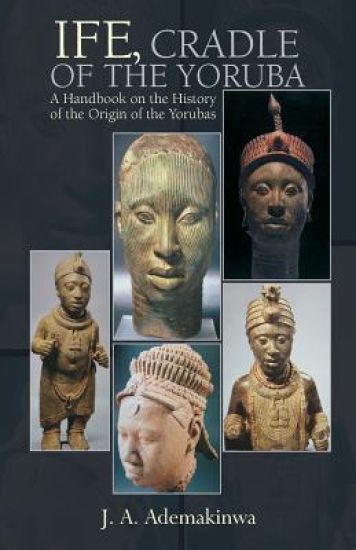
Believed to represent a king, the beautiful bronze head in the British Museum is one of seventeen objects unearthed in 1938–9 at the town of Ife in Nigeria. The stunning naturalism and sophisticated craftsmanship of the objects challenged Western perceptions of African art at the time, which were largely based around abstract wooden figures. It was consequently assumed at first that they must have been made by Europeans or under European influence. In time, however, they came to be seen as wholly African, probably dating from the twelfth to fourteenth centuries, and representative of a hitherto unknown artistic tradition on that continent. The bronze head from Ife is one of the most prized objects in the British Museum’s African collections. This book tells its fascinating story, from its discovery to its reception and exhibition in Britain, where it influenced and inspired several major artists. The author also describes how the head has taken on a new life and significance in its homeland, where images of it have abounded since Nigeria declared independence from Britain in 1960.
John Hassler Dietrich, born 1887, was a Conservative Christian. In College and seminary he studied science and met Unitarians. He became a Minister drawing in thousands of people to hear him speak. He was cut out of his Church because he was too liberal. He became a Unitarian Christian with thousands of listeners in Spokane, WA. He found that early Humans, created demons, Gods & Religion to help them. When they gained power in Politics they repressed people who belied differently. All of these Religions and Gods died out because they were not real. The Religions of the last 2000 years were created in the same way and wherever they became powerful they made war on other people and fought each other. They claimed they knew God and pretended to be Gods leaders of the People. The people had to believe them by faith without evidence. If they did not they were told they were disobeying God. Judaism has existed for about 6,000 years. In the middle of the first thousand years of Christianity, Islam arose with Muhammad. They all had periods of war and suppression. Some did good for others. In the Middle ages they suppressed, tortured and killed people and prohibited education.During this same period and after, Educated people came together and began cooperating, examining the Gods, with the Scientific Method to discover how the World operates, while always being skeptical of man made rules and rechecking for accuracy. When the Founding Fathers created the United States they created Freedom of Religion because in the past when Religions were powerful they suppressed people and made war within Governments as well as outside of them and limited education to their views. Thus, the Nation has always been Secular working toward cooperation by all people of any religion and the secular. Studies of Bibles have found so many problems that it is clear that an intelligent God was not involved, only error prone humans. Dietrich constructed a modern philosophy of life called Modern Humanism, or just Humanism, from the events of Human History based on Science showing people how to move from mythology, to a Philosophy based on the Natural Laws of Nature. Dietrich spoke every Sunday morning in Minniapolis to thousands of people, while other thousands heard him over the radio, and still other thousands all over the World. Scientific knowledge and intelligent research, a better under standing of The Natural Universe, and Natural Laws of Evolution in Nature, existing without a creator. Human rules to live by in this World. Many people have written about Humanism but no one else presented ideas on so many subjects, such as Humanism, Religion, Theism, Agnosticism, Atheism, Ethics, Morality, Families, individuals, Sex, Science, Natural Law, Evolution, Politics, War, death, God, Satan, and all human Welfare. The whole orthodox Christian church today is spending its time in trying to propitiate a God who is not angry, to save souls that are not lost, that they may enter a heaven that does not exist. Expending its energies along mistaken channels toward issues that are entirely imaginary I, Douglas Peary, raised as a Fundamentalist, educated in a manner like Dietrich and spent the last 45 years of my 75 years discovering the same thing and then discovering that Dietrich had done a better job 100 years ago. I agree with the original publishers of Dietrich's writings who said that the style is that of spoken and not written discourse, and does not so easily lend itself to print. My writing is the same way. Any attempt to change them, however, would have involved a difficult, if not impossible task. Neither would it be desirable. The chief effectiveness of a public address is the manner of presentment, and while it is impossible to impart this to the printed page; it can be done by preserving not changing the original utterances. I find that some of Dietrich's speeches make me feel the way I feel listening to a dynamic speaker. Editor Peary
Este corto libro es una traducci n de algunos de los mitos de los pueblos Yoruba de Nigeria. Es una historia de la creaci n del mundo, los dioses, y humanidad, y los d as tempranos de la sagrada ciudad de f , el centro tradicional de la cultura de Yoruba. El texto fue recitado al autor/traductor por los altos sacerdotes de f , y el libro todav a es citado en algunos libros en la religi n del Yoruba tradicional y en su pensamiento, hoy. Esto in-merecidamente se ha hecho y esto es bastante raro, puede ser considerado como un cl sico menor en el campo.
B.E.L. is a weekly planner that will make applying the feng shui bagua to your home or office easy and enjoyable whether you follow Traditional Feng Shui School or Western Feng Shui School. The pages are colorful in helping to focus on areas of your home or office as well as Feng Shui areas of your life. There are inspirational quotes about balance, energy, and life and include pictures depicting harmonious energies of feng shui. This six-month weekly planner starts out on your goals for the year. It includes a 2014 calendar as a guide for you to enter your own dates so you can start your planner anytime. Each of the six months include five colorful weekly views with a brilliant page of "to-do" lists while keeping an eye on physical, mental and spiritual goals.
This research monograph discusses the understudied and often misunderstood aspects of West African culture and religion especially that of the Yoruba people and their ""Book of Enlightenment"" (Ife-Ifa) together with its metaphysical importance to the Yoruba as a source of philosophy, religion and literature. Coverage includes chapters on Yoruba origins and ancestry as described in the ""Ile-Ife"", the cultural and trading centers, the advent of Sacred Literature, referring to the importance of the oral literature. Next, ethical values are discussed and contemporary African anthropological and social science research is analyzed as a tool to describe Yoruba ethical values. ""The Royal Scrolls"" are discussed and their role in developing a written language and a school of philosophy is investigated. Material on naming [Olodumare and other divinities], family life, and the dispersal of the oral tradition to other neighboring regions conclude the work.