The California School of Fine Arts in San Francisco was among a handful of institutions in the nation to offer an extensive program in photography and film during the postwar period. Under the new directorship of Douglas McAgy, CSFA's photography program, established by Ansel Adams and taught by Minor White, was the first in the country. The caliber of teachers such as Edward Weston, Dorothea Lange and Imogen Cunningham was unmatched anywhere, and the program soon earned a reputation as one of the most avant-garde art schools. The first decade of the program, 1945-55, spawned a unique group of photographers who went on to become important contributors to visual culture. The Golden Decade presents imagery from this time period by 32 photographers, among them Pirkle Jones, Ruth Marion Baruch, Philip Hyde and John Upton.
A reference for engineers and students, this volume devotes more than 300 pages to theoretical and experimental considerations. It progresses from elementary materials to methods used in the design of NACA low-drag airfoils, and it presents techniques for using wing-section data to predict wing characteristics. Requires differential and integral calculus and elementary mechanics. 1949 edition.
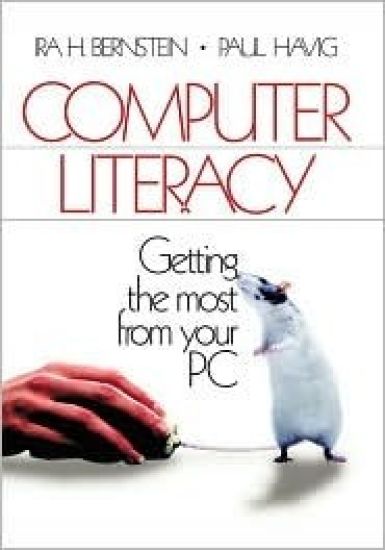
Using a horizontal organization (i.e., by task rather than program) Computer Literacy introduces students in the behavioral sciences to the computer resources they use on campus to do their work. Beginning with an introduction to computers, authors Ira H. Bernstein and Paul Havig use numerous examples with demonstrations (such as how to export an Excel file to a Word file) to show the reader how to select between programs for their specific needs, how to use the computer for communication and literature search purposes, how to use computers for databases and statistical programming, and some basics of computer programming. To enhance your students reading, the authors provide:
Using a horizontal organization (i.e., by task rather than program) Computer Literacy introduces students in the behavioral sciences to the computer resources they use on campus to do their work. Beginning with an introduction to computers, authors Ira H. Bernstein and Paul Havig use numerous examples with demonstrations (such as how to export an Excel file to a Word file) to show the reader how to select between programs for their specific needs, how to use the computer for communication and literature search purposes, how to use computers for databases and statistical programming, and some basics of computer programming. To enhance your students reading, the authors provide:
What should you see when you're analyzing real data using one of the major statistical packages, such as SPSS, SAS or Microsoft Excel? This book will show you, and will walk you through the output from a variety of statistical outcomes, such as data reflecting a single common factor. Through the use of actual demonstrations, the authors supply readers with the computer programs necessary to simulate data sets with the statistical properties (usually multivariate) that are often assumed of real data. The reader is then shown how to analyze these data sets and how to interpret the results. The book begins with a general introduction to doing research and tips for using the three statistical packages. The authors next explore how to create data structures and perform univariate, bivariate, and multivariate simulations. They then show how to use the simulations to understand common statistical algorithms and their outputs when doing a basic correlation analysis, exploratory factor analysis, confirmatory factor analysis, multidimensional scaling, multiple regression, discriminate analysis, classification analysis and MANOVA. Throughout the book, the authors provide the reader with helpful guides, such as: *Hint boxes to give readers tips for executing particular techniques using the statistical software packages. *Steps that show each stage of a procedure, such as importing an Excel file into SAS. *Problems end each chapter so the reader can practice the techniques described. *Web Site with the SAS and SPSS programs and sample data.
What should you see when you're analyzing real data using one of the major statistical packages, such as SPSS, SAS or Microsoft Excel? This book will show you, and will walk you through the output from a variety of statistical outcomes, such as data reflecting a single common factor. Through the use of actual demonstrations, the authors supply readers with the computer programs necessary to simulate data sets with the statistical properties (usually multivariate) that are often assumed of real data. The reader is then shown how to analyze these data sets and how to interpret the results. The book begins with a general introduction to doing research and tips for using the three statistical packages. The authors next explore how to create data structures and perform univariate, bivariate, and multivariate simulations. They then show how to use the simulations to understand common statistical algorithms and their outputs when doing a basic correlation analysis, exploratory factor analysis, confirmatory factor analysis, multidimensional scaling, multiple regression, discriminate analysis, classification analysis and MANOVA. Throughout the book, the authors provide the reader with helpful guides, such as: *Hint boxes to give readers tips for executing particular techniques using the statistical software packages. *Steps that show each stage of a procedure, such as importing an Excel file into SAS. *Problems end each chapter so the reader can practice the techniques described. *Web Site with the SAS and SPSS programs and sample data.
Like most academic authors, my views are a joint product of my teaching and my research. Needless to say, my views reflect the biases that I have acquired. One way to articulate the rationale (and limitations) of my biases is through the preface of a truly great text of a previous era, Cooley and Lohnes (1971, p. v). They draw a distinction between mathematical statisticians whose intel lect gave birth to the field of multivariate analysis, such as Hotelling, Bartlett, and Wilks, and those who chose to "concentrate much of their attention on methods of analyzing data in the sciences and of interpreting the results of statistical analysis . . . . (and) . . . who are more interested in the sciences than in mathematics, among other characteristics. " I find the distinction between individuals who are temperamentally "mathe maticians" (whom philosophy students might call "Platonists") and "scientists" ("Aristotelians") useful as long as it is not pushed to the point where one assumes "mathematicians" completely disdain data and "scientists" are never interested in contributing to the mathematical foundations of their discipline. I certainly feel more comfortable attempting to contribute in the "scientist" rather than the "mathematician" role. As a consequence, this book is primarily written for individuals concerned with data analysis. However, as noted in Chapter 1, true expertise demands familiarity with both traditions.
In one short and simple volume, Dr. Kirschenbaum answers all your questions about mostly all major hip problems including hip arthritis and replacements. Clear and elegant images accompany the book. Written for patients, nurses, physical therapists, nurse practitioners, physician assistants, and healthcare students.Dr. Kirschenbaum has had a notable and unique career as an orthopaedic surgeon with in-depth and wide-breadth patient education, entrepreneurial, corporate and non-profit experience in operations leadership, process reengineering, information technology, and innovation design. He has been the Executive Director of Medscape Orthopaedics and a Health Expert of WebMD. He currently is the Chairman of Orthopaedic Surgery at Bronx-Lebanon Hospital Center in New York.