Kirjojen hintavertailu. Mukana 11 342 296 kirjaa ja 12 kauppaa.

Kirjahaku

Etsi kirjoja tekijän nimen, kirjan nimen tai ISBN:n perusteella.

1000 tulosta hakusanalla Irving H. Buchen

Boxology

Boxology

Irving H. Buchen

Rowman Littlefield
2015
sidottu
Does every one inside the box think the same? No differentiation? No evolving levels? Then too where do those who think outside of the box, go? Back to the original box to go through further iterations? Not likely; after all they have outgrown their box. Like Adam they have tasted the fruit of knowledge and they are banished from the box of Eden. What happens to them? They fall into history and evolution. Each generation reenacts the drama of their thinking birth and emergence from the fetal paradisiacal box. Each one is doomed to further—perhaps endless—development. Each one is blessed and cursed forever with restlessness—with endless curiosity—and with the haunting memory of their original and archetypal release from the box of limited thought. Boxology: Thinking and Working Inside, Outside, and Beyond the Box and the Cubicle offers the answers to these and other questions in the realm of education.
Boxology

Boxology

Irving H. Buchen

Rowman Littlefield
2015
nidottu
Does every one inside the box think the same? No differentiation? No evolving levels? Then too where do those who think outside of the box, go? Back to the original box to go through further iterations? Not likely; after all they have outgrown their box. Like Adam they have tasted the fruit of knowledge and they are banished from the box of Eden. What happens to them? They fall into history and evolution. Each generation reenacts the drama of their thinking birth and emergence from the fetal paradisiacal box. Each one is doomed to further—perhaps endless—development. Each one is blessed and cursed forever with restlessness—with endless curiosity—and with the haunting memory of their original and archetypal release from the box of limited thought. Boxology: Thinking and Working Inside, Outside, and Beyond the Box and the Cubicle offers the answers to these and other questions in the realm of education.
The Future of the American School System

The Future of the American School System

Irving H. Buchen

Rowman Littlefield Education
2004
nidottu
Here, Irving H. Buchen projects the future of public education for the next 25 years. He identifies and examines the major drivers of change, profiles all the critical educational constituencies, and offers a number of common sense solutions to current and subsequent problems. Buchen also provides scenarios of solutions to prove that new approaches are doable and viable. The Future of the American School System will: Identify the major drivers of change, Profile the roles of the major players, Define and offer solutions to the major problems, Express those solutions in scenario form, Pinpoint the rallying points for collective action. This book will be of interest to teachers, administrators, professional staff, school board members, parents, departments and professors of education, and all elected officials.
Futures Thinking, Learning, and Leading

Futures Thinking, Learning, and Leading

Irving H. Buchen

Rowman Littlefield Education
2006
nidottu
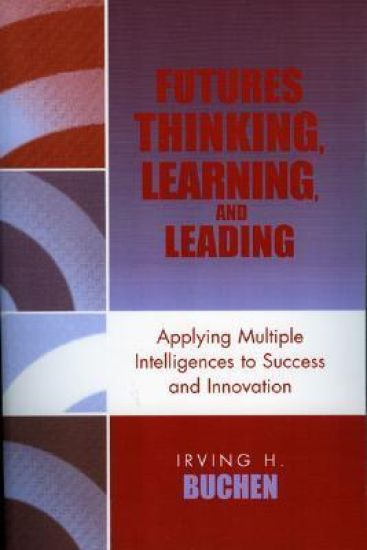
Futures Thinking, Learning, and Leading: Applying Multiple Intelligences to Success and Innovation explores the extent to which our thinking, learning, and leading are influenced and shaped by the future. In the process, professionals and organizations are classified into three basic types: future-oriented, future-poised, and future-driven. The last group typically includes divergent and convergent thinking and planning and routinely integrates, rather than separates, thinking, learning, and leading. The net results are the new norms of anticipatory management, holistic 360-degree forecasting and planning, and the productivity of innovation. Finally, leading has to epitomize the whole_it must be alive to the future and understand and incorporate into decision making how the future itself thinks, behaves, and learns. Buchen provides: _ a comprehensive survey of contemporary work environments _ an evaluation of their future learning and unlearning training systems _ a series of recommendations for developing a future-driven organization and workforce Also, Futures Thinking, Learning, and Leading identifies innovation strategies and the major new thinking systems, describes the steep learning and leading curves of the 21st century, and explores transition training. This book is suitable for business leaders and managers, human resource professionals, personnel recruiters, professional trainers and coaches, and colleges and professors of business.
Executive Intelligence

Executive Intelligence

Irving H. Buchen

Rowman Littlefield Education
2011
sidottu
Executive Intelligence zeros in on leadership smarts and notes that in all lists compiled by leadership experts, head hunters, and boards of directors the one and only trait that appears in all is intelligence. Obvious? No, because typically leadership savvy regularly trumps smarts. That is unfortunate because it obscures the cultivation and development of how leaders think, speculate, conceive, and problem solve their own firms and the way they lead. Executive intelligence like emotional intelligence acts like an advanced scout sizing up situations, identifying mine fields, creating contingencies, developing last minute ways out, and then acting like the artful dodger. In the process, the leader develops a special kind of intelligence tied to and defining the kind if leader he or she is; and that ultimately generates the leader's edge and comparative advantage.
Executive Intelligence

Executive Intelligence

Irving H. Buchen

Rowman Littlefield Education
2011
nidottu
Executive Intelligence zeros in on leadership smarts and notes that in all lists compiled by leadership experts, head hunters, and boards of directors the one and only trait that appears in all is intelligence. Obvious? No, because typically leadership savvy regularly trumps smarts. That is unfortunate because it obscures the cultivation and development of how leaders think, speculate, conceive, and problem solve their own firms and the way they lead. Executive intelligence like emotional intelligence acts like an advanced scout sizing up situations, identifying mine fields, creating contingencies, developing last minute ways out, and then acting like the artful dodger. In the process, the leader develops a special kind of intelligence tied to and defining the kind if leader he or she is; and that ultimately generates the leader's edge and comparative advantage.
Democratic Learning and Leading

Democratic Learning and Leading

Ronald J. Newell; Irving H. Buchen

Rowman Littlefield Education
2004
nidottu
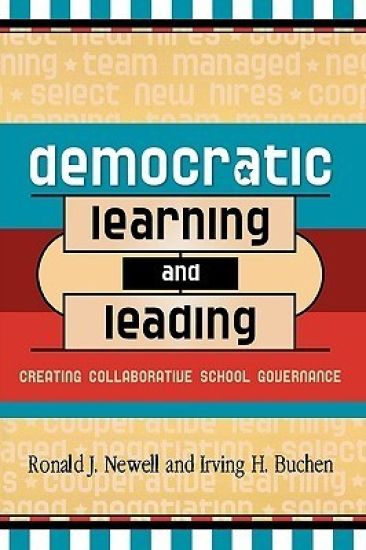
Here, authors Ronald Newell and Irving Buchen continue the dialogue begun by Roland Barth, Linda Lambert, Carl Glickman and others pertaining to democratic, teacher-led schools. Teachers are capable of managing schools, without designated principals and/or superintendents. A number of practitioners have taken up the gauntlet and have created collaborative cultures in order to fulfill the need for creating teacher-controlled environments. These environments are necessary to carry out the as-of-yet unfulfilled reform of practices that benefit students at the most elemental level of education—the relationship of teacher and learner. In teacher-managed schools, teachers have control of budgets, management, personnel, and all other decision-making. It is not enough for teachers to be willing to democratically control schools. The culture of schooling is not inherently democratic, and a collaborative culture must be cultivated by creating the community, the collective, the consensual, the consultative, and the coaching commitment. Newell and Buchen show how the experience of a group of practitioners has lighted the way for continual development of the elements of the collaborative culture by living them. They also discuss the problems and promises of creating and living this collaborative, democratic culture.
Daniel Webster

Daniel Webster

Irving H. Bartlett

WW Norton Co
1981
nidottu
For forty years, until his death in 1852, Daniel Webster played a dominant national role as a lawyer, orator, congressman, senator, secretary of state, leader of two major parties, and perennial presidential candidate. This new biography, drawing on the recently collected Webster papers, explains the Webster phenomenon in terms of the powerful positive and negative images he projected for nineteenth-century Americans.
John C. Calhoun

John C. Calhoun

Irving H. Bartlett

WW Norton Co
2007
nidottu
John C. Calhoun was a rare figure in American history: a lifelong politician who was also a profound political philosopher. Vice president under John Quincy Adams and Andrew Jackson, he was a dominant presence in the U.S. Senate. Now comes a major new biography from the author of Daniel Webster.
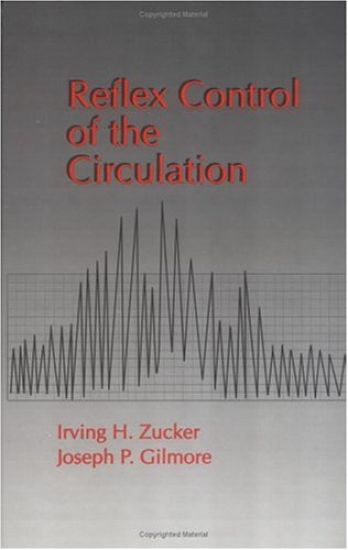
Reflex Control of the Circulation

Reflex Control of the Circulation

Irving H. Zucker; Joseph P. Gilmore

CRC Press Inc
1991
sidottu
Reflex Control of the Circulation presents an interdisciplinary discussion of concepts in the reflex control of circulation. This volume describes aspects of autonomic receptor physiology, central pathways of reflex control, the electrophysiology of cardiovascular afferents, the interaction between reflexes, the autonomic control of regional blood flows, the autonomic control of fluid and electrolyte balance, and neurohumoral control of the circulation through normal and pathological states (e.g., hypertension, congestive heart failure). In addition, the regulation of regional blood flow during exercise and developmental aspects of reflex control are examined. Any researcher interested in the autonomic system and its role in circulation will find this book fascinating reading.
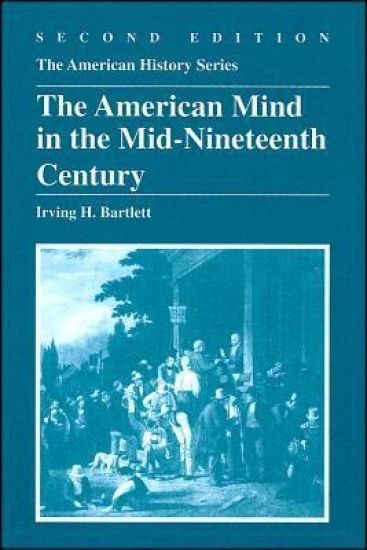
The American Mind in the Mid-Nineteenth Century

The American Mind in the Mid-Nineteenth Century

Irving H. Bartlett

Harlan Davidson Inc
1982
nidottu
EXCERPT: "The half century between the War of 1812 and the Civil War was above all an age of expansiveness in America. Whether measured in terms of population, territory, urbanization, economic growth, technological development, democratization, or nationalism, American society was transformed quantitatively and qualitatively at a spectacular rate. What Americans thought about themselves, their country, and their universe was always tightly linked to the changes they confronted, and the ideas they shared and disputed were both a product of and a commentary upon the expanding political, social, and economic democracy of the period. Strictly speaking, of course, there was no "American mind" during this period, since Americans were then, as they are now, of many minds. Child and adult, man and woman, native and foreign born, Northerner and Southerner, slave and citizen-everyone who lived in America lived in a world of ideas and values shaped in part by a particular history and particular circumstances. However, as Tocqueville observed after visiting America in the 1830s, the citizens of any vigorous society are usually "rallied and held together by certain predominant ideas." Except for the chapter on the slave-holding South, we will be concerned here with the dominant ideas and values most Americans shared and identified with their new nation during the years from 1815 to 1860."
How to Test and Improve Your Wine Judging Ability

How to Test and Improve Your Wine Judging Ability

Irving H. Marcus

Guanzi Institute Press
2011
nidottu
How to Test and Improve Your Wine Judging Ability (Third Edition) by Irving H. Marcus Updated and Edited by Heidi Butzine Written over 35 years ago, the wisdom in How to Test and Improve Your Wine Judging Ability is timeless. Even if you're not looking to become an "official" wine tasting judge, the author takes readers through the steps of understanding, evaluating and discussing wine. Useful to experienced and novice wine enthusiasts alike who want "to learn more about wine to enjoy it at its fullest" and be as good a wine judge as they can. NEW EXPANDED VERSION: includes insightful editor's notes... wine terms, aromas and flavors, grape varietals and regional wine styles comparison of today's popular wine rating systems wine aging guide and suggested comparisons for your own wine judging Comments about the book from over the years still stand today: San Francisco Chronicle: "A good book to have." Long Beach (Calif.) News-Post: "An important addition to wine literature; enjoyable and instructive." Liquor Store Magazine: "Can help the retailer become a better judge of the wines he buys." Los Angeles Times: "Helpful, concise and over nobody's head." Vintage Magazine: "A concrete basis to the subjective art of wine tasting and evaluation." San Francisco Examiner: "Games that measure the accuracy of a taster's perceptions." Sunset Magazine: "Has many suggestions for post-graduate tasters." Wine World Magazine: "A book for anyone who wants to develop his tasting ability or to find out how good it already is." Beverage Industry News: "Can improve the imbiber's ability to make sound quality Judgements." Chicago Tribune: "A meaty new treatise; a helpful handbook." American Wine Society Journal: "No question of its overall value.
Out-Executing the Competition

Out-Executing the Competition

Irving H. Rothman

John Wiley Sons Inc
2012
sidottu
An inside look at what makes a successful financial services company Irv Rothman may not have considered a career in the financial services early on, but he ended up in leadership positions at AT&T, Compaq and, for over a decade, Hewlett-Packard. His consistent record of success and insider perspective make him the perfect guide to the art of building and growing a financial services company, and in Out-Executing the Competition he shares his remarkable story and years of experience, giving readers a glimpse into his numerous accomplishments and providing takeaways they can apply to their own companies, whatever the industry. An engaging and lively account of Rothman's career focusing on his work at financial services companies during some of the most economically challenging periods of the past thirty years, the book explores the methods and tactics he used to help his companies not only weather financial uncertainty, but to thrive. Tells the story of financial services company expert Irv Rothman, in his own wordsIncludes invaluable insights into how to build a financial services company that can survive and thrive in even the toughest economic climateHelps readers working at financial services companies and in other industries to construct solid businesses that can outperform their competition Part biography, part how-to guide, Out-Executing the Competition is the ultimate inside look at building a financial services company that's sure to succeed.
Elastic And Inelastic Stress Analysis

Elastic And Inelastic Stress Analysis

Irving H Shames

CRC Press Inc
1997
sidottu
Presents certain key aspects of inelastic solid mechanics centered around viscoelasticity, creep, viscoplasticity, and plasticity. It is divided into three parts consisting of the fundamentals of elasticity, useful constitutive laws, and applications to simple structural members, providing extended treatment of basic problems in static structural mechanics, including elastic and inelastic effects. It contains worked-out examples and end-of-chapter problems.