Kirjojen hintavertailu. Mukana 11 244 527 kirjaa ja 12 kauppaa.

Kirjahaku

Etsi kirjoja tekijän nimen, kirjan nimen tai ISBN:n perusteella.

1000 tulosta hakusanalla Isidore Guët

Isidore

Isidore

Mary E Mellor

Hansebooks
2021
pokkari
Isidore - and other poems is an unchanged, high-quality reprint of the original edition of 1877. Hansebooks is editor of the literature on different topic areas such as research and science, travel and expeditions, cooking and nutrition, medicine, and other genres. As a publisher we focus on the preservation of historical literature. Many works of historical writers and scientists are available today as antiques only. Hansebooks newly publishes these books and contributes to the preservation of literature which has become rare and historical knowledge for the future.
Isidore of Seville and his Reception in the Early Middle Ages
Isidore of Seville (560—636) was a crucial figure in the preservation and sharing of classical and early Christian knowledge. His compilations of the works of earlier authorities formed an essential part of monastic education for centuries. Due to the vast amount of information he gathered and its wide dissemination in the Middle Ages, Pope John Paul II even named Isidore the patron saint of the Internet in 1997. This volume represents a cross section of the various approaches scholars have taken toward Isidore’s writings. The essays explore his sources, how he selected and arranged them for posterity, and how his legacy was reflected in later generations’ work across the early medieval West. Rich in archival detail, this collection provides a wealth of interdisciplinary expertise on one of history’s greatest intellectuals.
Isidore of the Mountains

Isidore of the Mountains

Florence Wilshire Mary Anne Q de Jesus

Lulu.com
2011
pokkari
This is the story of a mountain boy named Isidore as told by the boy's angel de la guardia or guardian angel. Isidore's angel de la guardia had been with the family since the marriage of Isidore's parents. Seven Angels had been hovering above the little nipa hut of Cipriano and Maria waiting for their wards to be born. The Angels were exactly named as the children in the family are named. The reason for their having the same name as each of their wards: Each angel de la guardia would whisper his or her name to the parents of the child when the parents start thinking of the question: What name should we give this child?
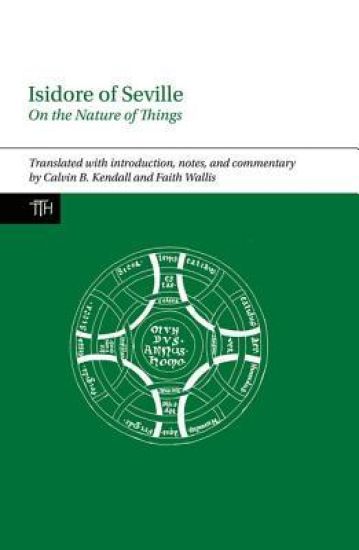
Isidore of Seville, On the Nature of Things
For scholars in the European Middle Ages, Isidore, bishop of Seville (560? — 636) was one of the most influential authorities for understanding the natural world. Isidore’s On the Nature of Things is the first work on natural science by a Christian author that is not a commentary on the creation story in Genesis. Instead, Isidore adopted a classical model to describe the structure of the physical cosmos, and discuss the principles of astronomy, physics, geography, meteorology and time-reckoning. Into this framework he incorporated an eclectic array of ancient and patristic erudition. The fact that On the Nature of Things presents an essentially Greco-Roman picture of the universe, but amplified with Christian reflections and allegories, played a crucial role in the assimilation of ancient science into the emerging culture of the Middle Ages. It exerted a deep and long-lasting influence on scholars like Bede, one of whose earliest works was an adaptation of On the Nature of Things. On the Nature of Things provides a new window into vital intellectual currents, as yet largely unexplored, flowing from Visigothic Spain into Celtic Ireland, Anglo-Saxon England, and Merovingian France. This is the first translation of this work into English. The introduction places the work in the context of Isidore's milieu and concerns, and traces the remarkable diffusion of his book. A chapter-by-chapter commentary explains how Isidore selected and transformed his source material, and added his own distinctive features, notably the diagrams that gave this work its medieval name The Book of Wheels (Liber rotarum).
Isidore of Seville, On the Nature of Things
For scholars in the European Middle Ages, Isidore, bishop of Seville (560? — 636) was one of the most influential authorities for understanding the natural world. Isidore’s On the Nature of Things is the first work on natural science by a Christian author that is not a commentary on the creation story in Genesis. Instead, Isidore adopted a classical model to describe the structure of the physical cosmos, and discuss the principles of astronomy, physics, geography, meteorology and time-reckoning. Into this framework he incorporated an eclectic array of ancient and patristic erudition. The fact that On the Nature of Things presents an essentially Greco-Roman picture of the universe, but amplified with Christian reflections and allegories, played a crucial role in the assimilation of ancient science into the emerging culture of the Middle Ages. It exerted a deep and long-lasting influence on scholars like Bede, one of whose earliest works was an adaptation of On the Nature of Things. On the Nature of Things provides a new window into vital intellectual currents, as yet largely unexplored, flowing from Visigothic Spain into Celtic Ireland, Anglo-Saxon England, and Merovingian France. This is the first translation of this work into English. The introduction places the work in the context of Isidore's milieu and concerns, and traces the remarkable diffusion of his book. A chapter-by-chapter commentary explains how Isidore selected and transformed his source material, and added his own distinctive features, notably the diagrams that gave this work its medieval name The Book of Wheels (Liber rotarum).