
Kirjahaku
Etsi kirjoja tekijän nimen, kirjan nimen tai ISBN:n perusteella.
1000 tulosta hakusanalla Isobel Kelly









Law of Commerce in South Africa
Dumile Baqwa; Elizabeth De Stadler; Roger Evans; Seig Eiselen; Tracy Humby; Michelle Kelly-Louw; Isobel Konyn; Shawn Kopel; Tjakie Naude; Susan Scott; Nicola Smit; Philip Sutherland; Tanya Woker
Oxford University Press Southern Africa
2014
nidottu
The Law of Commerce in South Africa 2/e provides a clear and practical introduction to various fields of commercial law, for students of accounting and other business disciplines. The text conveys concepts and principles of commercial law in a manner which is accessible and vibrant, clearly demonstrating the practical relevance and application of the legal principles in the commercial world. The text provides clear explanation and extensive illustrative examples to support understanding, as well as a clear pedagogical structure which includes end-of-chapter questions to assess comprehension.
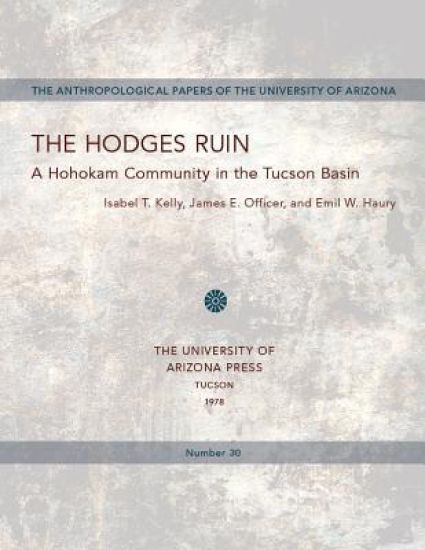
The Anthropological Papers of the University of Arizona is a peer-reviewed monograph series sponsored by the School of Anthropology. Established in 1959, the series publishes archaeological and ethnographic papers that use contemporary method and theory to investigate problems of anthropological importance in the southwestern United States, Mexico, and related areas.
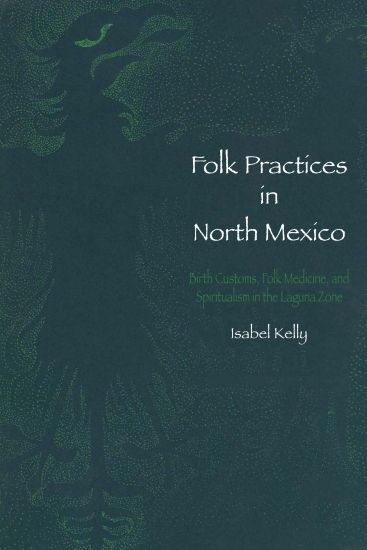
The Mexican folkways described in this monograph, of scientific interest to anthropologists, will fascinate laypeople as well. Isabel Kelly collected these notes in the 1950s, as a diversion when official field work was not feasible, in the vicinity of TorreÓn and particularly in the nearby village of El Cuije, in northern Mexico. She recounts folk customs and habits, focusing on beliefs and practices related to health and healing and on notions concerning magic. These form, Kelly believes, a core of folk culture which has survived tenaciously in the rural areas and on the outskirts of the cities, among mestizo families of scant education and limited economic resources. These people are well acquainted with simple, matter-of-fact illnesses which result from natural causes and which respond to treatment by herbal and other home remedies or by modern medicines. But they also recognize the evil eye and the emotional upset known as “fright.” They are thoroughly familiar with the ever-present danger of ailments which are not “natural” and God-sent, but which are deliberately inflicted by an enemy, through the artifice of a sorcerer or a spiritualist. Such “instigated” illnesses may take any form, from a cold in the head to a false pregnancy. If a person suspects that poor health results from such malevolence, he or she spurns Western medicine and looks instead to the witch or to the spiritualist as the only hope of a cure. El Cuije pays an annual quota from community funds to make available modern health services provided by the government. But community funds are similarly drawn upon to provide “medical” attention for those who repair to the sorcerers. Once a week the village truck takes all presumed witchcraft victims to a nearby town, where they receive clinical treatment from professional sorcerers. Kelly sees little that is genuinely indigenous in the beliefs and practices described; many of them demonstrably result from infiltration from the Old World in the years following the Spanish Conquest. She considers spiritualistic curing-important in northern Mexico and many other parts of Latin America-in some detail, but the specific outlines of its history in northern Mexico still awaited clarification at the time of her research.
This work has been selected by scholars as being culturally important and is part of the knowledge base of civilization as we know it.This work is in the public domain in the United States of America, and possibly other nations. Within the United States, you may freely copy and distribute this work, as no entity (individual or corporate) has a copyright on the body of the work.Scholars believe, and we concur, that this work is important enough to be preserved, reproduced, and made generally available to the public. To ensure a quality reading experience, this work has been proofread and republished using a format that seamlessly blends the original graphical elements with text in an easy-to-read typeface.We appreciate your support of the preservation process, and thank you for being an important part of keeping this knowledge alive and relevant.

This work has been selected by scholars as being culturally important and is part of the knowledge base of civilization as we know it.This work is in the public domain in the United States of America, and possibly other nations. Within the United States, you may freely copy and distribute this work, as no entity (individual or corporate) has a copyright on the body of the work.Scholars believe, and we concur, that this work is important enough to be preserved, reproduced, and made generally available to the public. To ensure a quality reading experience, this work has been proofread and republished using a format that seamlessly blends the original graphical elements with text in an easy-to-read typeface.We appreciate your support of the preservation process, and thank you for being an important part of keeping this knowledge alive and relevant.
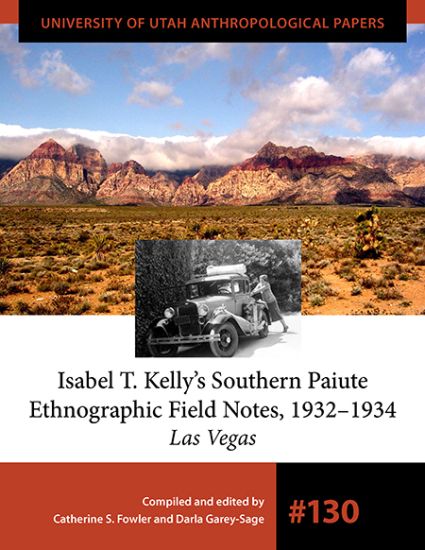
Isabel T. Kelly’s Southern Paiute Ethnographic Field Notes, 1932–1934
University of Utah Press,U.S.
2016
nidottu
This publication presents the first volume (Las Vegas) of the early ethnographic field work of anthropologist Isabel T. Kelly. From 1932 to 1934, Kelly interviewed thirty Southern Paiute people— from southeastern California, southern Nevada, northern Arizona, and southern Utah— about “the old ways.” She filled 31 notebooks, made maps, took photographs, collected nearly 300 ethnobotanical specimens, purchased and shipped over 400 ethnographic artefacts to museums, and traveled more than 7,000 miles. Her notes comprise the most extensive primary ethnographic documentation of Southern Paiute/ Chemehuevi lifeways of the late nineteenth and early twentieth centuries.Although Kelly intended to publish these notes, she was unable to do so before her death. Fowler and Garey-Sage have now synthesised the first set of these handwritten field notes and sketches, providing organisation, commentary and illustrations to put them in context for the modern reader. Kelly’s data, most of whichcould not be gathered anew today, are offered here for the use of generations to come.
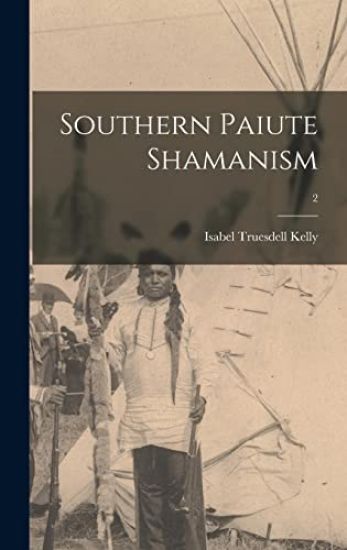
Southern Paiute Shamanism is a comprehensive book written by Isabel T. Kelly, which explores the spiritual beliefs and practices of the Southern Paiute tribe in the southwestern United States. The book provides an in-depth examination of the tribe's shamanic traditions, including their views on the afterlife, healing practices, and communication with the spirit world.Kelly draws on her extensive fieldwork with the Southern Paiute people to provide a detailed account of their shamanic practices. She describes the role of the shaman in Southern Paiute culture, their training, and the various techniques they use to enter altered states of consciousness.The book also delves into the Southern Paiute worldview, exploring their beliefs about the natural world, the relationship between humans and animals, and the importance of dreams and visions in their spiritual practices.Overall, Southern Paiute Shamanism is a fascinating and insightful read for anyone interested in Native American spirituality and shamanism. Kelly's thorough research and engaging writing style make this book a valuable resource for scholars, students, and general readers alike.This is a new release of the original 1939 edition.This scarce antiquarian book is a facsimile reprint of the old original and may contain some imperfections such as library marks and notations. Because we believe this work is culturally important, we have made it available as part of our commitment for protecting, preserving, and promoting the world's literature in affordable, high quality, modern editions, that are true to their original work.

A study of the four eastern bands of Southern Pauite: Kaibab, Kaiparowits, San Juan, and Panguitch. The text was written by Isabel Kelly on the basis of field data she gathered in 1932.

LONELY PLANET Reiseführer Irland
Isabel Albiston; Catherine Le Nevez; Noelle Kelly
MairDumont
2024
pokkari