Kirjojen hintavertailu. Mukana 11 627 373 kirjaa ja 12 kauppaa.

Kirjahaku

Etsi kirjoja tekijän nimen, kirjan nimen tai ISBN:n perusteella.

1000 tulosta hakusanalla Italo Calvino

Italo Calvino

Italo Calvino

Italo Calvino

PRINCETON UNIVERSITY PRESS
2013
sidottu
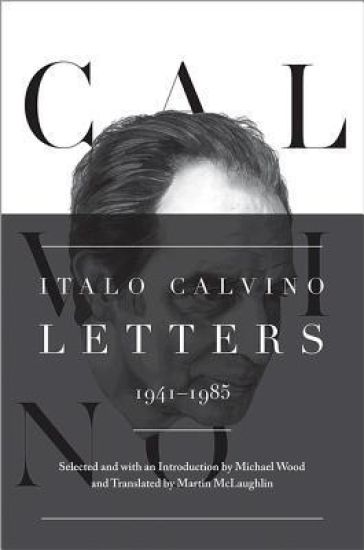
This is the first collection in English of the extraordinary letters of one of the great writers of the twentieth century. Italy's most important postwar novelist, Italo Calvino (1923-1985) achieved worldwide fame with such books as Cosmicomics, Invisible Cities, and If on a Winter's Night a Traveler. But he was also an influential literary critic, an important literary editor, and a masterful letter writer whose correspondents included Umberto Eco, Primo Levi, Gore Vidal, Leonardo Sciascia, Natalia Ginzburg, Michelangelo Antonioni, Pier Paolo Pasolini, and Luciano Berio. This book includes a generous selection of about 650 letters, written between World War II and the end of Calvino's life. Selected and introduced by Michael Wood, the letters are expertly rendered into English and annotated by well-known Calvino translator Martin McLaughlin. The letters are filled with insights about Calvino's writing and that of others; about Italian, American, English, and French literature; about literary criticism and literature in general; and about culture and politics. The book also provides a kind of autobiography, documenting Calvino's Communism and his resignation from the party in 1957, his eye-opening trip to the United States in 1959-60, his move to Paris (where he lived from 1967 to 1980), and his trip to his birthplace in Cuba (where he met Che Guevara). Some lengthy letters amount almost to critical essays, while one is an appropriately brief defense of brevity, and there is an even shorter, reassuring note to his parents written on a scrap of paper while he and his brother were in hiding during the antifascist Resistance. This is a book that will fascinate and delight Calvino fans and anyone else interested in a remarkable portrait of a great writer at work.
Italo Calvino

Italo Calvino

Italo Calvino; Michael (INT) Wood; Martin (TRN) McLaughlin

Princeton University Press
2014
pokkari
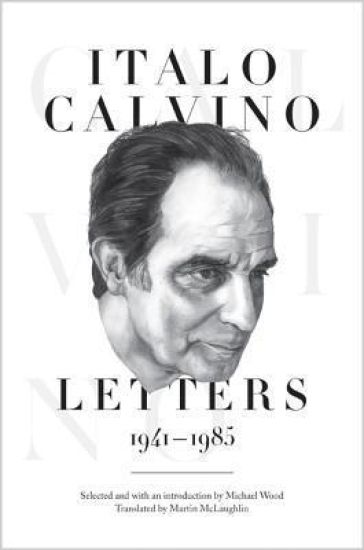
This is the first collection in English of the extraordinary letters of one of the great writers of the twentieth century. Italy's most important postwar novelist, Italo Calvino (1923-1985) achieved worldwide fame with such books as Cosmicomics, Invisible Cities, and If on a Winter's Night a Traveler. But he was also an influential literary critic, an important literary editor, and a masterful letter writer whose correspondents included Umberto Eco, Primo Levi, Gore Vidal, Leonardo Sciascia, Natalia Ginzburg, Michelangelo Antonioni, Pier Paolo Pasolini, and Luciano Berio. This book includes a generous selection of about 650 letters, written between World War II and the end of Calvino's life. Selected and introduced by Michael Wood, the letters are expertly rendered into English and annotated by well-known Calvino translator Martin McLaughlin.The letters are filled with insights about Calvino's writing and that of others; about Italian, American, English, and French literature; about literary criticism and literature in general; and about culture and politics. The book also provides a kind of autobiography, documenting Calvino's Communism and his resignation from the party in 1957, his eye-opening trip to the United States in 1959-60, his move to Paris (where he lived from 1967 to 1980), and his trip to his birthplace in Cuba (where he met Che Guevara). Some lengthy letters amount almost to critical essays, while one is an appropriately brief defense of brevity, and there is an even shorter, reassuring note to his parents written on a scrap of paper while he and his brother were in hiding during the antifascist Resistance.This is a book that will fascinate and delight Calvino fans and anyone else interested in a remarkable portrait of a great writer at work.
Italo Calvino

Italo Calvino

Martin McLaughlin

Edinburgh University Press
2001
nidottu
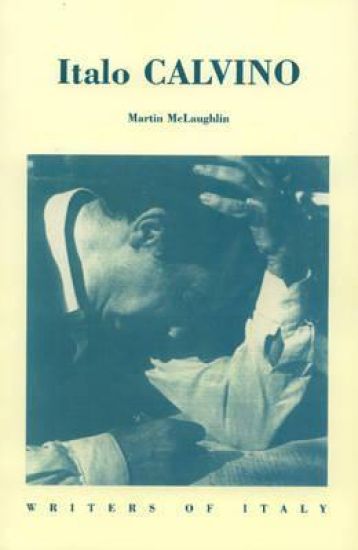
This first study in English of the complete writings of Italo Calvino (1923-85) offers new interpretations of Calvino's main works, taking into account some important unpublished material, and analyses Calvino's intertextual links with major writers of world literature (Conrad, Stevenson, Hemingway and Borges). Postmodern elements in his texts are assessed, and a chapter on Calvino's critical essays shed important light on his creative process.
Italo Calvino

Italo Calvino

Constance Markey

University Press of Florida
1999
sidottu
Concerned with the work of Italo Calvino, this text looks at the author in English translation, appraises his place in world literature and traces his development as a post-modern writer from the start of his writing career during World War II to his death in 1985.
Italo Calvino

Italo Calvino

Daniela Scharnagl

Grin Publishing
2013
pokkari
Studienarbeit aus dem Jahr 2005 im Fachbereich Romanistik - Italienische u. Sardische Sprache, Literatur, Landeskunde, Note: 2,0, Ludwig-Maximilians-Universit t M nchen (Institut f r Italianistik), Veranstaltung: Proseminar Italienische Literaturwissenschaft "Literarische Parodien seit Ludovico Ariosto," 15 Quellen im Literaturverzeichnis, Sprache: Deutsch, Abstract: Wie uns das Proseminar gezeigt hat, treffen wir literarische Parodien epochen- und gattungs bergreifend an. Angefangen bei Ludovico Ariosto im 15. Jahrhundert bis hin zu modernsten Autoren aus dem Jahre 1997 begegnen uns literarische Parodien unterschiedlichster Art. Gattungsspezifisch betrachtet lassen sich Parodien mit allen Sorten von Literaturgenres in Verbindung bringen, so beispielsweise mit dem Epos, der Lyrik, dem Dialog und der Prosa. In der hier vorliegenden Arbeit wird im Speziellen ein Werk der Verbindung zwischen Parodie und Prosa n her untersucht. Es handelt sich um den Roman Se una notte d'inverno un viaggiatore des italienischsprachigen Autors Italo Calvino, den er in der zweiten H lfte des 20. Jahrhunderts ver ffentlicht hat. Um das Thema umfassend zu er rtern, ist es notwendig, sich dem Gegenstand von verschiedenen Standpunkten aus zu n hern. Zun chst einmal erfolgt die Betrachtung der Biographie und der literarischen Vita des Autors. Leider gibt es meiner Meinung nach zu diesem Bereich noch keine ausreichend informative Forschungsliteratur. Anschlie end sollen die Merkmale der Postmoderne - jene Epoche, die das ausgehende 20. Jahrhundert gepr gt hat - n her erl utert werden. Auch zu dieser Thematik sollte die Forschung noch zus tzliche Anstrengungen unternehmen, um ausreichendes Informationsmaterial zur Verf gung stellen zu k nnen. Werkspezifischer wird es ab dem dritten Abschnitt. Hier widmen wir uns der formalen und inhaltlichen Betrachtung des Romans, um im vierten und letzten Argument durch berwiegende Eigeninterpretat
Italo Calvino's Architecture of Lightness
This study recovers Italo Calvino's central place in a lost history of interdisciplinary thought, politics, and literary philosophy in the 1960s. Drawing on his letters, essays, critical reviews, and fiction, as well as a wide range of works--primarily urban planning and design theory and history--circulating among his primary interlocutors, this book takes as its point of departure a sweeping reinterpretation of Invisible Cities. Passages from Calvino's most famous novel routinely appear as aphorisms in calendars, posters, and the popular literature of inspiration and self-help, reducing the novel to vague abstractions and totalizing wisdom about thinking outside the box. The shadow of postmodern studies has had a similarly diminishing effect on this text, rendering up an accomplished but ultimately apolitical novelistic experimentation in endless deconstructive deferrals, the shiny surfaces of play, and the ultimately rigged game of self-referentiality. In contrast, this study draws on an archive of untranslated Italian- and French-language materials on urban planning, architecture, and utopian architecture to argue that Calvino's novel in fact introduces readers to the material history of urban renewal in Italy, France, and the U.S. in the 1960s, as well as the multidisciplinary core of cultural life in that decade: the complex and continuous interplay among novelists and architects, scientists and artists, literary historians and visual studies scholars. His last love poem for the dying city was in fact profoundly engaged, deeply committed to the ethical dimensions of both architecture and lived experience in the spaces of modernity as well as the resistant practices of reading and utopian imagining that his urban studies in turn inspired.
Italo Calvino and the Compass of Literature

Italo Calvino and the Compass of Literature

Eugenio Bolongaro

University of Toronto Press
2003
sidottu
Looking at five of Italo Calvino's often neglected early novels: The Young People of Po, The Cloven Viscount, The Baron in the Trees, The Non-Existent Knight, and The Watcher, Eugenio Bolongaro argues that these works, written between 1948 and 1963, contain a sustained meditation on the role of the intellectual and on the irreducible ethical and political dimension of literature. This meditation provides an insight into a crucial moment in Calvino's development as a writer, and allows Bolongaro to lay the groundwork for a more 'political' reading of Calvino's later work. Italo Calvino and the Compass of Literature firmly situates Calvino within his historical context - the cultural revival of post-World War II Italy - by relating these early novels to Calvino's political and critical writings which played an important role in the cultural debates of the time. This approach provides a key to understanding Calvino's work in a new light, ably demonstrating that Calvino's full literary significance cannot be understood in isolation from the politics and cultural movements of the period. One of the few book-length English-language works on Calvino's early writings, Italo Calvino and the Compass of Literatur will prove to be an indispensable tool to Italianists and literary studies scholars.
Italo Calvino's Animals

Italo Calvino's Animals

Serenella Iovino

Cambridge University Press
2021
pokkari
The words 'Anthropocene animals' conjure pictures of dead albatrosses' bodies filled with plastic fragments, polar bears adrift on melting ice sheets, solitary elephants in the savannah. Suspended between the impersonal nature of the Great Extinction and the singularity of exotic individuals, these creatures appear remote, disconnected from us. But animals in the Anthropocene are not simply 'out there.' Threatening and threatened, they populate cities and countryside, often trapped in industrial farms, zoos, labs. Among them, there are humans, too. Italo Calvino's Animals explores Anthropocene animals through the visionary eyes of a classic modern author. In Calvino's stories, ants, cats, chickens, rabbits, gorillas, and other critters emerge as complex subjects and inhabitants of a world under siege. Beside them, another figure appears in the mirror: that of an anthropos without a capital A, epitome of subaltern humans with their challenges and inequalities, a companion species on the difficult path of co-evolution.
Italo Calvino's Architecture of Lightness
This study recovers Italo Calvino's central place in a lost history of interdisciplinary thought, politics, and literary philosophy in the 1960s. Drawing on his letters, essays, critical reviews, and fiction, as well as a wide range of works--primarily urban planning and design theory and history--circulating among his primary interlocutors, this book takes as its point of departure a sweeping reinterpretation of Invisible Cities. Passages from Calvino's most famous novel routinely appear as aphorisms in calendars, posters, and the popular literature of inspiration and self-help, reducing the novel to vague abstractions and totalizing wisdom about thinking outside the box. The shadow of postmodern studies has had a similarly diminishing effect on this text, rendering up an accomplished but ultimately apolitical novelistic experimentation in endless deconstructive deferrals, the shiny surfaces of play, and the ultimately rigged game of self-referentiality. In contrast, this study draws on an archive of untranslated Italian- and French-language materials on urban planning, architecture, and utopian architecture to argue that Calvino's novel in fact introduces readers to the material history of urban renewal in Italy, France, and the U.S. in the 1960s, as well as the multidisciplinary core of cultural life in that decade: the complex and continuous interplay among novelists and architects, scientists and artists, literary historians and visual studies scholars. His last love poem for the dying city was in fact profoundly engaged, deeply committed to the ethical dimensions of both architecture and lived experience in the spaces of modernity as well as the resistant practices of reading and utopian imagining that his urban studies in turn inspired.
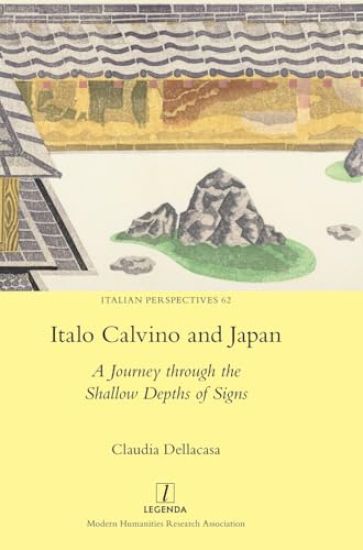
Italo Calvino and Japan

Italo Calvino and Japan

Claudia Dellacasa

Legenda
2024
sidottu
Italo Calvino (1923-85) travelled to Japan in the autumn of 1976. Thereafter, his work shows an increasing fascination with Japanese literature and Zen Buddhism, even as he adds Japanese works to the bookshelves of his library in Rome. This is the first study to restore to the author's writing the dynamics of East-West dialogues, addressing Japanese gardens and temples, but also literary and artistic expressions, as the spaces through which Calvino developed a landmark feature of his distinctive cultural ecology: a renewed awareness of the interdependency between human and other-than-human forms of life and communication.Claudia Dellacasa is Lecturer in Italian at the University of Glasgow.
Italo Calvino and Classics: Lightness - Quickness - Multiplicity
In his Memos for the Next Millennium, the Italian writer Italo Calvino identified five literary qualities that should accompany writers and readers into the literature of the future: lightness, quickness, exactitude, visibility, multiplicity. Though never finished, the Memos continue to inspire readers and scholars. This volume turns three of Calvino's poetic qualities - lightness, quickness, multiplicity - into powerful hermeneutic strategies for reading ancient and late antique texts, ranging widely from Homer's Iliad to Claudian's carmina minora. It is the first book to read ancient literature through the lens of Calvino's Memos, thus fostering a new discussion of the interactions between modern and ancient texts as well as between methodologies.
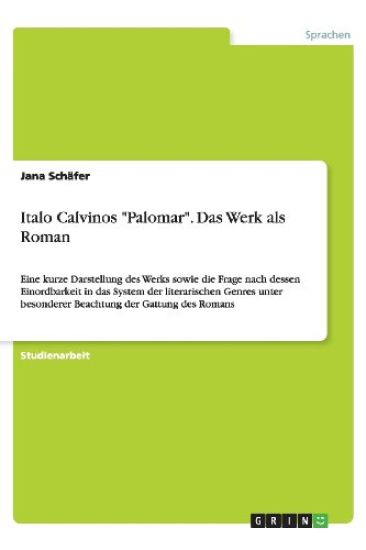
Italo Calvinos "Palomar." Das Werk ALS Roman
Studienarbeit aus dem Jahr 2012 im Fachbereich Romanistik - Italienische u. Sardische Sprache, Literatur, Landeskunde, Note: 2,0, Universit t Trier, Veranstaltung: Italo Calvino: dal neorealismo al postmodernismo, Sprache: Deutsch, Abstract: Das von Italo Calvino geschriebene erz hlerische Sp twerk "Palomar" z hlt zu den vielschichtigen und diversen Publikationen des italienischen Schriftstellers. Bereits das systematische Inhaltsverzeichnis erm glicht dem Leser eine erste Vorstellung ber die Besonderheit dieses letzten zu Italo Calvinos Lebzeiten erschienenen Buches, das mehrere in gewisser Weise eigenst ndige Geschichten bereith lt. Interessant ist dabei vor allem die Frage nach der Gattung des immer wieder als Roman deklarierten Werks, die Raum f r diverse Antwortm glichkeiten l sst. Um die Problematik der Einordbarkeit des Texts in die Kategorien der literarischen Gattungen zu kl ren und um den Versuch zu wagen, "Palomar" damit klaren Begriffen zuzuweisen, wird in dieser Arbeit nicht nur ein kurzer berblick ber einige zu dem Werk m glicherweise passenden literarischen Genres gegeben, sondern vor allem auch die Romanhaftigkeit des Buches erl utert. Der Fokus dieser Arbeit liegt neben eigenen Erkenntnissen anhand des Texts auf den Untersuchungen von Christine Lessle, die sich ausf hrlich mit "Palomar" auseinandergesetzt hat, sowie auf den Ausarbeitungen von Dieter Lamping, der ein breites Spektrum an literarischen Gattungen n her beleuchtet. Um ein klares Verst ndnis ber die Vita des erfolgreichen Schriftstellers zu erhalten, wird Italo Calvino selbst im Vorhinein ausf hrlich vorgestellt. Anschlie end soll die Struktur sowie der Inhalt des Werks "Palomar" in seinen Grundz gen dargestellt und kurz erl utert werden, um im darauffolgenden Kapitel auf die literarischen Genres unter besonderer Beachtung der Gattung des Romans einzugehen. Letztendlich folgt dann der Versuch, literarische Merkmale des Buches zu finden, die sich bestimmten Gattungen zuordnen lassen
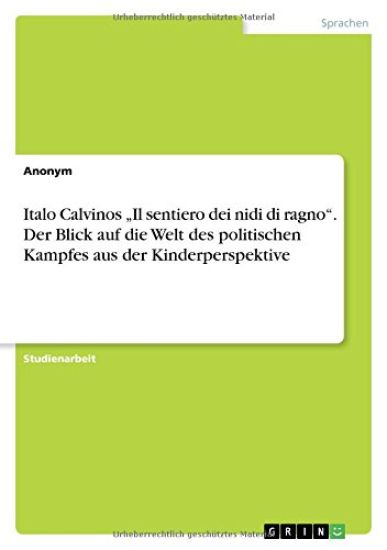
Italo Calvinos "Il sentiero dei nidi di ragno". Der Blick auf die Welt des politischen Kampfes aus der Kinderperspektive
Studienarbeit aus dem Jahr 2012 im Fachbereich Romanistik - Italienische u. Sardische Sprache, Literatur, Landeskunde, Note: 1,3, Ruhr-Universitat Bochum (Romanisches Seminar), Veranstaltung: Das Fruhwerk Italo Calvinos, Sprache: Deutsch, Abstract: Diese Arbeit beschaftigt sich mit der Frage, inwieweit es Italo Calvino in seinem Roman "Il sentiero dei nidi di ragno" gelingt, objektiv und losgelost von seiner eigenen Erfahrung uber den Partisanenkrieg und die Resistenza-Bewegung in Italien gegen Ende des Zweiten Weltkrieges zu berichten. Eine elementare Rolle nimmt hierbei die Wahl seines Perspektivtragers und dessen unbefangener und unmittelbarer kindlicher Blick auf die Welt zur Zeit des Kriegsendes ein. Im Rahmen dieser Fragestellung mussen im ersten Kapitel die relevanten Hintergrunde der politischen Situation im Jahre 1943 erlautert werden. Besonderes Augenmerk wird hierbei auf die politischen Widerstandskampfer, die Partisanen, zu denen auch Italo Calvino selbst gehorte, und ihre Ziele gerichtet. Im zweiten Kapitel soll dann auf die literarische Stromung der Nachkriegszeit, den Neorealismus, eingegangen werden, aus dieser zahlreiche Romane uber Partisanenerfahrungen entstanden sind. Um einen Unterschied zwischen den ublichen subjektiven Partisanenerzahlungen und einem neuen Schreibstil, einer neuen Form des Erzahlberichtes herzustellen, eignet sich der Roman Italo Calvinos "Il sentiero dei nidi di ragno" besonders. Dieser schildert eine Episode aus dem Leben eines Partisanenjungen, der den politischen Kampf eben aus der Sicht des Kindes Pin unter einem vollig anderen Blickwinkel erscheinen lasst. Die besondere Problematik, die sich dem Autor bei der Wahl eines Perspektivtragers stellte, wird im vierten Kapitel erlautert und unter Berucksichtigung seiner eigenen Beweggrunde weitergefuhrt. Auch auf die besondere Funktion und die Mehrschichtigkeit der Kinderperspektive wird eingegangen und sie wird durch einige Textbeispiele belegt. Desweiteren wird im Fazit