Kirjahaku
Etsi kirjoja tekijän nimen, kirjan nimen tai ISBN:n perusteella.
489 tulosta hakusanalla Ivor Brown
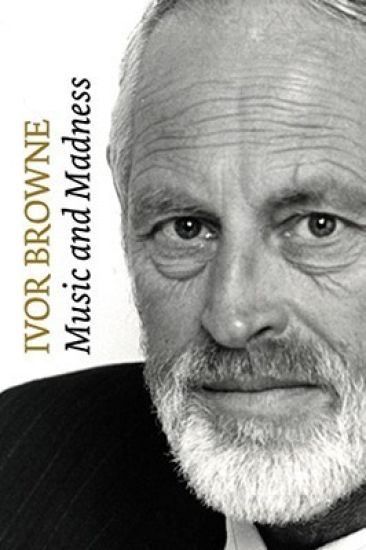
This book charts the career of a man who has always been respected for his compassion, quirky way of thinking and fearless opposition to orthodox psychiatry. More importantly, he tells of how he came to each one of his conclusions. Ivor Browne has had a positive input into Irish life on both sides of the border. As a young man he was given a fellowship to Harvard University where he studied Public and Community Mental Health. He returned to Ireland determined to put what he had learned into practice and it was his initiative which took the care of mental patients away from large institutions into the community.He conceived and was director of the Irish Foundation for Human Development. This set up the first Community Association in Ireland in Ballyfermot one of the early large housing estates in Dublin. Ballyfermot was merely a housing estate without any facilities, he went in with a professional team and helped the residents to turn it into a thriving working class community. This project was so successful that an off shoot was establish in Derry, called the Inner City Trust which not only rebuilt, but transformed the city of Derry during the years it was being torn down by both sides in the conflict. The work of rebuilding was done by young people of Derry, who were trained by the Trust and inspired away from taking part in the destruction of their home town. Derry was made a model for The Prince of Whales' urban village development project and other urban renewal developments around the world.
Ivor Browne is Professor Emeritus, University College, Dublin and retired as Chief Psychiatrist of the then Eastern Health Board in 1994. This book, through his writings, charts the growth of one man's journey in relation to psychiatry and human development. Ivor Browne has been a central and controversial figure in Irish life up until the mid-nineties when he retired. This book charts the career of a man who has always been respected for his compassion, quirky way of thinking and fearless opposition to orthodox psychiatry. Ivor Browne has had a positive input into Irish life on both sides of the border. As a young man he was given a fellowship to Harvard University where he studied Public and Community Mental Health. He returned to Ireland determined to put what he had learned into practice and it was his initiative which took the care of mental patients away from large institutions into the community. He conceived and was director of the Irish Foundation for Human Development. This set up the first Community Association in Ireland in Ballyfermot one of the early large housing estates in Dublin. Ballyfermot was merely a housing estate without any facilities, he went in with a professional team and helped the residents to turn it into a thriving working class community. This project was so successful that an offshoot was established in Derry, called the Inner City Trust which not only rebuilt, but transformed the city of Derry during the years it was being torn down by both sides in the conflict. The work of rebuilding was done by young people of Derry, who were trained by the Trust and inspired away from taking part in the destruction of their home town. Derry was made a model for The Prince of Wales' urban village development project and other urban renewal developments around the world.

This book is part of the Images of England series, which uses old photographs and archived images to show the history of various local areas in England, through their streets, shops, pubs, and people.
This work has been selected by scholars as being culturally important and is part of the knowledge base of civilization as we know it.This work is in the public domain in the United States of America, and possibly other nations. Within the United States, you may freely copy and distribute this work, as no entity (individual or corporate) has a copyright on the body of the work.Scholars believe, and we concur, that this work is important enough to be preserved, reproduced, and made generally available to the public. To ensure a quality reading experience, this work has been proofread and republished using a format that seamlessly blends the original graphical elements with text in an easy-to-read typeface.We appreciate your support of the preservation process, and thank you for being an important part of keeping this knowledge alive and relevant.
This work has been selected by scholars as being culturally important, and is part of the knowledge base of civilization as we know it. This work was reproduced from the original artifact, and remains as true to the original work as possible. Therefore, you will see the original copyright references, library stamps (as most of these works have been housed in our most important libraries around the world), and other notations in the work.This work is in the public domain in the United States of America, and possibly other nations. Within the United States, you may freely copy and distribute this work, as no entity (individual or corporate) has a copyright on the body of the work.As a reproduction of a historical artifact, this work may contain missing or blurred pages, poor pictures, errant marks, etc. Scholars believe, and we concur, that this work is important enough to be preserved, reproduced, and made generally available to the public. We appreciate your support of the preservation process, and thank you for being an important part of keeping this knowledge alive and relevant.
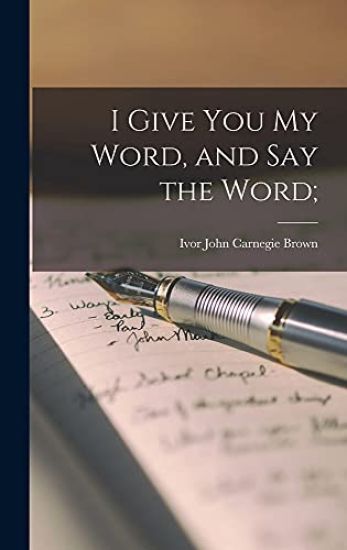
I Give You My Word, and Say the Word;
Ivor John Carnegie 1891-1974 Brown
Hassell Street Press
2021
sidottu
This work has been selected by scholars as being culturally important and is part of the knowledge base of civilization as we know it.This work is in the public domain in the United States of America, and possibly other nations. Within the United States, you may freely copy and distribute this work, as no entity (individual or corporate) has a copyright on the body of the work.Scholars believe, and we concur, that this work is important enough to be preserved, reproduced, and made generally available to the public. To ensure a quality reading experience, this work has been proofread and republished using a format that seamlessly blends the original graphical elements with text in an easy-to-read typeface.We appreciate your support of the preservation process, and thank you for being an important part of keeping this knowledge alive and relevant.
I Give You My Word, and Say the Word;
Ivor John Carnegie 1891-1974 Brown
Hassell Street Press
2021
nidottu
A history of West Shropshire mining fields
Magnetocumulative Generators
Larry L. Altgilbers; Mark D.J. Brown; Igor Grishnaev; Bucur M. Novac; Ivor R. Smith; Yuriy Tkach; Iaroslav Tkach
Springer-Verlag New York Inc.
2000
sidottu
Devices that convert explosive energy into electromagnetic energy are often called Flux Compression Generators (FCGs) in the United States, whereas the term Magnetocumulative Generators (MCGs) is more com monly used in Russia. Since the Russian literature is accessed more heavily in this book, the latter term is used here. In any event, the basic process involves using explosives to force an initial magnetic flux into a region of smaller inductance in such a manner that loss of flux is minimized. In the event that no flux is lost, the magnetic energy associated with the flux, inversely proportional to the inductance, must increase. Flux loss is min imized by confining it with good conductors which, in turn, are driven rapidly by the explosive to reduce the system inductance. The magnetic energy is increased by the work the conductors do as they are forcibly moved against the magnetic field, the energy, in turn, being supplied by the explosive driving them. As the reader may infer, there are different kinds of generators, some of which might be difficult to recognize as MCGs. Nonetheless, they all possess the features outlined above. Explosives have some unique features as energy sources. They have very high available energy densities; they release energy rapidly, or at high power; they can develop very high pressures.
Magnetocumulative Generators
Larry L. Altgilbers; Mark D.J. Brown; Igor Grishnaev; Bucur M. Novac; Ivor R. Smith; Yuriy Tkach; Iaroslav Tkach
Springer-Verlag New York Inc.
2012
nidottu
Devices that convert explosive energy into electromagnetic energy are often called Flux Compression Generators (FCGs) in the United States, whereas the term Magnetocumulative Generators (MCGs) is more com monly used in Russia. Since the Russian literature is accessed more heavily in this book, the latter term is used here. In any event, the basic process involves using explosives to force an initial magnetic flux into a region of smaller inductance in such a manner that loss of flux is minimized. In the event that no flux is lost, the magnetic energy associated with the flux, inversely proportional to the inductance, must increase. Flux loss is min imized by confining it with good conductors which, in turn, are driven rapidly by the explosive to reduce the system inductance. The magnetic energy is increased by the work the conductors do as they are forcibly moved against the magnetic field, the energy, in turn, being supplied by the explosive driving them. As the reader may infer, there are different kinds of generators, some of which might be difficult to recognize as MCGs. Nonetheless, they all possess the features outlined above. Explosives have some unique features as energy sources. They have very high available energy densities; they release energy rapidly, or at high power; they can develop very high pressures.