Bence Brechenhad is the sole survivor of the infamous Aeonian army. His fear of Deranian justice drives him to flee the country, abandoning his only companion, Queen Isabel, without so much as a good-bye. Bence leaves with Isabel's ring and a black pearl with one goal in mind: to find a new home and a fresh start.Throughout his adventures over rough seas and maze-like woods, the sins of his past lurk around every corner. When Bence reaches the country of Irelle, he rescues a baby Dunya, jeopardizing his chances of acceptance into their clan.Meanwhile, Isabel tries to fulfill her new role as queen. She is fully invested in rebuilding her kingdom, and funds her people's short-lived peace until a man she thought was dead and a banished Healer appear on her steps.Their arrival seems to prompt a string of murders cascading through Deran. Each victim is branded with the Aeonian mark, and Isabel's kingdom is inevitably sucked back into a vortex of violence and turmoil.The winds whisper to Bence, calling him back to Deran. Will he have the courage to confront his past and fight alongside Isabel once more?
Queen Isabel lost it all. Stuck on a remote island, she learns her husband Dante usurped the Deranian throne, and all her tribe leaders and allies are dead. Worst of all, her talismans that control the elements no longer work. The once closed-off sovereign of Deran catches the attention from countries around the world: the Empress of Waaken wants to forge an allegiance while a clan leader in Irelle demands a relationship over a broken agreement. Teaming up with Ami, a strong-willed innkeeper's daughter, Isabel must find a way to restore her magic and return Deran to its former glory. However, the sands of time are shifting ─ the events set in motion are eerily similar to what lead to the establishment of the Aeonians two hundred years ago.
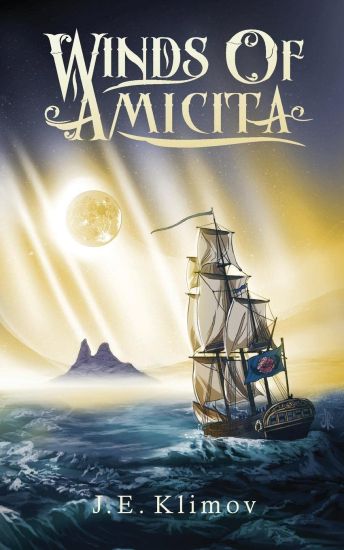
Once every century for the last five-hundred years, a brilliant curtain of light called The Luce blazes a path across the ocean to Amicita, an island shrouded in mystery. Rumored to be rich in natural resources and ancient artifacts, Amicita has caught interest from rest of the world.With the advent of another Luce just around the corner, Landree sees this as an opportunity to escape her life as an inn-keeper's daughter. Craving for adventure, she and her friends sign up for an expedition to the island. In a stroke of luck, Landree and five other students in the same village were selected, including a brooding, lone wolf named Nicholas, who is fixated on a myth that Amicita holds gemstones that grant elemental powers. He also warns that Amicita is hidden away from the rest of the world for a reason.After a storm maroons Landree and her friends on the island, everyone shifts their focus from exploration to survival. They race against time to gather enough supplies to sail home before The Luce, their only way to navigate home safely, vanishes when the two moons eclipse. As Landree and her friends stumble deeper into the wilderness, myth becomes reality when they awaken the powers within gemstones; however, they soon discover that the powers had been activated for a reason. Earthquakes worsen. People vanish one by one. Can Landree unravel the mystery of Amicita before it's too late?
The real world and imagination collide in this international collection of paranormal urban fantasies. Some cities are inhabited by lycanthropes: a werewolf-turned-private-eye takes on a kidnapping case that upsets his plans for a simple life; a vegetarian werewolf must join forces with a local pack to save their city; and a twenty-something lycan thinks she's the scariest monster in town until she meets a necromancer. Children are often the center of paranormal activity: a troop of Mountain Gals on a camping trip runs afoul of a witch; a high school outcast pairs up with an angel to guide ghosts to their final rests; a young fae intelligence agent is placed on his first undercover assignment at a high school; and a little girl rattles a zombie-run pub for supernatural clientele when she accidentally begins haunting it. These young urbanites are more than they seem: a kindhearted girl changes her life forever when she offers shelter to an injured hellhound; a runty dragon dwells in the sewers plotting revenge while dreaming of reliable takeout; and an ordinary detective must team up with a young hotshot magician to solve a mysterious disappearance. Step across the paranormal divide with these ten short stories, and you'll never look at your hometown the same way again.
The 18th century was a wealth of knowledge, exploration and rapidly growing technology and expanding record-keeping made possible by advances in the printing press. In its determination to preserve the century of revolution, Gale initiated a revolution of its own: digitization of epic proportions to preserve these invaluable works in the largest archive of its kind. Now for the first time these high-quality digital copies of original 18th century manuscripts are available in print, making them highly accessible to libraries, undergraduate students, and independent scholars.Western literary study flows out of eighteenth-century works by Alexander Pope, Daniel Defoe, Henry Fielding, Frances Burney, Denis Diderot, Johann Gottfried Herder, Johann Wolfgang von Goethe, and others. Experience the birth of the modern novel, or compare the development of language using dictionaries and grammar discourses. ++++The below data was compiled from various identification fields in the bibliographic record of this title. This data is provided as an additional tool in helping to insure edition identification: ++++British LibraryT097255The titlepage is engraved. Text and register are continuous.London: printed for John Millan, 1745. 4],30,33-40,33-104,113-120,113-128p.; 8
The 18th century was a wealth of knowledge, exploration and rapidly growing technology and expanding record-keeping made possible by advances in the printing press. In its determination to preserve the century of revolution, Gale initiated a revolution of its own: digitization of epic proportions to preserve these invaluable works in the largest archive of its kind. Now for the first time these high-quality digital copies of original 18th century manuscripts are available in print, making them highly accessible to libraries, undergraduate students, and independent scholars.Western literary study flows out of eighteenth-century works by Alexander Pope, Daniel Defoe, Henry Fielding, Frances Burney, Denis Diderot, Johann Gottfried Herder, Johann Wolfgang von Goethe, and others. Experience the birth of the modern novel, or compare the development of language using dictionaries and grammar discourses. ++++The below data was compiled from various identification fields in the bibliographic record of this title. This data is provided as an additional tool in helping to insure edition identification: ++++British LibraryT122213The titlepage is engraved.London: printed for John Millan, 1760. 4],128p., table; 8
Si conclude (forse) il romanzo scritto sotto forma di sceneggiatura, che racconta le vicende che vedono protagonisti Jo e Jolly: un uomo, una donna, due soldati, le loro complesse personalit e la loro incapacit di stare insieme. Da capitolo 77 a capitolo 88
At the height of his career, J.E.H. MacDonald’s paintings and oil sketches reveal a mastery of colour mixing, a sureness of brushstroke, and a deep understanding of compositional design. His striking landscapes and views of nature are an important artistic legacy and confirm his essential place among the Group of Seven painters. J.E.H. MacDonald Up Close provides a fresh interpretation of MacDonald’s artistic development and sheds new light on questions of authenticity and dating surrounding MacDonald’s paintings. Here art conservation experts Kate Helwig and Alison Douglas combine rigorous scientific analysis with a close visual examination of MacDonald’s work to focus on his materials and techniques. Exploring the interface between art history and science, Helwig and Douglas use excerpts from MacDonald’s diaries, letters, and lectures to provide socio-historical context to their in-depth reading of the paintings as physical objects.Helwig and Douglas’s fascinating text is accompanied not only by reproductions of key artworks, but also by never-before-seen photographs taken through a microscope. These unique, close-up views of MacDonald’s working methods reveal the texture of his brushstrokes and the characteristic ways he layered and mixed his paint.
*Includes pictures *Profiles the debate over the intention of Lee's orders to Stuart and who's to blame for what happened *Includes accounts of Stuart's operation written by his adjutant general and others *Includes online resources and a bibliography for further reading *Includes a table of contents "The failure to crush the Federal army in Pennsylvania in 1863, in the opinion of almost all of the officers of the Army of Northern Virginia, can be expressed in five words-the absence of the cavalry." - Confederate General Henry Heth As Robert E. Lee's army moved into Pennsylvania in June 1863, Stuart's cavalry screened his movements, thereby engaging in the more traditional cavalry roles, but it's widely believed he was hoping to remove the negative effect of Brandy Station by duplicating one of his now famous rides around the enemy army, much as he did to McClellan's Army of the Potomac during the Peninsula Campaign in 1862. This time, however, as Lee began his march north through the Shenandoah Valley in western Virginia, it is highly unlikely that is what he wanted or expected. Before setting out on June 25, the methodical Lee gave Stuart specific instructions as to the role he was to play in the Pennsylvania offensive. As the eyes of the army, the cavalry was to guard the mountain passes with part of his force while the Army of Northern Virginia was still south of the Potomac River, and then cross the river with the remainder of his army and screen the right flank of Confederate general Richard Stoddert Ewell's II Corps as it moved down the Shenandoah Valley, maintaining contact with Ewell's army as it advanced towards Harrisburg. Instead of taking the most direct route north near the Blue Ridge Mountains, however, Stuart chose a much more ambitious course of action. Stuart decided to march his three best brigades (under Generals Hampton, Fitzhugh Lee, and Col. John R. Chambliss) between the Union army and Washington, north through Rockville to Westminster, and then into Pennsylvania, a route that would allow them to capture supplies along the way and wreak havoc as they skirted Washington. To complicate matters even more, as Stuart set out on June 25 on what was probably a glory-seeking mission, he was unaware that his intended path was blocked by columns of Union infantry that would invariably force him to veer farther east than he or Lee had anticipated. Ultimately, his decision would prevent him from linking up with Ewell as ordered and deprive Lee of his primary cavalry force as he advanced deeper and deeper into unfamiliar enemy territory. According to Halsey Wigfall (son of Confederate States Senator Louis Wigfall) who was in Stuart's infantry, "Stuart and his cavalry left Lee's] army on June 24 and did not contact his] army again until the afternoon of July 2, the second day of the Gettysburg] battle." According to Stuart's own account, on June 29 his men clashed briefly with two companies of Union cavalry in Westminster, Maryland, overwhelming and chasing them "a long distance on the Baltimore road," causing a "great panic" in the city of Baltimore. On June 30, the head of Stuart's column then encountered General Judson Kilpatrick's cavalry as it passed through Hanover, during which they reportedly captured a wagon train and scattered the Union army before Kilpatrick's men were able to regroup and drive Stuart and his men out of town. Then, after a 20 mile trek in the dark, Stuart's exhausted men reached Dover, Pennsylvania on the morning of July 1. H.B. McClellan would point out in his book about Stuart that Lee's orders meant the army commander "was aware that under the most favorable circumstances Stuart must be separated from the army for at least three or four days." However, Stuart's cavalry would be gone for 7 days, and Stuart was too far removed from the Army of Northern Virginia to warn Lee of the Army of the Potomac's movements.