

Kirjahaku
Etsi kirjoja tekijän nimen, kirjan nimen tai ISBN:n perusteella.
1000 tulosta hakusanalla J Tyson Mitchell


Born and Raised in Chicago, Il, Until 1969.worked and Visited from New York, Ny, to Florida on the East Coast. from San Francisco to San Diego on the West Coast. from Minnesota, Detroit, and Chicago in the Midwest. from Arkansas and Mississippi in the Gulf Coast Area. Went to School in Arkansas and Georgia Vietnam Era Veteran

The Doctrines of the "Abolitionists" Refuted, in a Letter from J. Washington Tyson, the Democratic Harrison Candidate for Congress, in the First District, of Pennsylvania
J. Washington Tyson
Antigonos Verlag
2025
nidottu

Tyson, J: Social and intellectual state of the colony of Pen
Antigonos Verlag
2024
nidottu

Tyson, J: Social and intellectual state of the colony of Pen
Antigonos Verlag
2024
sidottu
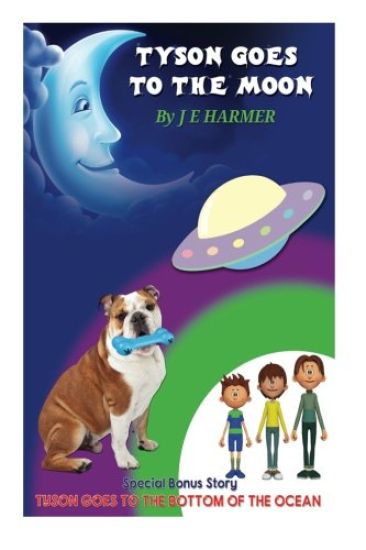
Tyson Goes To The Moon: Tyson Goes To The Bottom Of The Ocean
J. E. Harmer
Createspace Independent Publishing Platform
2015
nidottu


The Belousov-Zhabotinskii Reaction
J.J. Tyson
Springer-Verlag Berlin and Heidelberg GmbH Co. K
1976
nidottu
In 1958 B. P. Belousov discovered that the oxidation of citric acid by bromate in the presence of cerium ions does not proceed to equilibrium methodically and uniformly, like most chemical reactions, but rather oscillates with clocklike precision between a yellow and colorless state. See Fig. 11. 1, p. 30. A. M. Zhabotinskii followed up on Belousov's original observation and in 1964 his first investigations appeared in the Russian journal Biofizika. Though H. Degn (in Copenhagen at the time) knew of Zhabotinskii's work and published his own account of the mechanism of oscillation in Nature (1967), this interesting reaction attracted little attention among Western scientists until 1968, when Zhabotinskii and his coworkers and Busse (from Braunschweig, W. Germany) reported on their work at an international conference on biological and biochemical oscillators held in Prague. Shortly thereafter appeared· a flurry of papers on temporal oscillations and spatial patterns in this reaction system. Vavilin and Zhabotinskii (1969) [and later Kasperek and Bruice (1971)] studied the kinetics of the oxidation 3 of Ce+ by Br0 and the oxidation of organic species by Ce+4. Busse (1969) 3 reported his observation of colored bands of chemical activity propagating up and down in a long tube of unstirred solution. Zaikin and Zhabotinskii (1970) observed circular chemical waves in thin layers of solution.

Where The Players Dwell
Tyson Anthony; Carter J. Banks; Jaxon Grant
Tinsley Phelps, LLC
2017
nidottu

Das Universum für die Hosentasche
Neil Degrasse Tyson; J. Richard Gott; Michael A. Strauss
FinanzBuch Verlag
2022
sidottu

The Wounded Soul: A Legacy of Healing and Voice Restoration: A Legacy of Healing and Voice Restoration
Barbara J. Tyson
Doctors House LLC
2025
nidottu
A Discourse Before The Young Men's Colonization Society Of Pennsylvania
J. R. Tyson
Kessinger Pub
2007
pokkari

The book explains how scientific principles are applied so that information about the chemical composition of materials can be obtained. It provides a critical guide to the evaluation of the quality of the information that can be obtained about the identity and concentration of chemical compounds present at relatively low concentrations in complex sample materials and how to devise and validate a new analytical method. The book explains why it is difficult to obtain reliable information about the minor and trace chemical constituents of complex materials. As this kind of information underpins many areas of scientific endeavor, and our health and well-being, it is important that everyone concerned is aware of the scope and limitations of chemical measurement technology. Topics include Arsenic Compounds in Food and Drinking Water, The Environmental Chemistry of Arsenic, A Critical Review of Scientific Communication, Analytical Chemistry, Method development and evaluation, The Determination of Arsenic Compounds by Molecular Spectrometry, The Determination of Arsenic Compounds by Atomic Spectrometry, The Determination of Arsenic Compounds by Mass Spectrometry, The Determination of Arsenic Compounds by Electrochemistry, Separation Methods, High Performance Separations, Direct solid analysis, Field and Portable Methods, Problems with the analysis of real samples, especially rice, soil and urine, and Arsenic research projects for students at all stages and citizen scientists.

A Discourse Before The Young Men's Colonization Society Of Pennsylvania (1834)
J. R. Tyson
KESSINGER PUBLISHING, LLC
2010
sidottu
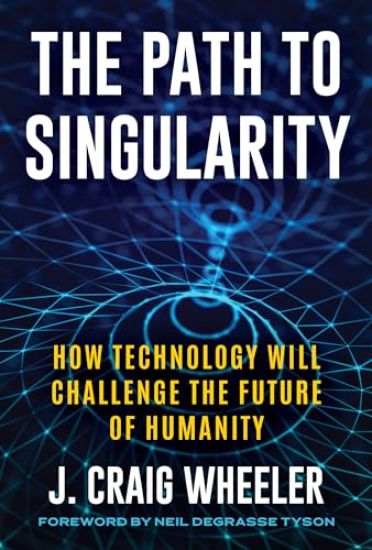
J. Craig Wheeler, a leading astrophysicist and former president of the American Astronomical Society, argues that we must take charge of our technology now, before we lose the ability to control it, which many estimate will happen around 2040, if not sooner. He reviews today’s technology in crucial areas that will have the greatest impact on our futures — artificial intelligence, robotics, brain/computer interfaces, and genetic engineering — and shows us how these technologies are interrelated and where they are heading We are developing autonomous self-evolving machines that are already vastly smarter and faster than we are in many ways — able to strategize and perhaps even potentially capable of becoming sentient mind-readers. Our understanding of the structure and function of DNA and proteins along with new techniques like CRISPR give us unprecedented power to manipulate our own biology, to cure disease, and maybe to control our own evolution, producing designer babies, lab-grown brains, and artificial life. He describes how all technology is developing at an increasingly swift pace that makes these issues more urgent than ever. There is likely to be a tipping point when change occurs at a pace so rapid that humans are not able to adjust, either individually or as a society. He then outlines the disruptions to our social, economic, and democratic systems these advances are likely to cause. Will there be jobs for those willing to work? Will social media companies manipulate us so cleverly that we lose our free will? Will AI nudge us to vote in certain ways, or even vote for us? If many people mentally connect, will a possible outcome be a single shared mind where our individuality dissolves, and we become a single entity? Have humans outgrown Earth’s resources? Must we limit the population? If we solve the ageing problem, what do we do with the new babies? What are the prospects of migrating to space?To maintain control, Wheeler argues that we must be informed. Only by understanding this era of accelerating change and its implications — both promising and frightening — will we gain the ability to control the technological developments that will dominate our lives. Throughout, he stresses the ethical and moral challenges that the new technology poses. Finally, he offers advice on what we must do to avoid a fate akin to a frog in a warming pot. On a personal level, we must cultivate an awareness mindset — to stay consciously aware of the onrush of technology. Building on that collective awareness, he offers clear and practical ways in which we can take control — if we start now.

Merlin’s Tour of the Universe for the Twenty-first Century
Neil deGrasse Tyson; Bronson (NRT) Pinchot; Stephen J. (ILT) Tyson
BLACKSTONE PUB
2024
cd
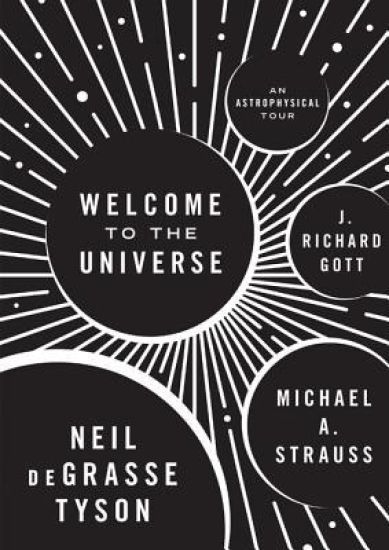
Welcome to the Universe
Neil deGrasse Tyson; Michael A. Strauss; J. Richard Gott
PRINCETON UNIVERSITY PRESS
2016
sidottu
A NEW YORK TIMES BESTSELLER Welcome to the Universe is a personal guided tour of the cosmos by three of today's leading astrophysicists. Inspired by the enormously popular introductory astronomy course that Neil deGrasse Tyson, Michael A. Strauss, and J. Richard Gott taught together at Princeton, this book covers it all--from planets, stars, and galaxies to black holes, wormholes, and time travel. Describing the latest discoveries in astrophysics, the informative and entertaining narrative propels you from our home solar system to the outermost frontiers of space. How do stars live and die? Why did Pluto lose its planetary status? What are the prospects of intelligent life elsewhere in the universe? How did the universe begin? Why is it expanding and why is its expansion accelerating? Is our universe alone or part of an infinite multiverse? Answering these and many other questions, the authors open your eyes to the wonders of the cosmos, sharing their knowledge of how the universe works. Breathtaking in scope and stunningly illustrated throughout, Welcome to the Universe is for those who hunger for insights into our evolving universe that only world-class astrophysicists can provide.
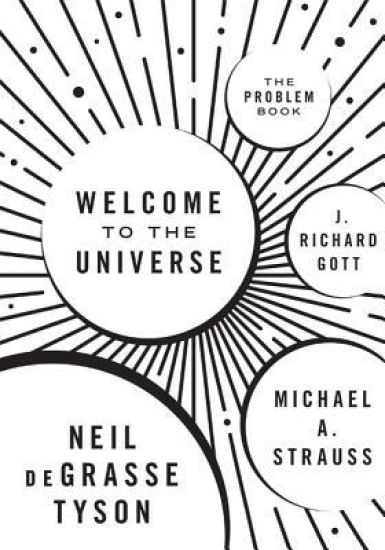
Welcome to the Universe
Neil deGrasse Tyson; Michael A. Strauss; J. Richard Gott
Princeton University Press
2017
sidottu
Here is the essential companion to Welcome to the Universe, a New York Times bestseller that was inspired by the enormously popular introductory astronomy course for non-science majors that Neil deGrasse Tyson, Michael A. Strauss, and J. Richard Gott taught together at Princeton. This problem book features more than one hundred problems and exercises used in the original course--ideal for anyone who wants to deepen their understanding of the original material and to learn to think like an astrophysicist. Whether you're a student or teacher, citizen scientist or science enthusiast, your guided tour of the cosmos just got even more hands-on with Welcome to the Universe: The Problem Book. * The essential companion book to the acclaimed bestseller* Features the problems used in the original introductory astronomy course for non-science majors at Princeton University* Organized according to the structure of Welcome to the Universe, empowering readers to explore real astrophysical problems that are conceptually introduced in each chapter* Problems are designed to stimulate physical insight into the frontier of astrophysics* Problems develop quantitative skills, yet use math no more advanced than high school algebra* Problems are often multipart, building critical thinking and quantitative skills and developing readers' insight into what astrophysicists do* Ideal for course use--either in tandem with Welcome to the Universe or as a supplement to courses using standard astronomy textbooks--or self-study* Tested in the classroom over numerous semesters for more than a decade* Prefaced with a review of relevant concepts and equations* Full solutions and explanations are provided, allowing students and other readers to check their own understanding