Kirjojen hintavertailu. Mukana 12 390 323 kirjaa ja 12 kauppaa.

Kirjahaku

Etsi kirjoja tekijän nimen, kirjan nimen tai ISBN:n perusteella.

1000 tulosta hakusanalla J. G. Honoré Greppo

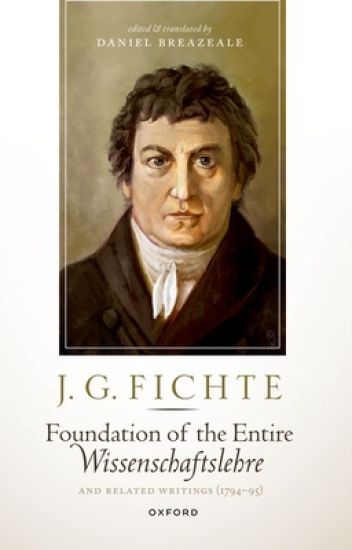
J. G. Fichte: Foundation of the Entire Wissenschaftslehre and Related Writings, 1794-95
The Wissenschaftslehre or "doctrine of science" was the great achievement of the German idealist philosopher J. G. Fichte. Daniel Breazeale presents accessible new translation of three works in which Fichte developed this philosophical system. The centerpiece of this volume is a new English translation of Fichte's only full-scale presentation of the principles of his philosophy, the Foundation of the Entire Wissenschaftslehre (1794/95). Accompanying this are new translations of the work in which Fichte first publicly introduced his new system, Concerning the Concept of the Wissenschaftslehre (1794) and the Outline of what is Distinctive of the Wissenschaftslehre with respect to the Theoretical Power (1795), which was intended as a companion to the Foundation. In addition Breazeale includes the transcripts of Fichte's unpublished "Zurich lectures" on his system (1794), translated here for the first time in English. Breazeale supplements his translations with an extensive historical and systematic introduction, detailed outlines of the contents and structure of the Foundation and Outline, and copious scholarly annotation of the translated texts, helping to orient readers who may otherwise find themselves lost in the wilderness of Fichte's complex "derivations."
J. G. Fichte: Foundation of the Entire Wissenschaftslehre and Related Writings, 1794-95
The Wissenschaftslehre or "doctrine of science" was the great achievement of the German idealist philosopher J. G. Fichte. Daniel Breazeale presents accessible new translations of three works in which Fichte developed this philosophical system. The centerpiece of this volume is a new English translation of Fichte's only full-scale presentation of the principles of his philosophy, the Foundation of the Entire Wissenschaftslehre (1794/95). Accompanying this are new translations of the work in which Fichte first publicly introduced his new system, Concerning the Concept of the Wissenschaftslehre (1794) and the Outline of what is Distinctive of the Wissenschaftslehre with respect to the Theoretical Power (1795), which was intended as a companion to the Foundation. In addition Breazeale includes the transcripts of Fichte's unpublished "Zurich lectures" on his system (1794), translated here for the first time in English. Breazeale supplements his translations with an extensive historical and systematic introduction, detailed outlines of the contents and structure of the Foundation and Outline, and copious scholarly annotation of the translated texts, helping to orient readers who may otherwise find themselves lost in the wilderness of Fichte's complex "derivations."
J. G. Ballard: Visions and Revisions
Providing an extensive reassessment of dominant and recurring themes in Ballard's writing, including historical violence, pornography, post 9/11 politics, and urban space, this book also engages with Ballard's 'late' modernism; his experimentation with style and form; and his sustained interests in psychology and psychopathology.
J. G. Ballard

J. G. Ballard

D. Harlan Wilson

University of Illinois Press
2017
sidottu
Prophetic short stories and apocalyptic novels like The Crystal World made J. G. Ballard a foundational figure in the British New Wave. Rejecting the science fiction of rockets and aliens, he explored an inner space of humanity informed by psychiatry and biology and shaped by surrealism. Later in his career, Ballard's combustible plots and violent imagery spurred controversy--even legal action--while his autobiographical 1984 war novel Empire of the Sun brought him fame. D. Harlan Wilson offers the first career-spanning analysis of an author who helped steer SF in new, if startling, directions. Here was a writer committed to moral ambiguity, one who drowned the world and erected a London high-rise doomed to descend into savagery--and coolly picked apart the characters trapped within each story. Wilson also examines Ballard's methods, his influence on cyberpunk, and the ways his fiction operates within the sphere of our larger culture and within SF itself.
J. G. Ballard

J. G. Ballard

D. Harlan Wilson

University of Illinois Press
2017
nidottu
Prophetic short stories and apocalyptic novels like The Crystal World made J. G. Ballard a foundational figure in the British New Wave. Rejecting the science fiction of rockets and aliens, he explored an inner space of humanity informed by psychiatry and biology and shaped by surrealism. Later in his career, Ballard's combustible plots and violent imagery spurred controversy--even legal action--while his autobiographical 1984 war novel Empire of the Sun brought him fame. D. Harlan Wilson offers the first career-spanning analysis of an author who helped steer SF in new, if startling, directions. Here was a writer committed to moral ambiguity, one who drowned the world and erected a London high-rise doomed to descend into savagery--and coolly picked apart the characters trapped within each story. Wilson also examines Ballard's methods, his influence on cyberpunk, and the ways his fiction operates within the sphere of our larger culture and within SF itself.
The Best Short Stories of J. G. Ballard

The Best Short Stories of J. G. Ballard

J. G. Ballard

St. Martins Press-3pl
2001
nidottu
First published in 1978, this collection of nineteen of J. G. Ballard's best short stories is as timely and informed as ever. This collection includes "The Garden of Time," the inspiration for the 2024 Met Gala-fashion's biggest night. His tales of the human psyche and its relationship to nature and technology, as viewed through a strong microscope, were eerily prescient and now provide greater perspective on our computer-dominated culture. Ballard's voice and vision have long served as a font of inspiration for today's cyber-punks, the authors and futurists who brought the information age into the mainstream.
The Complete Stories of J. G. Ballard

The Complete Stories of J. G. Ballard

J. G. Ballard; Martin (INT) Amis

WW Norton Co
2010
pokkari
With a body of work unparalleled in twentieth-century literature, J. G. Ballard is recognized as one of the greatest and most prophetic writers in the world. With the much-hailed release of The Complete Stories of J. G. Ballard, readers now have a means to celebrate the unmatched range and mesmerizing cadences of a literary genius. Whether writing about musical orchids, human cannibalism, or the secret history of World War III, Ballard's Complete Stories evokes the hallucinations of Kafka and Borges in its ability to render modern paranoia and fantastical creations on the page. A Washington Post Best Book of 2009, Boston Globe Best Book, Los Angeles Times Favorite Book, and San Francisco Chronicle Best Book.
H. G. J. Moseley

H. G. J. Moseley

J. L. Heilbron

University of California Press
2022
pokkari
H. G. J. Moseley (1887 - 1915), the son and grandson of distinguished English scientists, a favorite student of Rutherford's and a colleague of Bohr's, completed researches of capital importance for atomic physics just before the outbreak of World War I. He was urged to devote himself to scientific war work in England, but his duty as he aw it was to join the battle. He procured himself command of a signaling section in the Royal Engineers, a speedy trip to Gallipoli, and death in the bloody battle for Sari Bair. In this work the author presents a full record of Moseley's brief and brilliant career. It gives instructive detail about Eton, which, as Heilbron shows, offered more opportunity for acquiring a foundation in science than its emphasis on Greek and games would suggest; about Oxford, a scientific backwater in Moseley's time; and about Rutherford's thriving laboratory at the University of Manchester. It describes in detail Moseley's apprenticeship in experimental physics, his growth under the tight supervision of Manchester, and his classical independent work on X rays, which almost certainly would have brought him the Nobel Prize. An epilogue sketches the chief results secured by other in the decade after his death in the research lines he opened. Heilbron's account is informed by an unequaled acquaintance with the relevant manuscript material, including all of Moseley's known correspondence (most of which he discovered) and the paper of colleagues such as Bohr, W. H. Bragg, G. H. Darwin, F. A. Lindemann (Lord Cherwell), Rutherford, Henry Tizard, Georges Ubrain, and G. von Hevesy. An important feature of the book is the publication, in extenso, of Moseley's surviving correspondence. These letters are not only a rich source for historians of science and of education. Tehy are also splendid reading: well-written records of the maturing of a strong mind, pithy commentaries on the Establishment as Moseley saw it, and exciting notices of the course of one of the most important researches in modern physical science. This title is part of UC Press's Voices Revived program, which commemorates University of California Press's mission to seek out and cultivate the brightest minds and give them voice, reach, and impact. Drawing on a backlist dating to 1893, Voices Revived makes high-quality, peer-reviewed scholarship accessible once again using print-on-demand technology. This title was originally published in 1974.
H. G. J. Moseley

H. G. J. Moseley

J. L. Heilbron

University of California Press
2022
sidottu
H. G. J. Moseley (1887 - 1915), the son and grandson of distinguished English scientists, a favorite student of Rutherford's and a colleague of Bohr's, completed researches of capital importance for atomic physics just before the outbreak of World War I. He was urged to devote himself to scientific war work in England, but his duty as he aw it was to join the battle. He procured himself command of a signaling section in the Royal Engineers, a speedy trip to Gallipoli, and death in the bloody battle for Sari Bair. In this work the author presents a full record of Moseley's brief and brilliant career. It gives instructive detail about Eton, which, as Heilbron shows, offered more opportunity for acquiring a foundation in science than its emphasis on Greek and games would suggest; about Oxford, a scientific backwater in Moseley's time; and about Rutherford's thriving laboratory at the University of Manchester. It describes in detail Moseley's apprenticeship in experimental physics, his growth under the tight supervision of Manchester, and his classical independent work on X rays, which almost certainly would have brought him the Nobel Prize. An epilogue sketches the chief results secured by other in the decade after his death in the research lines he opened. Heilbron's account is informed by an unequaled acquaintance with the relevant manuscript material, including all of Moseley's known correspondence (most of which he discovered) and the paper of colleagues such as Bohr, W. H. Bragg, G. H. Darwin, F. A. Lindemann (Lord Cherwell), Rutherford, Henry Tizard, Georges Ubrain, and G. von Hevesy. An important feature of the book is the publication, in extenso, of Moseley's surviving correspondence. These letters are not only a rich source for historians of science and of education. Tehy are also splendid reading: well-written records of the maturing of a strong mind, pithy commentaries on the Establishment as Moseley saw it, and exciting notices of the course of one of the most important researches in modern physical science. This title is part of UC Press's Voices Revived program, which commemorates University of California Press's mission to seek out and cultivate the brightest minds and give them voice, reach, and impact. Drawing on a backlist dating to 1893, Voices Revived makes high-quality, peer-reviewed scholarship accessible once again using print-on-demand technology. This title was originally published in 1974.
J. G. Herder on Social and Political Culture

J. G. Herder on Social and Political Culture

J. G. Herder; F. M. Barnard

Cambridge University Press
2010
pokkari
The texts collected in this volume, which was originally published in 1969, contain Herder's most original and stimulating ideas on politics, history and language. They had for the most part not been previously available in English. In his introduction, Professor Barnard analyses the basic premises of Herder's political thought against the background of the Enlightenment. He examines Herder's concepts of language, community and culture, his theory of historical interaction, and his approach to the problem of change and progress. Finally, he provides a brief comparative analysis of traditionalist thought following the French Revolution, showing how substantive writers like Burke differed from Herder despite the close similarity of political vocabulary.