Kirjojen hintavertailu. Mukana 11 244 527 kirjaa ja 12 kauppaa.

Kirjahaku

Etsi kirjoja tekijän nimen, kirjan nimen tai ISBN:n perusteella.

1000 tulosta hakusanalla J. M. Synge

J. M. Synge

J. M. Synge

Seán Hewitt

Oxford University Press
2021
sidottu
This book is a complete re-assessment of the works of J.M. Synge, one of Ireland's major playwrights. The book offers the first complete consideration of all of Synge's major plays and prose works in nearly 30 years, drawing on extensive archival research to offer innovative new readings. Much work has been done in recent years to uncover Synge's modernity and to emphasise his political consciousness. This book builds on this re-assessment, undertaking a full systematic exploration of Synge's published and unpublished works. Tracing his journey from an early Romanticism through to the more combative modernism of his later work, the book's innovative methodology treats text as process, and considers Synge's reading materials, his drafts, letters, diaries, and journalism, turning up exciting and unexpected revelations. Thus, Synge's engagement with occultism, pantheism, socialism, Darwinism, and even a late reaction against eugenic nationalisms, are all brought into the critical discussion. Breaking new ground in ascertaining the tenets of Synge's spirituality, and his aesthetic and political idealization of harmony with nature, the book also builds on new work in modernist studies, arguing that Synge can be understood as a leftist modernist, exhibiting many of the key concerns of early modernism, but routing them through a socialist politics. Thus, this book is valuable not only to considerations of Synge and the Irish Revival, but also to modernist studies more broadly.
J. M. Synge and Travel Writing of the Irish Revival

J. M. Synge and Travel Writing of the Irish Revival

Giulia Bruna

Syracuse University Press
2017
nidottu
Between the late 1890s and the early 1900s, the young Irish writer John Millington Synge journeyed across his home country, documenting his travels intermittently for ten years. His body of travel writing includes the travel book The Aran Islands, his literary journalism about West Kerry and Wicklow published in various periodicals, and his articles for the Manchester Guardian about rural poverty in Connemara and Mayo. Although Synge’s nonfiction is often considered of minor weight compared with his drama, Bruna argues persuasively that his travel narratives are instances of a pioneering ethnographic and journalistic imagination. J. M. Synge and Travel Writing of the Irish Revival is the first comprehensive study of Synge’s travel writing about Ireland, compiled during the zeitgeist of the preindependence Revival movement. Bruna argues that Synge’s nonfiction subverts inherited modes of travel writing that put an emphasis on Empire and Nation. Synge’s writing challenges these grand narratives by expressing a more complex idea of Irishness grounded in his empathetic observation of the local rural communities he traveled amongst. Drawing from critically neglected revivalist travel literature, newspapers and periodicals, and visual and archival documents, Bruna sketches a new portrait of a seminal Irish Literary Renaissance figure and sheds new light on the itineraries of activism and literary engagement of the broader Revival movement.
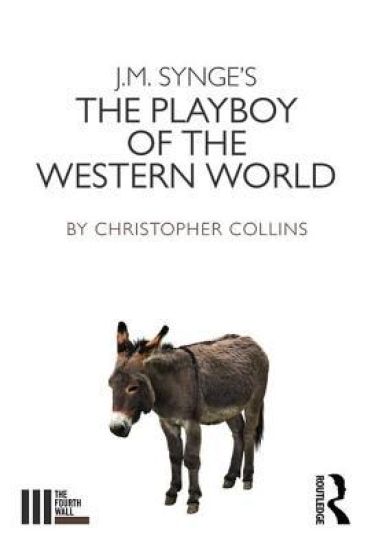
J. M. Synge's The Playboy of the Western World
‘I’m thinking this night wasn’t I a foolish fellow not to kill my father in years gone by.’ – Christy MahonOn the first night of J. M. Synge’s The Playboy of the Western World (1907) the audience began protesting in the theatre; by the third night the protests had spilled onto the streets of Dublin. How did one play provoke this? Christopher Collins addresses The Playboy ’s satirical treatment of illusion and realism in light of Ireland’s struggle for independence, as well as Synge’s struggle for artistic expression. By exploring Synge’s unpublished diaries, drafts and notebooks, he seeks to understand how and why the play came to be.This volume invites the reader behind the scenes of this inflammatory play and its first performances, to understand how and why Synge risked everything in the name of art.
J. M. Synge's The Playboy of the Western World
I'm thinking this night wasn't I a foolish fellow not to kill my father in years gone by.' – Christy MahonOn the first night of J. M. Synge's The Playboy of the Western World (1907) the audience began protesting in the theatre; by the third night the protests had spilled onto the streets of Dublin. How did one play provoke this? Christopher Collins addresses The Playboy 's satirical treatment of illusion and realism in light of Ireland's struggle for independence, as well as Synge's struggle for artistic expression. By exploring Synge's unpublished diaries, drafts and notebooks, he seeks to understand how and why the play came to be.This volume invites the reader behind the scenes of this inflammatory play and its first performances, to understand how and why Synge risked everything in the name of art.
A J. M. Synge Literary Companion

A J. M. Synge Literary Companion

Edward A. Kopper Jr.

Greenwood Press
1988
sidottu
In this 'literary companion,' Kopper includes excellent chapters devoted to (1) brief biography and chronology, (2) Synge's prose, (3) each of his six plays, (4) poems, (5) use of Christian and pagan motifs, (6) use of Irish mythology, (7) literary influences on Synge, (8) Synge's relationship to the Irish Literary Renaissance, (9) Synge's language of women, (10) his use of language generally, and (11) an assessment of Synge's achievement. In addition, Kopper includes a superb select bibliography; a detailed list (with annotation) of characters, locales, and motifs; and stage histories of Synge's plays. . . . Strongly recommended all libraries--academic and public--maintaining 20th-century Anglo-Irish literature collections or general drama/theater collections. Choice This companion to Synge's work covers the important issues in Synge criticism from about 1900 to the present day. Each essay includes a bibliography, and a general bibliography follows. Also included are a brief chronology; a glossary of characters, locales, and motifs; and representative stage histories which also describe productions of Synge's plays in Ireland, the United States, and several other countries. The final essay is the editor's assessment of Synge's overall contribution, and the volume concludes with a general index. This work takes into account the prominence that Synge and other writers of the Irish Renaissance have attained in recent years in the worldwide academic community. The essays deal with Synge's use of language, his place in the Irish Renaissance, his reputation abroad, the forces that influenced his thought and writing, and the foreign productions of his plays. Each essay supplements the author's analysis with bibliographical citations and a synthesis of previous Synge criticism in order to allow for further research. By combining thorough coverage of the basic issues and sources of Synge criticism with fresh approaches provided by a group of distinguished scholars, Kopper has produced an important study of Synge and his milieu. It should prove valuable for college and university courses in modern literature and the Irish Renaissance, modern drama, and the theatre.
J.M. Synge and Lady Gregory

J.M. Synge and Lady Gregory

Elizabeth 1909- Coxhead

Hassell Street Press
2021
sidottu
This work has been selected by scholars as being culturally important and is part of the knowledge base of civilization as we know it.This work is in the public domain in the United States of America, and possibly other nations. Within the United States, you may freely copy and distribute this work, as no entity (individual or corporate) has a copyright on the body of the work.Scholars believe, and we concur, that this work is important enough to be preserved, reproduced, and made generally available to the public. To ensure a quality reading experience, this work has been proofread and republished using a format that seamlessly blends the original graphical elements with text in an easy-to-read typeface.We appreciate your support of the preservation process, and thank you for being an important part of keeping this knowledge alive and relevant.
J.M. Synge and Lady Gregory

J.M. Synge and Lady Gregory

Elizabeth 1909- Coxhead

Hassell Street Press
2021
nidottu
This work has been selected by scholars as being culturally important and is part of the knowledge base of civilization as we know it.This work is in the public domain in the United States of America, and possibly other nations. Within the United States, you may freely copy and distribute this work, as no entity (individual or corporate) has a copyright on the body of the work.Scholars believe, and we concur, that this work is important enough to be preserved, reproduced, and made generally available to the public. To ensure a quality reading experience, this work has been proofread and republished using a format that seamlessly blends the original graphical elements with text in an easy-to-read typeface.We appreciate your support of the preservation process, and thank you for being an important part of keeping this knowledge alive and relevant.
Assessing the Achievement of J. M. Synge

Assessing the Achievement of J. M. Synge

Alexander G. Gonzalez

Praeger Publishers Inc
1996
sidottu
Though J. M. Synge is considered a major figure of Irish drama and an important canonical playwright, he is the subject of fewer and fewer books and conference sessions. In this volume, chapters by expert contributors confront the possibility that Synge's reputation may not be standing the test of time. The chapters reaffirm the relevance of Synge's plays to contemporary audiences and readers and invite a reassessment of his apparently declining popularity. Comparisions of Synge's work to that of other authors reinforce the argument in favor of his continuing relevance.J. M. Synge is generally considered one of the most important Irish dramatists, and his standing within the larger canon of world literature usually goes unchallenged. But his reputation may not be standing the test of time. A relative dearth of presentations on Synge's work at major national and international conferences and even at regional Irish studies conferences suggests that he is not studied as much as he once was, especially relative to other Irish authors such as Joyce, Yeats, O'Casey, and even Paul Muldoon and Eavan Boland. Tolerance for some of Synge's once-hailed extragavance is also lessening among students of his drama.The expert contributors of this book demonstrate that Synge's work is of continuing relevance to contemporary audiences and readers. Each of its essays illuminates the worth of Synge's dramatic canon either by some form of reassessment of individual plays or by comparison of Synge's work to that of authors whose reputation is still indisputably well established, such as Yeats, or to that of contemporary authors whose work is much in the public eye, such as Salman Rushdie. New approaches, including a feminist study of the language of Synge's heroines, also help establish the continued relevance of his drama to contemporary readers.
The Cambridge Companion to J. M. Synge

The Cambridge Companion to J. M. Synge

Cambridge University Press
2009
sidottu
John Millington Synge was a leading literary figure of the Irish Revival who played a significant role in the founding of Dublin's Abbey Theatre in 1904. This Companion offers a comprehensive introduction to the whole range of Synge's work from well-known plays like Riders to the Sea, The Well of the Saints and The Playboy of the Western World, to his influential prose work The Aran Islands. The essays provide detailed and insightful analyses of individual texts, as well as perceptive reflections on his engagements with the Irish language, processes of decolonisation, gender, modernism and European culture. Critical accounts of landmark productions in Ireland and America are also included. With a guide to further reading and a chronology, this book will introduce students of drama, postcolonial studies, and Irish studies as well as theatregoers to one of the most influential and controversial dramatists of the twentieth century.
The Cambridge Companion to J. M. Synge

The Cambridge Companion to J. M. Synge

Cambridge University Press
2009
pokkari
John Millington Synge was a leading literary figure of the Irish Revival who played a significant role in the founding of Dublin's Abbey Theatre in 1904. This Companion offers a comprehensive introduction to the whole range of Synge's work from well-known plays like Riders to the Sea, The Well of the Saints and The Playboy of the Western World, to his influential prose work The Aran Islands. The essays provide detailed and insightful analyses of individual texts, as well as perceptive reflections on his engagements with the Irish language, processes of decolonisation, gender, modernism and European culture. Critical accounts of landmark productions in Ireland and America are also included. With a guide to further reading and a chronology, this book will introduce students of drama, postcolonial studies, and Irish studies as well as theatregoers to one of the most influential and controversial dramatists of the twentieth century.