Kirjojen hintavertailu. Mukana 11 244 527 kirjaa ja 12 kauppaa.

Kirjahaku

Etsi kirjoja tekijän nimen, kirjan nimen tai ISBN:n perusteella.

1000 tulosta hakusanalla J. Mark Ramseyer

Second-Best Justice

Second-Best Justice

J. Mark Ramseyer

University of Chicago Press
2015
sidottu
It's long been known that fewer lawsuits are filed in Japan per capita than in the United States. Yet explanations for the difference have tended to be partial and unconvincing, ranging from circular arguments about Japanese culture to suggestions that the slow-moving Japanese court system acts as a deterrent. With Second-Best Justice, J. Mark Ramseyer offers a much more compelling, well-grounded explanation: the low rate of lawsuits in Japan is driven not by distrust of a dysfunctional system but by a system that works-that sorts and resolves disputes in such an overwhelmingly predictable pattern that opposing parties only rarely find it worthwhile to push their dispute to the trial stage. Using evidence from tort claims across many domains, Ramseyer reveals a court system that is designed not to find perfect justice, but to "make do"-to adopt strategies that are mostly right and that thereby resolve disputes quickly and economically. An eye-opening study of comparative law, Second-Best Justice will force a wholesale rethinking of the differences between Japanese and American legal systems and their broader consequences for social welfare.

Discrimination in Modern Japan: Case Studies in Identity Politics

Discrimination in Modern Japan: Case Studies in Identity Politics

J. Mark Ramseyer

University of Chicago Press
2022
sidottu
An informative rethinking of how Japanese society discriminates against its Korean, Okinawan, and Burakumin populations. In this book, J. Mark Ramseyer, a noted authority on Japan looks at discrimination against groups in Japanese society, focusing on the Korean, Okinawan, and Burakumin groups. Ramseyer asks why they experience discrimination in Japan, an unusually homogeneous society. Is it because of some prejudice on the part of the majority that prevents their integration into mainstream Japanese society? Or is it because some of the dynamics within the group create incentives for the group to stay together and to be on the fringes of society? Ramseyer argues that the real explanation is the latter, and each of these three groups has been victimized by its own leadership. Precisely because the groups are dysfunctional, members of the group cannot control members who would appoint themselves group leaders. The result has been the capture of leadership positions by people who manipulate the group to their own private advantage and to the detriment of the group as a whole.
Discrimination in Modern Japan: Case Studies in Identity Politics

Discrimination in Modern Japan: Case Studies in Identity Politics

J. Mark Ramseyer

University of Chicago Press
2022
nidottu
An informative rethinking of how Japanese society discriminates against its Korean, Okinawan, and Burakumin populations. In this book, J. Mark Ramseyer, a noted authority on Japan looks at discrimination against groups in Japanese society, focusing on the Korean, Okinawan, and Burakumin groups. Ramseyer asks why they experience discrimination in Japan, an unusually homogeneous society. Is it because of some prejudice on the part of the majority that prevents their integration into mainstream Japanese society? Or is it because some of the dynamics within the group create incentives for the group to stay together and to be on the fringes of society? Ramseyer argues that the real explanation is the latter, and each of these three groups has been victimized by its own leadership. Precisely because the groups are dysfunctional, members of the group cannot control members who would appoint themselves group leaders. The result has been the capture of leadership positions by people who manipulate the group to their own private advantage and to the detriment of the group as a whole.
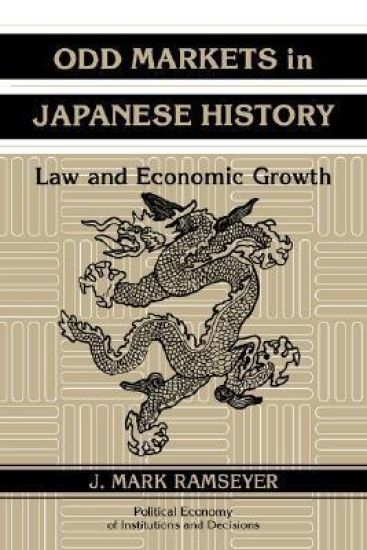
Odd Markets in Japanese History

Odd Markets in Japanese History

J. Mark Ramseyer

Cambridge University Press
2008
pokkari
Employing a rational-choice approach, Professor Ramseyer studies the impact of Japanese law on economic growth in Japan. Toward that end, the author investigates the way law governed various markets and the way that people negotiated contracts within those markets. For much of the period at stake, the Japanese government was an oligarchy rather than a democracy; the judges operated a civil rather than common law regime; the economy grew modestly but erratically; and social customs changed rapidly and radically. As a result, this study applies an economic logic, but to markets in a vastly different world, in a different historical period, and with a different political regime and legal system. Findings reveal that the legal system generally promoted mutually advantageous deals, and that people generally negotiated in ways that shrewdly promoted their private best interests. Whether in the markets for indentured servants, prostitutes, or marriage partners, Odd Markets in Japanese History reports little evidence of either age- or gender- related exploitation.
Odd Markets in Japanese History

Odd Markets in Japanese History

J. Mark Ramseyer

Cambridge University Press
1996
sidottu
Employing a rational-choice approach, Professor Ramseyer studies the impact of Japanese law on economic growth in Japan. Toward that end, the author investigates the way law governed various markets and the way that people negotiated contracts within those markets. For much of the period at stake, the Japanese government was an oligarchy rather than a democracy; the judges operated a civil rather than common law regime; the economy grew modestly but erratically; and social customs changed rapidly and radically. As a result, this study applies an economic logic, but to markets in a vastly different world, in a different historical period, and with a different political regime and legal system. Findings reveal that the legal system generally promoted mutually advantageous deals, and that people generally negotiated in ways that shrewdly promoted their private best interests. Whether in the markets for indentured servants, prostitutes, or marriage partners, Odd Markets in Japanese History reports little evidence of either age- or gender- related exploitation.
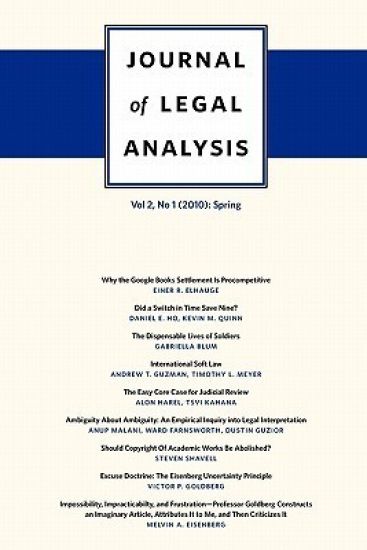
Journal of Legal Analysis

Journal of Legal Analysis

J. Mark Ramseyer

Harvard University Press
2011
nidottu
Co-published by the John M. Olin Center for Law, Economics, and Business at Harvard Law School and Harvard University Press, the JLA is a peer-reviewed publication on law. It aspires to be broad in coverage, including doctrinal legal analysis and interdisciplinary scholarship. JLA articles are free online and available for sale in bound issues.Volume 2, Issue 1 contains contributions from Einer R. Elhauge, Daniel E. Ho, Kevin M. Quinn, Gabriella Blum, Andrew T. Guzman, Timothy L. Meyer, Alon Harel, Tsvi Kahana, Anup Malani, Ward Fransworth, Dustin Guzior, Steven Shavell, Victor P. Goldberg, and Melvin A. Eisenberg.http: //jla.hup.harvard.edu
Contracting in Japan

Contracting in Japan

J. Mark Ramseyer

Cambridge University Press
2023
pokkari
Economic arrangements, Ramseyer writes, are structured and implemented with the intent and hope that they will be carried out with 'care, intelligence, discretion, and effort.' Yet entrepreneurs work with partial information about the products, and people, they are dealing with. Contracting in Japan illustrates this by examining five sets of negotiations and unusual contractual arrangements among non-specialist businessmen, and women, in Japan. In it, Ramseyer explores how sake brewers were able to obtain and market the necessary, but difficult-to-grow, sake rice that captured the local terroir; how Buddhist temples tried to compensate for rapidly falling donations by negotiating unusual funerary contracts; and how pre-war local elites used leasing instead of loans to fund local agriculture. Ramseyer examines these entrepreneurs, discovering how they structured contracts, made credible commitments, obtained valuable information, and protected themselves from adverse consequences to create, maintain, strengthen, and leverage the social networks in which they operated.
Contracting in Japan

Contracting in Japan

J. Mark Ramseyer

Cambridge University Press
2023
sidottu
Economic arrangements, Ramseyer writes, are structured and implemented with the intent and hope that they will be carried out with 'care, intelligence, discretion, and effort.' Yet entrepreneurs work with partial information about the products, and people, they are dealing with. Contracting in Japan illustrates this by examining five sets of negotiations and unusual contractual arrangements among non-specialist businessmen, and women, in Japan. In it, Ramseyer explores how sake brewers were able to obtain and market the necessary, but difficult-to-grow, sake rice that captured the local terroir; how Buddhist temples tried to compensate for rapidly falling donations by negotiating unusual funerary contracts; and how pre-war local elites used leasing instead of loans to fund local agriculture. Ramseyer examines these entrepreneurs, discovering how they structured contracts, made credible commitments, obtained valuable information, and protected themselves from adverse consequences to create, maintain, strengthen, and leverage the social networks in which they operated.
Aspen Treatise for Business Organizations

Aspen Treatise for Business Organizations

J. Mark Ramseyer

Aspen Publishing
2022
nidottu
This treatise analyzes the law of business organizations: corporate law, partnership and LLC law, agency, and selected aspects of securities regulation. In clean, uncomplicated prose, the text offers a clear and thoughtful overview. Business Organizations explains the structure of the law itself, placing it within an historical context, and outlines its economic effect. Integrating basic principles of business and finance in an unintimidating, uncomplicated manner, the text engages readers who have either an elemental or a sophisticated grasp of economics.New to the Third Edition: New cases discussed: Ackerman v. Sobol Family PartnershipZupnick v. GoizuetaCity of Birmingham Ret. and Relief System v. GoodSalman v. United StatesAmerisourceBergen Corp. v. Lebanon County Employees' Retirement FundTrinity Wall Street v. Wal-Mark Stores, Inc.Professors and students will benefit from: Tracks two principal texts: William A. Klein, J. Mark Ramseyer, and Stephen M. Bainbridge, Business Associations: Cases and Materials on Agency, Partnerships, and Corporations (10th ed., Foundation Press); and William T. Allen, Reinier Kraakman, and Vikramaditya S. Khanna, Commentaries and Cases on the Law of Business Organization (6th ed., Wolters Kluwer Legal Education)Photos used to engage the readerIncorporates pop culture references such as classic movies and comic books to enliven the text
Japanese Law

Japanese Law

J. Mark Ramseyer; Minoru Nakazato

University of Chicago Press
1999
sidottu
In this introduction to Japanese law, J. Mark Ramseyer and Minoru Nakazato present an economic approach to the law, to challenge commonly held ideas about the law. Where many studies assume that Japanese law differs fundamentally from law in the United States, this work shows the essential similarity between the two. Arguing against the idea that law plays only a trivial role in Japan or is culturally determined, the authors demonstrate that standard economic models in fact explain fundamental facets of the way Japanese manipulate the law. This study covers almost all the basic areas of Japanese law: property, contracts, torts, corporate, civil procedure, criminal law, administrative procedure, and tax. Ramseyer and Nakazato draw liberally from case law, and after outlining legal doctrine, they use economic theory and empirical data to sketch the implications the law poses for human behaviour.
Japanese Law

Japanese Law

J. Mark Ramseyer; Minoru Nakazato

University of Chicago Press
2000
nidottu
In this introduction to Japanese law, J. Mark Ramseyer and Minoru Nakazato present an economic approach to the law, to challenge commonly held ideas about the law. Where many studies assume that Japanese law differs fundamentally from law in the United States, this work shows the essential similarity between the two. Arguing against the idea that law plays only a trivial role in Japan or is culturally determined, the authors demonstrate that standard economic models in fact explain fundamental facets of the way Japanese manipulate the law. This study covers almost all the basic areas of Japanese law: property, contracts, torts, corporate, civil procedure, criminal law, administrative procedure, and tax. Ramseyer and Nakazato draw liberally from case law, and after outlining legal doctrine, they use economic theory and empirical data to sketch the implications the law poses for human behaviour.
Measuring Judicial Independence

Measuring Judicial Independence

J. Mark Ramseyer; Eric B. Rasmusen

University of Chicago Press
2003
sidottu
Article 76 of the Japanese Constitution requires that all judges be "independent in the exercise of their conscience and bound only by this Constitution and its laws. Consistent with this requirement, Japanese courts have long enjoyed a reputation for vigilant independence. Only leftists have challenged this, and only occasionally and anecdotally. In this book, J. Mark Ramseyer and Eric B. Rasmusen use the latest statistical techniques to examine whether (and if so, to what extent) Japanese politicians manipulate the careers of lower court judges to political advantage. One the basis of careful econometric analysis of career data for hundreds of judges, they find that Japanese politicians do influence judicial careers discreetly and indirectly: judges who decide politically charged cases in ways favoured by the ruling party enjoy better careers after their decisions than those who do not. Ramseyer and Rasmusen's sophisticated yet accessible analysis has much to offer anyone interested in judicial independence or the application of econometric techniques in the social sciences.
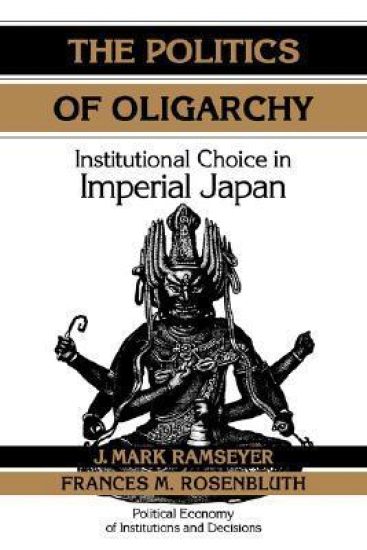
The Politics of Oligarchy

The Politics of Oligarchy

J. Mark Ramseyer; Frances McCall Rosenbluth

Cambridge University Press
1995
sidottu
In the latter-half of the nineteenth century and the first half of the twentieth century, Japan underwent two major shifts in political control. In the 1910s, the power of the oligarchy was eclipsed by that of a larger group of professional politicians; in the 1930s, the focus of power shifted again, this time to a set of independent military leaders. In this book, Ramseyer and Rosenbluth examine a key question of modern Japanese politics: why the Meiji oligarchs were unable to design institutions capable of protecting their power. The authors question why the oligarchs chose the political institutions they did, and what the consequences of those choices were for Japan’s political competition, economic development, and diplomatic relations. Indeed, they argue, it was the oligarchs’ very inability to agree among themselves on how to rule that prompted them to cut the military loose from civilian control - a decision that was to have disastrous consequences not only for Japan but for the rest of the world.
The Politics of Oligarchy

The Politics of Oligarchy

J. Mark Ramseyer; Frances McCall Rosenbluth

Cambridge University Press
1998
pokkari
In the latter-half of the nineteenth century and the first half of the twentieth century, Japan underwent two major shifts in political control. In the 1910s, the power of the oligarchy was eclipsed by that of a larger group of professional politicians; in the 1930s, the focus of power shifted again, this time to a set of independent military leaders. In this book, Ramseyer and Rosenbluth examine a key question of modern Japanese politics: why the Meiji oligarchs were unable to design institutions capable of protecting their power. The authors question why the oligarchs chose the political institutions they did, and what the consequences of those choices were for Japan's political competition, economic development, and diplomatic relations. Indeed, they argue, it was the oligarchs' very inability to agree among themselves on how to rule that prompted them to cut the military loose from civilian control - a decision that was to have disastrous consequences not only for Japan but for the rest of the world.
Japan’s Political Marketplace

Japan’s Political Marketplace

J. Mark Ramseyer; Frances McCall Rosenbluth

Harvard University Press
1997
nidottu
Mark Ramseyer and Frances McCall Rosenbluth show how rational-choice theory can be applied to Japanese politics. Using the concept of principal and agent, Ramseyer and Rosenbluth construct a persuasive account of political relationships in Japan. In doing so, they demonstrate that political considerations and institutional arrangements reign in what, to most of the world, looks like an independently powerful bureaucratic state.
Remilitarized Zone

Remilitarized Zone

J. Mark Ramseyer; Jason M. Morgan

ENCOUNTER BOOKS,USA
2024
sidottu
During World War II, the Japanese military extended Japan’s civilian licensing regime for domestic brothels to those next to its overseas bases. It did so for a simple reason: to impose the strenuous health standards necessary to control the venereal disease that had debilitated its troops in earlier wars. In turn, these brothels (dubbed "comfort stations") recruited prostitutes through variations on the standard indenture contracts used by licensed brothels in both Korea and Japan.The party line in Western academia, though, is that these “comfort women” were dragooned into sex slavery at bayonet point by Japanese infantry. But, as the authors of this book show, that narrative originated as a hoax perpetrated by a Japanese communist writer in the 1980s. It was then spread by a South Korean organization with close ties to the Communist North.Ramseyer and Morgan discuss how these women really came to be in Japanese military comfort stations. Some took the jobs because they were tricked by fraudulent recruiters. Some were under pressure from abusive parents. But the rest of the women seem to have been driven by the same motivation as most prostitutes throughout history: want of money. Indeed, the notion that these comfort women became prostitutes by any other means has no basis in documentary history.Ramseyer and Morgan’s findings caused a firestorm in Japanese Studies academia. For explaining that the women became prostitutes of their own volition, both authors of this book found themselves “cancelled.”In this book, the authors detail both the history of the comfort women and their own persecution by academic peers. Only in the West—and only through brutal stratagems of censorship and ostracism—has the myth of bayonet-point conscription survived.
The Fable of the Keiretsu

The Fable of the Keiretsu

Yoshiro Miwa; J. Mark Ramseyer

University of Chicago Press
2006
sidottu
For Western economists and journalists, the most distinctive facet of the post-war Japanese business world has been the keiretsu, or the insular business alliances among powerful corporations. Within keiretsu groups, argue these observers, firms preferentially trade, lend money, take and receive technical and financial assistance, and cement their ties through cross-shareholding agreements. In "The Fable of the Keiretsu", Yoshiro Miwa and J. Mark Ramseyer demonstrate that all this talk is really just urban legend. In their insightful analysis, the authors show that the very idea of the keiretsu was created and propagated by Marxist scholars in post-war Japan. Western scholars merely repatriated the legend to show the culturally contingent nature of modern economic analysis. Laying waste to the notion of keiretsu, the authors debunk several related "facts" as well: that Japanese firms maintain special arrangements with a "main bank," that firms are systematically poorly managed, and that the Japanese government guided post-war growth. In demolishing these long-held assumptions, they offer one of the few reliable chronicles of the realities of Japanese business.