Kirjojen hintavertailu. Mukana 11 627 373 kirjaa ja 12 kauppaa.

Kirjahaku

Etsi kirjoja tekijän nimen, kirjan nimen tai ISBN:n perusteella.

1000 tulosta hakusanalla J. Richard Evans Sr

W.J. MacKay and the NSW Police, 1910–1948

W.J. MacKay and the NSW Police, 1910–1948

Richard Evans

Springer International Publishing AG
2022
sidottu
This book tells the fascinating story of William John MacKay, a man who dominated policing in New South Wales for three decades, until his death in 1948. MacKay was fearless, brilliant and ruthless. He was responsible for beating-up striking unionists, but he also smashed the semi-fascist New Guard when it was a threat to democracy. He reformed and modernized the New South Wales Police Force, and he framed innocent men for capital crimes. He cracked down on organized crime and corruption, and he was himself corrupt. Dogged by scandal, he was the subject of no fewer than seven royal commissions. The story of W.J. MacKay is also the story of policing in Australia, from the 1920s through to the corruption-riddled period after the Second World War. This gripping history explores the messy complexities of police power and sheds new light on a fascinating period in Australian police history
W.J. MacKay and the NSW Police, 1910–1948

W.J. MacKay and the NSW Police, 1910–1948

Richard Evans

Springer International Publishing AG
2023
nidottu
This book tells the fascinating story of William John MacKay, a man who dominated policing in New South Wales for three decades, until his death in 1948. MacKay was fearless, brilliant and ruthless. He was responsible for beating-up striking unionists, but he also smashed the semi-fascist New Guard when it was a threat to democracy. He reformed and modernized the New South Wales Police Force, and he framed innocent men for capital crimes. He cracked down on organized crime and corruption, and he was himself corrupt. Dogged by scandal, he was the subject of no fewer than seven royal commissions. The story of W.J. MacKay is also the story of policing in Australia, from the 1920s through to the corruption-riddled period after the Second World War. This gripping history explores the messy complexities of police power and sheds new light on a fascinating period in Australian police history
Third Reich in History and Memory

Third Reich in History and Memory

Richard J Evans

Oxford University Press Inc
2015
sidottu
the seventy years since the demise of the Third Reich, there has been a significant transformation in the ways in which the modern world understands Nazism. In this brilliant and eye-opening collection, Richard J. Evans, the acclaimed author of the Third Reich trilogy, offers a critical commentary on that transformation, exploring how major changes in perspective have informed research and writing on the Third Reich in recent years. Drawing on his most notable writings from the last two decades, Evans reveals the shifting perspectives on Nazism's rise to political power, its economic intricacies, and its subterranean extension into postwar Germany. Evans considers how the Third Reich is increasingly viewed in a broader international context, as part of the age of imperialism; discusses the growing emphasis on the larger economic and cultural circumstances of the era; and emphasizes the development of research into Nazi society, particularly in the understanding of Nazi Germany as a political system based on popular approval and consent. Exploring the complex relationship between memory and history, Evans also points out the places where the growing need to confront the misdeeds of Nazism and expose the complicity of those who participated has led to crude and sweeping condemnation, when instead historians should be making careful distinctions. Written with Evans' sharp-eyed insight and characteristically compelling style, these essays offer a summation of the collective cultural memory of Nazism in the present, and suggest the degree to which memory must be subjected to the close scrutiny of history.
Altered Pasts

Altered Pasts

Richard J Evans; Hedva Ben-Israel

Brandeis University Press
2014
sidottu
A bullet misses its target in Sarajevo, a would-be Austrian painter gets into the Viennese academy, Lord Halifax becomes British prime minister in 1940 instead of Churchill: seemingly minor twists of fate on which world-shaking events might have hinged. Alternative history has long been the stuff of parlor games, war-gaming, and science fiction, but over the past few decades it has become a popular stomping ground for serious historians. The historian Richard J. Evans now turns a critical, slightly jaundiced eye on a subject typically the purview of armchair historians. The book's main concern is examining the intellectual fallout from historical counterfactuals, which the author defines as "alternative versions of the past in which one alteration in the timeline leads to a different outcome from the one we know actually occurred." What if Britain had stood at the sidelines during the First World War? What if the Wehrmacht had taken Moscow? The author offers an engaging and insightful introduction to the genre, while discussing the reasons for its revival in popularity, the role of historical determinism, and the often hidden agendas of the counterfactual historian. Most important, Evans takes counterfactual history seriously, looking at the insights, pitfalls, and intellectual implications of changing one thread in the weave of history. A wonderful critical introduction to an often-overlooked genre for scholars and casual readers of history alike. Hardcover is un-jacketed.
Altered Pasts

Altered Pasts

Richard J Evans; Hedva Ben-Israel

Brandeis University Press
2014
pokkari
A bullet misses its target in Sarajevo, a would-be Austrian painter gets into the Viennese academy, Lord Halifax becomes British prime minister in 1940 instead of Churchill: seemingly minor twists of fate on which world-shaking events might have hinged. Alternative history has long been the stuff of parlor games, war-gaming, and science fiction, but over the past few decades it has become a popular stomping ground for serious historians. The historian Richard J. Evans now turns a critical, slightly jaundiced eye on a subject typically the purview of armchair historians. The book's main concern is examining the intellectual fallout from historical counterfactuals, which the author defines as "alternative versions of the past in which one alteration in the timeline leads to a different outcome from the one we know actually occurred." What if Britain had stood at the sidelines during the First World War? What if the Wehrmacht had taken Moscow? The author offers an engaging and insightful introduction to the genre, while discussing the reasons for its revival in popularity, the role of historical determinism, and the often hidden agendas of the counterfactual historian. Most important, Evans takes counterfactual history seriously, looking at the insights, pitfalls, and intellectual implications of changing one thread in the weave of history. A wonderful critical introduction to an often-overlooked genre for scholars and casual readers of history alike.
Telling Lies About Hitler

Telling Lies About Hitler

Richard J Evans

Verso Books
2002
nidottu
In April 2000 a High Court judge branded the writer David Irving a racist, an antisemite, a Holocaust denier, and a falsifier of history. The key expert witness against Irving was the Cambridge historian Richard J. Evans who describes here, in a book which several publishers have been intimidated to withdrawing, his involvement in the case. Recounting his discovery of Irving's connections with far right Holocaust deniers in the United States and of how Irving falsified the documentary evidence on the Second World War, Evans reflects generally and eloquently on the interaction of historical and legal rules of evidence.Evans argues that the Irving trial does for the twenty-first century what the Eichmann trial did for the second half of the twentieth. It vindicates history's ability to come to reasoned conclusions on the basis of a careful examination of the evidence, even when eyewitnesses and survivors are no longer around to tell the tale.
Politik och ideologier : perspektiv från Engelbergsseminariet 2011

Politik och ideologier : perspektiv från Engelbergsseminariet 2011

Ulrike Ackermann; Scott Atran; James Bartolomew; Michael Bentley; Paul Berman; Vernon Bogdanor; Nick Boles; Robert Cooper; Stephan Eisel; Richard J Evans; Michael Freeden; David Frum; Dick Harrison; Anna Jardfeldt; Oliver Kamm; Robert D Kaplan; John Keane; Johan Lagerkvist; Mark Leonard; John Lloyd; Hisham Melhem; Richard Miles; Kenneth Minogue; Minxin Pei; Malise Ruthven; Roger Scruton; Per Schlingman; Nathan Shachar; Robert J Shapiro; Maria Wetterstrand

Bokförlaget Atlantis
2012
sidottu
Ideologiernas död har förutspåtts ett flertal gånger under åren, men gång på gång har vi också sett gamla ideologier återvända under nya beteckningar. I denna bok behandlar vi både nuet och det förflutna. Vi belyser en del av de politiska idéer och system i historien som fortsätter att utöva inflytande på samtiden. Vi granskar också den auktoritära statskapitalismen, som i fallet Kina, och ställer frågan om den är hållbar. Om så är fallet, hur kommer den att inverka på världen? Kommer den att bli förebilden, precis som liberal demokrati under lång tid har varit det för många människor och nationer? Kommer islamism, främlings- och invandrarfientliga partier och andra rörelser i marginalen av det politiska och ideologiska spektrumet i Europa, USA och den islamiska världen att befästa den rådande ordningen eller undergräva tilltron till den? Vilka är globaliseringens konsekvenser för politik och ideologi? Kommer svaret att bli ett världsparlament, en världsomfattande miljörörelse eller olika strömningar med religion som gemensam nämnare? Eller kommer vi kanske i stället att få se ett annat gammalt spöke återvända: nationalismen? Boken ingår i serien Engelsbergsseminarierna och utges i samarbete med Bokförlaget Atlantis och Axel och Margaret Ax:son Johnsons stiftelse för almännyttiga ändamål.
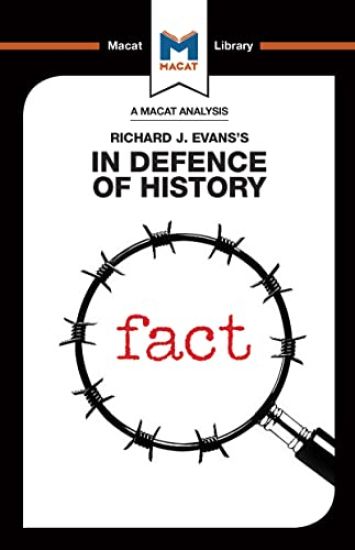
An Analysis of Richard J. Evans's In Defence of History

An Analysis of Richard J. Evans's In Defence of History

Nicholas Piercey; Tom Stammers

Macat International Limited
2017
nidottu
Richard Evans wrote In Defence of History at a time when the historian's profession was coming under heavy attack as a result of the ‘cultural turn’ taken by the discipline during the late 1980s and the 1990s. Historians were being forced to face up to postmodern thinking, which argued that, because all texts were the product of biased writers who had incomplete information, none could be privileged above others. In this reading, there could be no objective history, merely the study of the texts themselves. While In Defence of History addresses all aspects of historical method, its key focus is on an extensive evaluation of this postmodern thinking. Evans judges the acceptability of the reasoning advanced by the postmodernists – and finds it badly wanting. He is strongly critical both of the relevance and of the adequacy of their arguments, seeking to show that, ultimately, they are guilty of failing to accept the logic of their own position. All texts are equally valid, or invalid, they suggest – while insisting that the products of their own school are in fact more ‘true’ than those of their opponents. Evans concludes by pointing out that this same argument could be advanced to suggest that the works of Holocaust deniers are just as valid as are those of historians who accept that the Nazis set out to commit genocide. So why, he demands, is no postmodernist willing to say as much? A devastating example of the usefulness of relentless evaluation.
An Analysis of Richard J. Evans's In Defence of History

An Analysis of Richard J. Evans's In Defence of History

Nicholas Piercey; Tom Stammers

Macat International Limited
2017
sidottu
Richard Evans wrote In Defence of History at a time when the historian's profession was coming under heavy attack as a result of the ‘cultural turn’ taken by the discipline during the late 1980s and the 1990s. Historians were being forced to face up to postmodern thinking, which argued that, because all texts were the product of biased writers who had incomplete information, none could be privileged above others. In this reading, there could be no objective history, merely the study of the texts themselves. While In Defence of History addresses all aspects of historical method, its key focus is on an extensive evaluation of this postmodern thinking. Evans judges the acceptability of the reasoning advanced by the postmodernists – and finds it badly wanting. He is strongly critical both of the relevance and of the adequacy of their arguments, seeking to show that, ultimately, they are guilty of failing to accept the logic of their own position. All texts are equally valid, or invalid, they suggest – while insisting that the products of their own school are in fact more ‘true’ than those of their opponents. Evans concludes by pointing out that this same argument could be advanced to suggest that the works of Holocaust deniers are just as valid as are those of historians who accept that the Nazis set out to commit genocide. So why, he demands, is no postmodernist willing to say as much? A devastating example of the usefulness of relentless evaluation.
The Coming of the Third Reich

The Coming of the Third Reich

Richard J. Evans

Penguin Books Ltd
2004
pokkari
Richard J. Evans' The Coming of the Third Reich: How the Nazis Destroyed Democracy and Seized Power in Germany explores how the First World War, the Weimar Republic and the Great Depression paved the way for Nazi rule. They started as little more than a gang of extremists and thugs, yet in a few years the Nazis had turned Germany into a one-party state and led one of Europe's most advanced nations into moral, physical and cultural ruin and despair. In this consummate and compelling history, the first book in his acclaimed trilogy on the rise and fall of Nazi Germany, Richard Evans reveals how and why it happened, questions whether the rise of Hitler was inevitable and dramatically re-creates the maelstrom of disorder, economic disaster, violence and polarization that gave rise to the terror of the Third Reich. 'Monumental ... gripping ... the definitive account of our time' Andrew Roberts, Daily Telegraph 'Impressive ... perceptive ... humane ... the most comprehensive history in any language of the disastrous epoch of the Third Reich' Ian Kershaw, author of Hitler 'The most gripping account I've read of German life before and during the rise of the Nazis' A.S. Byatt, Times Literary Supplement Books of the Year Sir Richard J. Evans is Professor of Modern History at Cambridge University. His previous books include In Defence of History, Telling Lies about Hitler and the companions to this title, The Coming of the Third Reich and The Third Reich at War.
The Third Reich in Power, 1933 - 1939

The Third Reich in Power, 1933 - 1939

Richard J. Evans

Penguin Books Ltd
2006
pokkari
The second book in his acclaimed trilogy on the rise and fall of Nazi Germany, Richard J. Evans' The Third Reich in Power: How the Nazis Won Over the Hearts and Minds of a Nation explores how Hitler turned Germany from a vibrant democracy into a one-party state. Before Hitler seized power in 1933, Germany had been famous for its sophistication and complexity. So how was it possible for a group of ideological obsessives to re-mould it into a one-party state directed at war and race hate? How did the Nazis win over the hearts and minds of Germany's citizens, twist science, religion and culture, and transform the country's politics to achieve total dominance so quickly? From the Nuremberg Laws to the Olympic Games, Kristallnacht to the Hitler Youth, this gripping account shows how a whole population became enmeshed in a dictatorship that was consumed by hatred and driven by war. 'Impressive ... perceptive ... humane' Ian Kershaw 'Excellent ... powerful ... it makes an indelible impression' Robert Service, Sunday Times 'Likely to be the standard work for some years to come' Spectator Books of the Year 'A rich and detailed description of just what the Third Reich did in every compartment of the state and every corner of society ... Evans's magisterial study should be on our shelves for a long time to come' Economist 'Written with great style and human sympathy' Daily Telegraph Books of the Year 'Evans brilliantly conveys how the Fuhrer reignited Germans' pride as he led them to catastrophe' Neal Ascherson, Observer Sir Richard J. Evans is Professor of Modern History at Cambridge University. His previous books include In Defence of History, Telling Lies about Hitler and the companions to this title, The Coming of the Third Reich and The Third Reich at War.
The Third Reich at War

The Third Reich at War

Richard J. Evans

Penguin Books Ltd
2009
pokkari
The final book in his acclaimed trilogy on the rise and fall of Nazi Germany, Richard J. Evans's The Third Reich at War: How the Nazis Led Germany from Conquest to Disaster shows how Germany rushed headlong into destroying itself, shattering an entire continent. In 1939 Hitler mobilized Germany into all-out war. Richard Evans's astonishing, acclaimed history conjures up a whole society plunged into conflict - from generals and front-line soldiers to Hitler Youth activists and middle-class housewives - tracing events from the invasion of Poland and the Battle of Stalingrad to Hitler's plans for genocide and his eventual suicide. 'Masterly ... will surely be the standard history for many years to come ... This is a warning for the future, as much as a judgement on the past' Richard Overy, Daily Telegraph 'We all know how the story ends ... but Richard Evans brings it masterfully home ... magnificent' Peter Preston, Observer 'A chilling, brilliant read' Dominic Sandbrook, Sunday Telegraph Books of the Year 'It is hard to do justice to the humanity and scholarly range of The Third Reich at War ... triumphant ... a masterful historical narrative and the most comprehensive account of Nazi Germany' Nicholas Stargardt, The Times Literary Supplement 'It gives the reader persuasive answers to questions asked for so long, that will continue to be asked, about this most violent and inexplicable of regimes' Mark Mazower, Guardian Sir Richard J. Evans is Professor of Modern History at Cambridge University. His previous books include In Defence of History, Telling Lies about Hitler and the companions to this title, The Coming of the Third Reich and The Third Reich in Power.
The Pursuit of Power

The Pursuit of Power

Richard J. Evans

Penguin Books Ltd
2017
pokkari
'A scintillating, encyclopaedic history, rich in detail from the arcane to the familiar... a veritable tour de force' Richard Overy, New Statesman'Transnational history at its finest ... .. social, political and cultural themes swirl together in one great canvas of immense detail and beauty' Gerard DeGroot, The Times'Dazzlingly erudite and entertaining' Dominic Sandbrook, The Sunday TimesA masterpiece which brings to life an extraordinarly turbulent and dramatic era of revolutionary change.The Pursuit of Power draws on a lifetime of thinking about nineteenth-century Europe to create an extraordinarily rich, surprising and entertaining panorama of a continent undergoing drastic transformation. The book aims to reignite the sense of wonder that permeated this remarkable era, as rulers and ruled navigated overwhelming cultural, political and technological changes. It was a time where what was seen as modern with amazing speed appeared old-fashioned, where huge cities sprang up in a generation, new European countries were created and where, for the first time, humans could communicate almost instantly over thousands of miles. In the period bounded by the Battle of Waterloo and the outbreak of World War I, Europe dominated the rest of the world as never before or since: this book breaks new ground by showing how the continent shaped, and was shaped by, its interactions with other parts of the globe.Richard Evans explores fully the revolutions, empire-building and wars that marked the nineteenth century, but the book is about so much more, whether it is illness, serfdom, religion or philosophy. The Pursuit of Power is a work by a historian at the height of his powers: essential for anyone trying to understand Europe, then or now.
Hitler's People

Hitler's People

Richard J. Evans

PENGUIN BOOKS LTD
2025
pokkari
Why did so many Germans take part in the crimes of Nazi Germany? How did they come to support Hitler and follow him almost to the very end? For too long, the Nazis have been presented as little more than psychopaths or criminals. In his major new work, renowned historian Richard J. Evans makes use of a mass of recently unearthed new evidence to strip away the veneer of myth and legend from the faces of the Third Reich and present a more realistic view of Nazi perpetrators as human beings who were disturbingly like us.Evans offers rounded, fresh and often startling new portraits of the men and women who created and served Nazi Germany, beginning with Hitler himself and going on to encompass leading figures like Göring, Goebbels and Himmler, enforcers of Hitler’s orders such as Eichmann and Heydrich, propagandists like Leni Riefenstahl, low-level perpetrators such as the notorious Irma Grese and unknown sympathizers and fellow-travellers who helped the regime in myriad ways.Hitler’s People is a chilling, brilliantly written work which allows the reader to understand the texture and values of the Third Reich and just how far individuals will go when so many normal moral constraints have disappeared.
The Coming Of The Third Reich

The Coming Of The Third Reich

Richard J. Evans

The Penguin Press
2005
pokkari
The first in a three-volume series, a definitive history of Adolf Hitler's rise to power and the collapse of democracy in Nazi Germany explains why Nazism's ideology of hatred and racism found fertile ground in a country embittered by military defeat and economic disaster following World War I, undermined by an alienated army and civil service, and prey to widespread resentment, suspicion, and extremism. Reprint.
Death in Hamburg

Death in Hamburg

Richard J. Evans

Penguin Putnam Inc
2005
pokkari
'The terrible cholera epidemic of 1892' offers a wealth of insights into the inner life of a great European city at the height of the industrial age. Why were nearly 10,000 people killed in six weeks in Hamburg, whilst most of Europe was left almost unscathed? As Richard J.Evans explains, it was largely because the town was a unique anomaly: a 'free city' within Germany governed by local notables, who believed in the 'English' ideals of laissez-faire. Their failure to supply clean water, fresh air and pure food played a major role in the catastrophe. Their medical theories, influenced by political and economic interest, only made matters worse. The whole story of 'the cholera years' is tragically revealing of the age's social inequalities and administrative incompetence; it also offers some disquieting parallels with today's attitudes to AIDS.
The Third Reich in Power

The Third Reich in Power

Richard J. Evans

PENGUIN BOOKS
2006
nidottu
Documents the radical and rapid transformation of Germany in its first year under Nazi rule, exploring how virtually every area of life, from the arts and religion to education and literature, was reordered to comply with the regime's preparations for the war, in an account that also describes the increasing brutality that was suffered by marginalized groups. Reprint. 40,000 first printing.
The Pursuit of Power: Europe 1815-1914

The Pursuit of Power: Europe 1815-1914

Richard J. Evans

PENGUIN BOOKS
2017
nidottu
An Economist Best Book of the Year "Sweeping . . . an ambitious synthesis . . . Evans] writes with admirable narrative power and possesses a wonderful eye for local color . . . Fascinating."--Stephen Schuker, The Wall Street JournalFrom the bestselling author of The Third Reich at War, a masterly account of Europe in the age of its global hegemony; the latest volume in the Penguin History of Europe series Richard J. Evans, bestselling historian of Nazi Germany, returns with a monumental new addition to the acclaimed Penguin History of Europe series, covering the period from the fall of Napoleon to the outbreak of World War I. Evans's gripping narrative ranges across a century of social and national conflicts, from the revolutions of 1830 and 1848 to the unification of both Germany and Italy, from the Russo-Turkish wars to the Balkan upheavals that brought this era of relative peace and growing prosperity to an end. Among the great themes it discusses are the decline of religious belief and the rise of secular science and medicine, the journey of art, music, and literature from Romanticism to Modernism, the replacement of old-regime punishments by the modern prison, the end of aristocratic domination and the emergence of industrial society, and the dramatic struggle of feminists for women's equality and emancipation. Uniting the era's broad-ranging transformations was the pursuit of power in all segments of life, from the banker striving for economic power to the serf seeking to escape the power of his landlord, from the engineer asserting society's power over the environment to the psychiatrist attempting to exert science's power over human nature itself. The first single-volume history of the century, this comprehensive and sweeping account gives the reader a magnificently human picture of Europe in the age when it dominated the rest of the globe.