Kirjojen hintavertailu. Mukana 11 244 527 kirjaa ja 12 kauppaa.

Kirjahaku

Etsi kirjoja tekijän nimen, kirjan nimen tai ISBN:n perusteella.

1000 tulosta hakusanalla JOHN GRIBBIN

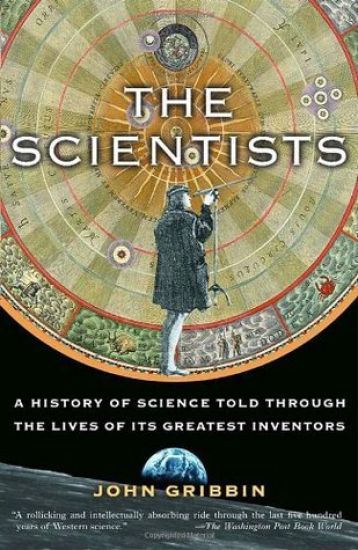
Science: A History

Science: A History

John Gribbin

Penguin Books Ltd
2003
pokkari
From award-winning science writer John Gribbin, Science: A History is the enthralling story of the men and women who changed the way we see the world, and the turbulent times they lived in. From Galileo, tried by the Inquisition for his ideas, to Newton, who wrote his rivals out of the history books; from Marie Curie, forced to work apart from male students for fear she might excite them, to Louis Agassiz, who marched his colleagues up a mountain to prove that the ice ages had occurred. Filled with pioneers, visionaries, eccentrics and madmen, this is the history of science as it has never been told before. 'Gripping and entertaining ... Wonderfully and pleasurably accessible' Independent on Sunday 'Tremendous ... moves me to bestow a reviewer's cliché I long ago vowed never to use: a tour de force' Spectator 'A magnificent history ... enormously entertaining' Daily Telegraph 'A splendid book ... demolishes innumerable myths and exposes the factual roots of some of science's well known tales (for example, Galileo never dropped weights of different sizes from Pisa's leaning tower)' Economist 'We experience his subjects' triumphs and failures as if we knew them personally ... I found myself whizzing through the pages' Sunday Telegraph John Gribbin is one of today's greatest writers of popular science and the author of bestselling books, including In Search of Schrödinger's Cat, Stardust, Science: A History and In Search of the Multiverse. Gribbin trained as an astrophysicist at Cambridge University and is currently Visiting Fellow in Astronomy at the University of Sussex.
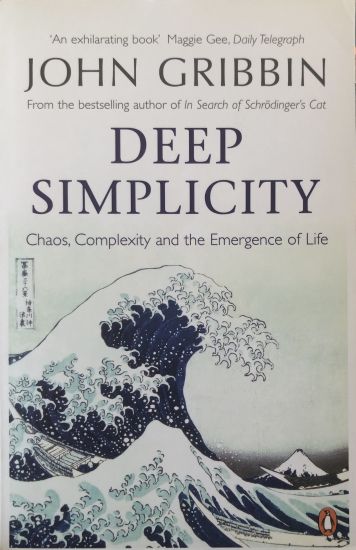
Deep Simplicity

Deep Simplicity

John Gribbin

Penguin Books Ltd
2005
pokkari
Simplifying chaos and complexity theory for the perplexed, John Gribbin's Deep Simplicity: Chaos, Complexity and the Emergence of Life brilliantly illuminates the harmony underlying our existence. The world around us can be a complex, confusing place. Earthquakes happen without warning, stock markets fluctuate, weather forecasters seldom seem to get it right - even other people continue to baffle us. How do we make sense of it all? In fact, John Gribbin reveals, our seemingly random universe is actually built on simple laws of cause and effect that can explain why, for example, just one vehicle braking can cause a traffic jam; why wild storms result from a slight atmospheric change; even how we evolved from the most basic materials. Like a zen painting, a fractal image or the pattern on a butterfly's wings, simple elements form the bedrock of a sophisticated whole. 'The master of popular science writing' Sunday Times 'What makes Deep Simplicity different from other books on complexity theory is that Gribbin ... goes back to the fundamentals' Daily Telegraph 'One is left feeling even more - if this is possible - filled with admiration for science and delight at the world it investigates' Financial Times John Gribbin is one of today's greatest writers of popular science and the author of bestselling books, including In Search of Schrödinger's Cat, Stardust, Science: A History and In Search of the Multiverse. Gribbin trained as an astrophysicist at Cambridge University and is currently Visiting Fellow in Astronomy at the University of Sussex.
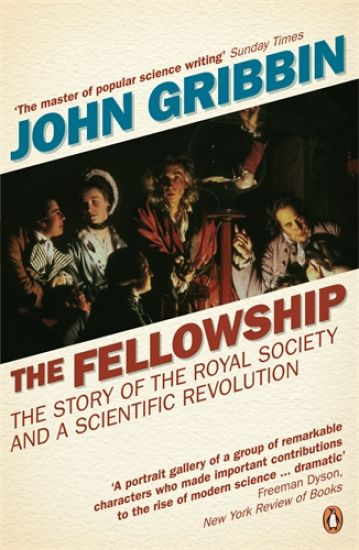
The Fellowship

The Fellowship

John Gribbin

Penguin Books Ltd
2006
pokkari
From the bestselling author of Science: A History comes the enthralling story of a revolution that shook the world. Seventeenth-century England was racked by civil war, plague and fire; a world ruled by superstition and ignorance. A series of meetings of 'natural philosophers' in Oxford and London saw the beginning of a new method of thinking based on proof and experiment. John Gribbin's gripping, colourful account of this unparalleled time of discovery explores the impact of the Royal Society, culminating with Isaac Newton's revolutionary description of the universe and Edmund Halley's prediction of the return of a comet in 1759. This compelling book shows the triumph not as the work of one isolated genius, but of a Fellowship.
The Universe

The Universe

John Gribbin

Penguin Books Ltd
2008
pokkari
John Gribbin's The Universe: A Biography explores the story of our cosmos, from the mystery of its origins to how scientists think it might end.How did the universe grow from a tiny fireball to its present size?Where did life on earth come from?How do planets form?How will the universe end?And how do we even know all this anyway?John Gribbin, one of Britain's most popular writers about science and the people who made it happen, has decided to create a biography of the greatest subject of all: the universe itself, from beginning to end (and beyond).From the Big Bang 14 billion years ago, the formation of stars and galaxies and the first stirrings of life, to the latest thinking on dark matter and a theory of everything - and beyond to the future possibility of a Big Crunch or a Big Rip - this is the life history of the entire world around us.'If you really want to know about the greatest story there is, then this is the book to read' - Independent on Sunday'As clear an account of current thinking on the subject as we are likely to get' - Daily Telegraph'One of Britain's best and most prolific science writers' - Sunday Telegraph'The master of popular science writing' - Sunday Times
He Knew He Was Right

He Knew He Was Right

John Gribbin

Penguin Books Ltd
2009
pokkari
Jim Lovelock (1919-2022) was an iconic figure in British science, a prophet whose prophecies are coming true. This is his definitive authorised biography. Lovelock is best known as the 'father' of Gaia theory, which is now established as the most useful way of understanding the dramatic changes happening to the environment of the Earth.But few people know about his early work as a chemist and inventor - work which included inventing the detectors used to search for life on Mars, and blowing the whistle on the depletion of ozone layer. In his personal life, he was a Quaker and conscientious objector in World War Two (later changing his mind in view of the evils of Nazism), supported his family for a time by selling his own blood, and gave up a salary and security to become an independent scientist based in an English village - from which all his best known work emerged.In the wake of his death on 26th July 2022, his 103rd birthday, this book truly reveals an independent, original and inspiring life.
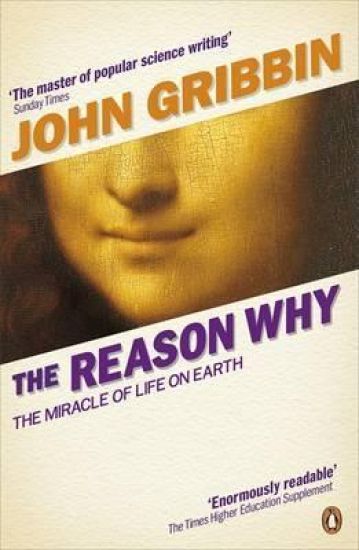
The Reason Why

The Reason Why

John Gribbin

Penguin Books Ltd
2012
pokkari
In The Reason Why: The Miracle of Life on Earth John Gribbin shows what makes our planet so special, explaining why the 'Fermi Paradox' - the apparent absence of alien life - holds the key to our uniqueness. There are several hundred billion stars in our Milky Way Galaxy, yet out of all of these Earth is the only planet with intelligent life on it. Why? For the first time, John Gribbin makes the link between the whole series of cosmic events that gave rise to our civilization - a unique set of circumstances that have not, and could not, occur anywhere else. John Gribbin is our best, most accessible guide to the big questions of science. In this book, he explores the biggest questions of all: why are we here, what does it mean to be alone in the universe - and do we have a future? 'The master of popular science writing' Sunday Times 'A fascinating journey through space and time ... this book presents an exciting insight into the many fortuitous events and cosmic quirks that have all come together to make Earth such a life-friendly world' Science Focus 'Lyrical, enormously readable ... John Gribbin explains just how our home world appears to be special, and exactly what we have to be thankful for' The Times Higher Education John Gribbin is one of today's greatest writers of popular science and the author of bestselling books, including In Search of Schrödinger's Cat, Stardust, Science: A History and In Search of the Multiverse. Gribbin trained as an astrophysicist at Cambridge University and is currently Visiting Fellow in Astronomy at the University of Sussex.
Galaxies

Galaxies

John Gribbin

Oxford University Press
2008
nidottu
Galaxies are the building blocks of the Universe: standing like islands in space, each is made up of many hundreds of millions of stars in which the chemical elements are made, around which planets form, and where on at least one of those planets intelligent life has emerged. Our own galaxy, the Milky Way, is just one of several hundred million other galaxies that we can now observe through our telescopes. Yet it was only in the 1920s that we realised that there is more to the Universe than the Milky Way, and that there were in fact other 'islands' out there. In many ways, modern astronomy began with this discovery, and the story of galaxies is therefore the story of modern astronomy. Since then, many exciting discoveries have been made about our own galaxy and about those beyond: how a supermassive black hole lurks at the centre of every galaxy, for example, how enormous forces are released when galaxies collide, how distant galaxies provide a window on the early Universe, and what the formation of young galaxies can tell us about the mysteries of Cold Dark Matter. In this Very Short Introduction, renowned science writer John Gribbin describes the extraordinary things that astronomers are learning about galaxies, and explains how this can shed light on the origins and structure of the Universe. ABOUT THE SERIES: The Very Short Introductions series from Oxford University Press contains hundreds of titles in almost every subject area. These pocket-sized books are the perfect way to get ahead in a new subject quickly. Our expert authors combine facts, analysis, perspective, new ideas, and enthusiasm to make interesting and challenging topics highly readable.
Six Impossible Things

Six Impossible Things

John Gribbin

MIT Press
2019
muu
A concise and engaging investigation of six interpretations of quantum physics.Rules of the quantum world seem to say that a cat can be both alive and dead at the same time and a particle can be in two places at once. And that particle is also a wave; everything in the quantum world can described in terms of waves--or entirely in terms of particles. These interpretations were all established by the end of the 1920s, by Erwin Schroedinger, Werner Heisenberg, Paul Dirac, and others. But no one has yet come up with a common sense explanation of what is going on. In this concise and engaging book, astrophysicist John Gribbin offers an overview of six of the leading interpretations of quantum mechanics. Gribbin calls his account "agnostic," explaining that none of these interpretations is any better--or any worse--than any of the others. Gribbin presents the Copenhagen Interpretation, promoted by Niels Bohr and named by Heisenberg; the Pilot-Wave Interpretation, developed by Louis de Broglie; the Many Worlds Interpretation (termed "excess baggage" by Gribbin); the Decoherence Interpretation ("incoherent"); the Ensemble "Non-Interpretation"; and the Timeless Transactional Interpretation (which theorized waves going both forward and backward in time). All of these interpretations are crazy, Gribbin warns, and some are more crazy than others--but in the quantum world, being more crazy does not necessarily mean more wrong.
Six Impossible Things: The Mystery of the Quantum World
A concise and engaging investigation of six interpretations of quantum physics. Rules of the quantum world seem to say that a cat can be both alive and dead at the same time and a particle can be in two places at once. And that particle is also a wave; everything in the quantum world can described in terms of waves--or entirely in terms of particles. These interpretations were all established by the end of the 1920s, by Erwin Schr dinger, Werner Heisenberg, Paul Dirac, and others. But no one has yet come up with a common sense explanation of what is going on. In this concise and engaging book, astrophysicist John Gribbin offers an overview of six of the leading interpretations of quantum mechanics. Gribbin calls his account "agnostic," explaining that none of these interpretations is any better--or any worse--than any of the others.Gribbin presents the Copenhagen Interpretation, promoted by Niels Bohr and named by Heisenberg; the Pilot-Wave Interpretation, developed by Louis de Broglie; the Many Worlds Interpretation (termed "excess baggage" by Gribbin); the Decoherence Interpretation ("incoherent"); the Ensemble "Non-Interpretation"; and the Timeless Transactional Interpretation (which theorized waves going both forward and backward in time). All of these interpretations are crazy, Gribbin warns, and some are more crazy than others--but in the quantum world, being more crazy does not necessarily mean more wrong.
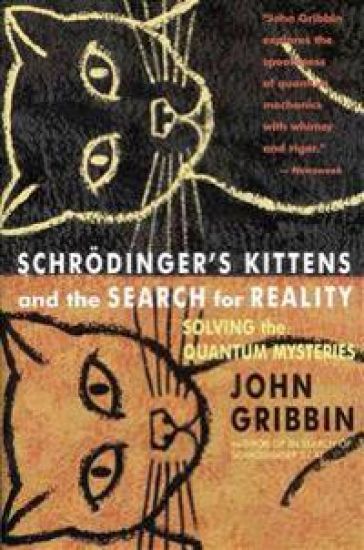
Schrodinger's Kittens and the Search for Reality: Solving the Quantum Mysteries Tag: Author of in Search of Schrod. Cat
In this eagerly anticipated sequel to the classic bestseller In Search of Schrodinger's Cat, John Gribbin digs even deeper into the mysterious and confounding world of quantum mechanics. Gribbin takes infinitely complex, mind-bending experiments, brings them to life, and makes them accessible to the lay reader. Under his deft guidance, we can begin to grasp the fundamental riddle of today's quantum mechanics: how a single photon can be seen going in two directions at once. Along the way, Gribbin reveals some fascinating discoveries: how quantum particles could one day be used in a Star Trek-type teleportation system, and how quantum cryptographers have developed ways of making unbreakable codes using quantum effects. Schrodinger's Kittens and the Search for Reality illuminates the world's most intriguing and enigmatic scientific phenomenon - and shows how the "impossible dreams" of such legendary scientists as Bohr, Feynman, and Einstein may soon become reality.
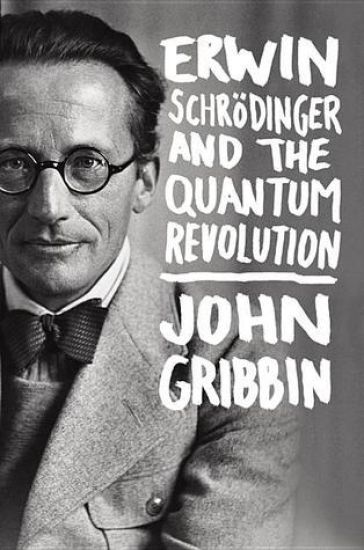
Erwin Schrodinger and the Quantum Revolution

Erwin Schrodinger and the Quantum Revolution

John Gribbin

Transworld Publishers Ltd
2013
pokkari
Erwin Schrödinger was an Austrian physicist famous for his contribution to quantum physics. He won the Nobel Prize in 1933 and is best known for his thought experiment of a cat in a box, both alive and dead at the same time, which revealed the seemingly paradoxical nature of quantum mechanics.
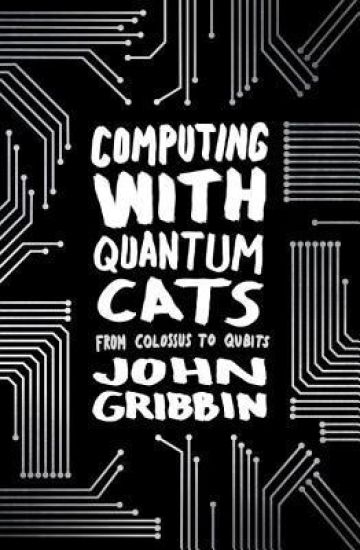
Computing with Quantum Cats

Computing with Quantum Cats

John Gribbin

Transworld
2015
pokkari
Pioneering physicists are on the brink of unlocking a new quantum universe which provides a better representation of reality than our everyday experiences and common sense ever could. This title explains how quantum theory developed to make quantum computers work in practice as well as in principle.
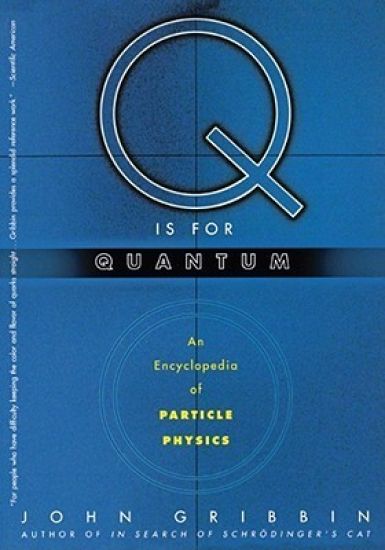
Q is for Quantum

Q is for Quantum

John Gribbin

Touchstone
2000
pokkari
THE QUANTUM WORLD FROM A TO Z Here in one volume, the award-winning science writer and physicist John Gribbin has provided everything you need to know about the quantum world -- the place where most of the greatest scientific advances of the twentieth century have been made. This exceptional A to Z reference begins with a thorough introduction setting out the current state of knowledge in particle physics. Throughout, Gribbin includes articles on the structure of particles and their interactions, accounts of the theoretical breakthroughs in quantum mechanics and their practical applications, and entertaining biographies of the scientists who have blazed the trail of discovery. In a special section, "Timelines," key dates in our quest to understand the quantum world are mapped out alongside landmarks in world history and the history of science. An encyclopedia of the fundamental science of the future, "Q is for Quantum" is an essential companion for anyone interested in particle physics.
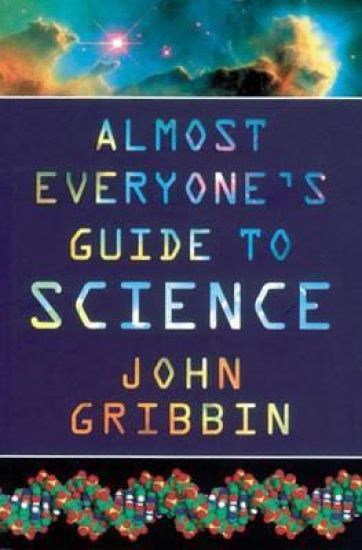
Almost Everyone's Guide to Science

Almost Everyone's Guide to Science

John Gribbin

Weidenfeld Nicolson
1999
pokkari
An introduction to the central facts, evidence and issues of modern science - from black holes to DNA, from the big bang to the workings of the brainJohn Gribbin is one of the few science writers who is equally comfortable writing about biology as about physics, and this beginner's guide will take the reader through the basics and the fundamental issues of the crucial areas of modern science, from the birth of the universe through to the evolution of our own species, the nature of human behaviour and the workings of our minds.Crucially, the book will not only provide an overview of the central areas in a single volume, but also explain how the areas link up, what evolutionary theory has to say about how we think, how sub-atomic particles came into being in the big bang, and atoms in stars.
Erwin Schrodinger and the Quantum Revolution

Erwin Schrodinger and the Quantum Revolution

John Gribbin

Trade Paper Press
2013
sidottu
A lively, fascinating biography of the father of quantum mechanics by the bestselling author of the science classic, In Search of Schr dinger's CatErwin Schr dinger, best known for his famous "Schr dinger's Cat" paradox, is one of the most famous physicists of the early twentieth century and a member of a new generation of quantum physicists, including Werner Heisenberg, Paul Dirac, and Niels Bohr. Yet Schr dinger's scientific discoveries only scratch the surface of what makes him so fascinating. More rumpled than Einstein, a devotee of eastern religion and philosophy, and infamous for his alternative lifestyle, his major contribution to physics--and the work for which he received the Nobel Prize in 1933--was to some extent a disappointment to him. Regardless, Schr dinger's masterpiece became an important part of the new physics of his time. This book tells the story of Schr dinger's surprisingly colorful life during one of the most fertile and creative moments in the history of science.The first accessible, in-depth biography of the Nobel Prize-winning Austrian physicist Erwin Schr dingerTakes you into the heart of the quantum revolution and explains the captivating world of quantum mechanics, which underpins all of modern scienceWritten by bestselling author John Gribbin, one of today's greatest popular science writers whose other books include In Search of Schr dinger's Cat , In Search of the Multiverse, and Alone in the Universe
Deep Simplicity: Bringing Order to Chaos and Complexity
An astrophysicist presents a lucid, accessible explanation of the fundamental principles of chaos and complexity theory, incorporating the latest research with frequent analogies and examples to explore simple applications of the theory in everyday life. By the author of In Search of Schrödinger's Cat and The Scientists. 22,000 first printing.
Future Worlds

Future Worlds

John Gribbin

Springer-Verlag New York Inc.
2012
nidottu
During the middle and late 1960s, concern about the way the world might be going began to move out of the arena of academic debate amongst specialists, and became a topic of almost everyday interest to millions of people. Concern about mankind's disruption of the natural balance of 'the environment' brought the term 'ecology' into widespread use, though not always with the meaning to be found in the dictionary, and fears that world population might be growing so rapidly that very soon we would run out of food, resulting in mass starvation and a disastrous collapse of civilisation, helped to make books such as The Limits to Growth best sellers in the early 1970s. Today, quite rightly, decisions on long-term policy with widespread repercussions - most notably, those concerning nuclear energy planning - are a subject of equally widespread public discussion. But all too often such debate focuses on specific issues without the prob­ lems ever being related effectively to an overall vision of where the world is going and how it is going to get there. At the Science Policy Res~arch Unit, University of Sussex, a group working on studies of social and tech­ nological alternatives for the future has been contributing to 'the futures debate' for several years, cautiously (perhaps, in a sense, almost too cautiously!) developing a secure foundation for forecasting the way the world may develop.
Q is for Quantum: An Encyclopedia of Particle Physics

Q is for Quantum: An Encyclopedia of Particle Physics

John Gribbin

Createspace Independent Publishing Platform
2015
nidottu
A comprehensive encyclopedia of quantum physics.Here in one volume, the award-winning science writer and physicist John Gribbin has provided everything you need to know about the quantum world -the place where most of the greatest scientific advances of the last hundred years have been made.This exceptional A to Z reference begins with a thorough introduction setting out the current state of knowledge in particle physics. Throughout, Gribbin includes articles on the structure of particles and their interactions, accounts of the theoretical breakthroughs in quantum mechanics and their practical applications, and entertaining biographies of the scientists who have blazed the trail of discovery. In a special section, "Timelines," key dates in our quest to understand the quantum world are mapped out alongside landmarks in world history and the history of science.An encyclopedia of the fundamental science of the future, Q is for Quantum is an essential companion for anyone interested in particle physics."Gribbin presents an overview of a hundred years of particle physics through a handy, accessible A-Z dictionary of definitions and identifications."-Natural History