Kirjojen hintavertailu. Mukana 11 244 527 kirjaa ja 12 kauppaa.

Kirjahaku

Etsi kirjoja tekijän nimen, kirjan nimen tai ISBN:n perusteella.

1000 tulosta hakusanalla Jack J. Lee

Practice Strategies That Cause Musical Improvements

Practice Strategies That Cause Musical Improvements

Jack Lee; J Reid Maxwell; Steven McWhirter

Createspace Independent Publishing Platform
2018
pokkari
If you practice frequently and consistently, your musical skills should rightly be improving. If not, this is about HOW you are practicing, and NOT about who you are. There should be NO doubt in your mind that you CAN become a better player.As musicians mature in their playing abilities and begin to perform, many will maintain a genuine desire to continuously improve their playing skills. Indeed, they can see this as a life-long pursuit. But over time it seems their practice no longer leads to the changes they are striving for.Today, research has led to a much better understanding of the ways to practice that will lead to improvement and the ways that will not. Many players simply do not practice in a way that will cause fundamental changes in the skills related to higher-quality playing.This book illuminates the path toward continuous improvement in the development of musical skills for the seasoned player.The creation of this book was aided by the insights of Jack Lee, Stuart Liddell, J. Reid Maxwell & Steven McWhirter.
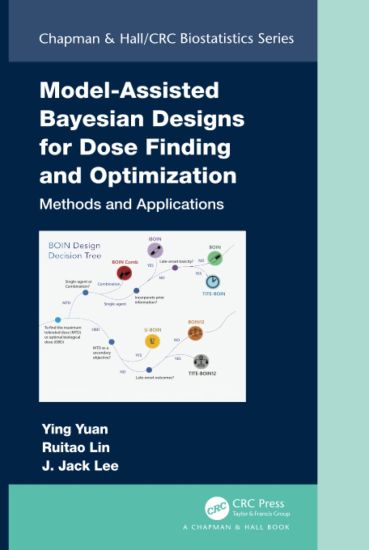
Model-Assisted Bayesian Designs for Dose Finding and Optimization

Model-Assisted Bayesian Designs for Dose Finding and Optimization

Ying Yuan; Ruitao Lin; J. Jack Lee

TAYLOR FRANCIS LTD
2022
sidottu
Bayesian adaptive designs provide a critical approach to improve the efficiency and success of drug development that has been embraced by the US Food and Drug Administration (FDA). This is particularly important for early phase trials as they form the basis for the development and success of subsequent phase II and III trials.The objective of this book is to describe the state-of-the-art model-assisted designs to facilitate and accelerate the use of novel adaptive designs for early phase clinical trials. Model-assisted designs possess avant-garde features where superiority meets simplicity. Model-assisted designs enjoy exceptional performance comparable to more complicated model-based adaptive designs, yet their decision rules often can be pre-tabulated and included in the protocol—making implementation as simple as conventional algorithm-based designs. An example is the Bayesian optimal interval (BOIN) design, the first dose-finding design to receive the fit-for-purpose designation from the FDA. This designation underscores the regulatory agency's support of the use of the novel adaptive design to improve drug development.FeaturesRepresents the first book to provide comprehensive coverage of model-assisted designs for various types of dose-finding and optimization clinical trialsDescribes the up-to-date theory and practice for model-assisted designsPresents many practical challenges, issues, and solutions arising from early-phase clinical trialsIllustrates with many real trial applicationsOffers numerous tips and guidance on designing dose finding and optimization trialsProvides step-by-step illustrations of using software to design trialsDevelops a companion website (www.trialdesign.org) to provide freely available, easy-to-use software to assist learning and implementing model-assisted designsWritten by internationally recognized research leaders who pioneered model-assisted designs from the University of Texas MD Anderson Cancer Center, this book shows how model-assisted designs can greatly improve the efficiency and simplify the design, conduct, and optimization of early-phase dose-finding trials. It should therefore be a very useful practical reference for biostatisticians, clinicians working in clinical trials, and drug regulatory professionals, as well as graduate students of biostatistics. Novel model-assisted designs showcase the new KISS principle: Keep it simple and smart!
Bayesian Adaptive Methods for Clinical Trials

Bayesian Adaptive Methods for Clinical Trials

Scott M. Berry; Bradley P. Carlin; J. Jack Lee; Peter Muller

TAYLOR FRANCIS LTD
2024
nidottu
Already popular in the analysis of medical device trials, adaptive Bayesian designs are increasingly being used in drug development for a wide variety of diseases and conditions, from Alzheimer’s disease and multiple sclerosis to obesity, diabetes, hepatitis C, and HIV. Written by leading pioneers of Bayesian clinical trial designs, Bayesian Adaptive Methods for Clinical Trials explores the growing role of Bayesian thinking in the rapidly changing world of clinical trial analysis.The book first summarizes the current state of clinical trial design and analysis and introduces the main ideas and potential benefits of a Bayesian alternative. It then gives an overview of basic Bayesian methodological and computational tools needed for Bayesian clinical trials. With a focus on Bayesian designs that achieve good power and Type I error, the next chapters present Bayesian tools useful in early (Phase I) and middle (Phase II) clinical trials as well as two recent Bayesian adaptive Phase II studies: the BATTLE and ISPY-2 trials. In the following chapter on late (Phase III) studies, the authors emphasize modern adaptive methods and seamless Phase II–III trials for maximizing information usage and minimizing trial duration. They also describe a case study of a recently approved medical device to treat atrial fibrillation. The concluding chapter covers key special topics, such as the proper use of historical data, equivalence studies, and subgroup analysis.For readers involved in clinical trials research, this book significantly updates and expands their statistical toolkits. The authors provide many detailed examples drawing on real data sets. The R and WinBUGS codes used throughout are available on supporting websites.Scott Berry talks about the book on the CRC Press YouTube Channel.
Bayesian Adaptive Methods for Clinical Trials

Bayesian Adaptive Methods for Clinical Trials

Scott M. Berry; Bradley P. Carlin; J. Jack Lee; Peter Muller

CRC Press Inc
2010
sidottu
Already popular in the analysis of medical device trials, adaptive Bayesian designs are increasingly being used in drug development for a wide variety of diseases and conditions, from Alzheimer’s disease and multiple sclerosis to obesity, diabetes, hepatitis C, and HIV. Written by leading pioneers of Bayesian clinical trial designs, Bayesian Adaptive Methods for Clinical Trials explores the growing role of Bayesian thinking in the rapidly changing world of clinical trial analysis.The book first summarizes the current state of clinical trial design and analysis and introduces the main ideas and potential benefits of a Bayesian alternative. It then gives an overview of basic Bayesian methodological and computational tools needed for Bayesian clinical trials. With a focus on Bayesian designs that achieve good power and Type I error, the next chapters present Bayesian tools useful in early (Phase I) and middle (Phase II) clinical trials as well as two recent Bayesian adaptive Phase II studies: the BATTLE and ISPY-2 trials. In the following chapter on late (Phase III) studies, the authors emphasize modern adaptive methods and seamless Phase II–III trials for maximizing information usage and minimizing trial duration. They also describe a case study of a recently approved medical device to treat atrial fibrillation. The concluding chapter covers key special topics, such as the proper use of historical data, equivalence studies, and subgroup analysis.For readers involved in clinical trials research, this book significantly updates and expands their statistical toolkits. The authors provide many detailed examples drawing on real data sets. The R and WinBUGS codes used throughout are available on supporting websites.Scott Berry talks about the book on the CRC Press YouTube Channel.
The Transformative Self

The Transformative Self

Jack J. Bauer

Oxford University Press Inc
2021
sidottu
The Transformative Self explores three of life's perennial questions: How do we make sense of our lives? What is a good life? How do we create one? In this comprehensive volume, developmental psychologist Jack J. Bauer responds to those three questions by integrating three main areas of study-narrative identity, the good life, and personal growth-to present an innovative model of humane flourishing and human development. The Transformative Self synthesizes an extensive range of scholarship, from scientific research in psychology to work in philosophy, literature, history, cultural studies, and more. The result is a cohesive framework for understanding how personal and cultural stories shape our development and how, through those stories, we might cultivate the growth of happiness, love, and wisdom for the self and others.
Information Communication Technology and Poverty Alleviation
Despite global economic disparities, recent years have seen rapid technological changes in developing countries, as it is now common to see people across all levels of society with smartphones in their hands and computers in their homes. However, does access to Information Communication Technologies (ICTs) actually improve the day-to-day lives of low-income citizens? This book argues that access to the internet can help alleviate poverty, improve development outcomes, and is now vital for realizing many human rights. This book posits that good governance is essential to the realization of inclusive pro-poor development goals, and puts forward policy recommendations that aim to mitigate the complex digital divide by employing governance as the primary actor. In making his argument, the author provides a quantitative analysis of developing countries, conjoined with a targeted in-depth study of Mexico. This mixed method approach provides an intriguing case for how improvements in the quality of governance impacts both ICT penetration, and poverty alleviation. Overall, the book challenges the neoliberal deterministic perspective that the open market will "solve" technology diffusion, and argues instead that good governance is the lynchpin that creates conducive conditions for ICTs to make an impact on poverty alleviation. In fact, the digital divide should not be considered binary, rather it is a multifaceted problem where income, education, and language all need to be considered to address it effectively. This book will be useful for researchers/students of development, communication technologies, and comparative politics as well as for development practitioners and policy makers with an interest in how modern technology is impacting the poor in the developing world.
Economic Evolution

Economic Evolution

Jack J Vromen

Routledge
1995
sidottu
The new institutional economics offers one of the most exciting research agendas in economics today. Yet can it really explain processes of economic change? Economic Evolution explores three of the main approaches within the new institutional economics:* the new theory of the firm,* Nelson and Winter's evolutionary economics * game theoretic accounts of spontaneous evolution.Close analysis reveals that the approaches differ on such fundamental issues as the meaning of terms like `institution' and `evolution'. However, the book also uncovers two evolutionary mechanisms that govern processes of economic change in all of these approaches.
Economic Evolution

Economic Evolution

Jack J Vromen

Routledge
1995
nidottu
The new institutional economics offers one of the most exciting research agendas in economics today. Yet can it really explain processes of economic change? Economic Evolution explores three of the main approaches within the new institutional economics:* the new theory of the firm,* Nelson and Winter's evolutionary economics * game theoretic accounts of spontaneous evolution.Close analysis reveals that the approaches differ on such fundamental issues as the meaning of terms like `institution' and `evolution'. However, the book also uncovers two evolutionary mechanisms that govern processes of economic change in all of these approaches.
Auditing Information Systems

Auditing Information Systems

Jack J. Champlain

John Wiley Sons Inc
2003
sidottu
The tools, guidelines, and procedures that IS auditors need Auditing Information Systems, Second Edition, explains clearly how to audit the controls and security over all types of information systems environments. The concepts and techniques in the book enable auditors, information security professionals, managers, and audit committee members of every knowledge and skill level to truly understand whether or not their computing systems are safe. The book provides a detailed examination of contemporary auditing issues such as: *Information systems audit approach (physical, logical, environmental security) *Security certifications such as SAS 70, TruSecure, SysTrust, and WebTrust *Computer forensics *E-Commerce and Internet security (including encryption and cryptography) *Information privacy laws and regulations *Information systems project management controls *New technologies and future risks Auditing Information Systems, Second Edition gives auditing professionals the tools they need to get their job done right. It is a must-have reference for any auditor’s library.