Kirjojen hintavertailu. Mukana 11 213 693 kirjaa ja 11 kauppaa.

Kirjahaku

Etsi kirjoja tekijän nimen, kirjan nimen tai ISBN:n perusteella.

1000 tulosta hakusanalla James Bonwick

The Last of the Tasmanians (1870) by: James Bonwick

The Last of the Tasmanians (1870) by: James Bonwick

James Bonwick

Createspace Independent Publishing Platform
2018
nidottu
James Bonwick (8 July 1817 - 6 October 1906) was an English-born Australian historical and educational writer.Bonwick was born Lingfield, Surrey, England, the eldest son of James Bonwick, carpenter, and his second wife Mary Ann n e Preston. James Bonwick, the elder, was a man of some mechanical ability, but he suffered from ill health, and his children were brought up in poor circumstances. His eldest son was educated at the Borough Road school, Southwark, and at 17 years of age began teaching at a school at Hemel Hempstead and similar positions followed at Bexley and Liverpool. In April 1840 he married Esther Ann Beddow, the daughter of a Baptist clergyman, and in the following year obtained a position at the Normal School, Hobart, Tasmania.Bonwick and his wife arrived at Hobart on 10 October 1841. He was a successful teacher in Hobart for eight years and published the first of his many school books Geography for the Use of Australian Youth in 1845. He went to Adelaide in 1850, and opened a private school. In 1852 made his way to the Victorian gold diggings after finding himself in debt. He did not find much gold, but his health benefited. He then went to Melbourne where he published The Australian Gold-Diggers' Monthly Magazine from October 1852 until its final edition in May 1853. In 1852 he also published "Notes of a gold digger: and gold digger's guide". He then established a successful boarding school at Kew now a suburb of Melbourne. He had already published several school books and pamphlets, when in 1856 he published his Discovery and Settlement of Port Phillip,
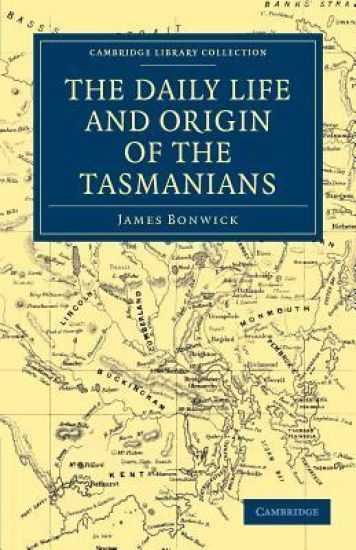
The Daily Life and Origin of the Tasmanians

The Daily Life and Origin of the Tasmanians

James Bonwick

Cambridge University Press
2011
pokkari
James Bonwick (1817–1906) arrived in Tasmania, then Van Diemen's Land, in 1841, beginning an unstable and itinerant career as school-master, writer, and archivist. A zealous non-conformist and mystic, who was briefly in contact with Madame Blavatsky, Bonwick became interested in the plight of the Tasmanian aborigines after a visit to Flinders Island, to which the last of the nearly extinct population had been removed. Published in 1870, by which time Bonwick had become a fellow of the Royal Geographical Society, this book is a sympathetic anthropological study of indigenous Tasmanian culture and society, based on colonial records, interviews with early settlers and Bonwick's own experiences. The companion volume to The Last of the Tasmanians, which discussed the reasons for the extinction and was cited by Darwin in The Descent of Man, it provides important source material, as well as insight into the morally difficult subject of nineteenth-century anthropology.
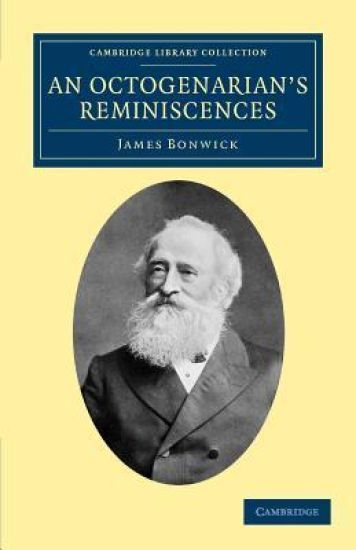
An Octogenarian's Reminiscences

An Octogenarian's Reminiscences

James Bonwick

Cambridge University Press
2011
pokkari
In this 1902 work, teacher, historian and archivist James Bonwick (1817–1906) recalls a long life's contribution to the fields of education and historical writing. More than sixty publications can be attributed to Bonwick, who was elected a fellow of the Royal Geographical Society in 1865. He traces his life from boyhood to the many years he spent in Australia, establishing, managing and inspecting schools. Bonwick stressed the need for observation and experimentation by the pupil rather than rote learning. He was also involved in the temperance movement, and was a sympathetic champion of the near-extinct Tasmanian aborigines. Upon returning to England in the early 1880s, Bonwick immersed himself in transcribing Australian source material, archived in London, that chronicled the British settlement in Australia. Many of his transcripts were subsequently used as the basis of works on the early history of Australia both by Bonwick himself and by others.