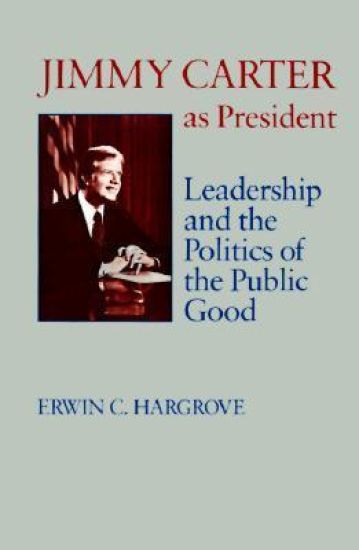
Jimmy Carter was, according to Erwin Hargrove, the first modern Democratic president to be substantially ahead of the party coalition. Concerned with issues of the future - inflation, the need for tax reform, energy shortages - Carter anticipated many questions that are only now being addressed, nearly a decade after his troubled tenure in office. The years 1976 to 1980 were difficult years for a Democrat to be president - especially difficult for a southern moderate who viewed the world in Wilsonian terms and who was politically unaligned, essentially an outsider in his party and in Washington. But Carter's inability to read or manipulate the political scene was not the only problem to beleaguer his presidency. Events such as the Soviet invasion of Afghanistan and the capture of American hostages in Iran also worked against Carter, creating situations in which no amount of political acumen could have salvaged his presidency. Hargrove places Carter in historical perspective. Examining his frequently overlooked successes, as well as his failures, Hargrove analyses both the content and the methods of Carter's policy leadership. His style of leadership is studied in the light of his beliefs and values, and of his problem-solving skills and experience. This profile draws heavily upon interviews with members of Carter's White House staff. In a consideration for Carter's domestic, economic, and foreign policies, Hargrove shows the congruence of purpose, politics, and process as a president shapes decision making. Because Carter was skilled at solving specific problems, he achieved notable successes - the Panama Canal Treaty, the Camp David Accord, and the SALT II talks - when he could keep matters in his own hands. Yet, despite such policy successes, his inability to build strong coalitions and delegate authority, exacerbated by uncontrollable world events, doomed Carter to political defeat. Throughout Jimmy Carter as President, Hargrove emphasises that in our assessment of presidents, we should evaluate skill within the historical context and thereby better understanding the ingredients of presidential success. Hargrove's effective and extensive use of interviews proves the advantages of integrating oral history into scholarly research and writing.
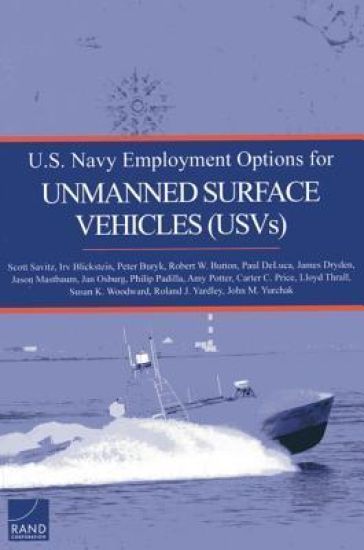
Scott Savitz; Irv Blickstein; Peter Buryk; Robert W. Button; Paul DeLuca; James Dryden; Jason Mastbaum; Jan Osburg; Philip Padilla; Amy Potter; Carter C. Price; Lloyd Thrall; Susan K. Woodward; Roland J. Yardley; John M. Yurchak
This report assesses in what ways and to what degree unmanned surface vehicles (USVs) are suitable for supporting U.S. Navy missions and functions. It briefly characterizes the current and emerging USV marketplaces to provide a baseline for near-term capabilities, describes USV concepts of employment to support diverse U.S. Navy missions and functions, and evaluates these concepts of employment to identify specific missions and functions for which they are highly suitable.
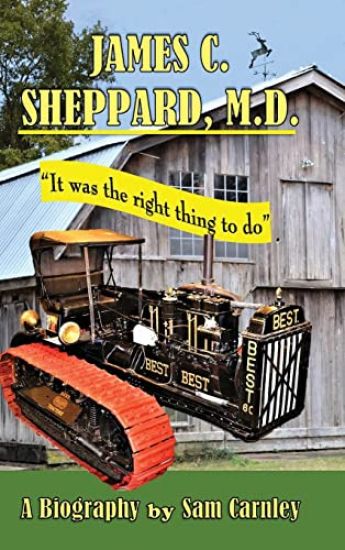
A biography of retired 87 year-old James C. Sheppard, M. D. Born to a poor tenant farmer below Dothan in south Alabama's Houston County, he excelled academically and earned through his educational journey a medical degree, after which he served a four year stint as a U, . S. Air Force flight surgeon. Following separation from the military, he earned specialist certifications in cardiology and internal medicine. He then practiced in Fort Walton Beach, Florida for 37 years. On his farm near DeFuniak Springs, Florida, he collected and restored to like-new condition over 150 antique John Deere and Caterpillar tractors as a hobby. His collection is possibly the largest of its kind in the world.
Reverend Carl Boston sat at the funeral of his best friend and colleague, the Right Reverend Dr. Morgan L. Kendal. Morgan was forty-five years old. He left to cherish his memory, his wife Lorraine and their son Lester, who was sitting on the front pew with other relatives, numb and bewildered, staring straight ahead and focused on Morgan's bronze casket. Morgan was donned in full regalia, a bishop's cross around his neck and a bishop's ring on his right hand, although it had been a posthumous elevation. Carl ached inside, wondering what was so terrible that the only way out for his best friend was to put a gun in his mouth and pull the trigger... None of those that gave remarks at the funeral, including Carl, addressed the "why." Instead, they attempted to console themselves with platitudes such as: "He's resting in Jesus's arms. Even if he could, he wouldn't return to this evil and perverse world," and "We'll surely see him again someday." ...
Reverend Carl Boston sat at the funeral of his best friend and colleague, the Right Reverend Dr. Morgan L. Kendal. Morgan was forty-five years old. He left to cherish his memory, his wife Lorraine and their son Lester, who was sitting on the front pew with other relatives, numb and bewildered, staring straight ahead and focused on Morgan's bronze casket. Morgan was donned in full regalia, a bishop's cross around his neck and a bishop's ring on his right hand, although it had been a posthumous elevation. Carl ached inside, wondering what was so terrible that the only way out for his best friend was to put a gun in his mouth and pull the trigger... None of those that gave remarks at the funeral, including Carl, addressed the "why." Instead, they attempted to console themselves with platitudes such as: "He's resting in Jesus's arms. Even if he could, he wouldn't return to this evil and perverse world," and "We'll surely see him again someday." ...
A celebration of the life and ministry of Bishop James C Richardson, Sr., former presiding prelate of the African-American Oneness Pentecostal denomination, the Apostle Church of Christ in God with personal reflections on the history and development of that body.
Sixth generation Texas Ranger James C. Blawcyzk has ruffled the feathers of his superiors at Company F one time too many. He's offered a choice: Either transfer to Company E, and an isolated post in far west Texas, resign, or be terminated. Knowing he'd be a better fit in the wild, wide-open spaces of the Big Bend anyway, Jim accepts the transfer. He and his family prepare to pack up and move west.