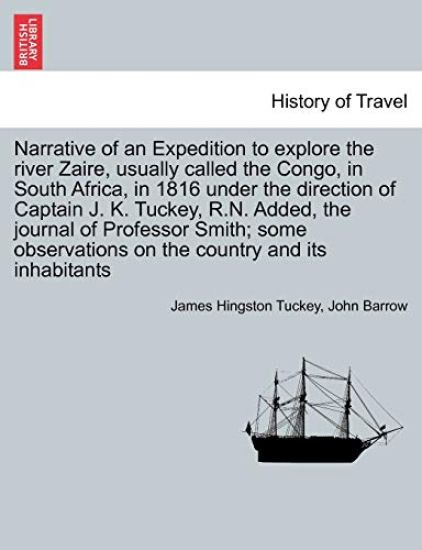
Title: Narrative of an Expedition to explore the river Zaire, usually called the Congo, in South Africa, in 1816 under the direction of Captain J. K. Tuckey, R.N. To which is added, the journal of Professor Smith; some general observations on the country and its inhabitants; and an appendix: containing the natural history of that part of the kingdom of Congo through which the Zaire flows. (Observations on Professor C. Smith's collection of plants from the vicinity of the river Congo, by R. Brown.) Edited by Sir J. Barrow.]Publisher: British Library, Historical Print EditionsThe British Library is the national library of the United Kingdom. It is one of the world's largest research libraries holding over 150 million items in all known languages and formats: books, journals, newspapers, sound recordings, patents, maps, stamps, prints and much more. Its collections include around 14 million books, along with substantial additional collections of manuscripts and historical items dating back as far as 300 BC.The HISTORY OF TRAVEL collection includes books from the British Library digitised by Microsoft. This collection contains personal narratives, travel guides and documentary accounts by Victorian travelers, male and female. Also included are pamphlets, travel guides, and personal narratives of trips to and around the Americas, the Indies, Europe, Africa and the Middle East. ++++The below data was compiled from various identification fields in the bibliographic record of this title. This data is provided as an additional tool in helping to insure edition identification: ++++ British Library Tuckey, James Hingston; Barrow, John; 1818. lxxxii. 498 p.; 4 . 147.f.1.
Two hundred and fifty years ago Captain James Cook, during his extraordinary voyages of navigation and maritime exploration, searched for Antarctica - the Unknown Southern Continent. During parts of his three voyages in the southern Pacific and Southern Oceans, Cook narrowed the options' for the location of Antarctica. Over three summers, he completed a circumnavigation of portions of the Southern Continent, encountering impenetrable barriers of ice, and he suggested the continent existed, a frozen land not populated by a living soul. Yet his Antarctic voyages are perhaps the least studied of all his remarkable travels. That is why James Hamilton's gripping and scholarly study, which brings together the stories of Cook's Antarctic journeys into a single volume, is such an original and timely addition to the literature on Cook and eighteenth-century exploration. Using Cook's journals and the log books of officers who sailed with him, the book sets his Antarctic explorations within the context of his historic voyages. The main focus is on the Second Voyage (1772-1775), but brief episodes in the First Voyage (during 1769) and the Third Voyage (1776) are part of the story. Throughout the narrative Cook's exceptional seamanship and navigational skills, and that of his crew, are displayed during often-difficult passages in foul weather across uncharted and inhospitable seas. Captain James Cook and the Search for Antarctica offers the reader a fascinating insight into Cook the seaman and explorer, and it will be essential reading for anyone who has a particular interest the history of the Southern Continent.
In Cook's relatively short and adventurous life (1728-79) he voyaged to the eastern and western seaboards of North America, the North and South Pacific and the Arctic and Antarctic bringing about a new comprehension of the world's geography and its people's. He was the linking figure between the grey specualtion of the early eighteenth century and the industrial age of the first half of the nineteenth century.Richard Hough's biograpahy is full of new insights and interpretations of one of the world's greatest mariners.
James Cook, born in 1728, was one of the most celebrated men of his time, the last and the greatest of the romantic navigator/explorers. His voyages in the Royal Navy to the eastern and western seaboards of North America, the North and South Pacific, the Arctic, and the Antarctic brought a new understanding of the worlds geography and of the peoples, flora, and fauna of the lands he discovered. Richard Hough's vivid narrative captures all the excitement of this age of discovery and establishes Cook as a link between the vague scientific speculations of the early eighteenth century and the industrial revolution to come. A pioneer in many fields, Cook produced maps of unprecedented accuracy; revolutionized the seaman's diet, all but eliminating scurvy; and exploded the myth of the Great Southern Continent imagined by earlier geographers and scientists. Hough consulted numerous archives and traveled in Cook's wake from Alaska to Tasmania, visiting many of the Pacific islands--including the spot where Cook was stoned to death by cannibals in the Hawaiian archipelago--to produce a comprehensive and immensely readable biography, full of new insights into the life of one of the worlds greatest mariners.