Kirjojen hintavertailu. Mukana 11 244 527 kirjaa ja 12 kauppaa.

Kirjahaku

Etsi kirjoja tekijän nimen, kirjan nimen tai ISBN:n perusteella.

1000 tulosta hakusanalla James E. Fleming

Fidelity to Our Imperfect Constitution

Fidelity to Our Imperfect Constitution

James E. Fleming

Oxford University Press Inc
2015
sidottu
In recent years, some have asked "Are we all originalists now?" and many have assumed that originalists have a monopoly on concern for fidelity in constitutional interpretation. In Fidelity to Our Imperfect Constitution, James Fleming rejects originalisms-whether old or new, concrete or abstract, living or dead. Instead, he defends what Ronald Dworkin called a "moral reading" of the United States Constitution, or a "philosophic approach" to constitutional interpretation. He refers to conceptions of the Constitution as embodying abstract moral and political principles-not codifying concrete historical rules or practices-and of interpretation of those principles as requiring normative judgments about how they are best understood-not merely historical research to discover relatively specific original meanings. Through examining the spectacular concessions that originalists have made to their critics, he shows the extent to which even they acknowledge the need to make normative judgments in constitutional interpretation. Fleming argues that fidelity in interpreting the Constitution as written requires a moral reading or philosophic approach. Fidelity commits us to honoring our aspirational principles, not following the relatively specific original meanings (or original expected applications) of the founders. Originalists would enshrine an imperfect Constitution that does not deserve our fidelity. Only a moral reading or philosophic approach, which aspires to interpret our imperfect Constitution so as to make it the best it can be, gives us hope of interpreting it in a manner that may deserve our fidelity.
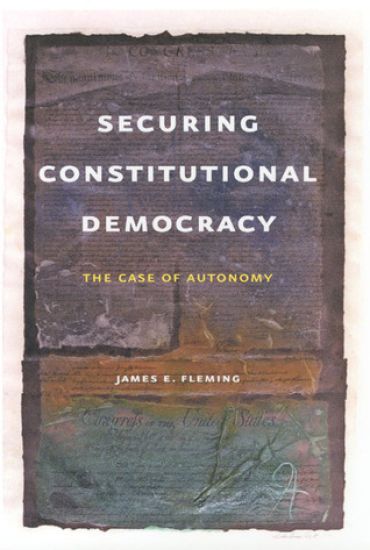
Securing Constitutional Democracy

Securing Constitutional Democracy

James E. Fleming

University of Chicago Press
2006
sidottu
Famously described by Louis Brandeis as "the most comprehensive of rights" and "the right most valued by civilized men," the right of privacy or autonomy is more embattled during modern times than any other. Debate over its meaning, scope, and constitutional status is so widespread that it all but defines the post-1960s era of constitutional interpretation. Conservative Robert Bork called it "a loose canon in the law," while feminist Catharine MacKinnon attacked it as the "right of men to be left alone to oppress women." Can a right with such prominent critics from across the political spectrum be grounded in constitutional law? In this book, James E. Fleming responds to these controversies by arguing that the right to privacy or autonomy should be grounded in a theory of securing constitutional democracy. His framework seeks to secure the basic liberties that are preconditions for deliberative democracy - to allow citizens to deliberate about the institutions and policies of their government - as well as deliberative autonomy - to enable citizens to deliberate about the conduct of their own lives. Together, Fleming shows, these two preconditions can afford everyone the status of free and equal citizenship in our morally pluralistic constitutional democracy.
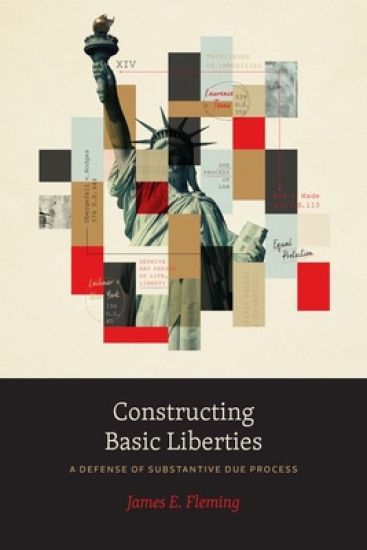
Constructing Basic Liberties

Constructing Basic Liberties

James E. Fleming

THE UNIVERSITY OF CHICAGO PRESS
2022
sidottu
A strong and lively defense of substantive due process. From reproductive rights to marriage for same-sex couples, many of our basic liberties owe their protection to landmark Supreme Court decisions that have hinged on the doctrine of substantive due process. This doctrine is controversial—a battleground for opposing views around the relationship between law and morality in circumstances of moral pluralism—and is deeply vulnerable today. Against recurring charges that the practice of substantive due process is dangerously indeterminate and irredeemably undemocratic, Constructing Basic Liberties reveals the underlying coherence and structure of substantive due process and defends it as integral to our constitutional democracy. Reviewing the development of the doctrine over the last half-century, James E. Fleming rebuts popular arguments against substantive due process and shows that the Supreme Court has constructed basic liberties through common law constitutional interpretation: reasoning by analogy from one case to the next and making complex normative judgments about what basic liberties are significant for personal self-government. Elaborating key distinctions and tools for interpretation, Fleming makes a powerful case that substantive due process is a worthy practice that is based on the best understanding of our constitutional commitments to protecting ordered liberty and securing the status and benefits of equal citizenship for all.
Constructing Basic Liberties

Constructing Basic Liberties

James E. Fleming

THE UNIVERSITY OF CHICAGO PRESS
2022
nidottu
A strong and lively defense of substantive due process. From reproductive rights to marriage for same-sex couples, many of our basic liberties owe their protection to landmark Supreme Court decisions that have hinged on the doctrine of substantive due process. This doctrine is controversial—a battleground for opposing views around the relationship between law and morality in circumstances of moral pluralism—and is deeply vulnerable today. Against recurring charges that the practice of substantive due process is dangerously indeterminate and irredeemably undemocratic, Constructing Basic Liberties reveals the underlying coherence and structure of substantive due process and defends it as integral to our constitutional democracy. Reviewing the development of the doctrine over the last half-century, James E. Fleming rebuts popular arguments against substantive due process and shows that the Supreme Court has constructed basic liberties through common law constitutional interpretation: reasoning by analogy from one case to the next and making complex normative judgments about what basic liberties are significant for personal self-government. Elaborating key distinctions and tools for interpretation, Fleming makes a powerful case that substantive due process is a worthy practice that is based on the best understanding of our constitutional commitments to protecting ordered liberty and securing the status and benefits of equal citizenship for all.
Ordered Liberty

Ordered Liberty

James E. Fleming; Linda C. McClain

Harvard University Press
2013
sidottu
Many have argued in recent years that the U.S. constitutional system exalts individual rights over responsibilities, virtues, and the common good. Answering the charges against liberal theories of rights, James Fleming and Linda McClain develop and defend a civic liberalism that takes responsibilities and virtues—as well as rights—seriously. They provide an account of ordered liberty that protects basic liberties stringently, but not absolutely, and permits government to encourage responsibility and inculcate civic virtues without sacrificing personal autonomy to collective determination.The battle over same-sex marriage is one of many current controversies the authors use to defend their understanding of the relationship among rights, responsibilities, and virtues. Against accusations that same-sex marriage severs the rights of marriage from responsible sexuality, procreation, and parenthood, they argue that same-sex couples seek the same rights, responsibilities, and goods of civil marriage that opposite-sex couples pursue. Securing their right to marry respects individual autonomy while also promoting moral goods and virtues. Other issues to which they apply their idea of civic liberalism include reproductive freedom, the proper roles and regulation of civil society and the family, the education of children, and clashes between First Amendment freedoms (of association and religion) and antidiscrimination law. Articulating common ground between liberalism and its critics, Fleming and McClain develop an account of responsibilities and virtues that appreciates the value of diversity in our morally pluralistic constitutional democracy.
Isometries on Banach Spaces

Isometries on Banach Spaces

Richard J. Fleming; James E. Jamison

CRC Press
2019
nidottu
Fundamental to the study of any mathematical structure is an understanding of its symmetries. In the class of Banach spaces, this leads naturally to a study of isometries-the linear transformations that preserve distances. In his foundational treatise, Banach showed that every linear isometry on the space of continuous functions on a compact metric space must transform a continuous function x into a continuous function y satisfying y(t) = h(t)x(p(t)), where p is a homeomorphism and |h| is identically one. Isometries on Banach Spaces: Function Spaces is the first of two planned volumes that survey investigations of Banach-space isometries. This volume emphasizes the characterization of isometries and focuses on establishing the type of explicit, canonical form given above in a variety of settings. After an introductory discussion of isometries in general, four chapters are devoted to describing the isometries on classical function spaces. The final chapter explores isometries on Banach algebras. This treatment provides a clear account of historically important results, exposes the principal methods of attack, and includes some results that are more recent and some that are lesser known. Unique in its focus, this book will prove useful for experts as well as beginners in the field and for those who simply want to acquaint themselves with this area of Banach space theory.
Isometries on Banach Spaces

Isometries on Banach Spaces

Richard J. Fleming; James E. Jamison

Chapman Hall/CRC
2002
sidottu
Fundamental to the study of any mathematical structure is an understanding of its symmetries. In the class of Banach spaces, this leads naturally to a study of isometries-the linear transformations that preserve distances. In his foundational treatise, Banach showed that every linear isometry on the space of continuous functions on a compact metric space must transform a continuous function x into a continuous function y satisfying y(t) = h(t)x(p(t)), where p is a homeomorphism and |h| is identically one. Isometries on Banach Spaces: Function Spaces is the first of two planned volumes that survey investigations of Banach-space isometries. This volume emphasizes the characterization of isometries and focuses on establishing the type of explicit, canonical form given above in a variety of settings. After an introductory discussion of isometries in general, four chapters are devoted to describing the isometries on classical function spaces. The final chapter explores isometries on Banach algebras. This treatment provides a clear account of historically important results, exposes the principal methods of attack, and includes some results that are more recent and some that are lesser known. Unique in its focus, this book will prove useful for experts as well as beginners in the field and for those who simply want to acquaint themselves with this area of Banach space theory.
Isometries in Banach Spaces

Isometries in Banach Spaces

Richard J. Fleming; James E. Jamison

Chapman Hall/CRC
2007
sidottu
A continuation of the authors’ previous book, Isometries on Banach Spaces: Vector-valued Function Spaces and Operator Spaces, Volume Two covers much of the work that has been done on characterizing isometries on various Banach spaces.Picking up where the first volume left off, the book begins with a chapter on the Banach–Stone property. The authors consider the case where the isometry is from C0(Q, X) to C0(K, Y) so that the property involves pairs (X, Y) of spaces. The next chapter examines spaces X for which the isometries on LP(µ, X) can be described as a generalization of the form given by Lamperti in the scalar case. The book then studies isometries on direct sums of Banach and Hilbert spaces, isometries on spaces of matrices with a variety of norms, and isometries on Schatten classes. It subsequently highlights spaces on which the group of isometries is maximal or minimal. The final chapter addresses more peripheral topics, such as adjoint abelian operators and spectral isometries. Essentially self-contained, this reference explores a fundamental aspect of Banach space theory. Suitable for both experts and newcomers to the field, it offers many references to provide solid coverage of the literature on isometries.
Constitutional Interpretation

Constitutional Interpretation

Sotirios A. Barber; James E. Fleming

Oxford University Press Inc
2007
nidottu
Ronald Dworkin famously argued that fidelity in interpreting the Constitution as written calls for a fusion of constitutional law and moral philosophy. Barber and Fleming take up that call, arguing for a philosophic approach to constitutional interpretation. In doing so, they systematically critique the competing approaches - textualism, consensualism, originalism, structuralism, doctrinalism, minimalism, and pragmatism - that aim and claim to avoid a philosophic approach. Constitutional Interpretation: The Basic Questions illustrates that these approaches cannot avoid philosophic reflection and choice in interpreting the Constitution. Barber and Fleming contend that fidelity in constitutional interpretation requires a fusion of philosophic and other approaches, properly understood. Within such a fusion, interpreters would begin to think of text, consensus, intentions, structures, and doctrines not as alternatives to, but as sites of philosophic reflection about the best understanding of our constitutional commitments. Constitutional Interpretation: The Basic Questions examines the fundamental inquiries that arise in interpreting constitutional law. In doing so, the authors survey the controversial and intriguing questions that have stirred constitutional debate in the United States for over two centuries, such as: how and for what ends should governmental institutions and powers be arranged; what does the Constitution mean under general circumstances and how should it be interpreted during concrete controversies; and finally how do we decide what our constitution means and who ultimately decides its meaning.
Microtentaciones: Bocados de realidad minuscula

Microtentaciones: Bocados de realidad minuscula

William E. Fleming; James Crawford Publishing

Createspace Independent Publishing Platform
2016
nidottu
Qu es lo que tiene una peque a ficci n para que estalle como un gran cohete en el cielo? Qu hay de oculto en una peque a l nea o en un simple p rrafo para que atraiga de una manera asombrosa? La brevedad es un g nero que se ha ido cultivando desde hace mucho tiempo. Siempre ha estado presente como greguer as, aforismos, microrrelatos, minicuentos, microcuentos... Una minificci n que en muchos casos se convierte en una gran tentaci n por saborearla. Descubre los entresijos que se ocultan con cada pincelada de estos microrrelatos, aprender de la locura como resultado del ARTE DEL ESCRITOR, o sentir el terror que se oculta DETR S DE LA PUERTA. Sufre LA FE DE LOS HORRORES de la mano de cada palabra que invoca al MIEDO o siente el homenaje al autor de ciencia ficci n Ray Bradbury.
The Collected Works of James E. Meade (Routledge Revivals)
This ten volume backlist collection brings together an assortment of seminal works by highly influential British economist and Nobel Laureate James Meade. This comprehensive and diverse collection encompasses everything from economic growth, through to international trade, property ownership and his work on the principles of political economy. Spanning more than 30 years in Professor Meade’s distinguished career, the reissued volumes in this collection, originally published between 1940 and 1976, offer a thorough and engaging insight into Professor Meade’s work, which will appeal to the general reader as well as to students of economics and professional economists.
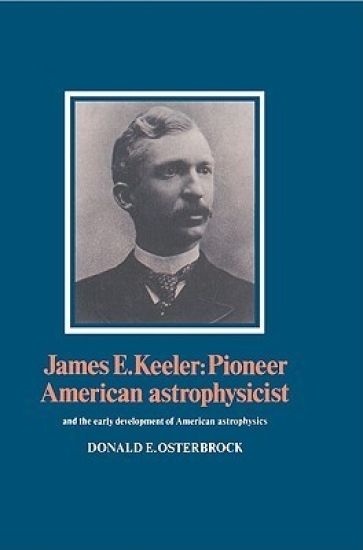
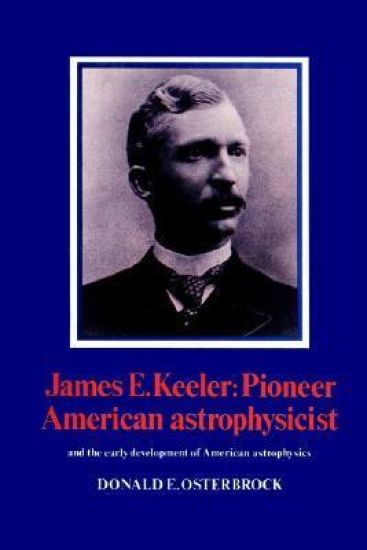
James E. Keeler: Pioneer American Astrophysicist

James E. Keeler: Pioneer American Astrophysicist

Donald E. Osterbrock

Cambridge University Press
2002
pokkari
This is the biography of James E. Keeler (1857–1900), a distinguished pioneer of astrophysics, the application of the methods of physics to understanding the nature of the stars, nebulae, planets, comets, and other objects that populate the universe. Keeler was an outstanding scientist, and his fellow astronomers and physicists at the end of the nineteenth century considered him the leading astronomical spectroscopist of his generation. His career was closely linked with that of George Ellery Hale, founder of Yerkes Observatory. Keeler himself was the first astronomer at Lick Observatory, and the story of his life tells much of the early history of these two early American ‘big-science’ research institutions.
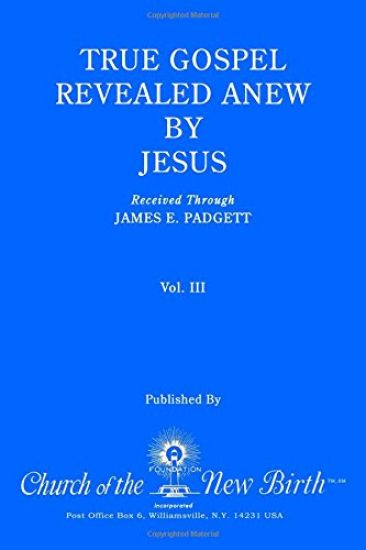
True Gospel Revealed Anew by Jesus, Volume III: Received Through James E Padgett

True Gospel Revealed Anew by Jesus, Volume III: Received Through James E Padgett

James E. Padgett

Createspace Independent Publishing Platform
1969
nidottu
Mr. James Edward Padgett was born August 25, 1852, in Washington, D.C. and attended the Polytechnic Academy Institute at Newmarket, Virginia. In 1880 he was admitted to the bar in Washington, D.C., and thereafter he practiced law for 43 years until his death on March 17, 1923. During his student years, he became friendly with Professor Joseph Salyards, an instructor at the Academy who, after his death in 1885, wrote him many interesting messages. His wife, Helen, died about February 1914, and was the first to write him from the spirit world. Padgett never practiced his gift of mediumship as a means of earning money. He was dedicated wholly to the reception of the great messages signed Jesus and his many disciples.
True Gospel Revealed Anew by Jesus, Volume II: Received Through James E Padgett

True Gospel Revealed Anew by Jesus, Volume II: Received Through James E Padgett

James E. Padgett

Createspace Independent Publishing Platform
1965
nidottu
Mr. James Edward Padgett was born August 25, 1852, in Washington, D.C. and attended the Polytechnic Academy Institute at Newmarket, Virginia. In 1880 he was admitted to the bar in Washington, D.C., and thereafter he practiced law for 43 years until his death on March 17, 1923. During his student years, he became friendly with Professor Joseph Salyards, an instructor at the Academy who, after his death in 1885, wrote him many interesting messages. His wife, Helen, died about February 1914, and was the first to write him from the spirit world. Padgett never practiced his gift of mediumship as a means of earning money. He was dedicated wholly to the reception of the great messages signed Jesus and his many disciples.
True Gospel Revealed Anew by Jesus, Volume IV: Received Through James E Padgett

True Gospel Revealed Anew by Jesus, Volume IV: Received Through James E Padgett

James E. Padgett

Createspace Independent Publishing Platform
1972
nidottu
Mr. James Edward Padgett was born August 25, 1852, in Washington, D.C. and attended the Polytechnic Academy Institute at Newmarket, Virginia. In 1880 he was admitted to the bar in Washington, D.C., and thereafter he practiced law for 43 years until his death on March 17, 1923. During his student years, he became friendly with Professor Joseph Salyards, an instructor at the Academy who, after his death in 1885, wrote him many interesting messages. His wife, Helen, died about February 1914, and was the first to write him from the spirit world. Padgett never practiced his gift of mediumship as a means of earning money. He was dedicated wholly to the reception of the great messages signed Jesus and his many disciples.
James E Carter: Treasure Hunter

James E Carter: Treasure Hunter

Jacob Tomassi

Createspace Independent Publishing Platform
2017
nidottu
James E Carter and Roge Dubois are two best friends studying at SFAS; the one and only School of Adventure Studies, whose mission it is to prepare young, brilliant people to become Master Treasure Hunters. James and Roge lead pretty average lives for the field of work they are going into: dodging explosive arrows one day, uncovering undersea relics another. That is, until they poke the wrong hornets' nest trying to expose their corrupt principal, get kidnapped by their favorite teacher, and are entangled in an adventure filled with everything from explosions and foreign countries to young love. With nothing between James and peril except Lady Luck herself, James must find a way to survive, reclaim the key to expelling their principal, and do it all in style.
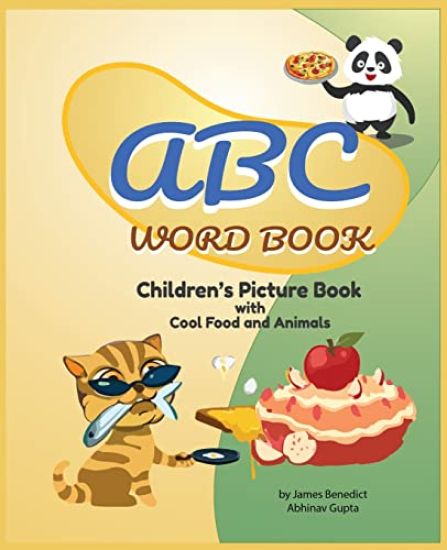
ABC Word Book- Children's Picture Book Food and Animals by James E Benedict
Have you seen a book with delicious food and unique animals that take you into another world? This playful ABC Children's Book, an alphabet book, is loaded with happy animals, and a variety of food.Ideas for toddlers, little ones, and kids that love colorful pictures. This educational book will inspire young students to open their eyes to learning.Book includes: A, B, C....Z alphabets ColorsDelicious FoodsHappy animalsA good educational and vibrant bookAuthor: James E, BenedictIllustrator: Abhinav Gupta