Kirjojen hintavertailu. Mukana 11 699 587 kirjaa ja 12 kauppaa.

Kirjahaku

Etsi kirjoja tekijän nimen, kirjan nimen tai ISBN:n perusteella.

1000 tulosta hakusanalla James G. Sanderson

Small Wild Cats

Small Wild Cats

James G. Sanderson

Johns Hopkins University Press
2011
sidottu
Did you know that most wild cat species are small and that lions, tigers, and other large cats are the exception? That adult bobcats, clouded leopards, and other small wild cats are completely asocial? And that they fight only as a last resort? This entertaining and informative book reveals these and hundreds of other facts about the behavior, biology, and conservation of the more than 30 small wild cat species. From bobcats to servals, small cats are spread across the globe. They range in size from the rusty-spotted cat and African black-footed cat, each of which weighs around 5 pounds when fully grown, to the Eurasian lynx, which can reach an adult weight of 60 pounds. These felids are elusive, some are nocturnal, others are arboreal, and all are rare and secretive, making them especially difficult to study. James G. Sanderson, the world's leading field expert on small wild cats, and naturalist and wildlife artist Patrick Watson provide informative and entertaining answers to common and unexpected questions about these animals.The authors explain why some small cats live on the ground while others inhabit trees, discuss the form and function of their coat types and colors, offer scientifically sound information on human-small wild cat interactions, and even review the role that small wild cats have played in literature, religion, and mythology. The world of cats is as fascinating as it is diverse. Small Wild Cats: The Animal Answer Guide shows just how important and interesting the littlest of the nondomesticated feline family are.

Small Wild Cats

Small Wild Cats

James G. Sanderson; Patrick Watson

Johns Hopkins University Press
2011
pokkari
Did you know that most wild cat species are small and that lions, tigers, and other large cats are the exception? That adult bobcats, clouded leopards, and other small wild cats are completely asocial? And that they fight only as a last resort? This entertaining and informative book reveals these and hundreds of other facts about the behavior, biology, and conservation of the more than 30 small wild cat species. From bobcats to servals, small cats are spread across the globe. They range in size from the rusty-spotted cat and African black-footed cat, each of which weighs around 5 pounds when fully grown, to the Eurasian lynx, which can reach an adult weight of 60 pounds. These felids are elusive, some are nocturnal, others are arboreal, and all are rare and secretive, making them especially difficult to study. James G. Sanderson, the world's leading field expert on small wild cats, and naturalist and wildlife artist Patrick Watson provide informative and entertaining answers to common and unexpected questions about these animals. The authors explain why some small cats live on the ground while others inhabit trees, discuss the form and function of their coat types and colors, offer scientifically sound information on human-small wild cat interactions, and even review the role that small wild cats have played in literature, religion, and mythology. The world of cats is as fascinating as it is diverse. Small Wild Cats: The Animal Answer Guide shows just how important and interesting the littlest of the nondomesticated feline family are.
Patterns in Nature

Patterns in Nature

Sanderson James G.; Pimm Stuart L.

University of Chicago Press
2015
sidottu
What species occur where, and why, and why some places harbor more species than others are basic questions for ecologists. Some species simply live in different places: fish live underwater, birds do not. Adaptations follow: most fish have gills; birds have lungs. But as Patterns in Nature reveals, not all patterns are so trivial. Bringing up to date a critical debate in the field of community ecology between Jared Diamond and colleagues Daniel Simberloff and Edward F. Connor-in which Connor and Simberloff claimed to have demonstrated that island communities did not differ from random expectations-this book undertakes the identification and interpretation of nature's large-scale patterns of species co-occurrence to offer insight into how nature truly works. Travel along any gradient-up a mountain, from forest into desert, from a north-facing slope to a south-facing one, from low tide to high tide on a shoreline, from Arctic tundra to tropical rain forests-and the species change. What explains the patterns of these distributions? Some patterns might be as random as a coin toss. But as with a coin toss, can ecologists differentiate associations caused by a multiplicity of complex, idiosyncratic factors from those structured by some unidentified but simple mechanisms? Can simple mechanisms that structure communities be inferred from observations of which species associations naturally occur? While the answers to these questions are not yet entirely clear, Patterns in Nature forces us to reexamine assumptions about species distribution patterns and will be of vital importance to ecologists and conservationists alike.
University Chemistry

University Chemistry

James G. Anderson

MIT PRESS LTD
2022
nidottu
A new approach to teaching university-level chemistry that links core concepts of chemistry and physical science to current global challenges. Introductory chemistry and physics are generally taught at the university level as isolated subjects, divorced from any compelling context. Moreover, the "formalism first" teaching approach presents students with disembodied knowledge, abstract and learned by rote. By contrast, this textbook presents a new approach to teaching university-level chemistry that links core concepts of chemistry and physical science to current global challenges. It provides the rigorous development of the principles of chemistry but places these core concepts in a global context to engage developments in technology, energy production and distribution, the irreversible nature of climate change, and national security. Each chapter opens with a "Framework" section that establishes the topic's connection to emerging challenges. Next, the "Core" section addresses concepts including the first and second law of thermodynamics, entropy, Gibbs free energy, equilibria, acid-base reactions, electrochemistry, quantum mechanics, molecular bonding, kinetics, and nuclear. Finally, the "Case Studies" section explicitly links the scientific principles to an array of global issues. These case studies are designed to build quantitative reasoning skills, supply the technology background, and illustrate the critical global need for the infusion of technology into energy generation. The text's rigorous development of both context and scientific principles equips students for advanced classes as well as future involvement in scientific and societal arenas. University Chemistry was written for a widely adopted course created and taught by the author at Harvard.
Evaluating the Organizational Impact of Health Care Information Systems

Evaluating the Organizational Impact of Health Care Information Systems

James G. Anderson; Carolyn Aydin

Springer-Verlag New York Inc.
2005
sidottu
Evaluating the Organizational Impact of Health Care Information Systems, Second Edition, is heavily updated and revised from its First Edition, which is entitled Evaluating Health Care Information Systems: Methods and Applications. The much-needed Second Edition is a guide for evaluating the organizational impacts of computer systems in health care institutions. It provides a practical guide for determining the appropriate questions to ask based on underlying models of change and the most effective methods available. An introduction to various methods is provided, as well as appendices containing survey instruments usable in research and evaluation, computer programs for data analyses, and other evaluation resources. The book provides a critical overview of current research and evaluation to date with numerous bibliographic references from health care and other fields. The methods and instruments described are applicable to a wide variety of other organizations that utilize information technology and they emphasize the importance of clearly specifying the purpose of the evaluation, recognizing assumptions about organizational change and using a multi-method approach to system evaluation. The material presented is drawn from a variety of social and health science disciplines in order to integrate the study of information system with social science theory and methods. Chapter highlights include Cognitive Approaches to Evaluation, Computer Simulation as an Evaluation Tool, and Research and Evaluation: Future Directions. Evaluating the Organizational Impact of Health Care Information Systems, Second Edition is timely since annual investment in information technology by health care organization in the U.S. now exceeds $15 billion. It will prove valuable to physicians, nurses, other health care providers, health care administrators, information systems personnel and consultants who are involved in planning, developing, implementing, utilizing and evaluating computer-based health care systems.
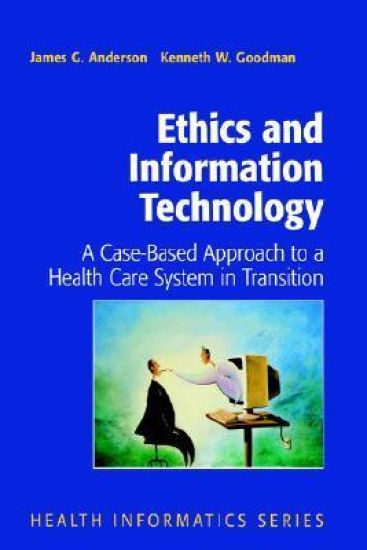
Ethics and Information Technology

Ethics and Information Technology

James G. Anderson; Kenneth Goodman

Springer-Verlag New York Inc.
2002
sidottu
This series is directed to health care professionals who are leading the tra- formation of health care by using information and knowledge. Launched in 1988 as Computers in Health Care, the series offers a broad range of titles: some addressed to specific professions such as nursing, medicine, and health administration; others to special areas of practice such as trauma and radi- ogy. Still other books in the series focus on interdisciplinary issues, such as the computer-based patient record, electronic health records, and networked health care systems. Renamed Health Informatics in 1998 to reflect the rapid evolution in the discipline now known as health informatics, the series will continue to add titles that contribute to the evolution of the field. In the series, eminent - perts, serving as editors or authors, offer their accounts of innovations in health informatics. Increasingly, these accounts go beyond hardware and so- ware to address the role of information in influencing the transformation of healthcare delivery systems around the world. The series also increasingly focuses on “peopleware” and the organizational, behavioral, and societal changes that accompany the diffusion of information technology in health services environments.
Evaluating the Organizational Impact of Health Care Information Systems

Evaluating the Organizational Impact of Health Care Information Systems

James G. Anderson; Carolyn Aydin

Springer-Verlag New York Inc.
2010
nidottu
Evaluating the Organizational Impact of Health Care Information Systems, Second Edition, is heavily updated and revised from its First Edition, which is entitled Evaluating Health Care Information Systems: Methods and Applications. The much-needed Second Edition is a guide for evaluating the organizational impacts of computer systems in health care institutions. It provides a practical guide for determining the appropriate questions to ask based on underlying models of change and the most effective methods available. An introduction to various methods is provided, as well as appendices containing survey instruments usable in research and evaluation, computer programs for data analyses, and other evaluation resources. The book provides a critical overview of current research and evaluation to date with numerous bibliographic references from health care and other fields. The methods and instruments described are applicable to a wide variety of other organizations that utilize information technology and they emphasize the importance of clearly specifying the purpose of the evaluation, recognizing assumptions about organizational change and using a multi-method approach to system evaluation. The material presented is drawn from a variety of social and health science disciplines in order to integrate the study of information system with social science theory and methods. Chapter highlights include Cognitive Approaches to Evaluation, Computer Simulation as an Evaluation Tool, and Research and Evaluation: Future Directions. Evaluating the Organizational Impact of Health Care Information Systems, Second Edition is timely since annual investment in information technology by health care organization in the U.S. now exceeds $15 billion. It will prove valuable to physicians, nurses, other health care providers, health care administrators, information systems personnel and consultants who are involved in planning, developing, implementing, utilizing and evaluating computer-based health care systems.
Ethics and Information Technology

Ethics and Information Technology

James G. Anderson; Kenneth Goodman

Springer-Verlag New York Inc.
2010
nidottu
This series is directed to health care professionals who are leading the tra- formation of health care by using information and knowledge. Launched in 1988 as Computers in Health Care, the series offers a broad range of titles: some addressed to specific professions such as nursing, medicine, and health administration; others to special areas of practice such as trauma and radi- ogy. Still other books in the series focus on interdisciplinary issues, such as the computer-based patient record, electronic health records, and networked health care systems. Renamed Health Informatics in 1998 to reflect the rapid evolution in the discipline now known as health informatics, the series will continue to add titles that contribute to the evolution of the field. In the series, eminent - perts, serving as editors or authors, offer their accounts of innovations in health informatics. Increasingly, these accounts go beyond hardware and so- ware to address the role of information in influencing the transformation of healthcare delivery systems around the world. The series also increasingly focuses on “peopleware” and the organizational, behavioral, and societal changes that accompany the diffusion of information technology in health services environments.
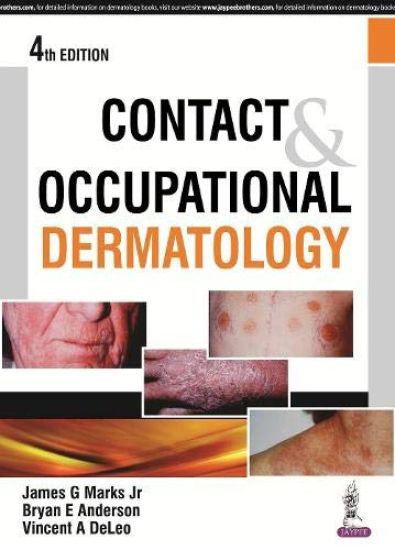
Contact & Occupational Dermatology

Contact & Occupational Dermatology

James G Marks Jr; Bryan E Anderson; Vincent A DeLeo

Jaypee Brothers Medical Publishers
2016
sidottu
Contact and Occupational Dermatology is the new, revised edition of this practical guide to the evaluation and care of patients with contact or occupational dermatitis. This book is divided into four parts, beginning with background information on contact and occupational dermatitis. The second part covers allergens, with separate chapters on preservatives, cosmetics, medicines and plants. The third part features occupational skin diseases and includes evaluation of the worker on site, management of occupational dermatitis, and a separate chapter on occupations commonly associated with contact dermatitis. The final section provides detail on contact urticaria (hives) and contact dermatitis in children as additional topics. This new edition of Contact and Occupational Dermatology includes brand new information and photographs; highlight boxes provide quick reference for important points throughout and the text is enhanced by 172 full colour images. This book is written by James Marks, Professor of Dermatology at Penn State Milton S. Hershey Medical Centre in the United States, ensuring authoritative content throughout. Key Points Latest edition of this practical guide to evaluation and care of contact/occupational dermatitis patientsPrevious edition published January 2002 (9780323014731)Highlight boxes throughout for quick reference172 full colour imagesWritten by Professor of Dermatology at Penn State Milton S. Hershey Medical Centre, USA
Wetland Ecosystems

Wetland Ecosystems

William J. Mitsch; James G. Gosselink; Li Zhang; Christopher J. Anderson

John Wiley Sons Inc
2009
sidottu
New focused text introduces readers to wetland ecosystems and systems approaches to studying wetlands With its comprehensive coverage of wetland science, management, and restoration, Mitsch and Gosselink's Wetlands has been the premier reference on wetlands for more than two decades. Now, the coverage of specific wetland ecosystem types from earlier editions of this acclaimed work has been updated, revised, and supplemented with additional content in order to create this new text focusing exclusively on wetland ecosystems. This book now complements Wetlands, Fourth Edition. Following an introduction to ecosystems in general and wetland ecosystems in particular, Wetland Ecosystems examines the major types of wetlands found throughout the world: coastal wetlands, freshwater marshes and forested swamps, and peatlands. The final chapter reviews three fundamental systems approaches to studying wetlands: mesocosms, full-scale experimental ecosystems, and mathematical modeling. This new text features: Updated descriptions of the hydrology, biogeochemistry, and biology of the main types of wetlands found in the world New content introducing general ecosystems, wetland ecosystems, whole ecosystem and mesocosm experiments with wetlands, and systems ecology and modeling A detailed description of the ecosystem services provided by wetlands A broad international scope, including many examples of wetlands located outside North America Two new coauthors offering new perspectives and additional insights into the latest ecosystem and modeling techniques An abundance of illustrations helps readers understand how different biological communities and the abiotic environment in wetland ecosystems interact and function. Tables and text boxes provide at-a-glance summaries of key information. Lastly, each chapter concludes with a list of recommended readings. This text has been designed as an introduction for students and professionals in wetland ecology and management, general ecology, environmental science, and natural resource management.
Wetlands

Wetlands

William J. Mitsch; James G. Gosselink; Christopher J. Anderson; M. Siobhan Fennessy

JOHN WILEY SONS INC
2023
sidottu
WETLANDS The definitive guide to wetlands for students and professionals alike Wetlands rank among the most productive but also the most vulnerable ecosystems. They break down toxins and help maintain aquatic ecosystems, provide both permanent and temporary homes for key species, and contribute enormously to biodiversity and global ecological health. In recent years the importance of wetlands has been increasingly well understood, and their management and restoration has become a particular focus of environmental research. Wetlands provides a thorough and comprehensive overview of wetlands, updated to reflect the latest research findings and methodological approaches, as it has done for more than a generation. The new edition has been optimized for classroom use, breaking down the topic into four parts: introduction to wetlands, the wetland environment, wetland ecosystems, and wetland management. Readers of the sixth edition of Wetlands will also find: A detailed discussion of the role of wetlands in improving water quality, protection from storm damage, and other ecosystem servicesThe latest approaches and examples of wetland creation and restorationA thorough discussion of the impacts of climate change on wetlands, and how to mitigate them Wetlands is essential reading for students and professionals in ecology, environmental engineering, and water resource management.
The Pictorial History of Scotland ... A.D. 79-1746. By J. Taylor, assisted by Professor Lindsay, Professor Eadie, J. Anderson, G. Macdonald, and other contributors.
Title: The Pictorial History of Scotland ... A.D. 79-1746. By J. Taylor, assisted by Professor Lindsay, Professor Eadie, J. Anderson, G. Macdonald, and other contributors.Publisher: British Library, Historical Print EditionsThe British Library is the national library of the United Kingdom. It is one of the world's largest research libraries holding over 150 million items in all known languages and formats: books, journals, newspapers, sound recordings, patents, maps, stamps, prints and much more. Its collections include around 14 million books, along with substantial additional collections of manuscripts and historical items dating back as far as 300 BC.The HISTORY OF EUROPE collection includes books from the British Library digitised by Microsoft. This collection includes works chronicling the development of Western civilisation to the modern age. Highlights include the development of language, political and educational systems, philosophy, science, and the arts. The selection documents periods of civil war, migration, shifts in power, Muslim expansion into Central Europe, complex feudal loyalties, the aristocracy of new nations, and European expansion into the New World. ++++The below data was compiled from various identification fields in the bibliographic record of this title. This data is provided as an additional tool in helping to insure edition identification: ++++ British Library Taylor, James; 1884-88 6 vol.; 4 . 9509.dd.7.
The Pictorial History of Scotland ... A.D. 79-1746. By J. Taylor, assisted by Professor Lindsay, Professor Eadie, J. Anderson, G. Macdonald, and other contributors.
Title: The Pictorial History of Scotland ... A.D. 79-1746. By J. Taylor, assisted by Professor Lindsay, Professor Eadie, J. Anderson, G. Macdonald, and other contributors.Publisher: British Library, Historical Print EditionsThe British Library is the national library of the United Kingdom. It is one of the world's largest research libraries holding over 150 million items in all known languages and formats: books, journals, newspapers, sound recordings, patents, maps, stamps, prints and much more. Its collections include around 14 million books, along with substantial additional collections of manuscripts and historical items dating back as far as 300 BC.The HISTORY OF EUROPE collection includes books from the British Library digitised by Microsoft. This collection includes works chronicling the development of Western civilisation to the modern age. Highlights include the development of language, political and educational systems, philosophy, science, and the arts. The selection documents periods of civil war, migration, shifts in power, Muslim expansion into Central Europe, complex feudal loyalties, the aristocracy of new nations, and European expansion into the New World. ++++The below data was compiled from various identification fields in the bibliographic record of this title. This data is provided as an additional tool in helping to insure edition identification: ++++ British Library Taylor, James; 1884-88 6 vol.; 4 . 9509.dd.7.
Societies in Eclipse

Societies in Eclipse

David G. Anderson; James W. Bradley; James A. Brown; R.P.Stephen Davis; Penelope B. Drooker; William R. Fitzgerald; Jeffrey L. Hantman

The University of Alabama Press
2005
nidottu
While contact with explorers, missionaries, and traders made a significant impact on natives of the Eastern Woodlands, Indian peoples cannot be solely understood from the historical record. Here, in ""Societies in Eclipse"", archaeologists combine recent research with insights from anthropology, historiography, and oral tradition to examine the cultural landscape preceding and immediately following the arrival of Europeans. The evidence suggests that native societies were in the process of significant cultural transformation prior to contact.
Letters to a Young Practitioner

Letters to a Young Practitioner

Anthony G. James Jr.; Leslie A. Anderson

Cognella, Inc
2022
nidottu
Letters to a Young Practitioner: Essays of Advice brings together invaluable insight from a variety of professionals in the counseling and educational practice fields into a single volume to provide students-in-training and new practitioners with mentorship. The text promotes career self-actualization and offers readers a greater understanding of the culture of their given profession, the technical knowledge they need to advance in their careers, suggestions for professional development, and more.The book features 22 essays written by clinical psychologists, couple/marriage and family therapists, clinical social workers, and others. Each essay is divided into three specific sections in which contributors provide general information about their educational background, discuss their experience and area of expertise, and offer advice in a particular area. Individual essays explore building community ties and navigating clinical errors; the experience of mentoring international students; handling conversations about race with clients; the challenges and promises inherent in child welfare social work; navigating the helping professions as a person of color; community and school-based therapy; and more. Offering readers the unique opportunity to receive valuable insight and mentorship from diverse practitioners in a single volume, Letters to a Young Practitioner is an exemplary resource for courses and programs in the helping professions, as well as new practitioners in the field.
Building Market Institutions in South Eastern Europe

Building Market Institutions in South Eastern Europe

Harry G. Broadman; James Anderson; Stijn Claessens; Randi Ryterman; Stefka Slavova

World Bank Publications
2004
nidottu
Building Market Institutions in South Eastern Europe, a collaborative effort of the World Bank and the EBRD, analyses the institutional impediments to investment and growth in eight SEE countries - Albania, Bosnia and Herzegovina, Bulgaria, Croatia, FYR Macedonia, Moldova, Romania, and Serbia and Montenegro - and suggests policy reforms to ease these constraints. The analysis focuses on four core issues: (i) Business competition and economic barriers to entry/exit, (ii) Access to regulated utilities and services, (iii) Corporate ownership, financial transparency and access to finance, and (iv) Commercial dispute resolution. These issues are investigated empirically across the SEE countries to allow for cross-country comparisons and to develop a regional perspective on corresponding policy challenges. The study is innovative not only because of its use of a cross-country comparative analytical framework applied to a well-defined - and politically important - region, but also because of the novel way it marries data from several sources: (i) official data from the eight countries; (ii) two rounds of results (for 1999 and 2002) of a quantitative firm-level survey (EBRD-World Bank Business Environment and Enterprise Performance Survey) covering approximately 1600 SEE firms; and (iii) the results from a set of 40 original enterprise-level business case studies developed in the field in each of the eight countries. Building Market Institutions in South Eastern Europe provides new insights on improving the South East European business environment and suggests concrete policy recommendations.
Stevens & Lowe's Human Histology

Stevens & Lowe's Human Histology

James S. Lowe; Peter G. Anderson; Susan I. Anderson

Elsevier Health Sciences
2024
nidottu
Stevens & Lowe's Human Histology, Sixth Edition provides students with a systematic approach to histology which is ideal as a study companion to support students of medicine, biomedical sciences and life sciences in their studies and also as an excellent tool for medical board review. This sixth edition has been fully updated by experts in the field, Stevens and Lowe’s Human Histology is designed to provide a highly-visual, well-structured, learning resource. Easy to read and follow - ideal grounding in the key concepts of histology, covering all the organ systems Clear illustrations, over 500 visually-engaging photos and graphics bring concepts to life Advanced Concept boxes link histology to cell biology and physiology for wider, integrated subject understanding Clinical example boxes anchors histology to its application in diagnosis as part of pathology and clinical medicine Carefully captioned histological images support development of microscopy skills Review questions for self-assessment Online review questions and clinical cases to support learning Online video support: watch the experts discuss microscopic images and experience how to approach a visual understanding of histology An enhanced eBook version is included with purchase. The eBook allows you to access all the text, figures and references, with the ability to search, customize your content, make notes and highlights, and have content read aloud
Environmental Investigation and Remediation

Environmental Investigation and Remediation

Thomas K.G. Mohr; William DiGuiseppi; James Hatton; Janet Anderson

CRC Press
2020
sidottu
Filled with updated information, equations, tables, figures, and citations, Environmental Investigation and Remediation: 1,4-Dioxane and Other Solvent Stabilizers, Second Edition provides the full range of information on 1,4-dioxane. It offers passive and active remediation strategies and treatment technologies for 1,4-dioxane in groundwater and provides the technical resources to help readers choose the best methods for their particular situation. This new edition includes all new information on remediation costs and reflects the latest research in the field. It includes new practical case studies to illustrate the concepts presented, including 1,4-dioxane occurrence in Long Island and the Cape Fear watershed in North Carolina.Features: Fully updated throughout to reflect the most recent research on 1,4-dioxane Describes the nature and extent of 1,4-dioxane releases, their regulation, and their remediation in a variety of geologic settings Examines 1,4-dioxane analytical chemistry, its many industrial uses, and 1,4-dioxane occurrence as a byproduct in production of many products Provides ample site data for recent and relevant remediation case studies, and a review of the widely varying regulatory landscape for 1,4-dioxane cleanup levels and drinking water limits Discusses the importance of accounting for contaminant archeology in investigating contaminated sites, and leveraging solvent stabilizers in forensic investigationsWhile written primarily for practicing professionals, such as environmental consultants and attorneys, water utility engineers, and laboratory managers, the book will also appeal to researchers and academics as well. This new edition serves as a highly useful reference on the occurrence, sampling and analysis, and remedial investigation and design for 1,4-dioxane and related contaminants.