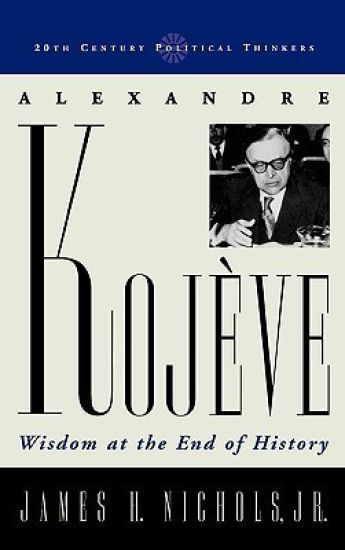
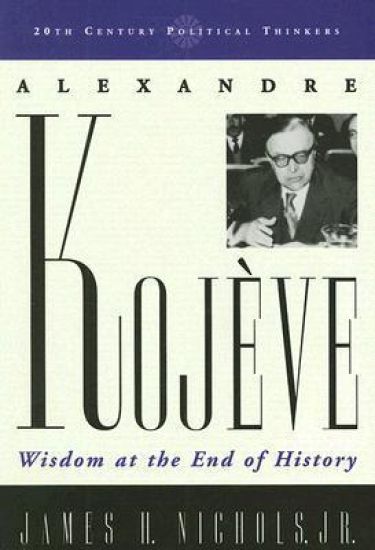
Nichols examines the major writings of Alexandre Kojève, and clarifies the character and brings to light the importance of his political philosophy. While emphasizing the political dimension of Kojève's thought, Nichols treats all his major published writings and shows how the remarkably varied parts of Kojève's intellectual endeavor go together. This is an essential assessment of Kojève which considers the works that preceded his turn to Hegel, seeks to articulate the character of his Hegelianism, and reflects in detail on the two different meanings that the end of history had in two different periods of his thought.
Nichols examines the major writings of Alexandre Koj_ve, and clarifies the character and brings to light the importance of his political philosophy. While emphasizing the political dimension of Koj_ve's thought, Nichols treats all his major published writings and shows how the remarkably varied parts of Koj_ve's intellectual endeavor go together. This is an essential assessment of Koj_ve which considers the works that preceded his turn to Hegel, seeks to articulate the character of his Hegelianism, and reflects in detail on the two different meanings that the end of history had in two different periods of his thought.
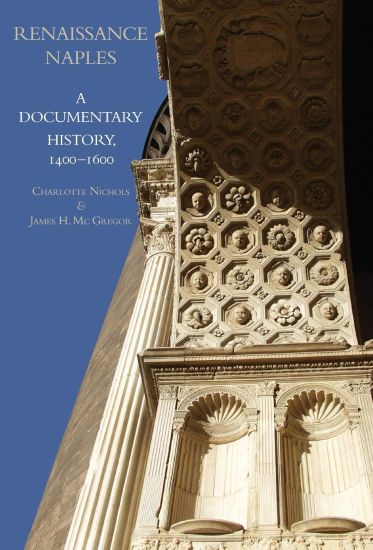
Naples was a major center of the Italian Renaissance and capital of the most important state in the Italian balance of power. Under the late Angevins, the Aragonese, and then the Spanish the city grew ever more important as a focus of political and military power, as an exemplar of early modern urbanism, and as a driver of intellectual and cultural life rivaling Florence, Rome, and Venice. It both attracted and nurtured generations of writers, theorists, painters, sculptors, architects and urban planners, whose legacy still graces this city and makes it a major modern attraction.Charlotte Nichols and James H. Mc Gregor offer the first comprehensive English-language collection of sources to treat the city of Naples from the end of the medieval to the early modern period. This book presents 169 readings in English translation drawn from historical, biographical, financial, literary, artistic, religious and cultural documents starting with the later Angevin dynasty and ending at the 17th century.The Introduction provides an up-to-date survey of the period covered with discussions of the historiography and interpretive issues around each major topic, including the humanists, urbanism, architecture, the visual arts, and literary life.This volume presents new English translations of several works. Among these are Giovanni Pontano's The Prince, On Magnificence, and selections from On Splendor; Pietro Summonte's letter to Marcantonio Michiel surveying the condition of the arts and culture in Renaissance Naples; and Loise de Rosa's Praise of Naples. This book also offers extensive selections from a wide variety of authors ranging from Valla, Facio, Panormita, Sannazaro, and Masuccio Salernitano to Notar Giacomo, Ferraiolo, Tansillo, Tasso, Vasari, and important women writers like Vittoria Colonna, Isabella de Morra, and Laura Bacio Terracina.558 pages, 169 readings, preface, introduction, notes and bibliography, appendices, including the Tavola Strozzi with key, Map of Renaissance Naples with thumbnail key, index.86 black-and-white figures, plus 48 thumbnail views. Links to online resources from A Documentary History of Naples, including image galleries with 417 additional images in full color.History, art history, literary history, cultural history, urban studies.
Naples was a major center of the Italian Renaissance and capital of the most important state in the Italian balance of power. Under the late Angevins, the Aragonese, and then the Spanish the city grew ever more important as a focus of political and military power, as an exemplar of early modern urbanism, and as a driver of intellectual and cultural life rivaling Florence, Rome, and Venice. It both attracted and nurtured generations of writers, theorists, painters, sculptors, architects and urban planners, whose legacy still graces this city and makes it a major modern attraction.Charlotte Nichols and James H. Mc Gregor offer the first comprehensive English-language collection of sources to treat the city of Naples from the end of the medieval to the early modern period. This book presents 169 readings in English translation drawn from historical, biographical, financial, literary, artistic, religious and cultural documents starting with the later Angevin dynasty and ending at the 17th century.The Introduction provides an up-to-date survey of the period covered with discussions of the historiography and interpretive issues around each major topic, including the humanists, urbanism, architecture, the visual arts, and literary life.This volume presents new English translations of several works. Among these are Giovanni Pontano's The Prince, On Magnificence, and selections from On Splendor; Pietro Summonte's letter to Marcantonio Michiel surveying the condition of the arts and culture in Renaissance Naples; and Loise de Rosa's Praise of Naples. This book also offers extensive selections from a wide variety of authors ranging from Valla, Facio, Panormita, Sannazaro, and Masuccio Salernitano to Notar Giacomo, Ferraiolo, Tansillo, Tasso, Vasari, and important women writers like Vittoria Colonna, Isabella de Morra, and Laura Bacio Terracina.558 pages, 169 readings, preface, introduction, notes and bibliography, appendices, including the Tavola Strozzi with key, Map of Renaissance Naples with thumbnail key, index.86 black-and-white figures, plus 48 thumbnail views. Links to online resources from A Documentary History of Naples, including image galleries with 417 additional images in full color.History, art history, literary history, cultural history, urban studies.
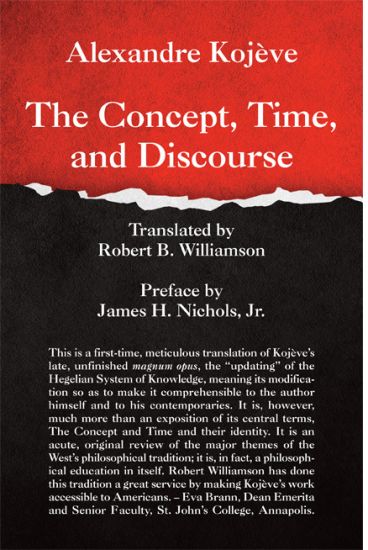
Alexandre Kojève (1902–1968) is most widely known in America for his provocative assertion that history is at its end, that is, its completion. In the “practical” sense, this means that the process of historical development can at last be seen (if from a distance) as the realization of the Marxist “universal and homogeneous state.” However, Kojève claimed as well that the history of philosophical thinking had also reached its goal in the transformation of philosophy, as the “love of wisdom” (or the unsatisfied quest for comprehensive knowledge), into that very Wisdom itself and had done so in the most essential respects in the philosophy of Hegel.The Concept, Time, and Discourse is the first volume of Kojève’s magnum opus, which was to have given an exposition of the (Hegelian) System of Knowledge and of which five volumes were written before his death. It contains, along with a preliminary discussion of the need for an updating of the Hegelian system, the first two of three introductions to the exposition of that system: a First Introduction of the Concept (the integrated totality of what is comprehensible, which is the final object of philosophic inquiry) and a Second Introduction concerning Time, both introductions leading to the (Hegelian) identification of the Concept with Time, an identification which alone takes adequate account of the fact that Philosophy is necessarily discursive (that it must actualize the requirements and essential structure of Discourse).The present volume offers Kojève’s fullest statement of his Ontology. It includes a critical discussion of the traditional oppositions of the “general” to the “particular” and of the “abstract” to the “concrete” and an analysis of the act of “generalizing abstraction,” which detaches Essence from the Existence of Things. Kojève then discusses the three great figures in the three-stage development of philosophy into wisdom: Parmenides, Plato, and Hegel. Parmenides’ monadic account of Being (= Eternity) rendered it ineffable, thereby reducing philosophy to (non-philosophic) silence; Plato’s dyadic account of Being (as eternal) was intended to make Being a possible subject of discourse but failed to reflect adequately the triadic (and temporally developing) structure which Plato himself discerned in Discourse. Finally, Hegel’s triadic account of Being as itself “dialectical” achieved the final identification of the Concept with Time.This is a first-time, meticulous translation of Kojève’s late, unfinished magnum opus, the “updating” of the Hegelian System of Knowledge, meaning its modification so as to make it comprehensible to the author himself and to his contemporaries. It is, however, much more than an exposition of its central terms, The Concept and Time and their identity. It is an acute, original review of the major themes of the West’s philosophical tradition; it is, in fact, a philosophical education in itself. Robert Williamson has done this tradition a great service by making Kojève’s work accessible to Americans. – Eva Brann, Dean Emerita and Senior Faculty, St. John’s College, Annapolis, MarylandWe now recognize Alexandre Kojève as one of the central figures of 20th century European philosophy. A translation of his The Concept, Time, and Discourse will enable English speaking readers to have a fuller understanding of his remarkably ambitious intellectual project. – Michael S. Roth, President, Wesleyan University, Middletown, Connecticut.Robert B. Williamson is Tutor Emeritus at St. John’s College in Annapolis, Maryland, where he continues to teach. He is co-author, with Alfred Mollin, of An Introduction to Ancient Greek (University Press of America) and the author of articles on Plato’s philosophy and Einstein’s early work on relativity theory.James H. Nichols, Jr. is Professor of Government and Dr. Jules L. Whitehill Professor of Humanism and Ethics at Claremont McKenna College, where he teaches political philosophy. Among his publications are Epicurean Political Philosophy: The De rerum natura of Lucretius, translations with interpretations of Plato’s Gorgias and Phaedrus, and most recently Alexandre Kojève: Wisdom at the End of History.
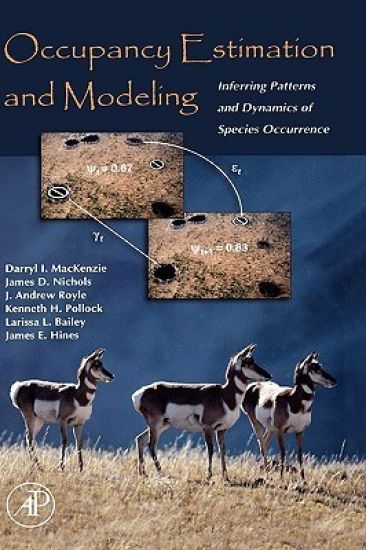
Occupancy Estimation and Modeling is the first book to examine the latest methods in analyzing presence/absence data surveys. Using four classes of models (single-species, single-season; single-species, multiple season; multiple-species, single-season; and multiple-species, multiple-season), the authors discuss the practical sampling situation, present a likelihood-based model enabling direct estimation of the occupancy-related parameters while allowing for imperfect detectability, and make recommendations for designing studies using these models.
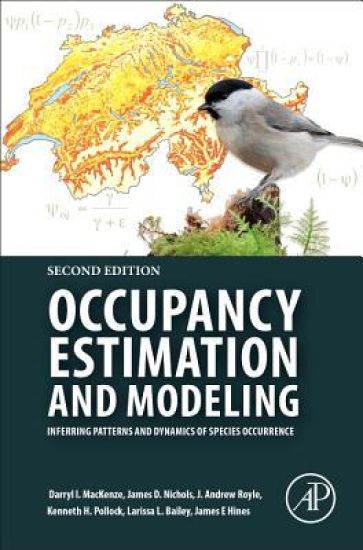
Occupancy Estimation and Modeling: Inferring Patterns and Dynamics of Species Occurrence, Second Edition, provides a synthesis of model-based approaches for analyzing presence-absence data, allowing for imperfect detection. Beginning from the relatively simple case of estimating the proportion of area or sampling units occupied at the time of surveying, the authors describe a wide variety of extensions that have been developed since the early 2000s. This provides an improved insight about species and community ecology, including, detection heterogeneity; correlated detections; spatial autocorrelation; multiple states or classes of occupancy; changes in occupancy over time; species co-occurrence; community-level modeling, and more. Occupancy Estimation and Modeling: Inferring Patterns and Dynamics of Species Occurrence, Second Edition has been greatly expanded and detail is provided regarding the estimation methods and examples of their application are given. Important study design recommendations are also covered to give a well rounded view of modeling.
Celebrated scientists Nicholas Christakis and James Fowler explain the amazing power of social networks and our profound influence on one another's lives. Your colleague's husband's sister can make you fat, even if you don't know her. A happy neighbor has more impact on your happiness than a happy spouse. These startling revelations of how much we truly influence one another are revealed in the studies of Dr. Christakis and Fowler, which have repeatedly made front-page news nationwide. In Connected, the authors explain why emotions are contagious, how health behaviors spread, why the rich get richer, even how we find and choose our partners. Intriguing and entertaining, Connected overturns the notion of the individual and provides a revolutionary paradigm-that social networks influence our ideas, emotions, health, relationships, behavior, politics, and much more. It will change the way we think about every aspect of our lives.
Your colleague's husband's sister can make you fat, even if you don't know her. A happy neighbor has more impact on your happiness than a happy spouse. These startling revelations of how much we truly influence one another are revealed in the studies of Drs. Christakis and Fowler, which have repeatedly made front-page news nationwide. In CONNECTED, the authors explain why emotions are contagious, how health behaviors spread, why the rich get richer, even how we find and choose our partners. Intriguing and entertaining, CONNECTED overturns the notion of the individual and provides a revolutionary paradigm-that social networks influence our ideas, emotions, health, relationships, behavior, politics, and much more. It will change the way we think about every aspect of our lives.
The Spiders of the United States - a collection of the arachnological writings of Nicholas Marcellus Hentz is an unchanged, high-quality reprint of the original edition of 1875. Hansebooks is editor of the literature on different topic areas such as research and science, travel and expeditions, cooking and nutrition, medicine, and other genres. As a publisher we focus on the preservation of historical literature. Many works of historical writers and scientists are available today as antiques only. Hansebooks newly publishes these books and contributes to the preservation of literature which has become rare and historical knowledge for the future.
RAND researchers developed a framework and metrics for examining vulnerabilities, opportunities, and risks to U.S. transmission, storage, and distribution (TS&D) systems through 2030 under a range of uncertainties. They assessed major stresses on and opportunities in three TS&D systems: oil and refined-oil products, electric power, and natural gas. They also considered the resilience that these systems have to short-term shocks and disruptions.
Basic Gas Chromatography, Third Edition provides a brief introduction to GC following the objectives for titles in this series. It should appeal to readers with varying levels of education and emphasizes a practical, applied approach to the subject. : This book provides a quick need-to-know introduction to gas chromatography; still the most widely used instrumental analysis technique, and is intended to assist new users in gaining understanding quickly and as a quick reference for experienced users. The new edition provides updated chapters that reflect changes in technology and methodology, especially sample preparation, detectors and multidimensional chromatography. The book also covers new detectors recently introduced and sample preparation methods that have become much more easily accessible since the previous edition.
It is said that California has the most complete recorded history of any state in the Union. Contemporaries called James H. (Henry) Carson's "sketches" as the most correct eye-witness reports of early California. The U. S. Congress declared war on Mexico in May 1846, and sent four units to occupy and hold Alta California, with a view to its acquisition. Sgt. Carson's Co. F, 3d Reg., Artillery, the "pioneer company," arrived in California in January 1847, after a five-months' voyage around the Horn; the Panama Canal was not yet built. In 1847 Carson served as commissary sergeant at 10th Military District Headquarters. In this capacity he obtained food supplies from the Califor-nios and shared in their social life, making him an important person at Monterey, capital of Alta California. He was one of the few who did not desert his post when gold was discovered in January 1848. In June-July he accompanied R. B. Mason, Col. 1st Dragoons, and Lt. W. T. Sherman (later Gen. Sherman of Civil War fame) on the first official tour of the Northern Gold Mines. In August 1848, on furlough, he discovered Carson Hill, classic gold mining ground of California. In July 1849 he traveled with Gen. B. Riley, Acting Governor of California and Lt. G. H. Derby on a tour of the Southern Mines. Upon discharge from the Army in November 1849, he elected to remain in California, and became a miner. In May 1850 he served as guide to Lt. Derby, Topographical Engineers, on the first official survey of San Joaquin Valley. It was here he contracted a fatal disease. He wrote his "sketches" during this period of inactivity until his death at Stockton on Dec. 12, 1853, aged thirty-two years. Carson was a keen observer, and wrote about California's mineral and agricultural resources; land titles and public domain; establishing a state capital; the first State Legislature. He "saw the elephant." He learned to laugh at himself, and his writings reflected a broad humor as he wrote about his fellowmen
John W. Campbell wrote this for a blurb for this tale when it appeared in Analog: He contracted for a charter trip -- but the man who hired his spacer wasn't quite a man, it turned out -- and he wanted more than service James H. Schmitz was a heck of a writer, and this story -- "The Winds of Time" -- is fascinating stuff. Star ships, aliens from the future, time travel, romance, cannibalism, pet humans, and mute-but-brilliant aliens. . . . and, of course, it's got a hero who solves every problem by being smarter and trickier and better-prepared than we'd ever imagine being. But what would you expect? This story first appeared in John W. Campbell's Analog. Analog heroes did it with their brains. Us? We have to work.