Moving from the slums of Tar Pit Terrace to the bungalows of Bay Tree Crescent, was a social wrench for both Edward Monkjack and his wife Janet. Here the roads were lined with trees rather than dead dogs. It had been the awkward and somewhat embarrassing demise of Edward's in-laws, that provided the means necessary for Janet to propel herself up the social ladder, bypassing a couple of rungs on the way. Edward reluctantly followed along, never quite letting go of his working class, rat catcher roots. The early 1950s saw the emergence of a new middle class. Bank managers, investment brokers and insurance agents made up this new social elite, and they dominated the Crescent. It was unlikely that common working-class people, such as the Monkjack's, would be invited in for cocktails, or indeed offered membership to the golf club. Edward however, knew that where there was brass, there was muck. If they wanted to make life difficult for him, which they did, he would go digging. They all had a secret.
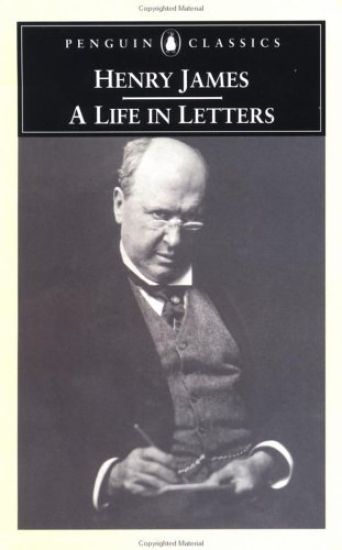
Presents a selection from the author's correspondence with presidents and prime ministers, painters, actresses and bishops, and the writers Robert Louis Stevenson, H G Wells and Edith Wharton. This book features the author's views on his own works, on the literary craft, on sex, politics and friendship.
From his birth in 1807 to his death in 1864 as Sherman's troops marched in triumph toward South Carolina, James Henry Hammond witnessed the rise and fall of the cotton kingdom of the Old South. Planter, politician, and partisan of slavery, Hammond built a career for himself that in its breadth and ambition provides a composite portrait of the civilisation in which he flourished.A long-awaited biography, Drew Gilpin Faust's James Henry Hammond and the Old South reveals the South Carolina planter who was at once characteristic of his age and unique among men of his time. Of humble origins, Hammond set out to conquer his society, to make himself a leader and a spokesman for the Old South. Through marriage he acquired a large plantation and many slaves, and then through shrewd management and progressive farming techniques he soon became one of the wealthiest men in South Carolina. He was elected to the United States House of Representatives and served as governor of his state. A scandal over his personal life forced him to retreat for many years to his plantation, but eventually he returned to public view, winning a seat in the United States Senate that he resigned when South Carolina seceded from the Union.James Henry Hammond's ambition was unquenchable. It consumed his life, directed almost his every move, and ultimately, in its titanic calculation and rigidity, destroyed the man confined within it. Like Faulkner's Thomas Sutpen, Faust suggests, Hammond had a ""design,"" a compulsion to direct every moment of his life toward self-aggrandizement and legitimation. Hammond envisioned himself as the benevolent, paternal, but absolute master of his family and his slaves. But in reality, neither his family, his slaves, nor even his own behavior was completely under his command. Hammond ardently wished to perfect and preserve the southern way of life. But these goals were also beyond his control. At the time of his death it had become clear to him that his world, the world of the Old South, had ended.
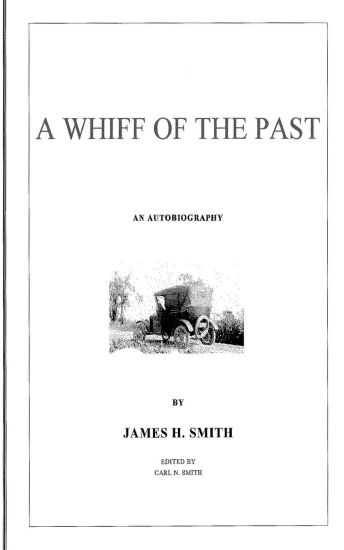
A Whiff of the Past is a memoir of James Henry Smith, written in his own hand in and around 1968. A strong family man, Smith writes in great detail concerning his parents and where they come from. He also describes his courtship with Erma Fischer, who he married, and with whom he fathered six children, including my mother, Nancy, and Carl Smith, who compiled and preserved this manuscript. James Smith lived through extraordinary times and he did extraordinary things. We see history through his eyes and we see people as he saw them. This memoir was typed originally one letter at a time, as James Smith had arthritic hands at the time, was later transcribed by Carl Smith, who preserved it and other documents. It is presented now in an electronic and paperback form in the hope of preserving it for future generations.
This book has been considered by academicians and scholars of great significance and value to literature. This forms a part of the knowledge base for future generations. So that the book is never forgotten we have represented this book in a print format as the same form as it was originally first published. Hence any marks or annotations seen are left intentionally to preserve its true nature.
This book presents a set of original letters exchanged between Rabindranath Tagore, the first Asian to win the Nobel Prize for Literature, and the eminent Irish poet and theosophist, James Henry Cousins. Through these letters, the volume explores their shared ideas of culture, art, aesthetics, and education in India; aspects of Irish Orientalism; Irish literary revival; theosophy, eastern knowledge, and spiritualism; cross-cultural dialogue and friendship; Renaissance in India; anti-imperialism; nationalism; internationalism; and cosmopolitanism. The book reveals a hitherto unexplored facet concerning two leading thinkers in the history of ideas in a transnational context.With its lucid style, extensive annotations and a comprehensive Introduction, this book will be an essential read for scholars and researchers of Indian literature, Bengali literature, comparative literature, South Asian studies, Tagore studies, modern Indian history, philosophy, cultural studies, education, political studies, postcolonial studies, India studies, Irish history, and Irish literature. It will also interest general readers and the Bengali diaspora.
This book presents a set of original letters exchanged between Rabindranath Tagore, the first Asian to win the Nobel Prize for Literature, and the eminent Irish poet and theosophist, James Henry Cousins. Through these letters, the volume explores their shared ideas of culture, art, aesthetics, and education in India; aspects of Irish Orientalism; Irish literary revival; theosophy, eastern knowledge, and spiritualism; cross-cultural dialogue and friendship; Renaissance in India; anti-imperialism; nationalism; internationalism; and cosmopolitanism. The book reveals a hitherto unexplored facet concerning two leading thinkers in the history of ideas in a transnational context.With its lucid style, extensive annotations and a comprehensive Introduction, this book will be an essential read for scholars and researchers of Indian literature, Bengali literature, comparative literature, South Asian studies, Tagore studies, modern Indian history, philosophy, cultural studies, education, political studies, postcolonial studies, India studies, Irish history, and Irish literature. It will also interest general readers and the Bengali diaspora.
This work has been selected by scholars as being culturally important and is part of the knowledge base of civilization as we know it.This work is in the public domain in the United States of America, and possibly other nations. Within the United States, you may freely copy and distribute this work, as no entity (individual or corporate) has a copyright on the body of the work.Scholars believe, and we concur, that this work is important enough to be preserved, reproduced, and made generally available to the public. To ensure a quality reading experience, this work has been proofread and republished using a format that seamlessly blends the original graphical elements with text in an easy-to-read typeface.We appreciate your support of the preservation process, and thank you for being an important part of keeping this knowledge alive and relevant.