Kirjojen hintavertailu. Mukana 12 390 323 kirjaa ja 12 kauppaa.

Kirjahaku

Etsi kirjoja tekijän nimen, kirjan nimen tai ISBN:n perusteella.

1000 tulosta hakusanalla James J. Theros

Tam Gu: Quest of the Four Friends

Tam Gu: Quest of the Four Friends

James J. Theros

Level 10 Martial Arts
2018
nidottu
Tam Gu: Quest of the Four Friends follows Sally, Sam, Billy and Joey as they discover a strange silver box that transports them into a parallel universe where they must complete an ancient quest in order to return home.On their quest, they meet a few strange characters and come face to face with their own fears and doubts.Will the kids ever make it home?
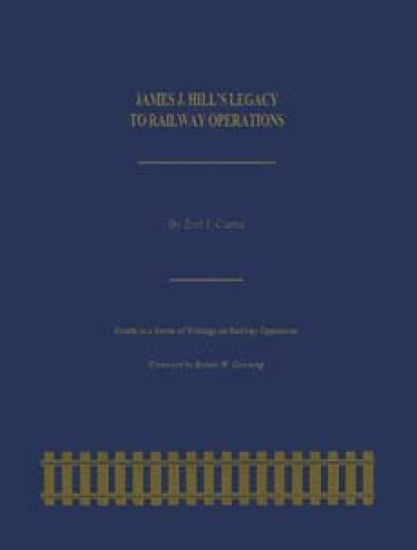
James J. Hill's Legacy to Railway Operations

James J. Hill's Legacy to Railway Operations

Earl J. Currie

Indiana University Press
2015
pokkari
Earl J. Currie examines the standards, methods, and practices for railway operations that James J. Hill developed and applied so successfully for the Great Northern and other railways companies that he controlled. Currie compares the performance and quality of infrastructure of "Hill roads" to competitive railways and their successors to show how Hill's principles continue to form the core practices needed to run an efficient, well-disciplined railway operation even today.
James J. Corbett

James J. Corbett

Armond Fields

McFarland Co Inc
2001
pokkari
When he died in 1933, James J. "Gentleman Jim" Corbett was honored by two distinguished groups of people: the professional boxing public, who celebrated him as America's greatest boxing champion, and the world of popular theater admirers, who revered him as one of Broadway's top vaudeville headliners. Corbett was uniquely instrumental in making boxing and popular theater both justifiable commercial enterprises, to be enjoyed by all classes of people. He became America's first national sports hero and went on to formulate the theater world's star system. This is the first definitive biography of the man who knocked out heavyweight champion John L. Sullivan, and who also knocked out audiences who flocked to see him in vaudeville and silent pictures. The focus herein is on the real man, the influences on his life, and the social and commercial environment within which he functioned. The author reveals that Corbett was a complex, driven, enigmatic man whose dedicated participation in popular entertainment changed American social values and mores, and at the same time reinvented the notion of a national hero.
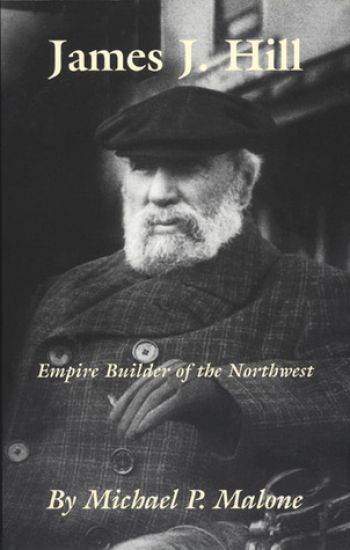
James J. Hill

James J. Hill

Michael P. Malone

University of Oklahoma Press
1997
nidottu
In this volume, Michael P. Malone provides a succinct interpretive biography of James J. Hill, the ""Empire Builder""-so called for his work in developing the region of the United States between the Great Lakes and the Pacific Northwest.Malone explores Hill's complex life and personality, his activities and interests, and recreates both the story of the railroad race to the Pacific and the complex interactions involved in the development of the region.""Michael Malone has written a model. . . .interpretative biography of James J. Hill. He has drawn on the research of others, published and unpublished, as he says, but also on his own knowledge of American economic development in Hill's time as a leading historian of mining and of a state in whose development Hill's railroads were major factors."" -Earl Pomeroy, Professor of History, Retired, University of Oregon and University of California, San Diego
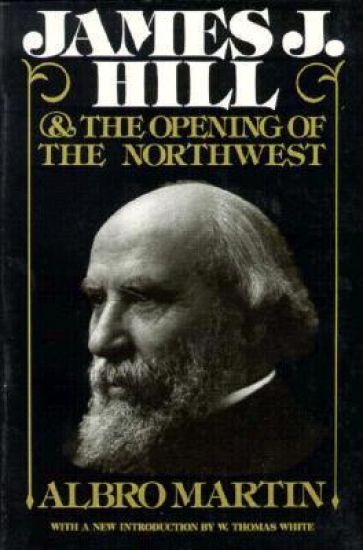
James J.Hill and the Opening of the Northwest

James J.Hill and the Opening of the Northwest

Albro Martin

Minnesota Historical Society Press,U.S.
1991
nidottu
James J. Hill (1838-1916), the Empire Builder, created a vast railroad network across the northwestern United States. In this splendid biography, Martin, the first researcher to have access to Hill's voluminous correspondence, richly portrays a man of many parts: an entrepreneur, a family man, a collector of notable French paintings, a promoter of scientific agriculture, and a booster for the Northwest.
James J. Curto Correspondence, 1948-1969

James J. Curto Correspondence, 1948-1969

Eric P Newman

Hassell Street Press
2021
nidottu
This work has been selected by scholars as being culturally important and is part of the knowledge base of civilization as we know it.This work is in the public domain in the United States of America, and possibly other nations. Within the United States, you may freely copy and distribute this work, as no entity (individual or corporate) has a copyright on the body of the work.Scholars believe, and we concur, that this work is important enough to be preserved, reproduced, and made generally available to the public. To ensure a quality reading experience, this work has been proofread and republished using a format that seamlessly blends the original graphical elements with text in an easy-to-read typeface.We appreciate your support of the preservation process, and thank you for being an important part of keeping this knowledge alive and relevant.
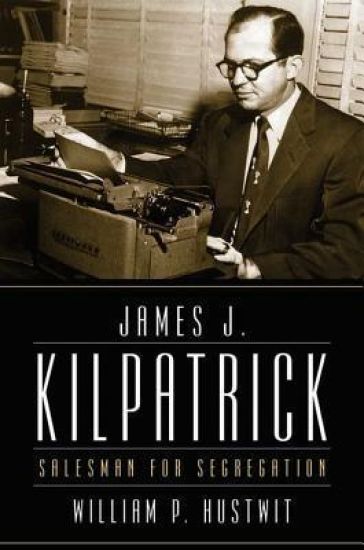
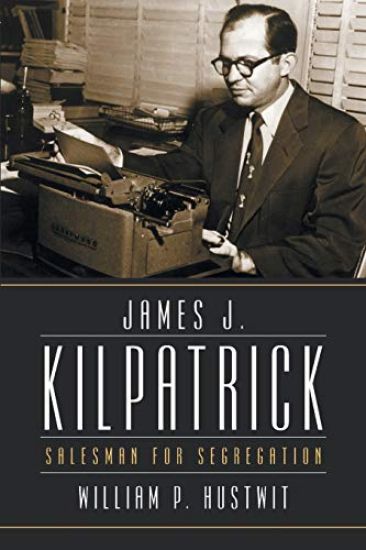
James J. Kilpatrick

James J. Kilpatrick

William P. Hustwit

The University of North Carolina Press
2013
sidottu
James J. Kilpatrick was a nationally known television personality, journalist, and columnist whose conservative voice rang out loudly and widely through the twentieth century. As editor of the Richmond News Leader, writer for the National Review, debater in the ""Point/Counterpoint"" portion of CBS's 60 Minutes, and supporter of conservative political candidates like Barry Goldwater, Kilpatrick had many platforms for his race-based brand of southern conservatism. In James J. Kilpatrick: Salesman for Segregation, William Hustwit delivers a comprehensive study of Kilpatrick's importance to the civil rights era and explores how his protracted resistance to both desegregation and egalitarianism culminated in an enduring form of conservatism that revealed a nation's unease with racial change.Relying on archival sources, including Kilpatrick's personal papers, Hustwit provides an invaluable look at what Gunnar Myrdal called the race problem in the ""white mind"" at the intersection of the postwar conservative and civil rights movements. Growing out of a painful family history and strongly conservative political cultures, Kilpatrick's personal values and self-interested opportunism contributed to America's ongoing struggles with race and reform.
James J. Kilpatrick

James J. Kilpatrick

The University of North Carolina Press
2018
nidottu
James J. Kilpatrick was a nationally known television personality, journalist, and columnist whose conservative voice rang out loudly and widely through the twentieth century. As editor of the Richmond News Leader, writer for the National Review, debater in the ""Point/Counterpoint"" portion of CBS's 60 Minutes, and supporter of conservative political candidates like Barry Goldwater, Kilpatrick had many platforms for his race-based brand of southern conservatism. In James J. Kilpatrick: Salesman for Segregation, William Hustwit delivers a comprehensive study of Kilpatrick's importance to the civil rights era and explores how his protracted resistance to both desegregation and egalitarianism culminated in an enduring form of conservatism that revealed a nation's unease with racial change.Relying on archival sources, including Kilpatrick's personal papers, Hustwit provides an invaluable look at what Gunnar Myrdal called the race problem in the ""white mind"" at the intersection of the postwar conservative and civil rights movements. Growing out of a painful family history and strongly conservative political cultures, Kilpatrick's personal values and self-interested opportunism contributed to America's ongoing struggles with race and reform.
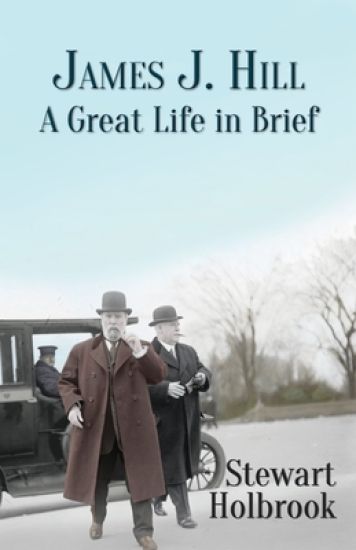
James J. Hill

James J. Hill

Stewart Holbrook

Epicenter Press (WA)
2018
pokkari
James J. Hill, the "Empire Builder," (1838-1916) was a Canadian-American railroad executive with the Great Northern Railway, responsible for building railways across the northern US. Part visionary, part robber baron, part buccaneer, Stewart Holbrook brings his story to life, in brief, as well as the lives of the other movers and shakers in the railway scene of the times.
In the Ring With James J. Jeffries

In the Ring With James J. Jeffries

Adam J. Pollack

ADAM J POLLACK
2009
sidottu
In the Ring With James J. Jeffries is Adam Pollack's 4th book in his heavyweight champion series. It describes in meticulous detail Jeffries' bouts from the 1890s up to 1905 (including round by round accounts as well as pre- and post-fight analysis), his opponents, and his training regimen. It discusses the time's heavyweight scene, including contenders, pre-fight hype and negotiations, political and legal obstacles, and the color line. Chapters also include descriptions and analysis of Corbett-Sharkey II, Fitzsimmons-Ruhlin, Fitz-Sharkey II, and Corbett-McCoy, as well as controversies surrounding several bouts. The book is based on next day local newspaper accounts, comparing and contrasting their descriptions and analysis in order to provide an authentic view of how heavyweight boxing was perceived at the time. The use of local primary sources gives readers a rare opportunity to relive Jeffries' career as if they were reading about it at the time he was fighting. The book also includes Jeffries' career record, over 100 photos, 924 footnotes, and an index.
Addresses by James J. Hill

Addresses by James J. Hill

James Jerome Hill

Hutson Street Press
2025
sidottu
A collection of addresses by James J. Hill, a key figure in the development of the American Northwest. These speeches offer insights into Hill's vision for economic growth, particularly through the expansion of the railroad system. The volume reflects the spirit of the late 19th and early 20th centuries, showcasing the ambition and challenges of building a transcontinental transportation network. "Addresses by James J. Hill" provides valuable primary source material for understanding the history of American business and transportation. This work has been selected by scholars as being culturally important, and is part of the knowledge base of civilization as we know it. This work was reproduced from the original artifact, and remains as true to the original work as possible. Therefore, you will see the original copyright references, library stamps (as most of these works have been housed in our most important libraries around the world), and other notations in the work. This work is in the public domain in the United States of America, and possibly other nations. Within the United States, you may freely copy and distribute this work, as no entity (individual or corporate) has a copyright on the body of the work. As a reproduction of a historical artifact, this work may contain missing or blurred pages, poor pictures, errant marks, etc. Scholars believe, and we concur, that this work is important enough to be preserved, reproduced, and made generally available to the public. We appreciate your support of the preservation process, and thank you for being an important part of keeping this knowledge alive and relevant.
Addresses by James J. Hill

Addresses by James J. Hill

James Jerome Hill

Hutson Street Press
2025
nidottu
A collection of addresses by James J. Hill, a key figure in the development of the American Northwest. These speeches offer insights into Hill's vision for economic growth, particularly through the expansion of the railroad system. The volume reflects the spirit of the late 19th and early 20th centuries, showcasing the ambition and challenges of building a transcontinental transportation network. "Addresses by James J. Hill" provides valuable primary source material for understanding the history of American business and transportation. This work has been selected by scholars as being culturally important, and is part of the knowledge base of civilization as we know it. This work was reproduced from the original artifact, and remains as true to the original work as possible. Therefore, you will see the original copyright references, library stamps (as most of these works have been housed in our most important libraries around the world), and other notations in the work. This work is in the public domain in the United States of America, and possibly other nations. Within the United States, you may freely copy and distribute this work, as no entity (individual or corporate) has a copyright on the body of the work. As a reproduction of a historical artifact, this work may contain missing or blurred pages, poor pictures, errant marks, etc. Scholars believe, and we concur, that this work is important enough to be preserved, reproduced, and made generally available to the public. We appreciate your support of the preservation process, and thank you for being an important part of keeping this knowledge alive and relevant.