Kirjojen hintavertailu. Mukana 11 627 484 kirjaa ja 12 kauppaa.

Kirjahaku

Etsi kirjoja tekijän nimen, kirjan nimen tai ISBN:n perusteella.

1000 tulosta hakusanalla James Joseph Sylvester

James Joseph Sylvester

James Joseph Sylvester

Karen Hunger Parshall

Oxford University Press
2013
nidottu
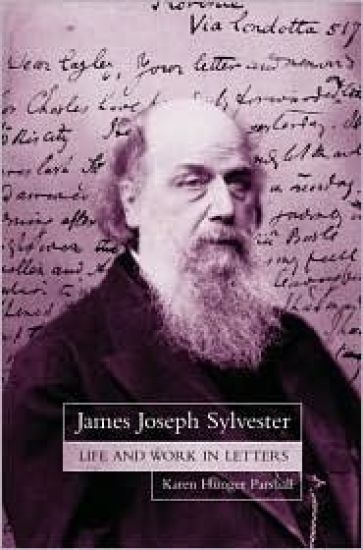
In the folklore of mathematics, James Joseph Sylvester (1814-1897) is the eccentric, hot-tempered, sword-cane-wielding, nineteenth-century British Jew who, together with the taciturn Arthur Cayley, developed a theory and language of invariants that then died spectacularly in the 1890s as a result of David Hilbert's groundbreaking, 'modern' techniques. This, like all folklore, has some grounding in fact but owes much to fiction. The present volume brings together for the first time 140 letters from Sylvester's correspondence in an effort to establish the true picture. It reveals - through the letters as well as through the detailed mathematical and historical commentary accompanying them - Sylvester the friend, man of principle, mathematician, poet, professor, scientific activist, social observer, traveller. It also provides a detailed look at Sylvester's thoughts and thought processes as it shows him acting in both personal and professional spheres over the course of his eighty-two year life. The Sylvester who emerges from this analysis - unlike the Sylvester of the folkloric caricature - offers deep insight into the development of the technical and social structures of mathematics.
James Joseph Sylvester

James Joseph Sylvester

Karen Hunger Parshall

Johns Hopkins University Press
2006
sidottu
Here, in this first biographical study of James Joseph Sylvester, Karen Hunger Parshall makes a signal contribution to the history of mathematics, Victorian history, and the history of science. A brilliant Cambridge student at first denied a degree because of his faith, Sylvester came twice to America to teach mathematics, ultimately becoming one of Daniel Coit Gilman's faculty recruits at Johns Hopkins in 1876 and winning the coveted Savilian Professorship of Geometry at Oxford in 1883. He held professorships of natural philosophy, worked as an actuary, was called to the bar, and taught mathematics to cadets training for engineering and artillery posts in the British Army. During his long, distinguished career he also edited England's Quarterly Journal of Pure and Applied Mathematics and established the American Journal of Mathematics, the first sustained mathematics research journal in the United States. Situating Sylvester's life within the political, religious, mathematical, and social currents of nineteenth-century England, Parshall penetrates the myth of this venerated figure, revealing how he lived, the choices he made and why, how the world in which he lived affected him-and how he affected that world. The story of Sylvester's life sheds light on the evolution of mathematical thought. It also examines the ways in which mathematics may be done and what factors may shape a mathematician's ideas. Parshall explores the development of academic professionalization, nineteenth-century mathematical culture, and the emergence of modern algebra as a mathematical discipline. She highlights the human side of what many view as that most arcane and otherworldly of intellectual endeavors, mathematics, which indeed answers to such diverse factors as religion, ego, and depression.
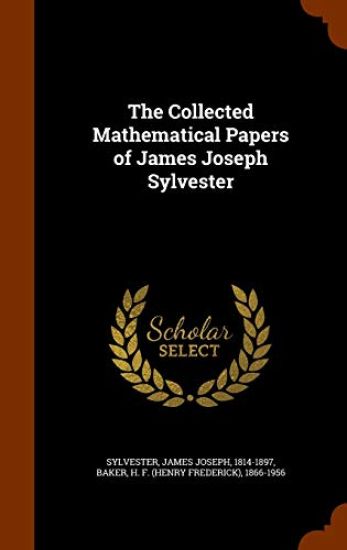
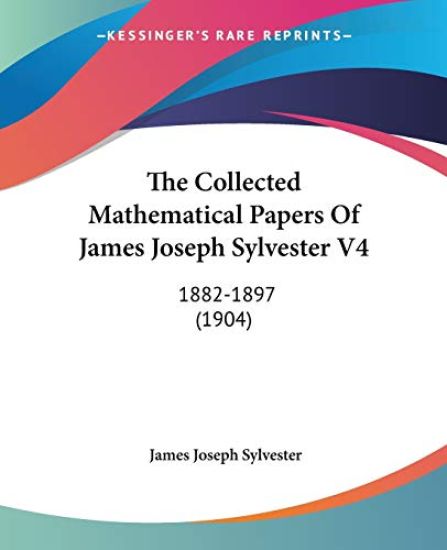
The Collected Mathematical Papers of James Joseph Sylvester: Volume 4, 1882–1897
James Joseph Sylvester (1814–97) was an English mathematician who made key contributions to numerous areas of his field and was also of primary importance in the development of American mathematics, both as inaugural Professor of Mathematics at Johns Hopkins University and founder of the American Journal of Mathematics. Originally published in 1912, this book forms the fourth in four volumes of Sylvester's mathematical papers, covering the period from 1882 to 1897. Together these volumes provide a comprehensive resource that will be of value to anyone with an interest in Sylvester's theories and the history of mathematics.
The Collected Mathematical Papers of James Joseph Sylvester: Volume 1, 1837–1853
James Joseph Sylvester (1814–97) was an English mathematician who made key contributions to numerous areas of his field and was also of primary importance in the development of American mathematics, both as inaugural Professor of Mathematics at Johns Hopkins University and founder of the American Journal of Mathematics. Originally published in 1904, this book forms the first in four volumes of Sylvester's mathematical papers, covering the period from 1837 to 1853. Together these volumes provide a comprehensive resource that will be of value to anyone with an interest in Sylvester's theories and the history of mathematics.
The Collected Mathematical Papers of James Joseph Sylvester: Volume 3, 1870–1883
James Joseph Sylvester (1814–97) was an English mathematician who made key contributions to numerous areas of his field and was also of primary importance in the development of American mathematics, both as inaugural Professor of Mathematics at Johns Hopkins University and founder of the American Journal of Mathematics. Originally published in 1909, this book forms the third in four volumes of Sylvester's mathematical papers, covering the period from 1870 to 1883. Together these volumes provide a comprehensive resource that will be of value to anyone with an interest in Sylvester's theories and the history of mathematics.
The Collected Mathematical Papers of James Joseph Sylvester: Volume 2, 1854–1873
James Joseph Sylvester (1814–97) was an English mathematician who made key contributions to numerous areas of his field and was also of primary importance in the development of American mathematics, both as inaugural Professor of Mathematics at Johns Hopkins University and founder of the American Journal of Mathematics. Originally published in 1908, this book forms the second in four volumes of Sylvester's mathematical papers, covering the period from 1854 to 1873. Together these volumes provide a comprehensive resource that will be of value to anyone with an interest in Sylvester's theories and the history of mathematics.
James Joseph Sylvester: Life and Work in Letters

James Joseph Sylvester: Life and Work in Letters

Karen Hunger Parshall

Clarendon Press
1998
sidottu
In the folklore of mathematics, James Joseph Sylvester (1814-1897) is the eccentric, hot-tempered, sword-cane-wielding, nineteenth-century British Jew who, together with the taciturn Arthur Cayley, developed a theory and language of invariants that then died spectacularly in the 1890s as a result of David Hilbert's groundbreaking, `modern' techniques. This, like all folklore, has some grounding in fact but owes much to fiction. The present volume brings together for the first time 140 letters from Sylvester's correspondence in an effort to establish the true picture. It reveals - through the letters as well as through the detailed mathematical and historical commentary accompanying them - Sylvester the friend, man of principle, mathematician, poet, professor, scientific activist, social observer, traveller. It also provides a detailed look at Sylvester's thoughts and thought processes as it shows him acting in both personal and professional spheres over the course of his eighty-two year life. The Sylvester who emerges from this analysis - unlike the Sylvester of the folkloric caricature - offers deep insight into the development of the technical and social structures of mathematics.