Kirjojen hintavertailu. Mukana 11 699 587 kirjaa ja 12 kauppaa.

Kirjahaku

Etsi kirjoja tekijän nimen, kirjan nimen tai ISBN:n perusteella.

1000 tulosta hakusanalla Jamie C. Kassler

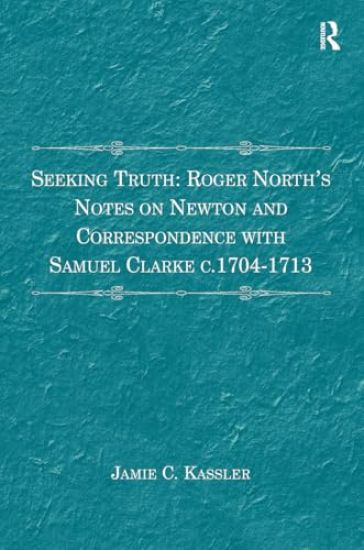
Seeking Truth: Roger North's Notes on Newton and Correspondence with Samuel Clarke c.1704-1713
In the early 1690s Roger North was preparing to remove from London to Rougham, Norfolk, where he planned to continue his search for truth, which for him meant knowledge of nature, including human nature. But this search was interrupted by three events. First, between c.1704 and the early part of 1706, he read Newton’s book on rational (quantitative) mechanics and, afterwards, his book on optics in Clarke’s Latin translation. Second, towards the latter part of 1706, he and Clarke, a Norfolk clergyman, corresponded about matters relating to Newton’s two books, after which Clarke removed to London and the correspondence ceased. Third, in 1712 North received a letter from Clarke, requesting him to read and respond to his new publication on the philosophy of the Godhead. As Kassler details, each of these events presented a number of challenges to North’s values, as well as the way of philosophising he had learned as a student and practitioner of the common law. Because he never made public his responses to the challenges, her book also includes editions of North's notes on reading Newton’s books, as well as what now remains of the 1706 and later correspondence with Clarke. In addition, she presents analyses of some of North’s ’second thoughts’ about the issues raised in the notes and 1706 correspondence and, from an examination of Clarke’s main writings, provides a context for understanding the correspondence relating to the 1712 book.
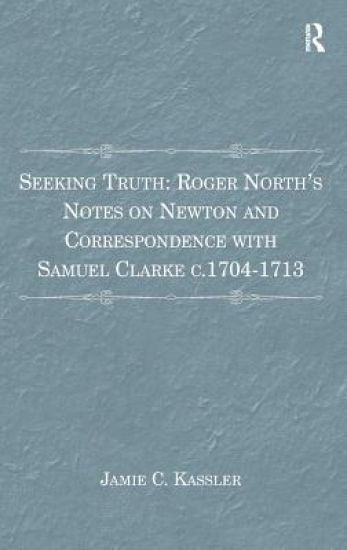
Seeking Truth: Roger North's Notes on Newton and Correspondence with Samuel Clarke c.1704-1713
In the early 1690s Roger North was preparing to remove from London to Rougham, Norfolk, where he planned to continue his search for truth, which for him meant knowledge of nature, including human nature. But this search was interrupted by three events. First, between c.1704 and the early part of 1706, he read Newton’s book on rational (quantitative) mechanics and, afterwards, his book on optics in Clarke’s Latin translation. Second, towards the latter part of 1706, he and Clarke, a Norfolk clergyman, corresponded about matters relating to Newton’s two books, after which Clarke removed to London and the correspondence ceased. Third, in 1712 North received a letter from Clarke, requesting him to read and respond to his new publication on the philosophy of the Godhead. As Kassler details, each of these events presented a number of challenges to North’s values, as well as the way of philosophising he had learned as a student and practitioner of the common law. Because he never made public his responses to the challenges, her book also includes editions of North's notes on reading Newton’s books, as well as what now remains of the 1706 and later correspondence with Clarke. In addition, she presents analyses of some of North’s ’second thoughts’ about the issues raised in the notes and 1706 correspondence and, from an examination of Clarke’s main writings, provides a context for understanding the correspondence relating to the 1712 book.
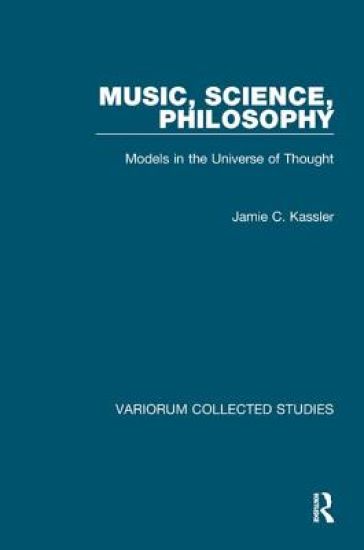
Music, Science, Philosophy

Music, Science, Philosophy

Jamie C. Kassler

Routledge
2019
nidottu
This book stresses the interrelatedness of knowledge by extricating models that cut across traditional disciplinary boundaries. For example, science can find models from the technology and semantic field of music, music can find its models from the technology and semantic field of science, and each domain may be guided by a philosophical or metaphysical principle - thus, the title of the book. But the book itself is structured as a mirror image of its title. Chapters 1-6 provide instances of the role of music in such domains as epistemology and logic, as well as in the early modern sciences of developmental biology, continuum mechanics, anatomy and physiological psychology, whereas Chapters 7-10 provide instances of what some other domains of knowledge have given back to the philosophy and theory of music.
The Beginnings of the Modern Philosophy of Music in England

The Beginnings of the Modern Philosophy of Music in England

Jamie C. Kassler

Ashgate Publishing Limited
2004
sidottu
In 1677 a slim quarto volume was published anonymously as A Philosophical Essay of Musick. Written by Francis North (1637-85), chief justice of the Common Pleas, the Essay is in the form of a legal case argued from an hypothesis. Utilising the pendulum as his hypothesis, North provided a rationale from mechanics for the emerging new musical practice we now call 'tonality'. He also made auditory resonance the connecting link between acoustical events in the external world and the musical meanings the mind makes on the basis of sensory perception. Thus began the modern philosophy of music that culminated with the work of Hermann von Helmholtz. As a step towards understanding this tradition, Jamie C. Kassler examines the 1677 Essay in its historical context. After assessing three seventeenth-century criticisms of it and outlining how one critic developed some implications in the Essay, she summarises the basic principles that have guided the modern philosophy of music from its beginnings in the 1677 Essay. The book includes an annotated edition of the Essay as well as the comments of the three critics.
The Honourable Roger North, 1651–1734

The Honourable Roger North, 1651–1734

Jamie C. Kassler

Ashgate Publishing Limited
2009
sidottu
Roger North is known today as a biographer and writer on music, architecture and estate management. Yet his writings, including thousands of pages still in manuscript, also contain critical reflections about intellectual and social changes taking place in England. This feature is little recognised, because North's reputation as an author was formed between 1740 and 1890, when seven of his manuscripts were published in editions that drastically altered his original texts, and when the reception of these works was influenced by 'Whig' criticism. Although some of North's writings were later edited according to more rigorous standards, many critics still utilise the discredited editions and continue to repeat 'Whig' stereotypes of North. Eschewing such stereotypes, Jamie C. Kassler provides the first interpretation of North's philosophy by retrieving what is consistent in his pattern of thought and by analysing some of his practices and purposes as a writer. By these methods, she shows that North, a common lawyer by profession, combined the moral scepticism of Montaigne with the legal philosophy of Coke, Selden and Hale. The result was a sceptical philosophy that accounts for North's critical reflections on the dogmatism of natural-law doctrine, both in its medieval intellectualist version and in its voluntarist reformulation that began with Grotius and was developed by Hobbes, Pufendorf and Locke. Kassler bases her interpretation on a wide range of North's writings, even those in which one might least expect to find a philosophy. In addition, one of his manuscripts, which is edited here for the first time, includes an exposition of his jurisprudence, as well as his attempt to bring England's past into the legal tradition. These features form part of North's broader argument that language, including the language of law, is the invention of humans and a representation of their changing history and habits, an argument that he later extended to musical 'language' in his more finished essay, 'The Musicall Grammarian' (1728).
Music, Science, Philosophy

Music, Science, Philosophy

Jamie C. Kassler

Variorum
2001
sidottu
This book stresses the interrelatedness of knowledge by extricating models that cut across traditional disciplinary boundaries. For example, science can find models from the technology and semantic field of music, music can find its models from the technology and semantic field of science, and each domain may be guided by a philosophical or metaphysical principle - thus, the title of the book. But the book itself is structured as a mirror image of its title. Chapters 1-6 provide instances of the role of music in such domains as epistemology and logic, as well as in the early modern sciences of developmental biology, continuum mechanics, anatomy and physiological psychology, whereas Chapters 7-10 provide instances of what some other domains of knowledge have given back to the philosophy and theory of music.
The Beginnings of the Modern Philosophy of Music in England
In 1677 a slim quarto volume was published anonymously as A Philosophical Essay of Musick. Written by Francis North (1637-85), chief justice of the Common Pleas, the Essay is in the form of a legal case argued from an hypothesis. Utilising the pendulum as his hypothesis, North provided a rationale from mechanics for the emerging new musical practice we now call 'tonality'. He also made auditory resonance the connecting link between acoustical events in the external world and the musical meanings the mind makes on the basis of sensory perception. Thus began the modern philosophy of music that culminated with the work of Hermann von Helmholtz. As a step towards understanding this tradition, Jamie C. Kassler examines the 1677 Essay in its historical context. After assessing three seventeenth-century criticisms of it and outlining how one critic developed some implications in the Essay, she summarises the basic principles that have guided the modern philosophy of music from its beginnings in the 1677 Essay. The book includes an annotated edition of the Essay as well as the comments of the three critics.
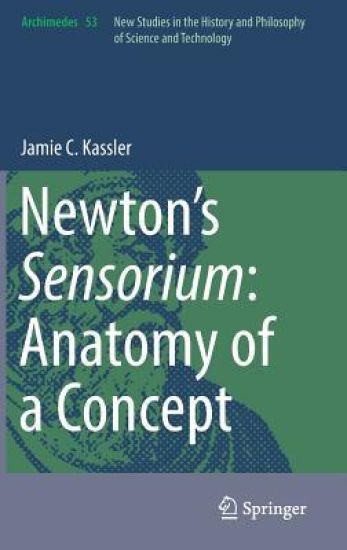
Newton’s Sensorium: Anatomy of a Concept

Newton’s Sensorium: Anatomy of a Concept

Jamie C. Kassler

Springer Nature Switzerland AG
2019
nidottu
These chapters analyze texts from Isaac Newton’s work to shed new light on scientific understanding at his time. Newton used the concept of “sensorium” in writings intended for a public audience, in relation to both humans and God, but even today there is no consensus about the meaning of his term. The literal definition of the Latin term 'sensorium', or its English equivalent 'sensory', is 'thing that feels’ but this is a theoretical construct.The book takes readers on a process of discovery, through inquiry into both Newton’s concept and its underlying model. It begins with the human sensorium. This part of his concept is situated in the context of the aforesaid writings but also in the context of the writings of two of Newton's contemporaries, the physicians William Briggs and Thomas Willis, both of whom were at the forefront of their respective specialties of ophthalmology and neurology. Only once the human sensorium has been explored is it possible to generalize to the unobservable divine sensorium, because Newton's method of reasoning from experience requires that the second part of his concept is last in the order of knowledge. And the reason for this sequence is that his method, the short-hand term for which is 'analogy of nature', proceeds from that which has been observed to be universally true to that which is beyond the limits of observation. Consequently, generalization passes insensibly into reasoning by analogy.Readers will see how certain widespread assumptions can be called into question, such as that Newton was a theological voluntarist for whom the will is superior to the intellect, or that, for Newton, not only the world or universe but also God occupies the whole extent of infinite space. The insights afforded through this book will appeal to scholars of the philosophy of science, human physiology, philosophy of mind and epistemology, among others.
Newton’s Sensorium: Anatomy of a Concept

Newton’s Sensorium: Anatomy of a Concept

Jamie C. Kassler

Springer International Publishing AG
2018
sidottu
These chapters analyze texts from Isaac Newton’s work to shed new light on scientific understanding at his time. Newton used the concept of “sensorium” in writings intended for a public audience, in relation to both humans and God, but even today there is no consensus about the meaning of his term. The literal definition of the Latin term 'sensorium', or its English equivalent 'sensory', is 'thing that feels’ but this is a theoretical construct.The book takes readers on a process of discovery, through inquiry into both Newton’s concept and its underlying model. It begins with the human sensorium. This part of his concept is situated in the context of the aforesaid writings but also in the context of the writings of two of Newton's contemporaries, the physicians William Briggs and Thomas Willis, both of whom were at the forefront of their respective specialties of ophthalmology and neurology. Only once the human sensorium has been explored is it possible to generalize to the unobservable divine sensorium, because Newton's method of reasoning from experience requires that the second part of his concept is last in the order of knowledge. And the reason for this sequence is that his method, the short-hand term for which is 'analogy of nature', proceeds from that which has been observed to be universally true to that which is beyond the limits of observation. Consequently, generalization passes insensibly into reasoning by analogy.Readers will see how certain widespread assumptions can be called into question, such as that Newton was a theological voluntarist for whom the will is superior to the intellect, or that, for Newton, not only the world or universe but also God occupies the whole extent of infinite space. The insights afforded through this book will appeal to scholars of the philosophy of science, human physiology, philosophy of mind and epistemology, among others.
10-Minute Life Lessons for Kids: 52 Fun and Simple Games and Activities to Teach Your Child Honesty, Trust, Love, and Other Important Values
52 playful and easy to understand activites to hhelp parents teach children moral lessons that they won't forget A child says, "I hear and I forget, I see and I remember, I do and I understand." 10-Minute Life Lessons for Kids is a book about seeing and doing--a book that gives parents the ability to teach the powerful principles of honesty, trust, generosity, love, and other values. Children will discover the objectives themselves as they actively participate in fun games and activities. The games can be done in any order, with very little planning and with very few supplies--just common objects most people have around the house like toothpicks, string, pennies, or an apple. Some can be done while riding in the car, and others can be expanded to fill a whole evening with family fun. The activities in 10-Minute Life Lessons for Kids will not only create cozy and enjoyable moments of family togetherness, they will have a lasting impact on your growing child.
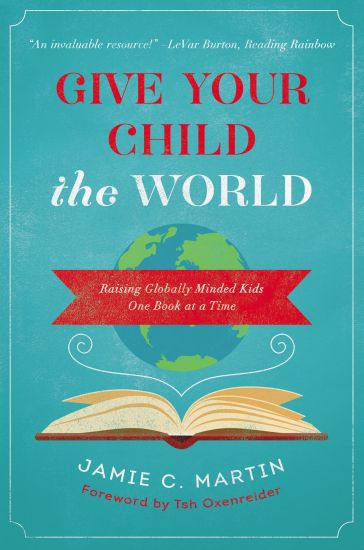
Give Your Child the World

Give Your Child the World

Jamie C. Martin; Tsh Oxenreider

Zondervan
2016
nidottu
Young children live with awe and wonder as their daily companions. But as they grow, worries often crowd out wonder. Knowing this, how can parents strengthen their kids' love for the world so it sticks around for the long haul?Thankfully, parents have at their fingertips a miracle vaccine--one that can boost their kids' immunity to the world's distractions. Well-chosen stories connect us with others, even those on the other side of the globe. Build your kids' lives on a story-solid foundation and you'll give them armor to shield themselves from the world’s cynicism. You'll give them confidence to persevere in the face of life's conflicts. You'll give them a reservoir of compassion that spills over into a lifetime of love in action.Give Your Child the World features inspiring stories, practical suggestions, and carefully curated reading lists of the best children's literature for each area of the globe. Reading lists are organized by region, country, and age range (ages 4-12). Each listing includes a brief description of the book, its themes, and any content of which parents should be aware.Parents can introduce their children to the world from the comfort of home by simply opening a book together. Give Your Child the World is poised to become a bestselling family reading treasury that promotes literacy, develops a global perspective, and strengthens family bonds while increasing faith and compassion.
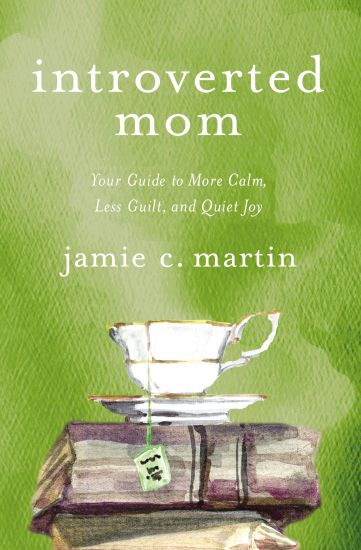
Introverted Mom

Introverted Mom

Jamie C. Martin

Zondervan
2019
nidottu
Your personality is a gift, not a liability. This book helps you uncover and embrace the hope, laughter, and joy of using your unique gifts to parent your children.Life as a mom is LOUD, but you long for quiet.When the volume of family life clashes with your personality, frustration, guilt, and overwhelm naturally result. In Introverted Mom, author Jamie C. Martin lifts these burdens from your shoulders, reminding you that your steady strength is exactly what your family needs in this chaotic world.Jamie shares vulnerable stories from her own life as well as thoughts from other introverted mothers, letting you know you're not alone. Her practical suggestions and creative inspiration are enhanced with quotes and insights from four beloved writers--Louisa May Alcott, Jane Austen, L. M. Montgomery, and Laura Ingalls Wilder. Together, Jamie and this band of fellow introverts share their wisdom on . . .Believing that you're enoughSelf-acceptance that leads to freedomNavigating heartache and disappointmentStretching out of your comfort zoneConnecting with God as an introvertCultivating calm wherever you areDefining for yourself what really mattersWhether you've just realized you're an introvert, or if you've known it all along, this book is for you. It's time to honor who you are and savor life as an introverted mom.*Note: Written from a Christian perspective
Passion and Prose

Passion and Prose

Jamie C Bazen

Jamie Carys Bazen
2021
pokkari
Elaine McDermitt, Laney to her friends, is always writing. Even at work, which gets her in trouble when the gorgeous co-worker she's been basing her main character on finally falls for her. Garrett Parker takes a chance on a relationship with Laney despite his troubled past.When romance blossoms between them, will words get in the way?
Maddie's Tee Time

Maddie's Tee Time

Jamie C Wolfe

Jamie Wolfe
2020
sidottu
Maddie loves spending time with her Dad, but new experiences can be scary and frustrating. When Dad takes her to the golf course for the very first time, Maddie learns an important lesson about trying new things.