Kirjojen hintavertailu. Mukana 11 342 296 kirjaa ja 12 kauppaa.

Kirjahaku

Etsi kirjoja tekijän nimen, kirjan nimen tai ISBN:n perusteella.

1000 tulosta hakusanalla Jan H. Landro

Frå Nora til Karl Ove: og 84 andre personar i norsk litteratur
Gullrekkja i norsk litteratur! Denne boka er ei skattkiste for alle som er glade i god litteratur. Kulturjournalist Jan H. Landro portretterer og skildrar korleis 86 oppdikta personar tenkjer og handlar i nokre av dei beste norske bøkene gjennom tidene, frå den norrøne sagalitteraturen og opp til dagens «verkelegheitsromanar». Her får du møte sagaens Gunnar frå Lidarende, Askeladden, Wergelands Stella og Petter Dass. Du kan lese om opprørske Inger-Johanna i Familien på Gilje, Tusten hos Tarjei Vesaas og den gåtefulle «Lillelord» hos Johan Borgen. Ikkje minst får du vite meir om personar frå vår tids litteratur, som incest-offeret Bergljot hos Vigdis Hjorth, kemneren Bjørn Hansen hos Solstad og den heilt gjennomsnittlege Harry Lund i Gryttens Bikubesong. Frå Nora til Karl Ove er ei engasjerande og underhaldande bok, som opnar opp den norske litterære gullrekkja for gamle og nye lesarar.
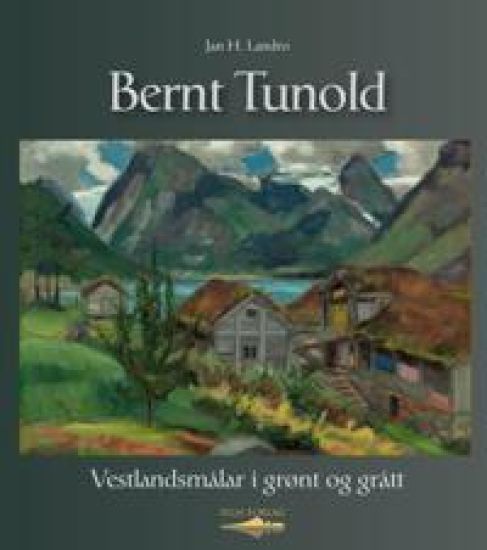
Bernt Tunold; vestlandsmålar i grønt og grått
Bernt Tunold (1877-1946) var ein av våre fremste målarar på 1900-talet - og vestlandsmålaren framfor nokon. Ingen skildra det grøne Vestlandet som Tunold. I unge år hamna han i skuggen av vennen Nikolai Astrup, men gjekk seinare sine eigne vegar. Mykje av livet sleit han med eigne demonar og ytre vilkår som gjorde kunstnarlivet vondt og vanskeleg. Bernt Tunold var frå Selje i Nordfjord, budde i periodar i Sigerfjord i Vesterålen og Hyen i Nordfjord, men hadde størstedelen av livet heimen sin i Bergen. Motiva sine, helst landskap og gamle tun, fann han over heile Vestlandet. Frå midten av trettiåra fekk stilleben og interiør ein sentral plass i kunsten hans. Forfattaren har reist i Tunold sine fotspor til dei mange stadene han vitja med staffeliet og paletten. Han har snakka med folk som kjende Tunold, sett Tunold-bilete på mange vegger, og har saumfare det som finst av skriftlege kjelder. Den personen som stig fram er ein heroisk kunstnar, som aldri gav opp å måle, og som endå i vanskelege tider skapte noko av sin finaste kunst. Boka inneheld kring 375 illustrasjonar, av dette over 200 måleri og teikningar, og ei verkliste med kring 750 måleri og teikningar av Bernt Tunold.
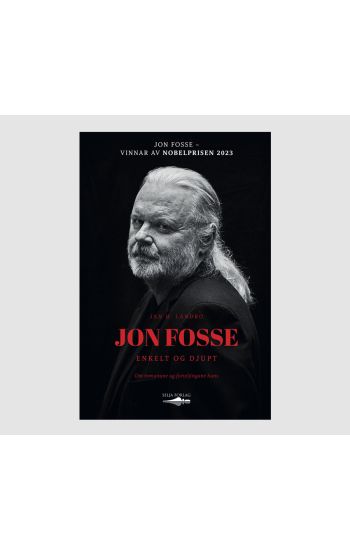
Jon Fosse - enkelt og djupt

Jon Fosse - enkelt og djupt

Jan H. Landro

Selja Forlag
2022
sidottu
JON FOSSE - Enkelt og djupt tek lesaren med inn i det særs fasinerande universet til ein av våre største nolevande forfattarar. For første gong vert alle romanane og dei lengre forteljingane hans presenterte og analyserte, kronologisk ordna frå debutromanen Raudt, svart til og med romansyklusen Septologien. Landro deler kunnskapen sin om korleis kvar enkelt bok er blitt til og knyter dette til andre deler av forfattarskapen. Dramatikken og lyrikken til Fosse blir trekt inn i analysane for å kaste lys over samanhengar og utviklingstrekk. I eit omfattande intervju gir Jon Fosse eit interessant innblikk i skrivinga si. Der fortel han korleis han arbeider og kva som ligg bak forfattarskapen. Han kommenterer sjølv bøkene som er analyserte, og går dels i dialog med analysane.
Skansemyren

Skansemyren

Jan H. Landro

Bodoni
2024
sidottu
For mange er stedsnavnet Skansemyren identisk med idrett. Titusener av bergensere, fra unge år til langt opp i voksen alder, har gjennom årene drevet med idrettsøvelser der. Først på «legeplassen» som anlegget ble kalt ved ferdigstillelsen i 1896, fra 29. juni 1924 på idrettsplassen slik man kjenner den i dag. Men Skansemyren er så mye mer enn idrett og fysisk fostring. Området på fjellhyllen under Fløyen har en lang historie. I 1814 solgte Bergen kommune denne delen av «Tagemarken» til to familier som ryddet jorden og ble Skansemyrens urinnvånere. Jordbruk ble drevet på Nordre Skansemyr frem til 1949. På 1950-tallet var Skansemyren, slik vi kjenner den i dag, ferdig utbygget. I Brannfunksjonærenes nybygg krydde det av barn. Flere av dem forteller minner fra en lykkelig barndom. Visste du at • I 1868 ble det oppført en reperbane på Skansemyren • Lekeplassen hadde i åpningsåret 1896 6000 besøkende • Barn under 10 år hadde kun adgang i følge med voksne. • I mai 1914 landet den franske flypioneren Pierre Chanteloup med sin «flyvemaskine» på Skansemyren etter «en lek med døden» for å bruke hans egne ord. • Sportsklubben Trane arrangerte sankthansaften 1949 et sommerhopprenn i Skansemyrbakken. 10 363 betalende tilskuere bivånte begivenheten • I juli 1962 arrangerte Jehovas Vitner landsstevne på idrettsplassen. 2602 personer deltok med «modige forkynnere» som tema. 47 personer lot seg der døpe i vann.
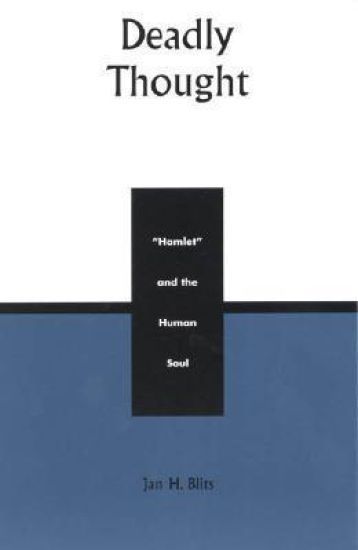
Deadly Thought

Deadly Thought

Jan H. Blits

Lexington Books
2001
nidottu
The human soul is for pre-modern philosophers the cause of both thinking and life. This double aspect of the soul, which makes man a rational animal, expresses itself above all in human action. Deadly Thought: "Hamlet" and the Human Soul traces Hamlet's famous inability to act to his inability to hold together these twin aspects of the soul. Combining careful attention to detail and interpretive breadth, noted scholar Jan H. Blits deftly illustrates how Hamlet collapses life into thought, and moral action into stage acting, and ultimately comes to see his own life as a stage play. Hamlet, the book demonstrates, epitomizes the intellectualism of the Renaissance and the modern age it began, and so becomes tragedy's first self-conscious protagonist, signaling the end of ancient tragedy. Erudite, innovative, and lively, Deadly Thought is a ground-breaking contribution that will appeal to Shakespeare scholars, political theorists, historians of philosophy, literary theorists and anyone interested in a truly fresh interpretation of this classic work.
The Soul of Athens

The Soul of Athens

Jan H. Blits

Lexington Books
2003
sidottu
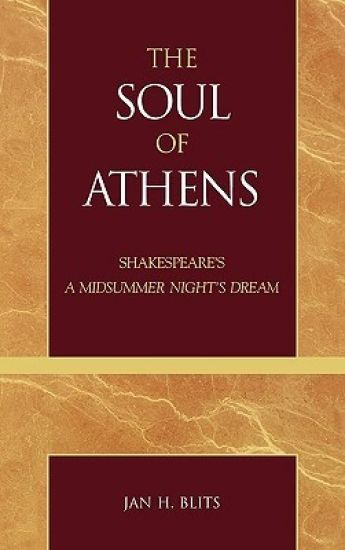
The Soul of Athens: Shakespeare's 'A Midsummer Night's Dream' studies Shakespeare's portrayal of the founding of Athens through a close reading of one of the Bard's most memorable comedies. Through a painstakingly close reading of the play, author Jan H. Blits shows how Shakespeare's portrayal of this legendary first democracy illuminates the natural doubleness of the human soul by emphasizing the lure of both beauty and wisdom.A Midsummer Night's Dream is thus Shakespeare's examination not only of a particular city at a particular time, but of the essential duality of the human soul. Coupling careful attention to detail with interpretive breadth, The Soul of Athens examines the nature of love, the natural doubleness of human thinking and the ambiguous relation of image and reality, as well as patriarchy and democracy, and heroic and moral virtue.
The Soul of Athens

The Soul of Athens

Jan H. Blits

Lexington Books
2003
nidottu
The Soul of Athens: Shakespeare's "A Midsummer Night's Dream" studies Shakespeare's portrayal of the founding of Athens through a close reading of one of the Bard's most memorable comedies. Through a painstakingly close reading of the play, author Jan H. Blits shows how Shakespeare's portrayal of this legendary first democracy illuminates the natural doubleness of the human soul by emphasizing the lure of both beauty and wisdom.A Midsummer Night's Dream is thus Shakespeare's examination not only of a particular city at a particular time, but of the essential duality of the human soul. Coupling careful attention to detail with interpretive breadth, The Soul of Athens examines the nature of love, the natural doubleness of human thinking and the ambiguous relation of image and reality, as well as patriarchy and democracy, and heroic and moral virtue.
Spirit, Soul, and City

Spirit, Soul, and City

Jan H. Blits

Lexington Books
2006
nidottu
Spirit, Soul, and City offers a new reading of Coriolanus, Shakespeare's most political play and the last of his great tragedies. Portraying the founding of the Roman republic and the life and soul of its legendary warrior, Coriolanus, the play brings to light not only the hidden working of Rome's mixed regime but the inherent tragic tensions in the soul's spirited tendency to strive to go beyond itself in order to be true to itself. Distinguished scholar Jan H. Blits provides a fresh interpretation of this rich, complex, and often perplexing play, combining meticulous detail and insightful breadth. Proceeding line-by-line through the play, this book reaches its conclusions by closely examining Shakespeare's text—his plot, characters, language, structure, allusions, puzzles, and other devices.
New Heaven, New Earth

New Heaven, New Earth

Jan H. Blits

Lexington Books
2009
sidottu
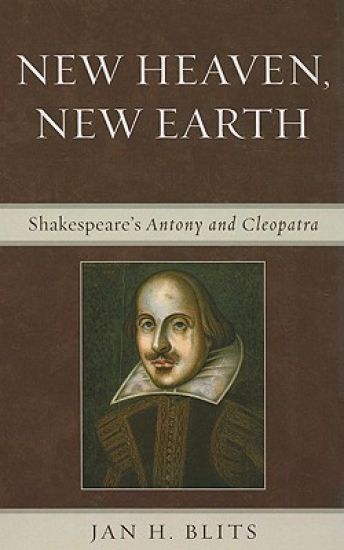
Patterned after his previous books on Shakespeare's plays, Jan H. Blits's New Heaven, New Earth is a scene-by-scene, line-by-line philosophical study of Antony and Cleopatra. Combining close attention to detail with interpretive breadth, Blits approaches Shakespeare as a first-rank thinker who, master of his own thought and writing, produced plays and poetry with an infinitely conscious art, like any commonly recognized philosophical poet. Treating the play as a fully coherent whole, Blits shows that Antony and Cleopatra, as much a history play as a love story, depicts the transition from the pagan to the Christian world—from the aftermath of the collapse of the Roman Republic and the decline of the pagan gods to the emergence of the Roman Empire and the conditions giving rise to Christianity. Instead of being organized thematically, New Heaven, New Earth follows the play from beginning to end, closely examining Shakespeare's text on its own terms and not on the terms of modern literary theory. Using this approach, Blits draws significant and insightful conclusions that will satisfy the interests of scholars of politics, literature, and history alike.
New Heaven, New Earth

New Heaven, New Earth

Jan H. Blits

Lexington Books
2010
nidottu
Patterned after his previous books on Shakespeare's plays, Jan H. Blits's New Heaven, New Earth is a scene-by-scene, line-by-line philosophical study of Antony and Cleopatra. Combining close attention to detail with interpretive breadth, Blits approaches Shakespeare as a first-rank thinker who, master of his own thought and writing, produced plays and poetry with an infinitely conscious art, like any commonly recognized philosophical poet. Treating the play as a fully coherent whole, Blits shows that Antony and Cleopatra, as much a history play as a love story, depicts the transition from the pagan to the Christian world_from the aftermath of the collapse of the Roman Republic and the decline of the pagan gods to the emergence of the Roman Empire and the conditions giving rise to Christianity. Instead of being organized thematically, New Heaven, New Earth follows the play from beginning to end, closely examining Shakespeare's text on its own terms and not on the terms of modern literary theory. Using this approach, Blits draws significant and insightful conclusions that will satisfy the interests of scholars of politics, literature, and history alike.
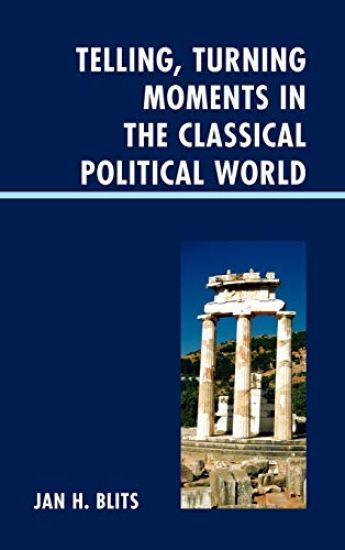
Telling, Turning Moments in the Classical Political World
Turning, Telling Moments in the Classical Political World examines developments in the classical political world which are both turning and telling moments. All the moments—from Theseus's founding of Athens to Augustus's establishment of the Principate—possess the double character of being turning points and revealing fundamental aspects of the ancient political world. While most books on ancient history are chiefly concerned with questions of literary sources and historical accuracy, this book deals with the significance of the facts and reports themselves. Blits treats the ancient histories as works of reflection rather than works of research. Instead of focusing on whether, or how, the ancient historians meet the professional standards of present-day historiography, Blits reveals the way they themselves understand-and intend us to understand-the ancient world.
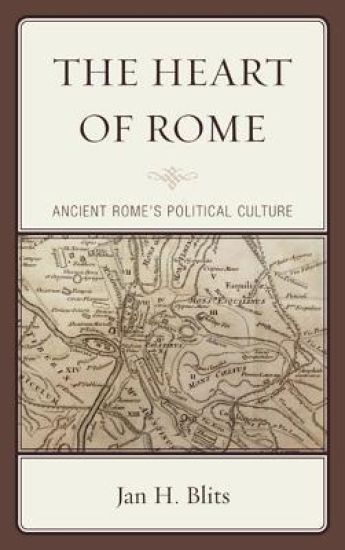
The Heart of Rome

The Heart of Rome

Jan H. Blits

Lexington Books
2013
sidottu
The essays in this book examine the political activities and institutions of pre-Imperial Rome in conjunction with the habits of the hearts and the minds of the Romans. Relying on the writings of ancient authors, the essays analyze significant political developments and events. They attempt to draw out the meaning of what the authors say and impose no theory on the ancient writings. Nor do they pursue the methodological techniques of contemporary historiography. While avoiding such common present-day anachronisms, they take their guidance directly from the ancient historians themselves and examine their understanding of Rome’s political history and culture. Harking back to the ancient view that a political culture or regime is both a city’s form of government and its way of life, the essays, trying to be true to the full character of Roman political life, seek to understand the political activities and the souls of the Romans, and to understand each in the light of the other.
The End of the Ancient Republic

The End of the Ancient Republic

Jan H. Blits

Rowman Littlefield
1993
nidottu
While recent criticism of Shakespeare's Julius Caesar has stressed the corruption of both the common people and the Republic's enemies within the patrician class, this book argues that at the core of the play lies the less obvious but more important corruption of the regime's leading defenders, particularly Brutus.
The Insufficiency of Virtue

The Insufficiency of Virtue

Jan H. Blits

Rowman Littlefield
1996
nidottu
The first scene-by-scene philosophical study of any Shakespeare play, this book demonstrates why Shakespeare's poetic writings still arouse and sustain serious inquiry and reflection. Using a combination of philosophical rigor, political insight, and textual thoroughness, Jan H. Blits delineates the competing forms of virtue within Macbeth—the courageous public virtue of warriors like Macbeth and the internal Christian virtue evoked by Duncan. This new interpretation of Macbeth explains crucial paradoxes overlooked by previous scholars and will serve as a model for future scholarship in the field.
Molecular Modeling Basics

Molecular Modeling Basics

Jan H. Jensen

CRC Press
2017
sidottu
Molecular modeling is becoming an increasingly important part of chemical research and education as computers become faster and programs become easier to use. The results, however, have not become easier to understand. Addressing the need for a "workshop-oriented" book, Molecular Modeling Basics provides the fundamental theory needed to understand not only what molecular modeling programs do, but also the gist of research papers that describe molecular modeling results. Written in a succinct manner using informal language, the book presents concise coverage of key concepts suitable for novices to the field. It begins by examining the potential energy surface (PES), which provides the connection between experimental data and molecular modeling. It explores ways to calculate energy by molecular and quantum mechanics. It describes molecular properties and the condensed phase, and shows how to extract and interpret information from a program output. The author uses hands-on exercises to illustrate concepts and he supplements the text with a blog containing animated tutorials and interactive figures. Drawn from the author‘s own lecture notes from a class he taught for many years at the University of Iowa, this volume introduces topics in such a way that beginners can clearly comprehend molecular modeling results. A perfect supplement to a molecular modeling textbook, the book offers students the "hands-on" practice they need to grasp sophisticated concepts. In addition to his blog, the author maintains a website describing his research and one detailing his seminars.
Where Were You?

Where Were You?

Jan H. van Bemmel

Lulu.com
2015
nidottu
The author is completely perplexed by the wonders in this world and far beyond. At the same time he realizes that this impressive beauty often goes together with incredible human and animal suffering and misery. His reflections are summarized in four different chapters: on Nature, the Universe, Intelligence, and the ultimate question: Why we are here. Of course, his answers are very personal and far from complete. Perhaps, more questions are asked than answers can ever be given. The material for his reflections was borrowed from the scientific literature, his own research, mainly in the biomedical field, his great interest in astronomy and cosmology, and from books of wisdom. The main source for his reflections are the different writings of prophets, historians and poets in the Bible.
Collisions

Collisions

Jan H. van Bemmel

Lulu.com
2012
nidottu
In the waning years of the Soviet Union scientific research falls far behind. Vasili, head of KGB, tries to gain Western knowledge by espionage. He persuades Dmitri, a physicist, to defect to the USA. Dmitri obtains a position at NSF and later at FermiLab, while remaining entangled in the KGB web. After the disintegration of the Soviet Union Vasili becomes very powerful and wants to strengthen science in the new Russia. He asks Dmitri to return home, because Russian knowledge needs upgrading. Dmitri is appointed director of IHEP in Moscow. He is not successful, because the best Russian scientists have emigrated to the West. Blackmail and intimidation pursue him. To escape Vasili's influence, Dmitri accepts a job at CERN in Geneva, where the largest particle accelerator in the world, the LHC, is under construction. Vasili now wants revenge. When he does not succeed in obtaining Western knowledge through espionage and cybercrime he wants to ruin Dmitri and to obstruct research at CERN.
Molecular Modeling Basics

Molecular Modeling Basics

Jan H. Jensen

CRC Press Inc
2010
nidottu
Molecular modeling is becoming an increasingly important part of chemical research and education as computers become faster and programs become easier to use. The results, however, have not become easier to understand. Addressing the need for a "workshop-oriented" book, Molecular Modeling Basics provides the fundamental theory needed to understand not only what molecular modeling programs do, but also the gist of research papers that describe molecular modeling results. Written in a succinct manner using informal language, the book presents concise coverage of key concepts suitable for novices to the field. It begins by examining the potential energy surface (PES), which provides the connection between experimental data and molecular modeling. It explores ways to calculate energy by molecular and quantum mechanics. It describes molecular properties and the condensed phase, and shows how to extract and interpret information from a program output. The author uses hands-on exercises to illustrate concepts and he supplements the text with a blog containing animated tutorials and interactive figures. Drawn from the author’s own lecture notes from a class he taught for many years at the University of Iowa, this volume introduces topics in such a way that beginners can clearly comprehend molecular modeling results. A perfect supplement to a molecular modeling textbook, the book offers students the "hands-on" practice they need to grasp sophisticated concepts. In addition to his blog, the author maintains a website describing his research and one detailing his seminars.