A rigorous but nontechnical treatment of major topics in urban economics.Lectures on Urban Economics offers a rigorous but nontechnical treatment of major topics in urban economics. To make the book accessible to a broad range of readers, the analysis is diagrammatic rather than mathematical. Although nontechnical, the book relies on rigorous economic reasoning. In contrast to the cursory theoretical development often found in other textbooks, Lectures on Urban Economics offers thorough and exhaustive treatments of models relevant to each topic, with the goal of revealing the logic of economic reasoning while also teaching urban economics.Topics covered include reasons for the existence of cities, urban spatial structure, urban sprawl and land-use controls, freeway congestion, housing demand and tenure choice, housing policies, local public goods and services, pollution, crime, and quality of life. Footnotes throughout the book point to relevant exercises, which appear at the back of the book. These 22 extended exercises (containing 125 individual parts) develop numerical examples based on the models analyzed in the chapters. Lectures on Urban Economics is suitable for undergraduate use, as background reading for graduate students, or as a professional reference for economists and scholars interested in the urban economics perspective.
This hard-hitting critique of US policy toward Latin America includes a historical sketch of US relations with individual countries. Black argues persuasively that the US has been the major oppponent of needed reforms in Latin American countries and the major proponent of predatory military establishments. The unwavering US goal, she believes, has been preservation of the established US empire in Latin America, but she cites differing strategies to attain this goal used by conservatives (President Reagan) and liberals (President Carter). She sees a weakening of US hegemony, however, as pressures for reform become irresistable. . . . This book should be read by all who view US policy toward Latin America as benevolent. Choice
Situated in a Mediterranean landscape, the Maeght Foundation is a unique Modernist museum, product of an extraordinary collaboration between the architect, José Luis Sert, and the artists whose work was to be displayed there. The architecture, garden design and art offer a rare opportunity to see work in settings conceived in active collaboration with the artists themselves. By focusing on the relationship between this art foundation and its Arcadian setting, including Joan Miró's labyrinth, George Braque's pool, Tal-Coat's mosaic wall and Giacometti's terrace, Jan K. Birksted demonstrates how the building articulates many of the ideas that preoccupied this group of artists during the culminating years of their lives. The study pays special attention to the ways in which architecture can shape the experience of time, and addresses the Modernist desire for wilderness and its problematic roots in the classical Mediterranean ideal. In showing how the design of the Maeght Foundation is a Modernist representation of Mediterranean culture, the author has developed an interpretation of architecture that accommodates not only the architect's handling of material or function, but shows as well how it can be the embodiment of a particular vision of space and time.
Mende is a diocese in south-central France where, in the 1260s, scribes of Bishop Odilon de Mercoeur created an extensive court book or register of litigated cases. Their intention was to develop an archive for the use of the chancery as well as to preserve the causae of the episcopal court. These records would later be used by Guillaume Durand the Younger to construct a version of the past which verified episcopal secular lordship and sovereignty in response to mounting intrusion by the king of France. For all of its importance to the history of religion in France, the court book of Mende has received little attention by historians and medieval scholars. In this study, Jan K. Bulman examines the interrelationships between the written records of the ecclesiastical court, the preservation of historical memory, and the defense of episcopal seigneurial rights. Bulman shows how the bishops of Mende followed a singular strategy to defend against loss of autonomy, one that was unique in its reliance on archival records, ancient charters, and narrative hagiography. Richly presented and comprehensively researched, this will be an indispensable work for scholars of religion and the history of medieval France.
Superb history by a renowned expert in the field of German militaria. This classic volume is now available in English and covers all aspects of the pre-1918 German uniform. Over 500 photos, many in color, show uniforms of the Infantry, Dragoons, Guards, Hussars, Light Cavalry and Cadets. Also, a special section in color on the personal uniforms of Kaiser Wilhelm II.
Situated in a Mediterranean landscape, the Maeght Foundation is a unique Modernist museum, product of an extraordinary collaboration between the architect, José Luis Sert, and the artists whose work was to be displayed there. The architecture, garden design and art offer a rare opportunity to see work in settings conceived in active collaboration with the artists themselves. By focusing on the relationship between this art foundation and its Arcadian setting, including Joan Miró's labyrinth, George Braque's pool, Tal-Coat's mosaic wall and Giacometti's terrace, Jan K. Birksted demonstrates how the building articulates many of the ideas that preoccupied this group of artists during the culminating years of their lives. The study pays special attention to the ways in which architecture can shape the experience of time, and addresses the Modernist desire for wilderness and its problematic roots in the classical Mediterranean ideal. In showing how the design of the Maeght Foundation is a Modernist representation of Mediterranean culture, the author has developed an interpretation of architecture that accommodates not only the architect's handling of material or function, but shows as well how it can be the embodiment of a particular vision of space and time.
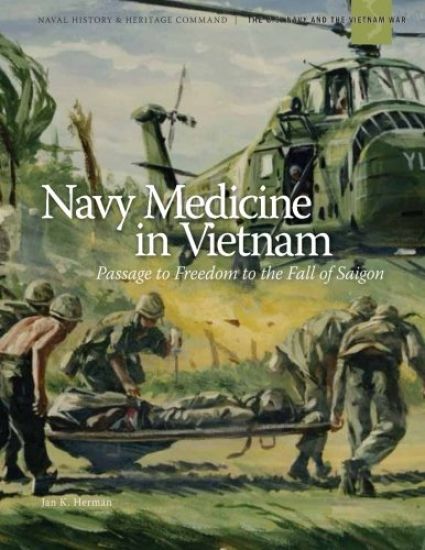
The book chronicles the Navy Medical Department's participation in Vietnam, beginning with the Navy's rescue of the French survivors of the Battle of Dien Bien Phu in 1954 and ending with the Navy's rescue of Vietnamese refugees fleeing the fall of South Vietnam in 1975. When American involvement reached its peak in 1968, the 750-bed Naval Support Activity Hospital Danang (NSAH) was in full operation, and two hospital ships--the USS Repose and the USS Sanctuary--cruised offshore. Whether the situation called for saving the lives of injured sailors aboard a burning aircraft carrier or treating a critically wounded Marine for shock in the rubble-strewn streets of Hue, Navy medical personnel were in Vietnam from the beginning of American involvement to the very end, saving thousands of lives. This book tells the story of the Navy Medical Department's involvement through stark and gripping first-person accounts by patients and the Navy physicians, dentists, nurses, and hospital corpsmen who treated them. More than 50 historic photos document their work.
In July 1953, U.S. and North Korean military officials signed an armistice at Panmunjom ending hostilities-but without a permanent peace on the Korean peninsula. Demobilization of the armed forces began almost immediately, following much the same pattern shortly after World War II. This military decrease was across the board and keenly felt by the Navy Medical Department.The authorized ratio of medical officers to active duty troop strength was cut in half. Between 1953 And 1954, the Navy lost more than 1,000 physicians-an astonishing 25 percent reduction. For the fleet, reductions meant that battleships went from two medical officers to one; aircraft carriers, from three medical officers to two; and LST (landing ship tank) squadrons, from two physicians to one. Besides personnel cuts, peacetime also meant disestablishing many naval hospitals or, at the very least, downgrading them from hospitals to infirmaries.Despite this retrograde movement in Navy medical personnel and facilities, the Cold War continued. Indochina replaced Korea as the number one hot spot. When French colonial rule in Indochina came to a chaotic end in 1954, following the climactic defeat at Dien Bien Phu, the U.S. Navy helped evacuate 721 French troops and transport them back to their homes in France and North Africa. These pitiful soldiers suffered not only from wounds but also from a variety of jungle diseases and malnutrition. The hospital ship Haven (AH 12), which had already seen action in World War II and four tours during the Korean War, was again pressed into service for the trip. When one of the Legionnaires died en route, "they off -loaded the body in a casket with the French flag draped over it," Navy nurse Anna Corcoran recalled. "That was very, very emotional to watch. Of course, at that time, we didn't know how many of our own would be going home that way from Vietnam. We couldn't have imagined back in 1954 that 10 years later we would be involved just like the French were."