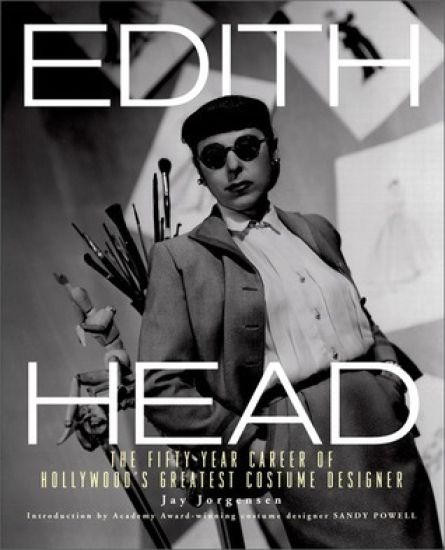
All About Eve. Funny Face. Sunset Blvd. Rear Window. Sabrina. A Place in the Sun. The Ten Commandments. Scores of iconic films of the last century had one thing in common: costume designer Edith Head (1897-1981). She racked up an unprecedented 35 Oscar nods and 400 film credits over the course of a fifty-year career. Never before has the account of Hollywood's most influential designer been so thoroughly revealed,because never before have the Edith Head Archives of the Academy of Motion Picture Arts and Sciences been tapped. This unprecedented access allows this book to be a one-of-a-kind survey, bringing together a spectacular collection of rare and never-before-seen sketches, costume test shots, behind-the- scenes photos, and ephemera.
The definitive history of Hollywood's most legendary costume designer, featuring an insightful biography and previously unseen sketches, ephemera, and photos behind the scenes of hundreds of iconic films.All About Eve. Funny Face. Sunset Blvd. Rear Window. Sabrina. A Place in the Sun. The Ten Commandments. Scores of cinema classics of the last century had one thing in common: Edith Head (1897-1981). She racked up an unprecedented 35 Oscar nods and 400 film credits over the course of a fifty-year career, and changed the fashion world forever with her timeless creations that continue to resonate and inspire present-day designers, fashion followers, and film-lovers.This one-of-a-kind survey of her life and work reveals the woman behind the famous dark glasses and brings together a spectacular collection of rare and never-before-seen sketches, costume test shots, behind-the-scenes photos, and ephemera. Stunningly illustrated with more than 350 images and packed with information, this is both the most comprehensive work on Edith Head ever published and a lavish history of Hollywood in the twentieth century.
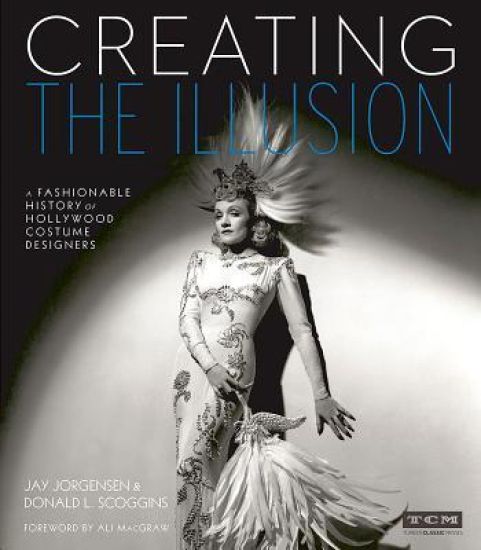
Marilyn Monroe made history by standing over a subway grating in a white pleated halter dress designed by William Travilla. Hubert de Givenchy immortalized the Little Black Dress with a single opening scene in Breakfast at Tiffany's . A red nylon jacket signaled to audiences that James Dean was a Rebel Without a Cause . For more than a century, costume designers have left indelible impressions on moviegoers' minds. Yet until now, so little has been known about the designers themselves and their work to complement and enrich stories through fashion. Creating the Illusion presents the history of fashion on film, showcasing not only classic moments from film favourites, but a host of untold stories about the creative talent working behind the scenes to dress the stars from the silent era to the present day. Among the book's sixty-five designer profiles are Clare West, Howard Greer, Adrian, Walter Plunkett, Travis Banton, Irene, Edith Head, Cecil Beaton, Bob Mackie, and Colleen Atwood. The designers'stories are set against the backdrop of Hollywood: how they collaborated with great movie stars and filmmakers how they maneuvered within the studio system and how they came to design clothing that remains iconic decades after its first appearance. The array of films discussed and showcased through photos spans more than one hundred years, from draping Rudolph Valentino in exotic sheik" dress to the legendary costuming of Gone with the Wind, Alfred Hitchcock thrillers, Bonnie and Clyde, Reservoir Dogs , and beyond. This gloriously illustrated volume includes candid photos of the designers at work, portraits and wardrobe tests of stars in costume, and designer sketches. Drawing from archival material and dozens of new interviews with award-winning designers, authors Jay Jorgensen and Donald L. Scoggins offer a highly informative, lavish, and entertaining history of Hollywood costume design.About TCM:Turner Classic Movies is the definitive resource for the greatest movies of all time. It engages, entertains, and enlightens to show how the entire spectrum of classic movies, movie history, and movie-making touches us all and influences how we think and live today.
The worthy purpose of this text is to provide a complete, self-contained development of the trace formula and theta inversion formula for SL(2,Z[i])\SL(2,C). Unlike other treatments of the theory, the approach taken here is to begin with the heat kernel on SL(2,C) associated to the invariant Laplacian, which is derived using spherical inversion. The heat kernel on the quotient space SL(2,Z[i])\SL(2,C) is arrived at through periodization, and further expanded in an eigenfunction expansion. A theta inversion formula is obtained by studying the trace of the heat kernel. Following the author's previous work, the inversion formula then leads to zeta functions through the Gauss transform.
Harish-Chandra's general Plancherel inversion theorem admits a much shorter presentation for spherical functions. The authors have taken into account contributions by Helgason, Gangolli, Rosenberg, and Anker from the mid-1960s to 1990. Anker's simplification of spherical inversion on the Harish-Chandra Schwartz space had not yet made it into a book exposition. Previous expositions have dealt with a general, wide class of Lie groups. This has made access to the subject difficult for outsiders, who may wish to connect some aspects with several if not all other parts of mathematics, and do so in specific cases of intrinsic interest. The essential features of Harish-Chandra theory are exhibited on SLn(R), but hundreds of pages of background can be replaced by short direct verifications. The material becomes accessible to graduate students with especially no background in Lie groups and representation theory. Spherical inversion is sufficient to deal with the heat kernel, which is at the center of the authors' current research. The book will serve as a self-contained background for parts of this research.
The worthy purpose of this text is to provide a complete, self-contained development of the trace formula and theta inversion formula for SL(2,Z[i])\SL(2,C). Unlike other treatments of the theory, the approach taken here is to begin with the heat kernel on SL(2,C) associated to the invariant Laplacian, which is derived using spherical inversion. The heat kernel on the quotient space SL(2,Z[i])\SL(2,C) is arrived at through periodization, and further expanded in an eigenfunction expansion. A theta inversion formula is obtained by studying the trace of the heat kernel. Following the author's previous work, the inversion formula then leads to zeta functions through the Gauss transform.
Harish-Chandra's general Plancherel inversion theorem admits a much shorter presentation for spherical functions. The authors have taken into account contributions by Helgason, Gangolli, Rosenberg, and Anker from the mid-1960s to 1990. Anker's simplification of spherical inversion on the Harish-Chandra Schwartz space had not yet made it into a book exposition. Previous expositions have dealt with a general, wide class of Lie groups. This has made access to the subject difficult for outsiders, who may wish to connect some aspects with several if not all other parts of mathematics, and do so in specific cases of intrinsic interest. The essential features of Harish-Chandra theory are exhibited on SLn(R), but hundreds of pages of background can be replaced by short direct verifications. The material becomes accessible to graduate students with especially no background in Lie groups and representation theory. Spherical inversion is sufficient to deal with the heat kernel, which is at the center of the authors' current research. The book will serve as a self-contained background for parts of this research.
Posn(R) and Eisenstein Series provides an introduction, requiring minimal prerequisites, to the analysis on symmetric spaces of positive definite real matrices as well as quotients of this space by the unimodular group of integral matrices. The approach is presented in very classical terms and includes material on special functions, notably gamma and Bessel functions, and focuses on certain mathematical aspects of Eisenstein series.
Analytic number theory and part of the spectral theory of operators (differential, pseudo-differential, elliptic, etc.) are being merged under amore general analytic theory of regularized products of certain sequences satisfying a few basic axioms. The most basic examples consist of the sequence of natural numbers, the sequence of zeros with positive imaginary part of the Riemann zeta function, and the sequence of eigenvalues, say of a positive Laplacian on a compact or certain cases of non-compact manifolds. The resulting theory is applicable to ergodic theory and dynamical systems; to the zeta and L-functions of number theory or representation theory and modular forms; to Selberg-like zeta functions; andto the theory of regularized determinants familiar in physics and other parts of mathematics. Aside from presenting a systematic account of widely scattered results, the theory also provides new results. One part of the theory deals with complex analytic properties, and another part deals with Fourier analysis. Typical examples are given. This LNM provides basic results which are and will be used in further papers, starting with a general formulation of Cram r's theorem and explicit formulas. The exposition is self-contained (except for far-reaching examples), requiring only standard knowledge of analysis.
The theory of explicit formulas for regularized products and series forms a natural continuation of the analytic theory developed in LNM 1564. These explicit formulas can be used to describe the quantitative behavior of various objects in analytic number theory and spectral theory. The present book deals with other applications arising from Gaussian test functions, leading to theta inversion formulas and corresponding new types of zeta functions which are Gaussian transforms of theta series rather than Mellin transforms, and satisfy additive functional equations. Their wide range of applications includes the spectral theory of a broad class of manifolds and also the theory of zeta functions in number theory and representation theory. Here the hyperbolic 3-manifolds are given as a significant example.
The aim of this volume is to bring together research ideas from various fields of mathematics which utilize the heat kernel or heat kernel techniques in their research. The intention of this collection of papers is to broaden productive communication across mathematical sub-disciplines and to provide a vehicle which would allow experts in one field to initiate research with individuals in another field, as well as to give non-experts a resource which can facilitate expanding their research and connecting with others.
Throughout my adult life I had often been saddled with that empty unsettled feeling of disconnection and a strong desire to go home. A desire to be close with loved ones and familiar settings tugged at me sometimes leading to depression and regret; something was missing in my life that I couldn't quite describe. In these pages a lifetime of thoughts all seeking that answer come together. Memories, Lessons, Wisdom, and the discovery that what was missing in my life and many others are simpler times. The place we have been longing for isn't a place at all, rather its a state of mind in which we can cry without regret, smile without guilt, and hope with complete abandon. Jay is a love letter to the lives and events that sculpted that hope filled state of mind in an attempt to share it with the world.
From New York Times bestselling author Jason June comes a moving and hilarious sex-positive teen rom-com about the complexities of first loves, first hookups, and first heartbreaks—and how to stay true to yourself while embracing what you never saw coming, that’s perfect for fans of Sandhya Menon and Becky Albertalli. There’s one thing Jay Collier knows for sure—he’s a statistical anomaly as the only out gay kid in his small rural Washington town. While all his friends can’t stop talking about their heterosexual hookups and relationships, Jay can only dream of his own firsts, compiling a romance to-do list of all the things he hopes to one day experience—his Gay Agenda.Then, against all odds, Jay’s family moves to Seattle and he starts his senior year at a new high school with a thriving LGBTQIA+ community. For the first time ever, Jay feels like he’s found where he truly belongs. But as Jay begins crossing items off his list, he’ll soon be torn between his heart and his hormones, his old friends and his new ones . . . because after all, life and love don’t always go according to plan.
From New York Times bestselling author Jason June comes a moving and hilarious sex-positive teen rom-com about the complexities of first loves, first hookups, and first heartbreaks—and how to stay true to yourself while embracing what you never saw coming, that’s perfect for fans of Sandhya Menon and Becky Albertalli. There’s one thing Jay Collier knows for sure—he’s a statistical anomaly as the only out gay kid in his small rural Washington town. While all his friends can’t stop talking about their heterosexual hookups and relationships, Jay can only dream of his own firsts, compiling a romance to-do list of all the things he hopes to one day experience—his Gay Agenda.Then, against all odds, Jay’s family moves to Seattle and he starts his senior year at a new high school with a thriving LGBTQIA+ community. For the first time ever, Jay feels like he’s found where he truly belongs. But as Jay begins crossing items off his list, he’ll soon be torn between his heart and his hormones, his old friends and his new ones . . . because after all, life and love don’t always go according to plan.